
智能座舱

Search documents
冲刺“智能座舱第一股”,博泰车联获众多明星机构追捧
Zheng Quan Shi Bao Wang· 2025-09-23 12:52
Group 1 - The core viewpoint of the news is that Botai Carlink is launching its IPO in Hong Kong, aiming to become the "first stock of smart cockpits" with significant backing from cornerstone investors [1] - Botai Carlink plans to issue 10.4369 million H-shares at a price of 102.23 HKD per share, with the IPO expected to conclude on September 25 and the listing on September 30 [1] - The company has attracted major cornerstone investors, including Horizon Together Holding Ltd., Huangshan SP, and Smart Ventures Limited, collectively subscribing for 466 million HKD, accounting for over 40% of the offering size [1] Group 2 - Botai Carlink is a leading supplier of smart cockpit solutions in China and one of the earliest developers in this field, offering integrated solutions that combine software, hardware, and cloud services [2] - The company has provided services for over 200 models across more than 50 automotive brands, including major Chinese OEMs like BYD and Geely, as well as international OEMs like Audi [2] - According to Zhaoshang Consulting, Botai Carlink ranks first among Chinese suppliers of smart cockpit solutions based on the number of high-end solutions equipped with Qualcomm Snapdragon 8295 chips as of December 31, 2024 [2] Group 3 - Botai Carlink has established a deep collaboration with Huawei, being a founding member of the Open Source Harmony Working Committee and obtaining patent cross-licensing with Huawei [3] - The company reported revenues of 1.22 billion CNY, 1.49 billion CNY, and 2.56 billion CNY for the years 2022 to 2024, with a compound annual growth rate of 44.9%, while still facing net losses [3] - In the first five months of 2025, the company achieved revenue of 750 million CNY, a year-on-year increase of 34.6%, with a net loss of 220 million CNY, a decrease of 10.1% year-on-year [3]
“剪刀差”扩大 斑马智行上市烦恼多
Bei Jing Shang Bao· 2025-09-23 10:33
Core Viewpoint - The recent executive changes at Zhibao Zhixing, particularly the departure of CTO Wang Jun to BYD, have raised concerns about the company's future performance, especially given its declining revenue and increasing net losses as highlighted in its prospectus [1][2]. Financial Performance - Zhibao Zhixing's revenue showed fluctuations from 2022 to 2024, with figures of 8.05 billion, 8.72 billion, and 8.24 billion respectively, followed by a decline in Q1 2025 to 1.36 billion from 1.68 billion year-on-year [2][3]. - The adjusted net losses for the same period were 7.26 billion, 7.92 billion, and 7.57 billion, with Q1 2025 losses increasing to 2.01 billion from 1.96 billion year-on-year [2][3]. - The company has reported a total adjusted net loss of 22.75 billion over three years, with a gross margin decrease from 53.9% in 2022 to 38.9% in 2025 Q1 [1][2]. Revenue Breakdown - Revenue is categorized into three segments: system-level operating system solutions, in-vehicle platform services, and AI end-to-end solutions. The system-level solutions accounted for over 80% of revenue from 2022 to 2025 Q1, peaking at 89.7% in Q1 2025 [3]. - In-vehicle platform services contributed 10% to 12.2% of revenue during the same period, while AI solutions remained in single digits [3]. Client Dependency - SAIC is Zhibao Zhixing's largest client, contributing 54.7%, 47.4%, 38.8%, and 47.8% of total revenue from 2022 to Q1 2025, respectively [7]. - The company is heavily reliant on SAIC, and any changes in SAIC's demand or partnerships could significantly impact Zhibao Zhixing's financial health [7]. Operational Metrics - The number of designated points, which indicates the number of OEMs selecting Zhibao Zhixing's solutions, decreased from 37 to 30 in Q1 2025, attributed to delays in internal approvals and contract signings [5]. - This metric is crucial as it directly correlates with future business growth and revenue potential [5]. Cost Structure - In Q1 2025, R&D expenses were 1.96 billion, down 22.6% year-on-year, while management and sales expenses increased by 18.1% and 7.4%, respectively [6]. - The company has indicated a focus on high-priority projects and core talent, leading to a reduction in employee costs [6]. Competitive Landscape - Zhibao Zhixing faces intense competition in the smart cockpit sector, with low technical barriers allowing OEMs to develop in-house solutions, potentially eroding market share [9][10]. - The company’s partnerships with major investors like Alibaba and SAIC provide some competitive advantages, but the lack of significant barriers to entry remains a concern [9].
博泰车联开启招股:中国高端智能座舱龙头企业
Xin Lang Cai Jing· 2025-09-23 02:47
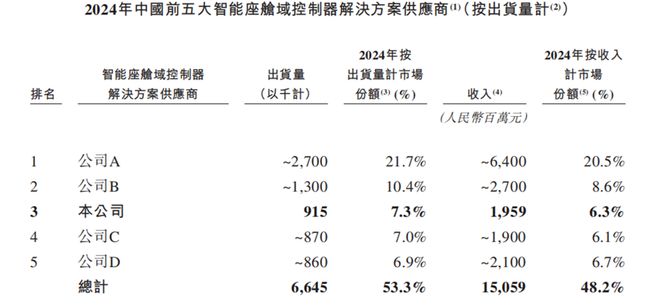
Core Viewpoint - 博泰车联科技 is a leading player in the automotive intelligence sector in China, officially launching its IPO on the Hong Kong Stock Exchange with a planned global offering of 10.4369 million H-shares at a price of HKD 102.23 per share, aiming to raise significant capital to support its growth and expansion in the smart cockpit solutions market [1][2]. Company Overview - Founded in 2009 and headquartered in Shanghai, 博泰车联 focuses on the automotive intelligence sector, being one of the earliest developers of smart cockpit solutions in China. The company has established a comprehensive industry chain covering R&D, production, and sales [5]. - 博泰车联 has a unique "software + hardware + cloud service" integrated model, providing customized smart cockpit solutions to meet diverse OEM and Tier 1 customer needs, with a growing international market presence [5][11]. Financial Performance - The company has experienced rapid revenue growth, with total revenue increasing from RMB 1.218 billion in 2022 to RMB 2.557 billion in 2024, representing a compound annual growth rate (CAGR) of 44.9%. The revenue from domain controllers, a key product, grew at a CAGR of 70.5% during the same period [9][10]. - For the five months ending May 31, 2025, revenue reached RMB 754 million, a year-on-year increase of 34.4%, driven by steady growth in domain controller shipments and an increase in high-end product sales [9]. Market Position and Competitive Advantage - 博泰车联 ranks as the third largest supplier of smart cockpit domain controller solutions in China, holding a market share of 7.3% as of 2024, with significant competitive advantages in technology and innovation [6][15]. - The company has established strategic partnerships with major automotive manufacturers and technology firms, enhancing its market position and enabling rapid response to market demands [11][15]. Industry Outlook - The Chinese automotive smart cockpit solutions market is projected to grow significantly, with an expected market size of RMB 129 billion in 2024, increasing to RMB 299.5 billion by 2029, reflecting a CAGR of 18.4% [13]. - The penetration rate of domain controllers in passenger vehicles is anticipated to rise from 13.7% in 2020 to over 90% by 2029, indicating substantial growth opportunities for leading companies like 博泰车联 [13]. Valuation Analysis - The IPO price of HKD 102.23 per share implies a market capitalization of HKD 15.334 billion. Based on the latest revenue figures, the company's price-to-sales (P/S) ratio is 5.1, which is significantly lower than the median P/S ratio of comparable companies at 13.04, suggesting that the company is undervalued [16].

“剪刀差”扩大、下降的里程碑数据 斑马智行上市烦恼多
Bei Jing Shang Bao· 2025-09-23 02:05
Core Insights - The recent executive shift at Zhibao Zhixing, with former VP and CTO Wang Jun joining BYD's smart cockpit team, has drawn attention to the company's declining performance and increasing losses as revealed in its prospectus [1][2] - Zhibao Zhixing's revenue has fluctuated from 8.05 billion yuan in 2022 to 8.24 billion yuan in 2024, with a drop in Q1 2025 to 1.36 billion yuan, while adjusted net losses totaled 22.75 billion yuan over three years [1][2][3] - The company heavily relies on SAIC as its largest customer, contributing 54.7% of total revenue in 2022, which has decreased to 47.8% in Q1 2025, indicating a growing risk due to dependency on a single client [7][8] Revenue Performance - Zhibao Zhixing's revenue from system-level operating system solutions has consistently accounted for over 80% of total revenue from 2022 to Q1 2025, with Q1 2025 contribution at 89.7% [3] - The company has seen a decline in revenue from its main operating segment, while AI end-to-end solutions and in-car platform services have not significantly compensated for this drop [3][4] Financial Metrics - In Q1 2025, Zhibao Zhixing reported a revenue of 1.36 billion yuan, down from 1.68 billion yuan year-on-year, with adjusted net losses increasing from 1.96 billion yuan to 2.01 billion yuan [2][4] - The company has reduced R&D expenses by 22.6% in Q1 2025, while management and sales expenses have increased by 18.1% and 7.4%, respectively [6] Market Position and Competition - Zhibao Zhixing faces intense competition in the smart cockpit sector, with low technical barriers allowing automakers to develop in-house solutions, potentially eroding market share [9][10] - The company has not established significant competitive barriers, and its reliance on partnerships with major investors like Alibaba and SAIC is seen as a double-edged sword [9][10]
计算机行业“一周解码”:荣威上车豆包大模型,智能座舱进入深度思考时代
Bank of China Securities· 2025-09-23 00:35
Investment Rating - The industry investment rating is "Outperform the Market," indicating that the industry index is expected to perform better than the benchmark index over the next 6-12 months [33]. Core Insights - The launch of the SAIC Roewe M7 DMH, which features the Doubao deep thinking model, marks a significant advancement in smart cockpit technology, redefining human-vehicle interaction from command-based to natural interaction [11][12]. - Figure AI has raised over $1 billion in Series C funding, achieving a post-money valuation of $39 billion, highlighting the growing interest in humanoid robotics and its potential applications in both domestic and commercial settings [13][15]. - NVIDIA is pushing for the development of a new microchannel liquid cooling plate (MLCP) technology due to the high power consumption of new AI platforms, which could become a strategic material in the industry [16][18]. Summary by Sections Smart Cockpit - The SAIC Roewe M7 DMH integrates the Doubao deep thinking model, enhancing its ability to understand ambiguous commands and execute complex vehicle control tasks, thus improving user experience significantly compared to conventional models [11][12]. - The smart cockpit is evolving from a simple command execution system to a more intuitive and emotionally engaging partner for users, indicating a shift in the automotive industry's competitive landscape towards data, computing power, and algorithm capabilities [12][11]. Humanoid Robotics - Figure AI's recent funding round reflects strong market confidence in humanoid robots, with plans to expand their production and deployment capabilities for both household and commercial applications [13][15]. - Despite the high valuation, concerns remain regarding Figure AI's ability to convert demonstration capabilities into actual delivery and operational success in real-world scenarios [14][15]. Cooling Technology - NVIDIA's MLCP technology is expected to address the cooling challenges posed by high-power AI platforms, with costs projected to be 3 to 5 times higher than traditional cooling solutions, indicating a shift in the cooling technology landscape [16][18]. - The introduction of MLCP is seen as a necessary evolution in the industry, as traditional cooling methods are becoming inadequate for the increasing power demands of AI hardware [17][18].


斑马智行上市烦恼多
Bei Jing Shang Bao· 2025-09-22 16:18
Core Viewpoint - The recent executive changes at Zhibo Zhixing, particularly the departure of CTO Wang Jun to BYD, have raised concerns about the company's performance, as indicated by its declining revenue and increasing net losses in its prospectus [1][2]. Financial Performance - Zhibo Zhixing's revenue fluctuated from 8.05 billion yuan in 2022 to 8.72 billion yuan in 2023, then decreased to 8.24 billion yuan in 2024. In Q1 2025, revenue further declined to 1.36 billion yuan from 1.68 billion yuan in the same period last year [2][3]. - The adjusted net losses for Zhibo Zhixing were 7.26 billion yuan in 2022, 7.92 billion yuan in 2023, and 7.57 billion yuan in 2024. In Q1 2025, the adjusted net loss increased to 2.01 billion yuan from 1.96 billion yuan year-on-year [2][3]. - The company reported a total adjusted net loss of 22.75 billion yuan over three years, with a gross margin decline from 53.9% in 2022 to 38.9% in Q1 2025 [1][2]. Revenue Breakdown - Revenue is categorized into three segments: system-level operating system solutions, in-vehicle platform services, and AI end-to-end solutions. The system-level solutions accounted for over 80% of revenue from 2022 to Q1 2025, peaking at 89.7% in Q1 2025 [3]. - The in-vehicle platform services contributed 10% to 12.2% of revenue during the same period, while AI solutions remained in single digits [3]. Key Operational Metrics - The number of designated points, which indicates the number of OEMs or their designated suppliers choosing Zhibo Zhixing's solutions, decreased from 37 to 30 in Q1 2025, attributed to delays in internal approvals and contract signings [5]. - The company expressed confidence in future revenue growth, particularly from in-vehicle platform services, which have lower sales costs compared to system-level solutions [4]. Cost Structure and R&D - In Q1 2025, Zhibo Zhixing's R&D expenses were 1.96 billion yuan, a decrease of 22.6% year-on-year, while management and sales expenses increased by 18.1% and 7.4%, respectively [6]. - The company has been streamlining its workforce and focusing on high-priority projects, which has led to a reduction in employee compensation and benefits [6]. Major Clients and Dependency - Alibaba and SAIC are the major stakeholders, with Alibaba holding 44.72% and SAIC holding 34.34% of shares. SAIC has been the largest customer, contributing 54.7% of revenue in 2022, which decreased to 47.8% in Q1 2025 [7][8]. - The heavy reliance on SAIC poses a significant risk to Zhibo Zhixing's financial stability, as any changes in SAIC's demand or partnerships could adversely affect the company [7]. Competitive Landscape - Zhibo Zhixing faces intense competition in the smart cockpit sector, with low technical barriers allowing OEMs to develop in-house solutions or choose alternative suppliers [9][10]. - The company has not established significant competitive barriers, which may lead to a loss of market share [9].
博泰车联网通过港交所上市聆讯 已累计融资超40亿元
Mei Ri Jing Ji Xin Wen· 2025-09-22 14:13
Core Viewpoint - The company, Botai Vehicle Networking Technology (Shanghai) Co., Ltd., is preparing for an IPO on the Hong Kong Stock Exchange to raise funds for product expansion, technology enhancement, and market development [1][2]. Group 1: Company Overview - Botai Vehicle Networking aims to leverage capital to strengthen R&D investment and production capacity, consolidating its high-end market advantage and expanding overseas [1]. - The company has completed multiple rounds of financing, raising over 4 billion yuan, with notable investors including Red Horse Capital and Xiaomi Group [2]. - Botai's core product is a domain controller for smart cockpits, allowing OEMs to customize solutions based on vehicle design [3]. Group 2: Financial Performance - Revenue is projected to double from 1.218 billion yuan in 2022 to 2.557 billion yuan in 2024, with a 34.4% year-on-year growth in the first five months of 2025 [2]. - R&D expenses for 2022 to 2024 are reported at 277 million yuan, 235 million yuan, and 207 million yuan, respectively [2]. Group 3: Market Position and Competition - Botai is the third-largest supplier of domain controller solutions for passenger vehicles in China, holding a market share of 7.3% [4]. - The market for passenger vehicle smart cockpit solutions is expected to grow from 129 billion yuan in 2024 to 299.5 billion yuan in 2029, with a compound annual growth rate of 18.4% [4]. Group 4: Industry Challenges - The automotive smart industry is highly competitive, and any failure to compete effectively could significantly impact the company's performance [6]. - Botai relies heavily on Qualcomm for system-on-chip purchases, which poses risks related to geopolitical influences and cost fluctuations [5][6].
高管变动、官司败诉,斑马智行上市烦恼多
Bei Jing Shang Bao· 2025-09-22 11:38
Core Viewpoint - The recent executive changes at Zhibao Zhixing, particularly the departure of CTO Wang Jun to BYD, have raised concerns about the company's performance, as indicated by its declining revenue and increasing net losses in its prospectus [1][3][4]. Financial Performance - Zhibao Zhixing's revenue fluctuated from 8.05 billion yuan in 2022 to 8.72 billion yuan in 2023, then decreased to 8.24 billion yuan in 2024, with a further decline in Q1 2025 to 1.36 billion yuan, a 19.5% drop year-on-year [4][5]. - The adjusted net losses increased from 7.26 billion yuan in 2022 to 7.92 billion yuan in 2023, then slightly decreased to 7.57 billion yuan in 2024, but rose again to 2.01 billion yuan in Q1 2025 [4][5]. Revenue Composition - The revenue structure heavily relies on system-level operating system solutions, which accounted for over 80% of total revenue from 2022 to Q1 2025, contributing 89.7% in Q1 2025 [6][8]. - The contribution from vehicle platform services ranged between 10% and 12.2% from 2022 to 2024, while AI end-to-end solutions remained in single digits [7]. Client Dependency - SAIC is Zhibao Zhixing's largest client, contributing 54.7% of total revenue in 2022, which decreased to 38.8% in 2024, and 47.8% in Q1 2025, indicating a declining but still significant reliance on this client [12]. - Alibaba holds a 44.72% stake in Zhibao Zhixing, while SAIC holds 34.34%, making them critical stakeholders in the company's operations [12][13]. Competitive Landscape - The smart cockpit sector is highly competitive, with low technical barriers, leading to potential market share erosion as automakers increasingly pursue in-house development [14]. - Zhibao Zhixing's competitive advantage lies in its partnerships with major players like Alibaba, which provide unique smart experiences that are difficult for competitors to replicate [14].
港股智能座舱第一股博泰车联开启招股
Sou Hu Cai Jing· 2025-09-22 11:28
Group 1 - The core viewpoint of the news is that Botai Vehicle Networking Technology (Shanghai) Co., Ltd. has officially launched its IPO process on the Hong Kong Stock Exchange, with plans to list on September 30 [1] - The company plans to globally issue 10.4369 million H-shares, with 1.0437 million shares allocated for Hong Kong and 9.3932 million shares for international markets [1] - The subscription period for the IPO is set from September 22 to September 25, with a fixed offer price of HKD 102.23 per share [1] Group 2 - Botai Vehicle Networking has been a leader in the automotive intelligence sector since its establishment in 2009, focusing on smart cockpit solutions [2] - The company has developed an integrated model of "software + hardware + cloud services," which has helped establish a strong technological barrier in a competitive market [2] - As of December 31, 2024, Botai Vehicle Networking holds the highest number of registered invention patents among domestic suppliers of smart cockpit and connected service solutions [2]
博泰车联拟全球发售1043.69万股H股 预计9月30日挂牌
Zheng Quan Shi Bao Wang· 2025-09-22 01:09
Group 1 - The core point of the article is that Botai Automotive will launch an IPO from September 22 to 25, offering 10.4369 million H-shares at a price of HKD 102.23 per share, with trading expected to start on September 30 [1] - Botai Automotive is a leading provider of intelligent cockpit solutions in China, ranking third in the market share for intelligent cockpit domain controllers for passenger cars in 2024, with a market share of 7.3% [1] - The company offers integrated intelligent cockpit solutions that combine software, hardware, and cloud services, distinguishing itself from competitors that primarily focus on hardware [1] Group 2 - The cornerstone investment agreements have been signed with Horizon Together Holding Ltd., Huangshan SP, and Smart Ventures Limited, with a total investment amount of approximately HKD 466 million, subscribing to 4.5575 million shares [1] - The net proceeds from the offering are expected to be approximately HKD 919 million, which will be primarily used for expanding the product portfolio and technology R&D (30%), enhancing production and verification capabilities (30%), expanding sales and service networks (20%), strategic investments (10%), and working capital and general corporate purposes (10%) [1]