
自行车

Search documents
上海凤凰(600679.SH):上半年净利润4786.63万元,同比增长17.87%
Ge Long Hui A P P· 2025-08-22 11:12
格隆汇8月22日丨上海凤凰(维权)(600679.SH)公布2025年半年度报告,报告期实现营业收入12.99亿 元,同比增长7.36%;归属于上市公司股东的净利润4786.63万元,同比增长17.87%;归属于上市公司股 东的扣除非经常性损益的净利润3982.6万元,同比增长3.32%;基本每股收益0.0929元。 ...

早报李强:采取有力措施巩固房地产市场止跌回稳态势;A股市值历史首次突破100万亿元大关
Sou Hu Cai Jing· 2025-08-19 08:19
Company News - China Shipbuilding announced that the number of valid dissenting shares is 0, and the stock will resume trading [5] - Midea Group stated on the interactive platform that it has undertaken the first large-scale all-liquid cooling intelligent computing data center project from China Telecom in the Guangdong-Hong Kong-Macao Greater Bay Area [5] - Tibet Tianluo reported a net loss of 112 million yuan for the first half of the year [5] - Yanghe Distillery announced a 45% year-on-year decline in net profit for the first half of the year [5] - Zhifei Biological announced a net loss of 597 million yuan for the first half of the year, marking a transition from profit to loss [5] - Tongzhou Electronics announced that the information circulating about the company entering the supply chain of Nvidia and other enterprises is untrue [5] - O-film Technology reported a net loss of 109 million yuan for the first half of the year, transitioning from profit to loss [5] - Chuangzhong Technology announced that if abnormal trading of the company's stock continues, it may apply for a trading suspension for verification [5] - Nanya New Materials announced that during the period of abnormal stock trading, board member Zhang Dong and others reduced their holdings of the company's shares [5] Industry News - The A-share market's total market capitalization has historically surpassed 100 trillion yuan, with an increase of 1.45 trillion yuan this year [3] - The positive performance of the A-share market has led to an increase in brokerage account openings, with most brokerages reporting a growth in new accounts, some reaching new highs for August [3] - According to a report by the China Automobile Dealers Association, only 30.3% of dealers met their sales targets in the first half of 2025, with 29.0% of dealers failing to meet 70% of their targets [3] - A new low-altitude flight route connecting Kunshan, Jiangsu, and downtown Shanghai has officially opened, allowing for a 20-minute direct flight between the two locations [3] - The Shenzhen Stock Exchange has sent a special letter to member units requesting assistance in conducting research on the network voting situation for customer credit trading guarantee securities accounts [4] - Bicycle prices have significantly decreased, with many brands dropping by around 1,000 yuan, and some high-end imported models seeing price reductions exceeding 50% [4] - The National Radio and Television Administration has issued measures to enrich television content and improve the supply of broadcasting content [4]






深中华A:上半年净利润1857.08万元 同比增长224.8%
Zheng Quan Shi Bao Wang· 2025-08-18 12:27
Core Insights - The company reported a significant increase in revenue and net profit for the first half of 2025, indicating strong business performance [1] Financial Performance - The company achieved an operating revenue of 320 million yuan, representing a year-on-year growth of 49.86% [1] - The net profit attributable to shareholders reached 18.57 million yuan, showing a remarkable year-on-year increase of 224.80% [1] - Basic earnings per share were reported at 0.03 yuan [1] Business Segments - The main business activities of the company include jewelry and gold operations, as well as bicycle and new energy lithium battery materials [1] - As of the end of the reporting period, the company's inventory balance for jewelry business was 244 million yuan, which is an increase of 189% compared to the beginning of the period [1]

中路股份(600818)2025年中报简析:增收不增利
Zheng Quan Zhi Xing· 2025-08-17 16:00
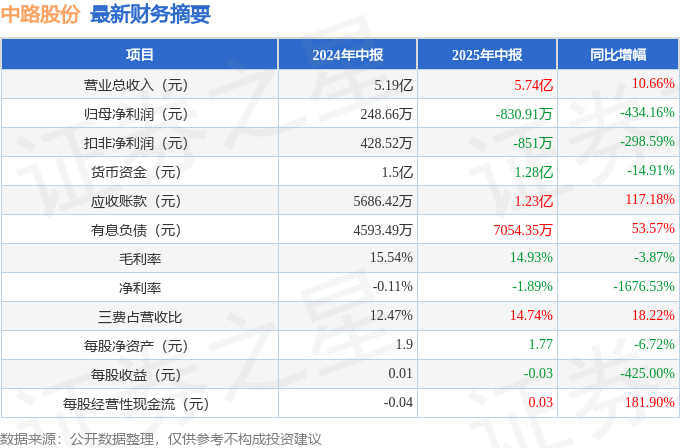
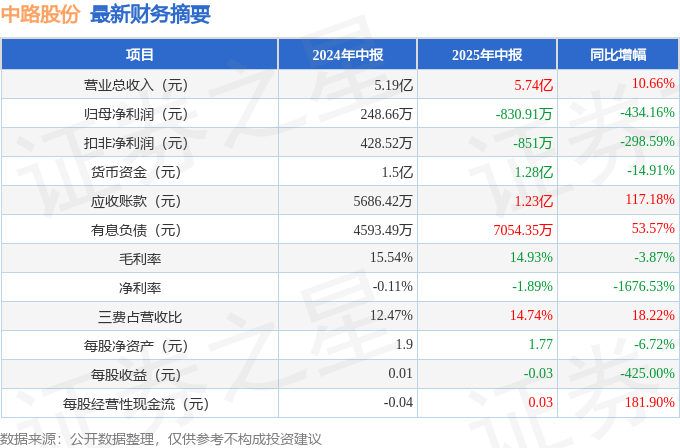
Core Viewpoint - Zhonglu Co., Ltd. reported a revenue increase but a significant decline in net profit for the first half of 2025, indicating challenges in profitability despite higher sales [1][3]. Financial Performance - The total revenue for the first half of 2025 reached 574 million yuan, a year-on-year increase of 10.66% compared to 519 million yuan in 2024 [1]. - The net profit attributable to shareholders was -8.31 million yuan, a decline of 434.16% from a profit of 2.49 million yuan in the previous year [1]. - The gross margin decreased to 14.93%, down 3.87% year-on-year, while the net margin fell to -1.89%, a drop of 1676.53% [1]. - Total expenses (selling, administrative, and financial) amounted to 84.60 million yuan, accounting for 14.74% of revenue, an increase of 18.22% year-on-year [1]. - The company reported a significant increase in accounts receivable, which rose by 117.18% to 123 million yuan [1]. Business Strategy and Outlook - The company aims to focus on "environmental low-carbon, green health" and plans to upgrade its bicycle product structure to meet market demands [3][4]. - Future strategies include enhancing brand differentiation and expanding into high-end carbon fiber bicycles, as well as diversifying revenue streams through the integration of the bicycle industry chain [4]. - The company is also investing in high-altitude wind energy technology and improving operational management of industrial parks [4][5]. Industry Context - The bicycle industry faces intense competition due to low entry barriers and evolving consumer demands for comfort, personalization, and cost-effectiveness [4]. - The company plans to enhance product competitiveness through continuous R&D, brand building, and operational efficiency improvements [4].

永久自行车出海遇阻母公司中路股份半年亏831万元
Xin Lang Cai Jing· 2025-08-17 12:03
Core Viewpoint - The traditional bicycle brand "Yongjiu" faces significant challenges from international market pressures and rising internal costs, leading to a decline in profitability despite a revenue increase. Financial Performance - In the first half of 2025, the company reported total revenue of 574 million yuan, a year-on-year increase of 10.66%, but incurred a net loss of 8.31 million yuan, a dramatic decline of 4% [2] - The company's gross margin decreased from 15.53% in the same period last year to 14.93%, while the net margin fell from -0.10% to -1.89% [2] - In Q2, revenue was 324 million yuan, with a modest growth of 1.91%, but the net loss increased to 5.08 million yuan, a year-on-year decline of 162.24% [2] Cost Structure - Management expenses surged to 51.92 million yuan, a 51.09% increase year-on-year, primarily due to increased intermediary service fees from cross-border equity investments [3] - Sales expenses reached 31.67 million yuan, up 7.38%, driven by costs associated with new product launches; financial expenses were 1.00 million yuan, a 24.24% increase [3] - Total period expenses amounted to 95.53 million yuan, an increase of 19.34 million yuan year-on-year, with a period expense ratio of 16.65%, up 1.95 percentage points [3] Market Environment - The bicycle industry is facing severe impacts from tariff policies, with the U.S. imposing a 53% tariff on general bicycles and 42% on e-bikes, significantly affecting demand [4] - The U.S. market accounts for 33% of Taiwan's bicycle exports, making it the second-largest market after the EU, but demand remains weak due to tariffs and uncertainty [4] - Southeast Asia shows resilience and potential for growth, but it remains uncertain whether it can compensate for losses in the U.S. and European markets [4] Strategic Initiatives - The company is pursuing high-end and diversified strategies to overcome operational challenges, including acquiring a stake in the high-end bicycle brand Factor [5] - Factor specializes in high-performance carbon fiber road bicycles, aiming to penetrate the high-end market [5] - The company is also investing in high-altitude wind energy technology in collaboration with Tsinghua University, indicating a diversification strategy [5] Financial Health - As of the end of Q2, the company's net assets were 570 million yuan, a 3.2% decrease from the previous year, with a net asset value per share of 1.77 yuan, down 6.72% [6] - The company's median ROIC over the past decade is only 3.27%, indicating challenges in capital efficiency [6] - The global bicycle market is undergoing structural adjustments, and the company's ability to adapt will be crucial for its future success [6]
中路股份2025年中报简析:增收不增利
Zheng Quan Zhi Xing· 2025-08-16 22:46
Core Viewpoint - Zhonglu Co., Ltd. reported a revenue increase but a significant decline in net profit for the first half of 2025, indicating challenges in profitability despite higher sales [1] Financial Performance - Total revenue for the first half of 2025 reached 574 million yuan, a year-on-year increase of 10.66% [1] - Net profit attributable to shareholders was -8.31 million yuan, a decline of 434.16% compared to the previous year [1] - Gross margin decreased to 14.93%, down 3.87% year-on-year, while net margin fell to -1.89%, a drop of 1676.53% [1] - Total expenses (selling, administrative, and financial) amounted to 84.60 million yuan, accounting for 14.74% of revenue, an increase of 18.22% year-on-year [1] - Earnings per share were -0.03 yuan, a decrease of 425.00% compared to the previous year [1] Business Segments - The company's revenue composition for 2024 included bicycles and children's vehicles (71.35%), electric bicycles (21.81%), rental and storage (4.40%), and high-altitude wind energy and others (2.44%) [4] - Electric bicycles and rental/storage businesses saw growth of 6.56% and 18.29% respectively compared to the previous year [4] Strategic Focus - The company aims to enhance its product structure in bicycles, focusing on green and low-carbon initiatives, and plans to develop high-end carbon fiber bicycles through collaboration with Factor [3] - Future strategies include extending the bicycle industry chain and increasing investment in high-altitude wind energy technology [3] Governance and Oversight - Independent directors are committed to protecting minority shareholders' interests and ensuring compliance and transparency in company operations [5] - The company plans to revise its governance structure in 2025 to enhance internal control and management [5] Industry Context - The bicycle industry faces intense competition due to low entry barriers and evolving consumer demands for comfort, personalization, and cost-effectiveness [5] - The company is focusing on R&D and brand building to improve product competitiveness in a challenging market [5]
中路股份: 关于计提资产减值准备的公告
Zheng Quan Zhi Xing· 2025-08-15 11:17
证券代码:600818 证券简称:中路股份 公告编号:2025-033 中路股份有限公司 本公司董事会及全体董事保证本公告内容不存在任何虚假记载、误导性陈 述或者重大遗漏,并对其内容的真实性、准确性和完整性承担法律责任。 中路股份有限公司(以下简称"公司")于 2025 年 8 月 15 日召开十一届十 三次董事会,审议通过了《关于计提资产减值的议案》,现将相关情况公告如下: 一、计提资产减值准备概述 根据《企业会计准则》及公司会计政策的相关规定,为了更加真实、准确地 反映公司截至 2025 年 6 月 30 日财务状况和 2025 年半年度的经营成果,基于谨 慎性原则,对公司合并报表范围内存在减值迹象的资产进行了减值测试,并对其 中存在减值迹象的资产相应计提了减值准备。 公司 2025 年第二季度合并财务报表范围内共发生信用资产减值损失 235.34 万元。明细如下表: | 资产名称 | 减值金额(元) | | --- | --- | | 信用减值损失 | 2,353,441.93 | | 其中:应收账款坏账损失 | 2,028,785.92 | | 其他应收款坏账损失 | -303,328.69 | | ...
83岁博士一年卖近23万台自行车,卖出一个IPO
21世纪经济报道· 2025-08-06 04:47
Core Viewpoint - Dahon Technology (Shenzhen) Co., Ltd. is poised to become the first publicly listed folding bicycle company in China, having submitted its IPO application to the Hong Kong Stock Exchange and received approval from the China Securities Regulatory Commission [1][3]. Market Position and Performance - Dahon holds a market share of 26.3% in retail volume and 36.5% in retail value within the Chinese folding bicycle industry as of 2024 [3]. - The company has experienced positive growth in revenue and profit from 2022 to 2024, reflecting the rising popularity of outdoor sports and cycling [3][6]. - Dahon's sales figures for 2022, 2023, and 2024 are projected at 149,000, 156,900, and 229,500 units, respectively, with revenues of RMB 254.2 million, RMB 300.2 million, and RMB 450.7 million [6][7]. Product Development and Innovation - Dahon's product range includes over 70 models, utilizing advanced folding technologies and materials, with a significant portion of revenue coming from mid-range bicycles priced between RMB 2,500 and RMB 5,000 [8][9]. - The company plans to enhance its R&D capabilities and product offerings, focusing on smart manufacturing and supply chain integration to accelerate business growth [3][13]. Expansion Plans - Dahon aims to expand its market presence internationally, currently selling products in 28 countries, with plans to strengthen its operations in Southeast Asia and Europe [9][12]. - The global folding bicycle market is expected to grow, with a projected compound annual growth rate of 7.3% from 2024 to 2029, reaching a market size of 5.2 million units by 2029 [9]. Competitive Landscape - The folding bicycle market is witnessing increased competition from both domestic and international brands, with Dahon positioned as a leader in the segment [12]. - The company is also entering the electric assist bicycle market, launching lightweight models to cater to diverse consumer needs [13]. Operational Challenges - Dahon faces production capacity constraints, with its current facility in Huizhou operating at high utilization rates, necessitating the establishment of a new production facility to meet growing demand [13].

轻工行业积极推进绿色低碳循环发展战略
Xiao Fei Ri Bao Wang· 2025-08-06 02:52
Group 1 - The central government of China has elevated the construction of a green, low-carbon, and circular development economic system to a national strategy, emphasizing the need to improve the green development standard system [1] - The National Development and Reform Commission, along with other ministries, has initiated a plan to support the establishment of zero-carbon parks, aiming for a step-by-step transition towards low-carbon and zero-carbon modifications in various parks and enterprises [1] - The China Light Industry Federation plans to enhance the green product standards, certification, and labeling system during the 14th Five-Year Plan period, aiming to select 100 benchmark enterprises in green manufacturing [1] Group 2 - Various light industry organizations and enterprises are actively responding to national calls by developing relevant standards and conducting training courses to establish a unified carbon footprint management system [2] - The China Lighting Electrical Association has released three group standards for carbon footprint accounting related to lighting products, while other associations have also published standards for household appliances, bicycles, and paper products [2] - The China Plastics Processing Industry Association has organized training sessions for professionals in carbon footprint evaluation and carbon asset management [2] Group 3 - The China Light Industry Information Center is exploring the use of information technology to implement carbon footprint accounting in the light industry [3] - Carbon labeling is identified as a core tool for quantifying the carbon emissions of products throughout their lifecycle, facilitating the identification of emission reduction points in the industrial chain [3] - The China Light Industry Information Center has issued a call for light industry enterprises to establish a carbon labeling system, promoting the construction of standard systems and service platforms to support the green and digital transformation of the industry [3]
柬埔寨经济更新 2025年6月:应对不确定性:特别关注为柬埔寨的未来增强收入
Shi Jie Yin Hang· 2025-08-05 09:02
Economic Performance - Cambodia's economy shows strong but uneven performance, with manufacturing and services growth driven by stable exports, particularly in garments and tourism[35] - Agricultural sector employment remains significant, supporting 3.1 million jobs, but its contribution to GDP growth is limited, only 0.2 percentage points in 2024[36] - Total rice production increased by 11.0% in 2024, but structural challenges persist, including reliance on weather conditions and price volatility[36] Trade and Investment - Exports to the US, especially garments, remain strong, with a year-on-year growth of 11.6% in Q1 2025, contributing significantly to consumer confidence[38] - Foreign Direct Investment (FDI) inflows are primarily from China, accounting for 65.5% of total net FDI, while domestic investment approvals have sharply declined by 96.7% year-on-year[39][43] - Total goods exports reached $26.673 billion in 2024, with a significant contribution from the garment, travel goods, and footwear sectors[43] Inflation and Monetary Policy - Inflation rose to 3.7% in March 2025, driven mainly by food price increases, while broad money supply growth reached 19.0%[38] - The banking sector reported a non-performing loan (NPL) rate of 7.9% by the end of 2024, indicating deteriorating asset quality[40] Fiscal Policy and Public Debt - Central government revenue increased by 11.2% year-on-year in Q1 2025, primarily due to significant growth in VAT and non-tax revenues[40] - Public debt remains low at 25.9% of GDP as of the end of 2024, with a projected fiscal deficit of 2.7% of GDP for 2025[41] Social Impact and Inequality - Economic recovery has been uneven, with household consumption per capita growing by 8% from 2021 to 2023, but disparities exist between income groups[42] - The poorest 20% saw a 7% increase in consumption, while the wealthiest 20% experienced a 10% increase, highlighting income inequality[42]