
自行车

Search documents
春暖动起来 户外消费随之升温
Xin Lang Cai Jing· 2026-02-27 22:33
Group 1 - The outdoor consumption in Chengdu is increasing as the weather improves, with more citizens engaging in outdoor activities such as park visits and hiking [1] - Sales of outdoor products, particularly lightweight jackets and camping gear, have seen a significant rise, with Decathlon reporting a 65.8% increase in sales from February 15 to 21 compared to the previous week [2] - The consumer profile for outdoor activities is becoming more diverse, with families preferring park camping and experienced individuals exploring more challenging hiking routes [2] Group 2 - Bicycle rentals have surged, with an increase of 30% to 40% in rental customers at local bike rental shops, particularly among tourists and new local riders [3] - The rental model is appealing to consumers due to its cost-effectiveness compared to purchasing a bike, with rental prices averaging around 80 yuan per day [3] - The warming weather is driving enthusiasm for outdoor activities, positively impacting the local sports retail and rental market [3]
中美关系要生变!莫迪向全球发话,带头对美出手,拉30多国一起上阵
Sou Hu Cai Jing· 2026-02-27 21:44
Group 1 - The core argument of the article highlights the failure of Trump's tariff strategy, which was intended to pressure other countries but has backfired, leading to a systemic collapse in trade relations [1][38] - The U.S. Supreme Court ruled that Trump's tariffs, imposed under the International Emergency Economic Powers Act, were an overreach of authority, undermining the legal basis for these tariffs [3][34] - The ruling affects approximately $15 billion in monthly tariff revenue, which is now considered "illegal income" [5][31] Group 2 - The article notes that foreign exporters only bear about 10% of the additional costs from tariffs, with 90% falling on U.S. importers and consumers, leading to increased prices and layoffs [3][29] - Following the Supreme Court's decision, hundreds of companies have filed lawsuits to reclaim overpaid tariffs, indicating a significant backlash against the government's tariff policies [5][7] - The article discusses the shift in India's stance on oil purchases from Russia, which reflects a broader trend of countries reassessing their trade relationships with the U.S. in light of the tariff situation [11][38] Group 3 - The article emphasizes that the tariffs have not revitalized U.S. manufacturing as promised, with many manufacturers reporting increased burdens due to reliance on imported components [29][31] - The article points out that the U.S. government's tariff revenue, while substantial, represents only a small fraction of total federal revenue, raising questions about the overall economic impact of these tariffs [33][31] - The article concludes that the current trade environment has led to a loss of trust in U.S. commitments, with countries now considering alternative trade arrangements to reduce dependence on the U.S. [38][42]

造纸轻工周报:关注关税政策变化、AI眼镜新品催化,家居和内需消费有望边际改善-20260226
Shenwan Hongyuan Securities· 2026-02-26 13:43
Investment Rating - The report maintains a "Positive" outlook on the paper and light industry sectors, highlighting potential improvements in domestic demand and the impact of tariff policy changes [1][2]. Core Insights - The report emphasizes the expected marginal improvement in domestic demand, driven by real estate policy stabilization and consumer confidence recovery [2][10]. - The AI glasses market is anticipated to see significant growth, with Meta's sales surging and Apple's upcoming product launch expected to enhance market penetration [2][12]. - The paper industry is experiencing price stability and potential profitability improvements due to strong overseas production control and rising prices [2][14]. Summary by Sections Export Sector - Changes in tariff policies are expected to boost export performance, with recommendations for companies like 嘉益股份, 匠心家居, and 永艺股份 due to their strong performance certainty [2][4]. - The U.S. Supreme Court's ruling against additional tariffs and the introduction of a 10% global tariff are pivotal developments [4][10]. Home Furnishing Sector - The home furnishing industry is at a valuation bottom, with real estate policies likely to catalyze upward valuation adjustments [2][10]. - The sector is witnessing accelerated consolidation, with mid-tier companies exiting and capital entering leading firms, enhancing industry concentration [2][11]. - Companies like 顾家家居, 索菲亚, and 欧派家居 are highlighted for their potential valuation recovery [2][11]. AI Glasses Sector - Meta's smart glasses sales have seen explosive growth, with a reported increase of nearly threefold, while Apple's anticipated entry is expected to further drive market penetration [2][11]. - The report suggests focusing on companies like 康耐特光学 and 明月镜片, which are well-positioned in this emerging market [2][12]. Paper Industry - The report notes that overseas pulp mills are showing strong production control intentions, leading to price increases [2][14]. - Companies like 太阳纸业 and 玖龙纸业 are recommended due to their integrated operations and cost advantages [2][14]. Domestic Demand - There is an expectation of marginal improvement in domestic demand, with companies like 百亚股份 and 公牛集团 identified as potential beneficiaries [2][17]. - The report highlights the importance of consumer confidence and spending power recovery in driving demand [2][17].



27张被时间磨损的照片,二战时期的战壕,嵌在树中的硬币
Sou Hu Cai Jing· 2026-02-25 06:53
Group 1 - The article highlights the transformative power of time and nature, showcasing how remnants of the past are reclaimed by the environment [1][2][4][15][18] - It illustrates the evolution of technology, particularly in mobile phones, emphasizing the significant advancements over the past two decades [3] - The narrative includes various objects and locations that have changed over time, symbolizing the passage of time and the impact of nature on human creations [5][6][12][19][20] Group 2 - The article discusses the historical significance of certain locations and objects, such as the Great Wall and the steps of a building, which bear witness to countless human experiences [16][25][23] - It reflects on the relationship between humans and nature, showing how nature ultimately prevails over human-made structures [10][14][22] - The text also touches on personal growth and change, as seen in the journey of a traveler and the evolution of a pet, symbolizing the broader theme of life's progression [13][27]

爸爸妈妈别塞了,这些真不让带!
Xin Lang Cai Jing· 2026-02-23 12:30
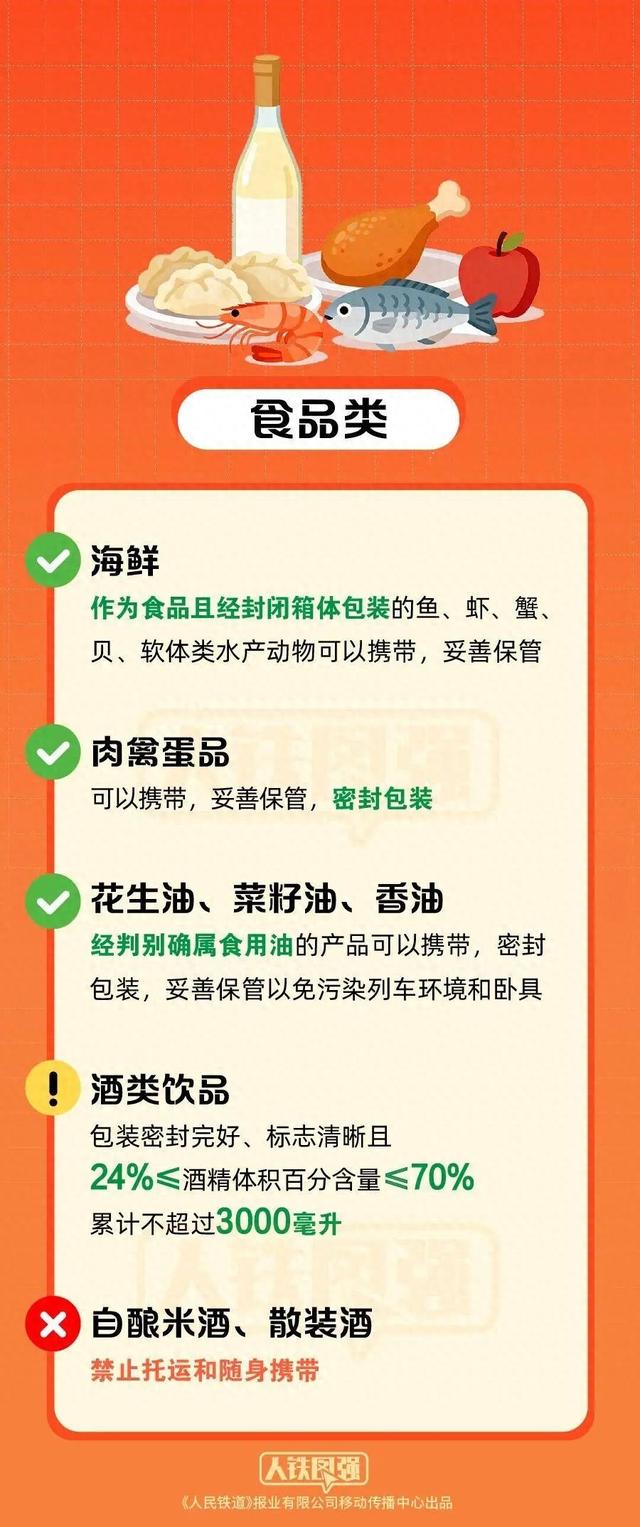
Group 1 - The article provides guidelines on items that can and cannot be carried on trains, emphasizing the importance of proper packaging and handling to avoid contamination and safety issues [1][3][4] - Specific food items such as meat, poultry, and eggs are allowed if properly sealed and stored, while certain alcoholic beverages are permitted under specific conditions, including a maximum alcohol content of 70% and a total volume not exceeding 3000 milliliters [3][4] - Personal care items like perfumes and sprays are allowed in limited quantities, with restrictions on container sizes for flammable products [6][7] Group 2 - Items such as knives with blades longer than 60mm are prohibited for carry-on but can be checked in, while smaller knives are allowed [7][11] - Certain recreational items like folding strollers and wheelchairs are permitted, with specific guidelines for electric wheelchairs [8][9] - Prohibited items include flammable liquids, certain tools, and weapons, which cannot be carried on or checked in [14][15] Group 3 - Smoking is strictly prohibited on high-speed trains and in designated areas of regular trains, with fines imposed for violations [18] - Passengers are allowed to carry a limited number of electronic cigarettes and lighters, but usage is restricted [18] - Guidelines for transporting small animals, such as guide dogs and pets, are provided, including weight limits and health requirements [19] Group 4 - The article outlines procedures for reporting lost items, including using the railway's official app and contacting customer service for assistance [20][21][22][23]
特朗普暗示违法征收的关税不退了,美财长称关税收入将“基本保持不变”
Hua Er Jie Jian Wen· 2026-02-20 23:52
Core Viewpoint - The Trump administration is determined to maintain tariff barriers despite a Supreme Court ruling declaring most of the tariffs illegal, indicating a shift to new tariffs under different legal provisions to replace those struck down [1][2][3]. Group 1: Tariff Changes and Legal Framework - President Trump announced plans to impose a 10% import tariff on global goods, replacing the tariffs deemed illegal by the Supreme Court [1]. - Treasury Secretary Becerra stated that the government will utilize alternative legal powers granted by Congress, including provisions from the Trade Act of 1974 and the Trade Expansion Act of 1962, to establish a new tariff system [1][2]. - Becerra emphasized that no reduction in tariff revenue is expected, projecting that tariff income will remain "basically unchanged" by 2026 [2]. Group 2: Financial Implications and Refunds - The Supreme Court's ruling could lead to a significant refund battle, with estimates suggesting that over $170 billion in tariffs may need to be refunded to importers [3][4]. - The U.S. government’s actual tariff revenue is closer to $130 billion, contrary to estimates suggesting $175 billion, indicating potential discrepancies in financial expectations [2]. - The refund process is expected to be complex and lengthy, potentially taking weeks to months, or even exceeding a year [5]. Group 3: Industry Reactions and Market Impact - Various industries, including textiles, toys, and food and beverage, are significantly affected by the tariff changes, with many companies already filing lawsuits to reclaim paid tariffs [3][4]. - The National Retail Federation has called for a streamlined refund process, highlighting the economic boost that tariff reductions could provide [5]. - Analysts predict that while the ruling may offer short-term relief, broader trade policy uncertainties will continue to impact retail sales, with benefits expected to diminish by 2028 [5][6].
春晚广告位争夺战:四十年国民记忆与商业洪流
Xin Lang Cai Jing· 2026-02-19 07:21
Core Insights - The evolution of the CCTV Spring Festival Gala sponsorship reflects the transformation of Chinese society and economy over the past 40 years, showcasing the changing consumer demands and emerging industries [20][21]. Group 1: 1980s to Early 1990s - The Era of Scarcity - In the 1980s, as China transitioned from a planned economy to a market economy, consumer goods were scarce, leading to a high demand for basic commodities [22]. - The first brand to sponsor the Spring Festival Gala was Kambas watches in 1984, which used 3,000 quartz watches as payment, marking the beginning of brand sponsorship in the gala [22][23]. - Kambas became a household name, with production reaching 1.26 million units in 1987 and over 2 million by 1991, despite the high price of its watches relative to average incomes [23][24]. Group 2: Mid-1990s to Early 2000s - The Rise of Consumerism - The mid-1990s saw a shift in consumer spending from basic goods to electronics, with Shandong Kongfu Banquet Wine becoming the first "advertising king" by paying 30.79 million yuan for sponsorship in 1995 [26]. - The competition among liquor brands for sponsorship reflected the rise of "social consumption," where premium liquor became a status symbol for social gatherings [28]. - After winning the Spring Festival sponsorship, Qin Pool Wine's sales skyrocketed from 180 million yuan in 1995 to 950 million yuan in 1996, demonstrating the immediate impact of gala sponsorship [29]. Group 3: 2000s to Early 2010s - The Home Appliance Boom - The early 2000s marked a shift towards home appliances as the primary consumer focus, with Midea becoming the most frequent sponsor, securing 16 sponsorships from 2003 to 2019 [30]. - The cost of advertising during the gala increased significantly, with Midea's sponsorship fee rising from 6.8 million yuan in 2005 to 57.2 million yuan in 2011, an increase of 840% [30]. - Midea's revenue grew from 17.5 billion yuan in 2003 to over 140 billion yuan in 2014, reflecting the effectiveness of its gala sponsorship strategy [12][30]. Group 4: Mid-2010s to Present - The Digital Economy and Technological Innovation - The rise of internet companies has transformed the Spring Festival Gala into a platform for digital engagement, with WeChat's "red envelope war" in 2015 significantly boosting viewer interaction [15][35]. - The gala's advertising has evolved from one-way promotion to interactive engagement, with platforms like Douyin and Kuaishou participating in sponsorships [16][35]. - The presence of technology companies has increased, with innovations such as AI and robotics showcased during the gala, indicating a shift from traditional advertising to technology-driven marketing [19][37].



春晚40年赞助商变迁史,从康巴丝到机器人见证中国经济跃迁
Sou Hu Cai Jing· 2026-02-18 02:17
Group 1 - The article discusses the evolution of sponsorship in the CCTV Spring Festival Gala over the past 40 years, reflecting changes in Chinese society and consumer behavior [2][3] - The first sponsor, 康巴丝 (Kambas), set a precedent in 1984 by using 3,000 quartz watches as payment, marking the beginning of brand sponsorship in the gala [6][8] - The transition from watches to bicycles as the next major sponsor in 1995 illustrates the shift in consumer goods that represented status during the era of material scarcity [10][12] Group 2 - The late 1990s saw a surge in consumer spending on new household appliances, with 山东孔府宴酒 (Shandong Confucius Banquet Wine) becoming the first "mark king" of the gala in 1995, paying 30.79 million yuan [10][12] - The rapid growth of the liquor industry during this period was fueled by "human consumption," where premium liquor became a social currency [12][14] - The article highlights the consequences of over-reliance on advertising without maintaining product quality, as seen in the case of 秦池酒 (Qin Pool Wine), which faced a significant drop in sales after quality issues emerged [14][15] Group 3 - From the early 2000s, the focus shifted to home appliances, with 美的 (Midea) becoming a prominent sponsor, securing 16 sponsorships from 2003 to 2019 [17][19] - The cost of advertising during the gala increased significantly, with Midea's sponsorship fee rising from 6.8 million yuan in 2005 to 57.2 million yuan in 2011, reflecting the growing viewership [17][19] - The brand storytelling approach adopted by companies like 海尔 (Haier) and 格力 (Gree) during this period indicates a shift towards building emotional connections with consumers [20] Group 4 - The rise of internet companies post-2010 transformed the gala's advertising landscape, with platforms like WeChat leveraging the event for massive user engagement through interactive features like the "red envelope battle" [21][23] - The article notes that the 2015 Spring Festival Gala saw WeChat's user engagement peak, with over 10.1 billion red envelopes sent, showcasing the event's potential as a digital marketing platform [21][23] - The involvement of tech giants in the gala reflects a broader trend of digital economy reshaping traditional advertising methods, with companies like 快手 (Kuaishou) and 抖音 (Douyin) entering the sponsorship arena [25][27] Group 5 - The article concludes by emphasizing the transition from showcasing products to highlighting technological advancements, as seen with the introduction of robots in recent galas [27] - This shift signifies a broader change in China's economic landscape, moving from manufacturing to innovation-driven growth, with a focus on high-tech industries [27] - The future of the Spring Festival Gala sponsorship landscape remains uncertain, raising questions about which industries will dominate the next decade [27]

春晚广告位争夺战:四十年国民记忆与商业暗流
创业邦· 2026-02-17 10:32
Core Viewpoint - The evolution of the Spring Festival Gala sponsorship reflects the changing landscape of China's economy and consumer behavior over the past 40 years, showcasing the transition from material scarcity to technological innovation and brand storytelling [4][24]. Group 1: 1980s to Early 1990s - The 1980s marked a period of material scarcity, where items like watches and radios were symbols of wealth and status, leading to the first brand sponsorship by 康巴丝 (Kangbasi) at the Spring Festival Gala [5][7]. - 康巴丝 sponsored the gala by trading 3,000 quartz watches for advertising, which significantly boosted its brand recognition and sales, reaching an annual production of 1.26 million watches by 1987 [8]. - The sponsorship model evolved, with 中华自行车 (Zhonghua Bicycle) taking over the sponsorship in 1995, reflecting the changing consumer demands and economic conditions [9][14]. Group 2: Mid-1990s to Early 2000s - The mid-1990s saw a surge in consumer spending, with the emergence of "标王" (advertising king) sponsorships, particularly in the liquor industry, exemplified by 山东孔府宴酒 (Shandong Confucius Feast Wine) and 秦池酒 (Qinchijiu) [11][12]. - 秦池酒's sponsorship led to a dramatic increase in sales from 1.8 billion yuan in 1995 to 9.5 billion yuan in 1996, highlighting the impact of gala sponsorship on brand visibility and sales [16]. - The era was characterized by a shift towards consumerism, with brands leveraging the gala to enhance their market presence, although some faced backlash due to quality issues [16]. Group 3: 2000s to Early 2010s - The early 2000s marked the rise of home appliance brands, with 美的 (Midea) becoming a prominent sponsor, securing 11 sponsorships from 2003 to 2014, reflecting the growing importance of brand trust [17][19]. - The cost of advertising skyrocketed, with Midea's sponsorship fee increasing from 6.8 million yuan in 2005 to 57.2 million yuan in 2011, indicating the gala's significant viewership and advertising value [21]. - Brands began to focus on storytelling and emotional connections with consumers, moving beyond mere product promotion to build brand loyalty [23]. Group 4: Mid-2010s to Present - The 2010s saw the rise of internet companies as key players in the advertising space, with platforms like WeChat revolutionizing audience engagement through interactive features like the "red envelope battle" during the gala [25][26]. - The digital transformation of the gala allowed for unprecedented levels of interaction, with WeChat reporting 10.1 billion red envelope transactions on New Year's Eve, significantly enhancing its user base [26]. - The emergence of technology companies in the gala sponsorship landscape reflects a broader shift towards innovation and digital engagement, with brands like Xiaomi and AI robotics showcasing advancements in technology [32].





河北邢台:骑行运动“骑”出消费与产业增长新路径
Xin Lang Cai Jing· 2026-02-16 23:40
Group 1 - The cycling trend in Xingtai has evolved beyond fitness, integrating "sports + culture and tourism + industry," creating diverse consumption scenarios and driving local economic growth [1] - The market for bicycles and related equipment is shifting towards professional and high-end products, with sales of high-end models accounting for 40% of total sales, a 35% increase year-on-year [2] - The active cycling community has led to a burgeoning service economy, with over 100 cycling organizations and more than 30,000 members generating stable income for local businesses through activities and services [2] Group 2 - Xingtai has developed approximately 870 kilometers of 50 premium cycling routes, connecting cultural and natural attractions, which has expanded consumption from "single points" to "whole areas" [3] - Various cycling events have attracted over 200,000 participants, significantly boosting local consumption, with cycling tourists spending 2.3 times more than average tourists [3] - The local bicycle industry is undergoing transformation towards intelligent and innovative manufacturing, with over 4,500 production enterprises and annual output exceeding 100 million bicycles [4] Group 3 - Local manufacturers are responding to market demands for lightweight and smart products, with significant advancements in technology, such as magnesium alloy integration, leading to increased sales of high-end models [4] - The industrial clusters in Pingxiang and Guangzong counties reported revenues of 34.19 billion and 23.19 billion respectively, with year-on-year growth of 10.1% and 10.8%, showcasing the strong interaction between consumption and industry [4]