
CRO

Search documents
CRO概念股承压走低 康龙化成跌超4% 昭衍新药跌超3%
Zhi Tong Cai Jing· 2025-12-22 07:36
Group 1 - CRO concept stocks are under pressure, with notable declines in share prices: Kanglong Chemical down 4.32% to HKD 21.24, Zhaoyan New Drug down 3.29% to HKD 21.16, Kelaiying down 2.31% to HKD 78.15, and Weiya Bio down 1.98% to HKD 1.98 [1] - The revised U.S. Biodefense Law was passed in the Senate with a vote of 77 in favor and 20 against, completing the main legislative process and is set to be signed by the President [1] - According to Xinda Securities, the Biodefense Law has been a significant factor suppressing the valuation of the CXO sector over the past two years, but the final version is relatively mild compared to the initial draft, as it does not name specific companies [1] Group 2 - With the Federal Reserve entering a rate-cutting phase, global biopharmaceutical investment and financing are expected to improve marginally [1] - The implementation of the Biodefense Law is anticipated to lead to a dual recovery in performance and valuation for the CXO sector [1]

港股收盘 | 恒指收涨0.75% 智能驾驶方向走强 生物医药股显著反弹
Zhi Tong Cai Jing· 2025-12-19 09:27
Market Overview - US inflation slowdown supports interest rate cut expectations, while the Bank of Japan raised rates by 25 basis points, leading to a rise in Hong Kong's three major indices. The Hang Seng Index increased by 0.75% to 25,690.53 points with a total turnover of HKD 221.186 billion [1] - The Hang Seng Index experienced a cumulative decline of 1.1% for the week, while the Hang Seng China Enterprises Index and the Hang Seng Tech Index fell by 1.96% and 2.82%, respectively [1] Blue Chip Performance - Shenzhou International (02313) led the decline among blue chips, falling by 3.18% to HKD 60.95, with a turnover of HKD 490 million, negatively impacting the Hang Seng Index by 2.67 points. Despite exceeding market expectations in revenue and profit, the company's net profit dropped by 32% year-on-year due to declining profit margins and pressures on direct sales [2] - Other notable blue chip performances included WuXi Biologics (02269) rising by 4.4% and Li Auto-W (02015) increasing by 3.81% [2] Sector Highlights - Large tech stocks mostly rose, with Tencent, Kuaishou, and Meituan each gaining over 1%. The L3-level autonomous driving sector saw significant activity, while pharmaceutical stocks rebounded sharply [3] - The L3-level autonomous driving concept stocks surged, with Youjia Innovation (02431) up by 31.22% and Xiaopeng Motors-W (09868) rising by 7.65%. The Ministry of Industry and Information Technology's approval of L3-level autonomous driving vehicles is expected to accelerate the industry's value reconstruction [3] - Pharmaceutical stocks also saw a notable rebound, with Kelaiying (06821) increasing by 10.42% and WuXi Biologics (02269) up by 4.4%. The geopolitical concerns regarding China's CXO industry are expected to stabilize, supporting innovation in the sector [4] Lithium Industry - Lithium stocks experienced a rally, with Ganfeng Lithium (01772) rising by 1.87% and Tianqi Lithium (09696) increasing by 1.72%. The price of lithium carbonate futures broke through the 110,000 yuan mark [4][5] Robotics Sector - The robotics sector was active, with Hong Kong Robot (00370) rising by 10.29%. Recent collaborations in the humanoid robot space are expected to drive market growth, with projections indicating a potential market size of USD 5 trillion by 2050 [6] Notable New Listings - New listings showed a stark contrast, with Zhihui Mining (02546) surging by 90.69% while Xidi Intelligent Driving (03881) fell by 13.69% on their debut [7] Company-Specific Developments - CIMC Group (02039) saw a strong performance, rising by 15.47% after announcing a buyback plan for H-shares worth up to HKD 300 million [8] - Changfei Optical Fiber (06869) climbed by 12.01%, driven by signs of recovery in the traditional optical fiber market and growth in the overseas special optical fiber market [9] - China Duty Free Group (01880) rose by 6.88% following the launch of the Hainan Free Trade Port, with expectations of increased offshore duty-free sales [10] - China Tobacco Hong Kong (06055) increased by 6.68% amid new regulations aimed at strengthening electronic cigarette oversight, with positive outlooks for the tobacco sector [11]
港股异动 | 医药股显著反弹 药明生物(02269)涨超6% 三生制药(01530)涨超5%
智通财经网· 2025-12-19 03:02
兴业证券认为,近期创新药板块情绪回落,随着BD持续落地,该行认为当前板块景气度可持续,"创新 +国际化"创新药产业趋势不变,短期调整后创新药板块弹性进一步提升。同时,可继续重点关注基本 面已开始改善的创新药产业链,当前在投融资数据、订单和业绩层面均看到向好趋势。 消息面上,据券商中国日前报道,北京时间12月18日凌晨,参议院官网显示,搭载修订版《生物安全法 案》的美国2026财年国防授权法案(2026NDAA)获通过。新版本生物安全法未具体点名任何一家公 司。有券商研究机构认为,2025年法案进展阶段性落地,行业回归中长期增量逻辑。 智通财经APP获悉,医药股今早明显反弹,CRO、创新药方向居前。截至发稿,凯莱英(06821)涨 6.28%,报77港元;药明生物(02269)涨6.11%,报34.72港元;三生制药(01530)涨5.04%,报26.68港元; 诺诚健华(09969)涨4.25%,报13.74港元。 ...
海南封关,江苏开放再迎新机遇
Xin Hua Ri Bao· 2025-12-18 23:47
Core Viewpoint - The official launch of the Hainan Free Trade Port's full island closure operation is seen as a strategic opportunity for Jiangsu enterprises, enabling them to leverage Hainan's policies for global procurement, processing, and distribution, thus enhancing their competitiveness and operational efficiency [1][2]. Group 1: Policy and Economic Impact - The closure of Hainan is a critical step in forming the Free Trade Port, providing Jiangsu companies with a "VIP card" for global operations, leading to lower costs and higher efficiency [2]. - Jiangsu, as a manufacturing powerhouse with all 41 industrial categories, can utilize Hainan's zero-tariff and processing value-added tax exemptions to enhance the global competitiveness of its products [2]. - For example, exporting industrial robots to Brazil can save 80,000 to 100,000 yuan in tariffs by utilizing Hainan's processing capabilities [2]. Group 2: Innovation and Collaboration - The collaboration between Jiangsu and Hainan in the high-tech biopharmaceutical sector is deepening, with a model of "Jiangsu R&D + Hainan application" emerging as a benchmark for cross-regional innovation [4]. - Companies like Ding Tai Pharmaceutical Research have established significant operations in Hainan, creating a strategic reserve of non-human primates for drug research, which enhances international collaboration [4]. - The establishment of a medical testing facility by Shi He Gene in Hainan is expected to accelerate the clinical validation and market entry of innovative products [4]. Group 3: Data and Digital Economy - The closure of Hainan is facilitating a new phase of "data collaboration" between Jiangsu and Hainan, moving from infrastructure integration to rule coordination and industrial linkage [6]. - A cross-border data cooperation mechanism is being explored to reduce compliance costs and time barriers for enterprises, enhancing data flow between the two regions [6]. - The collaboration aims to create a dual business loop of "Hainan pre-processing and Jiangsu value-added export," optimizing industrial division of labor [6]. Group 4: Systematic Development - The cooperation between Jiangsu and Hainan is evolving from a one-way "policy leverage" to a deep "system coupling," establishing a new paradigm for regional collaborative development driven by institutional innovation [7]. - Hainan is positioned as a "pressure testing zone" for exploring international rules, while Jiangsu serves as a "industrial transformation field" to unleash innovative capabilities [7].
昭衍新药涨近10% 月内累升超30% 机构指头部CRO有望受益于行业回暖+实验猴涨价
Ge Long Hui· 2025-12-17 03:30
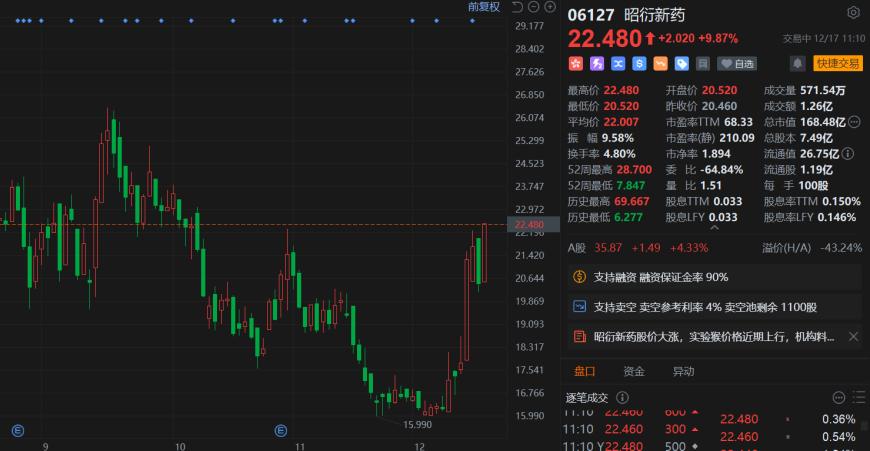
Group 1 - The core viewpoint of the article highlights the significant rise in the stock price of Zhaoyan New Drug (6127.HK), which increased nearly 10% to HKD 22.48, marking a two-month high, with a cumulative increase of over 30% in December, leading to a total market capitalization of HKD 16.86 billion [1] - The price of experimental monkeys has surged, with the cost of 3-5 year old crab-eating macaques reaching HKD 140,000 each, indicating a supply-demand imbalance this year [1] - The recovery in the CRO (Contract Research Organization) industry and the upward cycle of innovative drugs are contributing factors to the rising prices of experimental monkeys, with several CRO companies, including Zhaoyan New Drug and Yinos, having substantial resources in this area [1] Group 2 - According to Founder Securities, leading CROs with rich strategic resource reserves are expected to benefit from the industry recovery and the fair value gains from monkey prices [1] - For Zhaoyan New Drug, assuming an average price of HKD 84,900 per monkey in 2024 and an increase to HKD 140,000 by Q4 2025, with an estimated output rate of 17% from 23,200 monkeys, the projected new fair value in 2025 could be approximately HKD 220 million [1]

港股异动|昭衍新药涨近10% 月内累升超30% 机构指头部CRO有望受益于行业回暖+实验猴涨价
Ge Long Hui A P P· 2025-12-17 03:24
Group 1 - The core viewpoint of the article highlights the significant rise in the stock price of Zhaoyan New Drug (6127.HK), which increased nearly 10% to HKD 22.48, marking a two-month high, with a cumulative increase of over 30% in the month, resulting in a total market capitalization of HKD 16.86 billion [1] - The price of experimental monkeys has surged, with the cost for 3-5 year old crab-eating macaques reaching HKD 140,000 each, indicating a supply-demand imbalance this year [1] - The increase in monkey prices is linked to the upward cycle of innovative drugs and the recovery of orders in the CRO industry, with several CRO companies, including Zhaoyan New Drug and Yinos, having substantial resources in experimental monkeys [1] Group 2 - According to Founder Securities, leading CROs with rich strategic resource reserves are expected to benefit from the industry recovery and the fair value gains from monkey prices [1] - For Zhaoyan New Drug, assuming an average price of HKD 84,900 per monkey in 2024 and an increase to HKD 140,000 by Q4 2025, with an estimated output rate of 17% from a known 23,200 monkeys, the projected new fair value in 2025 could be approximately HKD 220 million [1]
“美女董秘”上任11天就闪电辞职,一场阵痛而已?
Sou Hu Cai Jing· 2025-12-16 07:52
Core Viewpoint - The sudden resignation of Gao Yingying, the newly appointed secretary of the board at Ruizhi Pharmaceutical, after only 11 days in office, raises concerns about the company's internal environment and governance issues [1][3][4]. Group 1: Company Background - Ruizhi Pharmaceutical is located in Yuexiu District, Guangzhou, and primarily engages in the research and production of biological and chemical drugs [8]. - The company has experienced significant turmoil in its leadership, with multiple changes in the actual controller and chairman, leading to instability [4][6]. Group 2: Executive Changes - Since 2021, at least eight core executives, including the general manager and CFO, have resigned, impacting strategic continuity and team stability [6]. - Gao Yingying's predecessor, Xu Jian, also faced challenges, including regulatory scrutiny and early resignation due to compliance issues [7]. Group 3: Financial Performance - The company's revenue from 2019 to 2024 showed fluctuations, with figures of 13.28 billion, 14.82 billion, 16.91 billion, 13.27 billion, 11.38 billion, and 9.7 billion respectively [8]. - In the first three quarters of 2025, Ruizhi Pharmaceutical achieved a revenue of 8.17 billion, a year-on-year increase of 13.68%, while net profit reached 7.09 million, up 111.5% [8]. Group 4: Market Reaction - The stock price of Ruizhi Pharmaceutical saw a significant increase of over 100% in 2025 but began to decline after reaching a peak of 15.28 yuan per share in July, falling to around 9.48 yuan by mid-December [8].


价格狂飙近2倍!A股,又一涨价题材强势来袭!
Xin Lang Cai Jing· 2025-12-16 04:40
Group 1 - The price of crab-eating macaques, a key biological resource for CRO (Contract Research Organization) companies, has surged nearly 2 times, increasing from 50,000 yuan to 140,000 yuan per monkey, leading to a supply-demand imbalance in the market [1][16] - The stock of Longzhou Co., a leading CRO with significant macaque resources, has seen a remarkable increase of over 122% in just 12 trading days, closing at 11.93 yuan with a market capitalization of 6.709 billion yuan [22][24] - Longzhou Co. has attracted substantial investments, including 6.7 million shares from social security funds and over 19 million shares from well-known institutions, indicating strong market interest [21][22] Group 2 - The ETF market has expanded significantly, with an increase of over 2 trillion yuan in total market size this year, driven by continuous capital inflow across various asset classes [25] - The Huatai-PineBridge CSI 300 ETF has seen a notable growth of 63.042 billion yuan this year, highlighting the increasing attractiveness of ETFs as an asset allocation tool [25] - The capital market is projected to receive nearly 1 trillion yuan in potential incremental funds by 2027, as financial institutions are expected to increase their equity asset allocation [26] Group 3 - Over 80% of listed securities firms have distributed dividends at least twice this year, with notable performances in total cash dividends from smaller firms [27] - Xibu Securities has implemented three cash dividends totaling 446 million yuan this year, with additional dividends in progress [27] - The highest cash dividend amount this year has been from Guotai Junan, reaching 7.581 billion yuan, followed by Huatai Securities and others [27] Group 4 - Two new companies have been accepted for IPO on the Sci-Tech Innovation Board, bringing the total number of new acceptances this year to 210 [28] - As of December 14, there are 266 companies under review across various boards, indicating ongoing market activity [28]

“天价猴”再临CRO,20cm大红柱吹响昭衍新药(06127)股价反攻号角?
智通财经网· 2025-12-13 14:20
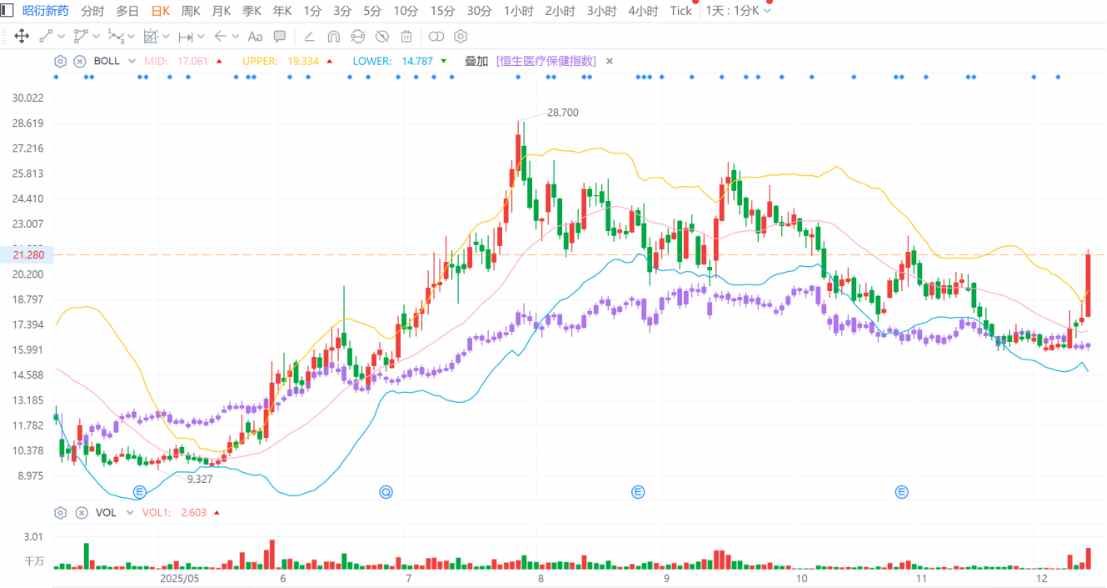
Core Viewpoint - The stock price of Zhaoyan New Drug has rebounded significantly, reaching a peak of 21.54 HKD after a prolonged decline, driven by market interest and the recent surge in monkey prices [1][2][3]. Stock Performance - After a four-month decline, Zhaoyan New Drug's stock price surged by 21.22% in a single day, marking its return to the 20 HKD level [1][2]. - The stock had previously peaked at 28.70 HKD in July 2023 but faced a significant drop to 13.89 HKD by June 20, 2023, representing a decline of 28.73% [3]. - The stock's price fluctuated around the 60-day moving average until October 4, 2023, when it broke below this level, indicating a downward trend [5]. Market Dynamics - The recent rebound in stock price is attributed to the influx of funds from the Hong Kong Stock Connect, with significant buying from mainland retail investors [6][8]. - The average cost of shares held by investors has decreased from 23.30 HKD in early October to 19.44 HKD by December 11, 2023, with a notable increase in profit margins following the recent price surge [8]. Financial Performance - Zhaoyan New Drug reported a revenue of 985 million CNY for the first three quarters of 2023, a decline of 26.23% year-on-year, with Q3 revenue dropping by 34.87% [12][13]. - The company has faced challenges due to a significant loss in biological asset valuation, amounting to 267 million CNY, impacting its profitability [13]. Industry Outlook - The CRO industry is expected to show resilience in 2024, driven by increased R&D budgets from multinational corporations and favorable domestic policies promoting innovation [11]. - The demand for experimental monkeys, crucial for drug development, is anticipated to rise due to a supply-demand gap, potentially boosting Zhaoyan New Drug's performance in 2025 and beyond [14].
“天价猴”再临CRO,20cm大红柱吹响昭衍新药股价反攻号角?
Zhi Tong Cai Jing· 2025-12-13 14:20
Core Viewpoint - The stock price of Zhaoyan New Drug has rebounded significantly, reaching a peak of 21.54 HKD after a prolonged decline, indicating renewed market interest in the company and its leading position in the CRO industry [1][2]. Group 1: Stock Performance - After a four-month decline, Zhaoyan New Drug's stock price surged by 21.22% in a single day, marking its return above the 20 HKD threshold [1][2]. - The stock had previously reached a high of 28.70 HKD in July 2023 but faced a significant drop to 13.89 HKD by June 20, representing a decline of 28.73% from its peak [3]. - Following a period of volatility, the stock began to recover, with a notable rebound in the Hang Seng Healthcare Index, which increased by 9.45% since June 20 [3]. Group 2: Market Dynamics - The recent stock price increase is attributed to the influx of funds from the Hong Kong Stock Connect, with significant buying from mainland retail investors [6]. - The average holding cost for Zhaoyan New Drug shares has decreased from 23.30 HKD in early October to 19.44 HKD by December 11, with a notable increase in profit margins following the recent price surge [7]. Group 3: Financial Performance - Zhaoyan New Drug reported a revenue decline of 26.23% year-on-year for the first three quarters of 2023, with Q3 revenue dropping by 34.87% [10][11]. - The company has faced challenges due to a significant loss in fair value of biological assets, amounting to 267 million HKD, impacting profitability despite revenue growth in new orders [11]. - New signed orders for the first three quarters of 2025 reached 1.64 billion HKD, reflecting a year-on-year growth of 17.1%, indicating potential recovery in demand [11]. Group 4: Industry Outlook - The CRO industry is expected to show resilience in 2024, driven by increased R&D budgets from multinational corporations and improved regulatory conditions in China [10]. - The demand for experimental monkeys, a key asset for Zhaoyan New Drug, is projected to rise due to a supply-demand gap, which could positively impact the company's performance in 2025 and beyond [12].