公用事业

Search documents
港股异动 | 大众公用(01635)午后一度涨超22% 市场追捧宇树及摩尔线程概念
智通财经网· 2025-10-02 05:53
公开资料显示,大众公用为公用事业与金融创投齐头并进的投资控股型企业,其中,创投业务是大众公 用较为重要的业务板块和利润来源,该公司持有深创投10.80%股权。 智通财经APP获悉,大众公用(01635)午后一度涨超22%,截至发稿,涨17.09%,报3.7港元,成交额 6947.08万港元。 消息面上,9月26日,上交所官网披露信息显示,摩尔线程科创板IPO申请通过上交所上市委会议审 议。据悉,摩尔线程成立后曾获得包括深创投在内的多家机构投资。大众公用此前在互动平台表示,公 司参股深创投,深创投及其基金持有宇树科技股份。宇树科技预计于今年四季度向证券交易所提交上市 申请文件。 ...


AES Corp. shares surge on reported $38B BlackRock-backed bid
Invezz· 2025-10-01 13:26
Shares in U.S. utility AES Corp. surged more than 12% in premarket trading Wednesday after reports that BlackRock-owned Global Infrastructure Partners (GIP) is preparing a takeover bid worth about $38... ...



Buy High Visibility Cash Flows For The Rate Cut Cycle
Seeking Alpha· 2025-09-30 21:46
Core Viewpoint - The upcoming cycle of interest rate cuts is expected to correct mispricing in securities, particularly benefiting those with high visibility and certainty of cash flows, while those with low certainty may remain mispriced [1][2]. Group 1: Discounting and Cash Flow Visibility - The article discusses the application of discounting math to both bonds and equities, highlighting that securities with high visibility of cash flows are better positioned as interest rates decrease [2]. - Bonds have perfect visibility of cash flows, allowing precise discounting calculations, while equities exhibit more complexity due to varying cash flow visibility [3][9]. - Value stocks, characterized by lower duration due to high earnings relative to price, should theoretically outperform growth stocks during rate hikes, but this has not been observed in practice [10][11]. Group 2: Mispricing Observations - Despite the expectation that growth stocks would suffer more during rate hikes due to their higher duration, they have outperformed value stocks, indicating a significant mispricing in the market [11][13]. - The observed phenomenon shows that value stocks with visible cash flows were more punished during interest rate increases, contrary to mathematical expectations [22]. - REITs and utilities, which have high cash flow visibility and shorter durations, were expected to be more resilient but also faced mispricing during the rate hike cycle [23][24]. Group 3: Future Expectations and Sector Performance - As interest rates are anticipated to decrease, sectors with high cash flow visibility, such as REITs and utilities, are expected to benefit significantly from the rate cuts [26][28]. - The long-duration sectors are projected to be the biggest beneficiaries of rate cuts, with specific subsectors like triple net, retail, and industrial REITs expected to outperform due to their long rental contracts [32]. - The current valuation and fundamental strength in these subsectors support the expectation of outperformance during the upcoming rate cut cycle [33].

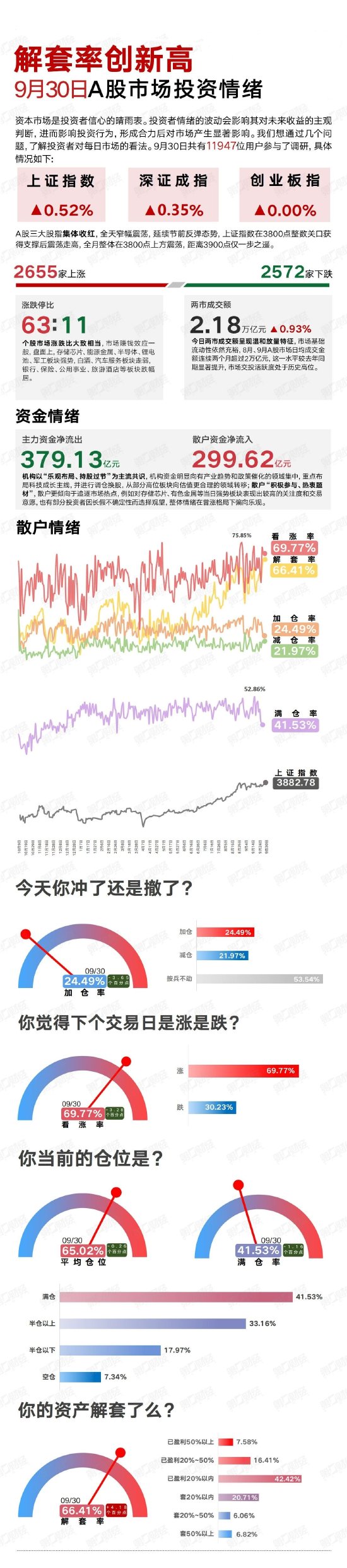
解套率创新高
第一财经· 2025-09-30 11:51
Market Overview - The three major A-share indices closed higher, continuing the pre-holiday rebound, with the Shanghai Composite Index supported at the 3800-point level and moving upward, remaining above 3800 points throughout the month, just a step away from 3900 points [3] - The market showed a moderate increase in trading volume, with a total transaction amount exceeding 2 trillion yuan, indicating a significant increase compared to the same period last year, and the trading activity is at a historical high [5] Sector Performance - Among the sectors, storage chips, energy metals, semiconductors, lithium batteries, and military industries performed strongly, while the liquor and automotive service sectors weakened, with banks, insurance, public utilities, and tourism hotels experiencing the largest declines [4] Investor Sentiment - Institutional investors are optimistic, focusing on sectors with industrial trends and policy catalysts, particularly in technology growth areas, while retail investors are actively participating and chasing market hotspots, showing high interest in strong sectors like storage chips and non-ferrous metals [7] - Retail investor sentiment is reported at 75.85%, indicating a generally optimistic outlook [8] Fund Flow - There was a net outflow of 79 billion yuan from institutional funds, while retail investors showed a net inflow, reflecting differing investment strategies between the two groups [6]

9月30日A股市场投资情绪:解套率创新高
Di Yi Cai Jing· 2025-09-30 09:28
Core Viewpoint - The A-share market shows a significant rebound in investor sentiment as of September 30, with a high level of participation and optimism among both institutional and retail investors, despite some caution due to the upcoming holiday [1][5]. Market Performance - All three major A-share indices closed in the green, with the Shanghai Composite Index supported at the 3800-point level, indicating a continued upward trend [3]. - The market saw 2,655 stocks rise, reflecting a balanced gain-loss ratio, and the average daily trading volume in August and September reached 2 trillion yuan, marking a historical high in trading activity [3]. Investor Sentiment - Institutional investors are adopting a "optimistic layout, holding stocks through the holiday" strategy, reallocating funds towards sectors with reasonable valuations, while retail investors are actively chasing market hotspots like storage chips and energy metals [5]. - A survey indicated that 52.86% of investors are fully invested, with 24.49% increasing their positions, while 53.54% chose to hold their positions [7][9]. Trading Behavior - Retail investors displayed a strong inclination towards active trading, with 69.77% predicting a market decline in the next trading day, while 30.23% anticipated a rise [11].
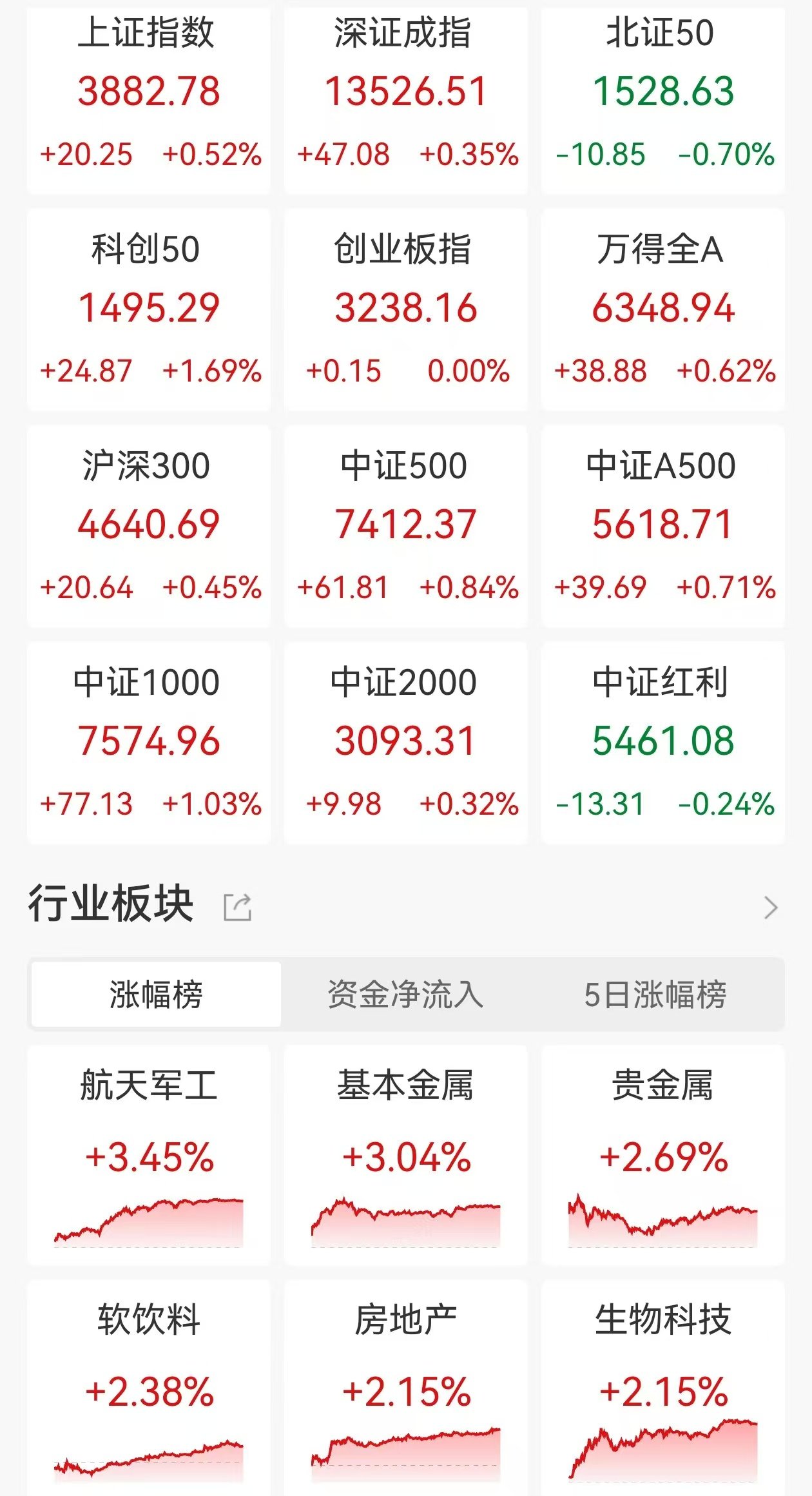
A股收评:沪指涨0.52%报3882点,存储芯片、有色金属板块走高
Ge Long Hui A P P· 2025-09-30 07:13
Market Overview - The major A-share indices mostly recorded gains today, with the Shanghai Composite Index rising by 0.52% to close at 3882 points, and the Shenzhen Component Index increasing by 0.35% [1] - The total market turnover reached 2.2 trillion yuan, an increase of 191 billion yuan compared to the previous trading day, with over 2600 stocks rising and more than 2500 stocks declining [1] Sector Performance - The storage chip sector strengthened due to recent price increases from major storage chip companies, with stocks like Jiangbolong and Demingli hitting the daily limit [1] - The lithium mining concept saw a rise, with Defang Nano increasing by over 12% [1] - The non-ferrous metals sector was boosted by the issuance of a stable growth work plan, leading to stocks like Jingyi Co. and Jiangxi Copper hitting the daily limit [1] - AI chips, Shanghai Free Trade Zone, energy metals, and aerospace sectors also showed significant gains [1] - Conversely, the public utilities sector declined, with Lianmei Holdings hitting the daily limit down [1] - The banking and insurance sectors weakened, with Suzhou Bank leading the decline [1] - The textile and apparel sector also fell, with Hongxing Co. nearing the daily limit down [1] - Brokerage, wheel motor, and automotive integrated die-casting sectors experienced notable declines [1] Top Gainers and Fund Flow - Aerospace and military industry stocks led the gainers with a rise of 3.45% [2] - Base metals and precious metals sectors also saw positive fund inflows, with increases of 3.04% and 2.699% respectively [2] - Soft drinks, real estate, and biotechnology sectors recorded gains of 2.38%, 2.15%, and 2.15% respectively [2]
A股节后怎么走?谁会站上风口?机构最新研判来了!
天天基金网· 2025-09-30 06:19
Core Viewpoint - The article discusses the sentiment and strategies of private equity funds as they approach the National Day holiday, indicating a generally optimistic outlook for the market post-holiday, with a significant portion of funds choosing to hold high positions in their portfolios [4][6][11]. Group 1: Private Equity Fund Positioning - Over 65% of private equity funds are opting for heavy or full positions during the holiday, believing that external market disturbances will be limited and that domestic fundamentals and policy environments provide a solid safety margin [6][4]. - The overall private equity position index reached 78.41% as of September 19, marking a 0.37 percentage point increase from the previous week and reflecting a trend of increased allocations [6][4]. - The majority of private equity funds are optimistic about the market's performance after the holiday, with 70.19% expecting a gradual recovery driven by policy and capital support [9][4]. Group 2: Investment Focus Areas - The primary investment focus is on technology growth sectors, with 59.62% of private equity funds highlighting areas such as AI, semiconductors, and innovative pharmaceuticals as key opportunities [10][4]. - A significant portion of funds (21.15%) is also looking at the valuation recovery in the new energy and real estate sectors, anticipating that clearer industry policies will provide rebound opportunities [10][4]. - There is a belief that the market will exhibit a balanced style post-holiday, with 62.50% of funds expecting a rotation among technology growth, value blue chips, and leading stocks [9][10]. Group 3: Market Sentiment and Future Outlook - The sentiment among private equity funds is generally positive, with many viewing the current market as transitioning from the second to the third phase of a bull market [11][12]. - The article notes that historical data shows a greater than 70% probability of market gains following the National Day holiday, supported by liquidity from institutional investments and retail participation [11][12]. - The anticipated "slow bull" market trend suggests that while short-term volatility may occur, the long-term outlook remains favorable, particularly for technology growth sectors [12][11].

逾六成私募将重仓过节
Zheng Quan Shi Bao· 2025-09-30 05:28
Core Viewpoint - The upcoming National Day holiday has led to increased attention on private equity fund positioning and their outlook for post-holiday market trends [1] Group 1: Private Equity Fund Positioning - Over 65% of private equity funds are opting for heavy or full positions during the holiday, indicating a positive outlook for market trends post-holiday [2][4] - The overall private equity position index has risen to a new high for the year, reaching 78.41%, reflecting a general trend of increasing positions among private equity funds [5] - A majority of private equity funds believe that the recent market adjustments have mitigated risks, leading to an expectation of continued market rebound post-holiday [4][5] Group 2: Market Outlook Post-Holiday - Approximately 70.19% of private equity funds hold an optimistic view regarding the A-share market's performance after the holiday, anticipating a gradual recovery driven by policy and capital [7] - 62.50% of private equity funds expect a balanced market style post-holiday, with rotation among technology growth, value blue chips, and high-quality stocks [7][8] - The focus on technology growth remains strong, with 59.62% of private equity funds prioritizing sectors such as AI, semiconductors, and innovative pharmaceuticals for investment [8] Group 3: Investment Strategies and Themes - Private equity funds are particularly optimistic about sectors benefiting from policy support and economic transformation, such as AI and semiconductors [8][10] - Some funds are also looking at opportunities in undervalued sectors like renewable energy and real estate, anticipating valuation recovery [8][10] - The investment strategy is expected to balance between growth and value, with a focus on sectors that show resilience and potential for recovery [10][11]

逾六成私募将重仓过节
证券时报· 2025-09-30 04:35
Core Viewpoint - The article discusses the positioning of private equity funds ahead of the National Day holiday, indicating a general optimism about the market's performance post-holiday, with a significant majority opting for high exposure levels [2][5][6]. Group 1: Private Equity Fund Positioning - Over 65% of private equity funds are choosing to hold heavy or full positions (over 70% exposure) during the holiday, believing that external market disturbances will be limited and that domestic fundamentals and policy environments provide a solid safety margin [5][6]. - 17.31% of private equity funds are adopting a moderately heavy position (50% to 70% exposure), citing the presence of uncertainties during the holiday but still recognizing structural opportunities in individual stocks [5]. - Only 5.77% of private equity funds are opting for light positions (less than 30% exposure), reflecting a cautious stance due to significant market gains prior to the holiday and potential for adjustments post-holiday [5][6]. Group 2: Market Outlook Post-Holiday - 70.19% of private equity funds are optimistic about the A-share market's performance after the holiday, viewing pre-holiday market fluctuations as a consolidation phase, with expectations for gradual recovery driven by policy and capital [8][12]. - 62.50% of private equity funds anticipate a balanced market style post-holiday, with rotations among technology growth, value blue chips, and high-quality stocks [8][9]. - The focus on technology growth remains strong, with 59.62% of private equity funds favoring sectors such as AI, semiconductors, and innovative pharmaceuticals, which are seen as key drivers for future economic transformation [9][12]. Group 3: Investment Strategies and Themes - The article highlights a consensus among private equity funds that the investment focus will remain on technology growth, with 23.08% firmly optimistic about sectors like AI and semiconductors continuing to perform well [9][10]. - 21.15% of private equity funds are looking at the valuation recovery of the new energy and real estate sectors, expecting these low-valuation areas to provide rebound opportunities as industry policies clarify [9][10]. - The article also notes that 14.42% of private equity funds foresee a "high-low switch" in the market, where previously lagging traditional industries and high-dividend blue chips may experience a resurgence [9].