直播电商

Search documents
董宇辉单飞一年后,东方甄选股价涨超2.4倍!俞敏洪曾称:风物长宜放眼量
Xin Lang Cai Jing· 2025-08-12 13:29
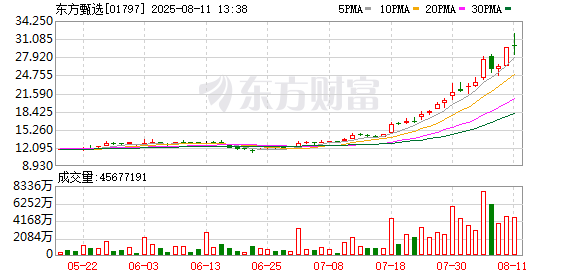
Core Viewpoint - After the departure of key figure Dong Yuhui, Dongfang Zhenxuan's stock price has rebounded significantly, indicating a recovery from previous lows and a shift in business strategy towards self-operated products [2][5]. Group 1: Stock Performance - On August 12, Dongfang Zhenxuan's stock rose by 1.11% to HKD 30.86, with a total market capitalization of HKD 32.3 billion, reflecting a 245% increase from the low of HKD 8.92 at the time of Dong Yuhui's departure [2]. - The stock has also increased over 204% from its year-to-date low of HKD 10.12 [2]. Group 2: Leadership Changes - Dong Yuhui's departure on July 25, 2024, caused a significant impact, with the stock dropping 23.39% in a single day, resulting in a market value loss of over HKD 2.5 billion [3]. - Another prominent host, Duntun, left the company on June 18, 2024, citing contract expiration, although he expressed a desire to continue collaborating with Dongfang Zhenxuan [4]. Group 3: Financial Performance - For the first half of the 2025 fiscal year, Dongfang Zhenxuan reported a net loss of HKD 96.5 million, a stark contrast to a profit of HKD 160 million in the same period the previous year [3]. - Excluding the financial impact of the sale of a subsidiary, the core business achieved a profit of HKD 32.7 million during the reporting period [3]. Group 4: Business Strategy - Dongfang Zhenxuan has shifted its focus towards self-operated products, launching new sanitary products that have seen strong sales, with the first product selling out 180,000 units shortly after launch [5][6]. - The company is adopting a membership model, with 228,300 paid members as of November 2024, indicating potential for growth compared to competitors like Sam's Club, which has 9 million members [6]. Group 5: Market Positioning - The company is positioning itself similarly to high-quality retail brands like Pang Donglai and Sam's Club, focusing on consumer-centric product development and high-quality offerings [6].

事关直播电商食品安全,要求配备食品安全总监,新规要来了
Nan Fang Du Shi Bao· 2025-08-12 09:28
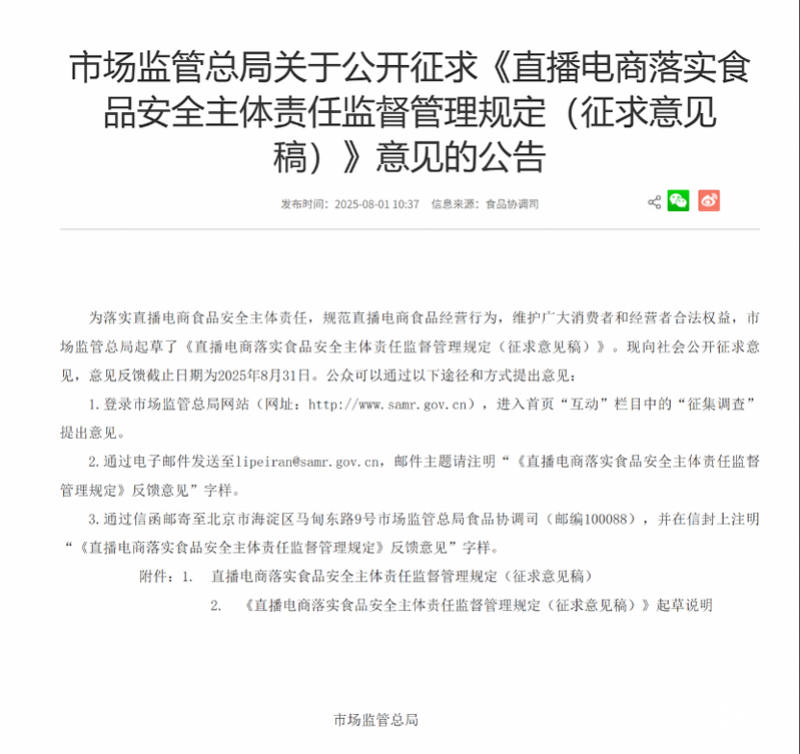
为落实直播电商食品安全主体责任,规范直播电商食品经营行为,维护广大消费者和经营者合法权益,国家市场 监督管理总局牵头组织起草了《直播电商落实食品安全主体责任监督管理规定(征求意见稿)》(以下简称《规 定》),并于近日向社会公开征求意见。 据悉,《规定》明确了适用范围,适用范围包括直播电商平台经营者、直播间运营者、直播营销人员服务机构、 直播营销人员等。 市场监管总局在起草说明中表示,近年来,通过直播电商购买商品已成为消费者一种常态化的购物方式,其中, 食品以高频消费特性占据重要地位。与此同时,虚假宣传、假冒伪劣等乱象逐渐显现,影响了人民群众的食品安 全感,社会反映强烈。为规范直播电商食品经营行为,落实相关主体食品安全责任,市场监管总局依法牵头组织 起草了《规定》。 对于主体责任,《规定》明确,提供食品交易服务的直播电商平台经营者应当建立健全食品安全管理制度,食品 类年营业收入500万元及以上的直播电商平台经营者应配备食品安全总监。 直播电商平台经营者还应当按照《食品生产经营企业落实食品安全主体责任监督管理规定》建立"日管控、周排 查、月调度"工作制度,对平台内食品经营行为进行检查。检查中发现存在违法行为的,应 ...
直播电商领域将迎新规,剑指虚假营销等乱象
Xin Hua Wang· 2025-08-12 05:50
Core Viewpoint - The State Administration for Market Regulation (SAMR) is drafting a new regulation aimed at strengthening the supervision of live e-commerce, addressing issues such as false marketing and ensuring consumer rights [1][2]. Group 1: Regulatory Framework - The new regulation, titled "Live E-commerce Supervision Management Measures (Draft for Comments)," aims to clarify the legal responsibilities of various stakeholders in the live e-commerce ecosystem, including platform operators, live streamers, and marketing personnel [1][2]. - The regulation emphasizes a balanced approach between regulatory compliance and promoting industry development, focusing on problem-oriented measures to address existing issues in the live e-commerce sector [2][3]. Group 2: Responsibilities of Platform Operators - The regulation outlines specific responsibilities for platform operators, including compliance with verification, information reporting, and training mechanisms, to enhance accountability and consumer protection [3][4]. - It aims to establish a collaborative governance model that includes not only platform operators but also live streamers and service agencies, addressing the complexities and risks associated with the live e-commerce model [3]. Group 3: Implementation and Impact - The SAMR assures that the new regulation will not impose additional burdens on stakeholders, as it aligns with existing laws such as the E-commerce Law and Consumer Rights Protection Law [4]. - The regulation will incorporate a blacklist system for non-compliant entities, which is already a common practice among live e-commerce platforms [4][5].
直播电商监督管理办法公开征求意见 直播电商平台经营者将建立黑名单制度
Xin Hua Wang· 2025-08-12 05:50
Core Viewpoint - The draft regulation on live e-commerce aims to clarify the responsibilities and obligations of platform operators, enhancing supervision to protect consumer rights and promote healthy industry development [1][2][5]. Group 1: Responsibilities and Obligations - The draft specifies the responsibilities of live e-commerce platform operators in areas such as violation handling, qualification verification, information reporting, training mechanisms, hierarchical management, dynamic control, and information disclosure [1][5]. - Platform operators are required to establish comprehensive platform agreement rules, strengthen identity verification and qualification audits for live stream operators and marketing personnel, and enhance the handling of illegal activities [1][5][6]. Group 2: Industry Challenges and Regulatory Approach - The rapid growth of the live e-commerce industry has led to issues such as false marketing and counterfeit products, primarily due to inadequate responsibility enforcement among industry participants [2][3]. - The draft aims to implement the Electronic Commerce Law and other regulations, clarifying the legal responsibilities of various stakeholders, including platform operators and marketing personnel, to foster a better online trading environment [2][3]. Group 3: Regulatory Framework and Future Directions - The draft emphasizes the need for a foundational and forward-looking regulatory framework tailored to the characteristics of the live e-commerce industry, establishing basic legal responsibilities and obligations for different entities [3][4]. - It highlights the critical role of platform operators in the ecosystem, aiming to maximize regulatory efficiency by ensuring they fulfill their responsibilities and transmit compliance requirements to other stakeholders [4][5]. Group 4: Consumer Protection and Market Integrity - The draft regulation seeks to enhance product quality oversight through special inspections and stricter enforcement against false advertising, thereby maintaining fair competition and improving online product quality [5][6]. - It addresses public concerns regarding the potential burden on platform operators, clarifying that the draft aligns with existing laws and will not impose additional burdens on stakeholders [6][7].
直播电商:“小兴趣” 撬动 “大产业”
Xiao Fei Ri Bao Wang· 2025-08-12 02:34
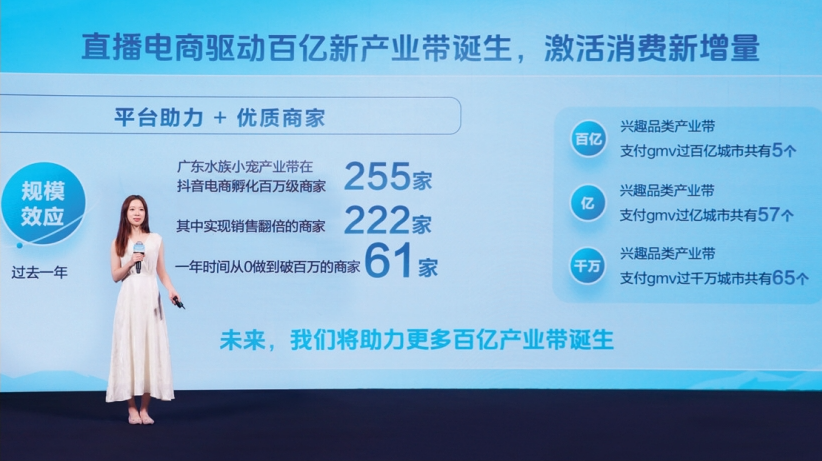
Core Insights - Douyin e-commerce is transforming niche interests into a billion-dollar market, with significant growth in transaction volumes across various interest-driven industries [1][12] - The report indicates that five cities have surpassed a GMV of 10 billion yuan, while 57 cities have crossed the 100 million yuan threshold, showcasing the rapid expansion of interest-based commerce [1][11] Group 1: Market Growth and Trends - Douyin e-commerce has seen a 39% year-on-year increase in the number of merchants in interest industries, with over 14,000 merchants achieving a GMV of over 1 million yuan through live streaming [11] - The platform has enabled traditional industries, such as ceramics in Jingdezhen, to reach younger consumers by integrating cultural heritage with contemporary needs, resulting in a 47% growth in merchants with annual sales exceeding 10 million yuan [12][11] Group 2: Consumer Engagement and Content Strategy - Douyin's unique "visual selling" capability allows products to be presented dynamically, effectively connecting niche interests with a broader audience and breaking down regional barriers [6][10] - The platform's content-driven approach has led to significant engagement, with merchants like "Hai Dashi" expanding their businesses from 80 square meters to 3,000 square meters through effective use of live streaming [4][5] Group 3: Support for Domestic Brands - Domestic brands are leveraging Douyin e-commerce to transition from OEM to original product development, with brands like "Da Nei Mi Tan" achieving high sales volumes and customer loyalty through educational content [7][10] - The platform's ability to aggregate niche user groups fosters community engagement and product co-creation, enhancing brand loyalty and market penetration [10][12] Group 4: Policy Support and Future Outlook - Douyin e-commerce has launched a support plan for interest industries, offering incentives such as zero commission for new merchants and promotional fee refunds to enhance operational efficiency [13] - The platform is positioned to lead the niche interest economy into a new era, where diverse passions can be recognized and fulfilled, contributing to the high-quality development of China's real economy [13]
东北雨姐账号10月解封?当地网信办:可继续直播带货
Bei Jing Shang Bao· 2025-08-11 13:47
Core Viewpoint - The article discusses the potential return of the influencer "Northeast Rain Sister" (东北雨姐) to live streaming and e-commerce after a year of suspension due to previous violations, highlighting the challenges she may face in regaining trust and adhering to regulations [3][5]. Group 1: Background and Current Status - Northeast Rain Sister's Douyin account is set to be unblocked in October 2023, provided she complies with regulations [3]. - She previously gained millions of followers by showcasing rural life in Northeast China but faced a trust crisis after being exposed for selling products that did not meet advertised standards [5]. - Following the exposure, she was fined 1.65 million yuan and her account was suspended [5]. Group 2: Business and Regulatory Environment - The local internet information office has stated that her return to live streaming will be monitored by regulatory bodies to ensure compliance with relevant laws [3]. - Northeast Rain Sister is associated with five companies, three of which have been dissolved, while two remain active [5]. - Her husband controls 31 companies, with some recently dissolved, indicating potential financial instability [5].

1月暴涨130%,东方甄选走出阴霾?
Ge Long Hui· 2025-08-11 11:14
Core Insights - The stock price of Dongfang Zhenxuan has increased by over 130% since July, doubling within a month [1] - The company appears to have moved past the challenges posed by the departure of key influencer Dong Yuhui over a year ago [2] - Despite the recent surge, there are concerns about the sustainability of this growth, as similar patterns have occurred in the past [5] Financial Performance - Dongfang Zhenxuan reported an estimated revenue of approximately $150 million for the period from March to May 2025, reflecting a year-on-year decline of about 30%, although the rate of decline has narrowed compared to previous periods [9] - The operating profit for the same period was around 79 million yuan, with an operating profit margin of approximately 7%, which is a 3 percentage point increase from the previous quarter [10] - In June 2025, the Gross Merchandise Value (GMV) grew by about 28% year-on-year, reaching 880 million yuan, indicating a gradual recovery in revenue [11][12] Business Strategy and Product Development - Dongfang Zhenxuan has successfully launched new products, including a cotton sanitary napkin that sold 180,000 units in two days, generating over 19 million yuan in total sales [13] - The company has expanded its product categories beyond food to include high-margin daily necessities, with its self-owned brand gross margin increasing from 10% to 21% [14] - The membership model has attracted 228,300 paid members, with a high repurchase rate of 86% and a satisfaction rate of 99.3%, indicating strong customer loyalty [15] Competitive Landscape - Dongfang Zhenxuan is being compared to Sam's Club, especially in light of recent trust issues faced by Sam's China, positioning Dongfang Zhenxuan as a potential alternative [6][15] - The company operates on a flexible model compared to the high maintenance costs associated with Sam's physical stores, which may provide a competitive advantage [18] Operational Challenges - Despite recent successes, Dongfang Zhenxuan still relies heavily on a traditional selection and outsourcing model for logistics, which complicates cost control and inventory management [19][21] - The company faces ongoing challenges related to inventory costs and transportation expenses, which have been cited as reasons for not achieving profit growth despite increased revenue [21] - As the company expands its product offerings, it must enhance its brand management to avoid potential damage to its reputation, similar to issues faced by Sam's Club [22][24] Future Outlook - The recent stock price surge reflects a revaluation of Dongfang Zhenxuan's strategy to move away from influencer dependency and focus on supply chain management [26] - Continued success in launching popular products and maintaining GMV growth could support the elevated valuation [26] - The company must navigate a competitive market characterized by price competition and challenges in customer acquisition to sustain its growth trajectory [26]

董宇辉出走1年 东方甄选股价暴涨超200% 正在内蒙古“游山玩水”的俞敏洪 做对了什么?
Mei Ri Jing Ji Xin Wen· 2025-08-11 05:39
Core Viewpoint - The article discusses the transformation and recovery of Dongfang Zhenxuan (东方甄选) after the departure of its prominent host Dong Yuhui, highlighting the company's strategic shift from a host-driven model to a product-driven approach, resulting in significant stock price recovery and business growth. Group 1: Company Performance - After the split with Dong Yuhui, Dongfang Zhenxuan's stock price dropped over 23% on the first trading day, losing approximately 3 billion HKD in market value, reaching a low of 8.92 HKD [2][4] - As of August 11, 2025, the stock price reached 29.38 HKD, with a market capitalization exceeding 30 billion HKD, marking a 190% increase from the year's low of 10.12 HKD and a 229% increase from the low following Dong Yuhui's departure [8][11] - The company's self-operated product GMV (Gross Merchandise Volume) share increased to 39%, with over 600 product varieties and a cold chain coverage rate of 92%, indicating deep supply chain integration [11][12] Group 2: Strategic Shifts - Dongfang Zhenxuan has shifted its focus from seeking a new host to strengthening its supply chain and self-operated products, completing a transition from a host-driven to a product-driven model [11][16] - The launch of a self-operated sanitary napkin product sold out within minutes, demonstrating the effectiveness of the company's supply chain strategy and consumer trust [12][14] - The company aims to create a "Sam's Club online" by establishing a membership economy, with over 250,000 paid members and a repurchase rate 2.7 times higher than regular users [17][18] Group 3: Financial Metrics - The net profit for the company after distributing 50% to Dong Yuhui was reported at 141.414 million RMB [4] - The gross margin for self-operated products increased from 10% in the second half of 2024 to 21% in the first half of 2025, while operating profit margin rose from 3% to 7% [17] - Dong Yuhui's new venture, Yuhui Tongxing, conducted 265 live broadcasts in 2025, achieving a total viewership of 3.15 billion, with average sales per broadcast significantly increasing [18]
董宇辉出走1年,东方甄选股价暴涨超200%,正在内蒙古“游山玩水”的俞敏洪,做对了什么?
Mei Ri Jing Ji Xin Wen· 2025-08-11 05:37
Core Insights - The article discusses the transformation and recovery of Dongfang Zhenxuan after the departure of its prominent host, Dong Yuhui, highlighting the company's strategic shift from a host-driven model to a product-driven approach [3][10][13]. Financial Performance - After the split with Dong Yuhui, Dongfang Zhenxuan's stock price dropped over 23% on the first trading day, losing approximately 3 billion HKD in market value [3][10]. - As of August 11, 2025, the stock price reached 29.38 HKD, with a market capitalization exceeding 30 billion HKD, marking a 190% increase from its lowest point of 10.12 HKD earlier in the year [10][13]. - The company's self-operated product GMV (Gross Merchandise Volume) share increased to 39%, with over 600 product varieties and a cold chain coverage rate of 92% [13][14]. Strategic Shifts - Dongfang Zhenxuan has focused on supply chain integration and self-operated products, moving away from reliance on individual hosts [13][17]. - The launch of a self-operated sanitary napkin product sold out quickly, indicating strong consumer demand and trust in the brand [14][16]. - The company aims to build a membership economy, converting one-time transactions into long-term customer relationships, with over 250,000 paid members and a repurchase rate 2.7 times higher than regular users [19][20]. Market Positioning - Dongfang Zhenxuan is positioning itself as a platform for selecting quality products, emphasizing self-operated agricultural products and cultural dissemination [19][20]. - The company has achieved a significant increase in gross margin for self-operated products, rising from 10% in the second half of 2024 to 21% in the first half of 2025 [19][20].

2025年淘宝直播商家运营方法论白皮书
艾瑞咨询· 2025-08-10 00:06
Core Viewpoint - The article emphasizes the transition of the live e-commerce industry in China into a new phase driven by efficiency, focusing on refined operations in product management, traffic, and marketing strategies to achieve sustainable growth [1][2]. Group 1: Market Overview - The live e-commerce market in China is projected to reach 5.8 trillion yuan in 2024, reflecting a year-on-year growth of 17.7%, indicating a shift from extensive growth to deep operational efficiency [2]. - The industry is facing structural challenges as user growth slows, with user penetration rates in short videos, live broadcasts, and online shopping exceeding 75%, leading to a focus on existing user engagement [5]. Group 2: User Behavior and Demand - User behavior is evolving towards a multi-threaded approach, with consumers actively comparing products across platforms, necessitating a non-linear, dynamic outreach strategy from merchants [8]. - There is a notable shift in consumer demand from "extreme cost-effectiveness" to a dual focus on "price + quality," with 76.9% of consumers prioritizing product quality over price sensitivity [14]. Group 3: Merchant Strategies - Merchants are required to adopt refined strategies for user operations, focusing on "activating existing users, deepening demand, and recreating value" to maximize user lifetime value [5]. - The E-MAX merchant operation framework is introduced, emphasizing full-cycle supply, all-touchpoint penetration, and cross-field marketing to enhance product efficiency and integrate marketing resources [21][60]. Group 4: Operational Methodologies - The full-cycle supply strategy involves enhancing the efficiency of product supply across different stages: incubation, explosion, and deep cultivation, with tailored strategies for each phase [23][61]. - The all-touchpoint penetration strategy aims to connect various traffic channels, including public and private domains, to reach dispersed users effectively [33][36]. Group 5: Marketing Integration - The all-field marketing approach integrates live marketing with brand marketing, creating a resonance effect that enhances both short-term sales and long-term brand positioning [63]. - Merchants are encouraged to leverage platform resources for dynamic marketing strategies that balance promotional bursts with ongoing operational efficiency [19][46]. Group 6: Case Studies and Examples - Successful case studies highlight how brands like UR and vivo have utilized the E-MAX framework to achieve significant sales growth and brand exposure through strategic live broadcasts and marketing campaigns [66][84]. - The article illustrates how high-quality content and differentiated product offerings can drive brand recognition and consumer trust, essential for long-term success in the live e-commerce landscape [78][79].