云计算

Search documents
小摩:对阿里巴巴-W未来6至12个月交易前景持建设性看法 建议增持股票
Zhi Tong Cai Jing· 2026-01-09 07:12
Core Viewpoint - Morgan Stanley maintains an optimistic outlook on Alibaba's (09988) trading prospects over the next 6 to 12 months, recommending an "overweight" rating on the stock, anticipating that the share price will overcome short-term profit pressures and be re-rated once the monetization point of "cloud business + generative AI" becomes clearer [1] Group 1 - Morgan Stanley believes that the risk and reward profile for Alibaba leans towards the upside, as the potential of AI-driven cloud business and the value of platform optionality outweigh short-term investment hurdles [1] - The firm has lowered its target price for Alibaba's U.S. stock from $230 to $215, based on a 16x price-to-earnings ratio for the fiscal year 2028, and reduced the target price for its Hong Kong stock from HKD 225 to HKD 210 [1] - Despite increased investments in food delivery, instant retail, and user acquisition for generative AI native applications potentially weakening profit margins in the short term, these adverse factors are gradually being understood by the market, with investment pace largely dependent on management's self-regulation [1] Group 2 - Morgan Stanley has revised its earnings per share forecasts for Alibaba for 2027 to 2028 down by 15% and 7% respectively, reflecting increased investment in food delivery, instant retail, and generative AI user acquisition, as well as weakened monetization capabilities in the domestic e-commerce sector amid soft consumer demand [2] - The firm anticipates that as these adverse factors continue to unfold over the coming quarters, profitability may have further downside potential, leading to a more differentiated and potentially volatile trading style [2]

小摩:对阿里巴巴-W(09988)未来6至12个月交易前景持建设性看法 建议增持股票
智通财经网· 2026-01-09 07:05
Group 1 - Morgan Stanley maintains an optimistic outlook on Alibaba's (09988) trading prospects for the next 6 to 12 months, recommending to overweight the stock as it is expected to overcome short-term profit pressures [1] - The target price for Alibaba's US stock is lowered from $230 to $215, based on a 16x price-to-earnings ratio for the fiscal year 2028, while the Hong Kong target price is adjusted from HKD 225 to HKD 210 [1] - Despite short-term profit margin pressures due to increased investments in food delivery, instant retail, and generative AI applications, these negative factors are gradually being understood by the market, with investment pace largely dependent on management's self-regulation [1] Group 2 - Earnings per share forecasts for Alibaba for 2027 and 2028 are reduced by 15% and 7% respectively, reflecting increased investment in user acquisition for food delivery, instant retail, and generative AI applications, alongside weakened monetization capabilities in the domestic e-commerce sector due to soft consumer demand [2] - It is anticipated that profit margins may have further downside potential in the coming quarters as these adverse factors continue to unfold, leading to a more differentiated and potentially volatile trading style [2]
中国车企出海100%用阿里云 长安打造可复用的欧洲数字化模板
Di Yi Cai Jing· 2026-01-09 06:04
Group 1 - Changan Automobile has fully deployed Alibaba Cloud services at its Frankfurt site in Europe, achieving cloud-based deployment of numerous core systems [1] - The comprehensive cloud costs are reduced by 40% compared to traditional solutions, and operational efficiency has improved by 30% [1] - This deployment provides a reusable digital template for future expansion into new European markets [1] Group 2 - At the 2026 Singapore International Auto Show, it was revealed that Alibaba Cloud has achieved a "double hundred" breakthrough in the automotive industry, with Chinese automakers fully adopting Alibaba Cloud domestically and 100% using it for overseas operations [1]

AI硬切软?低费率云计算50ETF(516630)涨超2.6%,易点天下涨停
Sou Hu Cai Jing· 2026-01-09 05:52
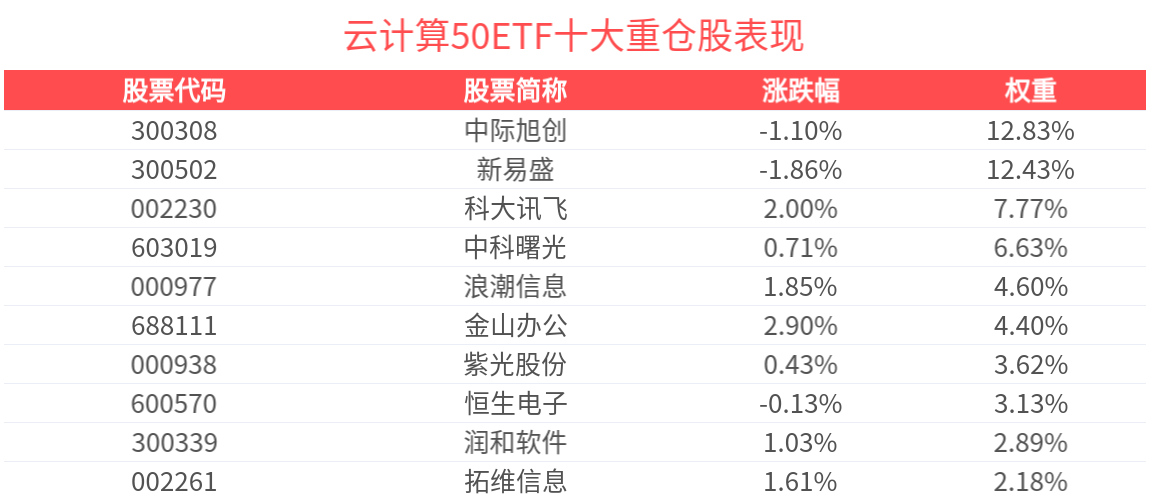
Group 1 - The AI software sector is experiencing significant growth, with the China Securities Cloud Computing and Big Data Theme Index rising by 2.57% as of January 9, 2026, and the Cloud Computing 50 ETF increasing by 2.62% [1] - The Cloud Computing 50 ETF has seen a net inflow of 31.02 million yuan, indicating strong investor interest [1] - The Ministry of Industry and Information Technology and eight other departments issued an implementation opinion on "Artificial Intelligence + Manufacturing," aiming to promote deep integration of AI technology and manufacturing by 2027 [1] Group 2 - As of January 8, 2026, the Cloud Computing 50 ETF has a maximum drawdown of 0.35% this year, indicating low drawdown risk [2] - The Cloud Computing 50 ETF closely tracks the China Securities Cloud Computing and Big Data Theme Index, which includes 50 companies involved in cloud computing and big data services [2] - The top ten weighted stocks in the index account for 50.01% of the total, with notable companies including iFlytek, Kingsoft Office, and Zhongji Xuchuang [2]


欧盟强化数字竞争力纸黄金保持韧性
Jin Tou Wang· 2026-01-09 04:10
Group 1 - The European digital economy is heavily reliant on external sources, with significant deficiencies in infrastructure and industrial capabilities, hindering its digital sovereignty efforts [2] - European cloud infrastructure providers hold only about 15% market share in their local market, dominated by American companies like Amazon, Microsoft, and Google, making it difficult for local competitors to catch up [2] - In the artificial intelligence sector, Europe has a limited number of local large models and lags behind the US and China in innovation and deployment [2] Group 2 - The EU plans to launch an "AI Super Factory" project in 2026, aiming to establish up to five large computing centers to address its technological shortcomings [2] - The EU's proposed digital regulatory reforms in November 2025 aim to ease regulations on the AI Act and General Data Protection Regulation to reduce costs and enhance competitiveness [3] - Despite these reforms, there are concerns that they may not resolve the structural roots of transatlantic tensions [3] Group 3 - The price of paper gold is currently trading around 1003.45 CNY per gram, showing a slight increase of 0.35% and maintaining an upward trend [4] - Key support and resistance levels for paper gold are identified at 1000.00 CNY and between 1009-1012 CNY, respectively, with strong linkage to Shanghai Gold Exchange prices [4] - Market activity remains robust with stable positions, supported by central bank gold purchases and expectations of Federal Reserve interest rate cuts, although short-term risks may arise from upcoming CPI data [4]
卓易信息股价涨5.13%,大成基金旗下1只基金重仓,持有24.86万股浮盈赚取121.34万元
Xin Lang Cai Jing· 2026-01-09 02:26
Group 1 - The core viewpoint of the news is that Zhuoyi Information's stock has seen a significant increase, with a rise of 5.13% to 99.98 CNY per share, and a total market capitalization of 12.11 billion CNY [1] - Zhuoyi Information, established on May 12, 2008, and listed on December 9, 2019, focuses on cloud computing technology, with its main revenue sources being core firmware for cloud computing devices (35.09%), cloud services (33.64%), and PB business (27.98%) [1] - The company's cloud service segment includes IoT cloud services (22.80%) and government-enterprise cloud services (10.84%), with other supplementary services contributing 3.30% [1] Group 2 - From the perspective of major fund holdings, Dachen Fund has a significant position in Zhuoyi Information, with its Dachen Zhizhen Return Mixed A Fund holding 248,600 shares, representing 2.38% of the fund's net value [2] - The Dachen Zhizhen Return Mixed A Fund has a total size of 636 million CNY and has achieved a year-to-date return of 6.83%, ranking 797 out of 8827 in its category [2] - The fund manager, Du Cong, has been in charge for 5 years and 138 days, with the fund's total assets amounting to 4.436 billion CNY, achieving a best return of 84.85% during his tenure [3]

云计算指数盘中拉升,龙头股表现突出
Mei Ri Jing Ji Xin Wen· 2026-01-09 02:18
(文章来源:每日经济新闻) 每经AI快讯,1月9日,云计算指数盘中拉升,龙头股表现突出,琏升科技涨逾19%,奥飞数据涨超 11%,亚信安全涨8%,光环新网、东软集团等涨超5%。 ...
【财经分析】跨大西洋摩擦持续 欧洲寻求数字主权突破之路
Xin Hua She· 2026-01-08 23:01
Core Viewpoint - The ongoing tensions between the EU and the US regarding digital sovereignty have escalated, with the US imposing visa restrictions on European advocates, highlighting the geopolitical struggle and the challenges Europe faces in strengthening its digital sovereignty amidst external pressures and internal weaknesses [1][2][3]. Group 1: US-EU Tensions - The US State Department announced visa restrictions on five European individuals, including former EU Commissioner Thierry Breton, which Breton described as "political persecution" [2]. - This escalation follows the EU's first non-compliance decision under the Digital Services Act, where a fine of €120 million was imposed on Elon Musk's social media platform X [2]. - The EU has been increasingly enforcing regulations against US tech giants, with significant fines imposed on companies like Apple, Meta, and Google for various violations [2][4]. Group 2: Europe's Digital Sovereignty Challenges - Europe is starting from a "weak position" in the digital economy, with significant reliance on external sources for key infrastructure and industry capabilities, which poses a challenge to its digital sovereignty [4][5]. - A report indicated that European cloud infrastructure providers hold only about 15% of the local market, while US companies dominate the sector, making it difficult for European competitors [4]. - In the artificial intelligence sector, Europe lacks sufficient local models and is falling behind the US and China in innovation and deployment [4]. Group 3: EU's Strategic Adjustments - In response to US pressures, the EU is adjusting its strategies to enhance competitiveness, including launching a project for "AI super factories" in 2026 and aiming to triple data center capacity within 5 to 7 years [6][7]. - The EU is also proposing reforms to digital and tech regulations to reduce compliance costs for businesses, which some view as an attempt to improve competitiveness and signal stability in US relations [7].

阿里巴巴20260108
2026-01-08 16:02
Summary of Alibaba's Conference Call Company Overview - **Company**: Alibaba Group - **Industry**: E-commerce and Cloud Computing Key Points E-commerce and Flash Sales Concerns - Market concerns regarding the December quarter's e-commerce and flash sales business led to stock price volatility, but the long-term performance of the e-commerce business remains strong [2][3] - Alibaba maintains a leading position in instant retail, with losses narrowing faster than competitors, indicating an optimistic long-term outlook [2][3] Cloud Business Growth - Alibaba Cloud showed robust growth, with Q3 2025 revenue increasing by 34% year-over-year, and Q4 growth expected to exceed 35% [2][4] - Both internal and external demand are strong, suggesting high market vitality, with potential for mid-term profit margin improvements due to economies of scale [4] E-commerce CMR Growth Adjustment - E-commerce CMR growth was slightly below expectations, revised down from 6% to 3-5%, but this has minimal impact on overall performance [2][5] - Increased competition in instant retail has created challenges in performance forecasting, but the company aims to maintain its market share, which may require significant short-term investments [5] AI Investments - Significant investments in AI and emerging fields include the launch of products like Qianwen APP, Aifu, Gaode Map, and World Model, aimed at enhancing model training and promoting AI-native applications [2][6] - These investments, while increasing short-term losses, are expected to provide new growth opportunities in the future [6] International E-commerce Profitability - The international e-commerce business is beginning to move towards profitability, with increased investments in global promotional events like Double Eleven and Black Friday, which may temporarily increase losses but hold long-term growth potential [2][6] Investment Timing - Recent stock price fluctuations due to market sentiment present a favorable investment opportunity, with expectations of performance normalization and strategic plan execution leading to a positive long-term outlook [2][7] - The company maintains a buy rating, encouraging investors to focus on future performance [7]
兴业证券:2025年并购重组有何新动向?
智通财经网· 2026-01-08 12:31
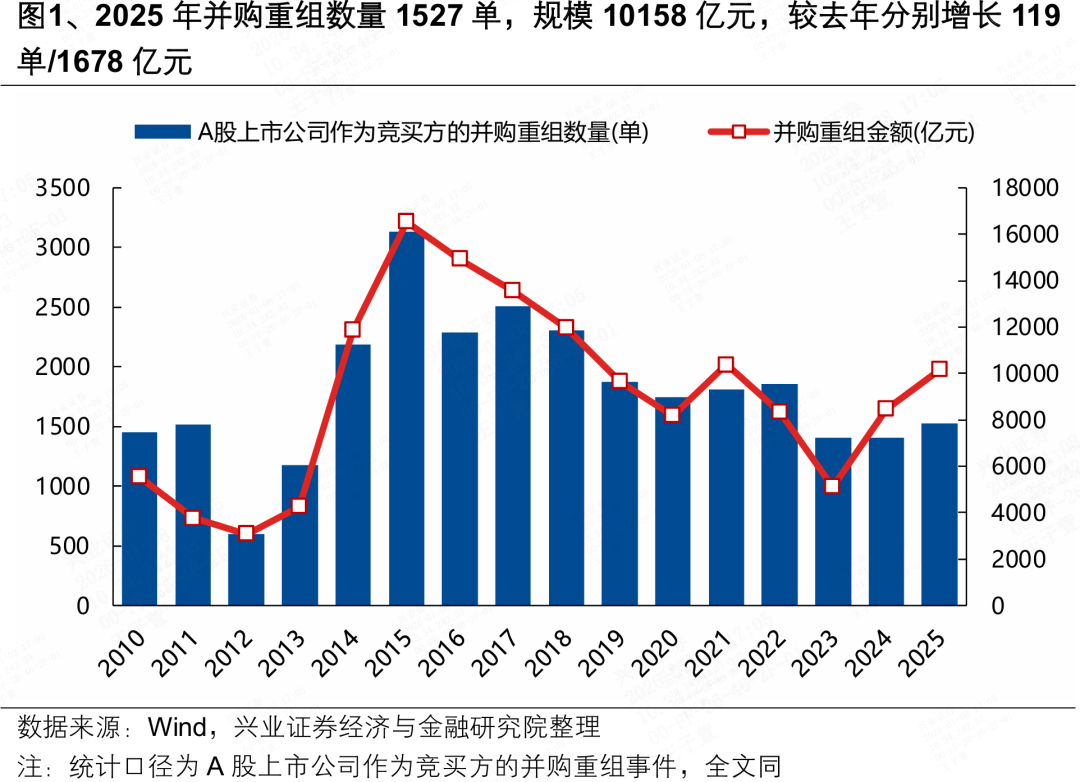
Core Viewpoint - The M&A market in 2025 is expected to remain active, with a significant increase in both the number and scale of transactions, driven by policy support and market recovery [1][3]. Group 1: Market Activity - The number of M&A cases involving A-share listed companies reached 1,527, with a total scale of 10,158 billion yuan, marking a new high since 2022, representing an increase of 119 cases and 1,678 billion yuan compared to the previous year [1]. - In the first half of 2025, there were 665 M&A cases with a scale of 4,174 billion yuan, while the second half is expected to see 862 cases totaling 5,984 billion yuan, indicating a faster pace of M&A activity [3]. Group 2: Industry Focus - The majority of M&A cases in 2025 are concentrated in the new productivity sectors, with traditional industries also contributing significantly to large-scale M&A cases [7]. - Key industries for M&A activity include chemicals, electronics, pharmaceuticals, machinery, power equipment, automotive, and computing, reflecting a trend towards resource integration driven by new productivity [10]. Group 3: Company Attributes - The participation of non-state-owned enterprises in M&A transactions has increased significantly, with their share of transaction amounts rising from 23.5% in 2024 to 37.2% in 2025 [14]. - Non-state-owned enterprises are leading M&A activities in new productivity sectors, while state-owned enterprises dominate traditional industries such as coal, banking, and public utilities [17]. Group 4: M&A Characteristics - Cross-industry M&A has increased, accounting for 56.31% of total M&A cases in 2025, up by 6.2 percentage points from 2024 [22]. - Most cross-industry M&A cases are focused on internal resource integration within the industry chain, with fewer traditional industry cases acquiring new productivity companies [28]. Group 5: Stock Performance - Companies involved in M&A activities, particularly those transitioning from traditional industries to new productivity sectors, have shown significant excess returns post-announcement [32][36].