
未来网络

Search documents
新型储能纳入政府投资基金投向!国家首次作出系统规范
中关村储能产业技术联盟· 2026-01-13 12:15
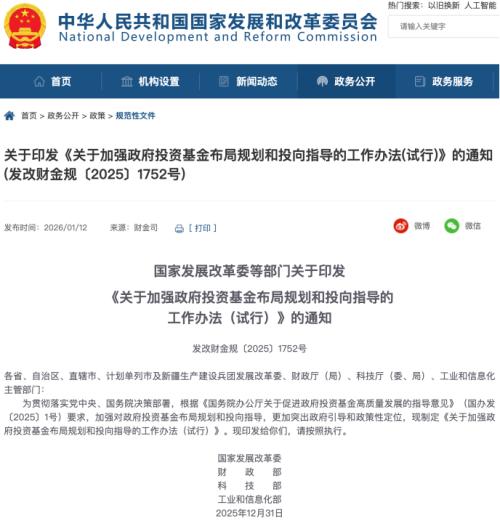
Core Viewpoint - The article discusses the implementation of a new regulatory framework for government investment funds in China, aimed at optimizing their layout and guiding investment directions to support national strategies and industrial upgrades [2][3][4]. Group 1: Government Investment Fund Overview - Government investment funds are established by various levels of government to guide social capital in supporting industry development and innovation through market-oriented methods such as equity investment [2][12]. - The new framework includes a systematic approach to fund layout and investment direction, marking the first national-level regulation of government investment funds [2][4]. Group 2: Supported Investment Areas - The framework identifies key investment areas, including: - Emerging and future industries such as information technology, new energy, advanced manufacturing, and artificial intelligence [2][3]. - Upgrading traditional industries and supporting high-quality development in manufacturing [3][4]. - Promoting the digital economy through initiatives like "AI+" and the application of 5G technology [3][4]. Group 3: Policy Measures - The framework outlines 14 policy measures focusing on three main aspects: where to invest, how to invest, and who manages the funds [3][4]. - It emphasizes early, small, long-term investments in hard technology and aims to prevent homogeneous competition and crowding out of social capital [11][12]. Group 4: Evaluation Management - An evaluation management method has been established to assess the investment direction of government funds, focusing on compliance with national planning and industry directories [4][5]. - The evaluation system includes three main indicators: policy compliance (60% weight), optimization of productivity layout (30% weight), and policy execution capability (10% weight) [6][7]. Group 5: Specific Evaluation Indicators - The evaluation indicators cover aspects such as support for new productivity, technology innovation, green development, and the promotion of private investment [29][33]. - Specific metrics include the proportion of investments in encouraged industries, the effectiveness of fund management, and the impact on social welfare [29][33][40].

重磅利好!万亿级“国家队”投向明确了
Zhong Guo Jing Ji Wang· 2026-01-13 02:32
Core Viewpoint - The Chinese government has established a systematic framework for the development and direction of government investment funds, marking the first time such guidelines have been issued at the national level [1]. Group 1: Policy Framework - The "Work Method" outlines three main aspects: where to invest, how to invest, and who manages the funds, proposing 14 policy measures [3]. - The framework emphasizes supporting major strategies and key areas, particularly in sectors where market resources are insufficient, promoting deep integration of technological and industrial innovation, and focusing on nurturing emerging pillar industries [3]. Group 2: Investment Guidance - Funds must align with national major plans and encourage industries listed in the national industrial directory, while avoiding investments in restricted, eliminated, or prohibited sectors [3]. - Provincial development and reform departments are tasked with creating lists of key investment areas to optimize fund allocation [3]. Group 3: Evaluation Metrics - The "Management Method" establishes three primary indicators: 1. Policy compliance (60% weight), assessing the fund's role in supporting new productive forces, technological innovation, and green development [4]. 2. Optimization of productive layout (30% weight), evaluating alignment with national regional strategies and effective capacity utilization [5]. 3. Policy execution capability (10% weight), focusing on fund efficiency and the professional level of fund managers [5]. Group 4: Focus Areas - The investment focus includes emerging industries such as next-generation information technology, new energy, high-end equipment, and green technology, as well as future industries like the metaverse, brain-computer interfaces, and generative artificial intelligence [5].
【关注“十五五”规划】前瞻布局未来产业 中国具备禀赋优势
Zheng Quan Shi Bao· 2025-12-01 18:12
Core Viewpoint - The Chinese government has outlined a strategic initiative to proactively layout future industries, focusing on six key areas: quantum technology, biomanufacturing, hydrogen energy and nuclear fusion, brain-computer interfaces, embodied intelligence, and sixth-generation mobile communication. This initiative aims to enhance the country's industrial structure and drive economic growth [1]. Group 1: Future Industry Layout - The strategic layout of future industries is expected to clarify the direction of China's industrial structure and serve as a new pillar for economic growth [1]. - The six core areas identified for future industry development are characterized by their strategic, leading, and disruptive features [1]. Group 2: Advantages of Development - China possesses three unique advantages for developing future industries: a new type of national system for resource concentration, a complete industrial system for technology commercialization, and a vast market for rapid application and iteration of new technologies [1]. - The country is also expected to leverage its technological innovation advantages to support these developments [1]. Group 3: Technological Advancements - In embodied intelligence, China is achieving breakthroughs in both "smart brains" and "strong bodies," with increasing levels of model generalization [2]. - The country has developed leading brain-computer interface technologies, including ultra-flexible, minimally invasive electrodes and dynamic electrodes that can navigate within animal brains [2]. - In biomanufacturing, China leads globally in CAR-T cell therapy and original drug production [2]. - Quantum technology advancements include the "Zuchongzhi No. 3" supercomputer, which is significantly faster than the world's fastest supercomputer, and the "Wukong" quantum computer, which has completed over 710,000 calculations globally [2]. Group 4: Innovation Rankings - According to the Global Innovation Index 2025, China has entered the top ten for the first time, achieving its highest ranking at fourth place [3]. - The Global Key and Emerging Technologies Index 2025 indicates that while the U.S. remains the leading technology power, China ranks second in key technology fields such as semiconductors and artificial intelligence [3]. - China has 24 of the world's top 100 innovation clusters, maintaining its position as the global leader for three consecutive years [3]. Group 5: Policy Initiatives - The National Development and Reform Commission and the Ministry of Industry and Information Technology have issued implementation opinions to promote innovation in future industries, including specific policies for brain-computer interfaces and biomanufacturing [4]. - The State Council has introduced measures to accelerate the cultivation of application scenarios across various fields, establishing a comprehensive ecosystem for future industries [4]. Group 6: Industry Growth - Approximately 350 companies related to brain-computer interfaces have emerged in China, creating a complete industrial chain from core components to end applications [5]. - China has established the largest solar panel and flat screen film production bases globally, along with 23 biomanufacturing bases [5]. - With over 300 billion yuan allocated to quantum technology and substantial local funding, major provinces are developing numerous quantum technology application scenarios [5]. - The country has built 4.55 million 5G base stations, indicating a strong push towards future industries characterized by national strategic guidance and large-scale market applications [5].
第九届未来网络发展大会在南京发布三大科技成果
Zhong Guo Xin Wen Wang· 2025-08-20 16:32
Core Insights - The Ninth Future Network Development Conference was held in Nanjing, focusing on artificial intelligence, large models, and computing networks, featuring significant technological achievements and major cooperation projects [1][2] Group 1: Technological Achievements - Three major technological achievements were announced, including a network large model and multi-agent system tested in real-world environments, achieving L4 level in 20 out of 22 test items, enabling rapid data insights and fault diagnosis [1] - The overall intelligence capability of the system reached L4 level, facilitating applications in urban computing networks and industry-specific networks [1] Group 2: Strategic Collaborations - A strategic cooperation agreement was signed to promote the "East Data West Computing" project, with 32 new members joining the "East Data West Computing - Future Computing Network Collaborative Scheduling Alliance" [2] - This collaboration aims to create a nationwide computing supply ecosystem covering eight major hubs, enhancing the integration of the "East Data West Computing" initiative [2] Group 3: Regional Development Initiatives - Nanjing is positioning itself as a core city for future network industry layout, focusing on building a "6G city" and a leading demonstration area for 6G industrial development [2] - The city is enhancing future network testing facilities and developing dedicated networks for various sectors, including industrial, government, medical, and data trading [2]
广州市场主体总量突破400万户 跃居全国第三
Nan Fang Ri Bao Wang Luo Ban· 2025-08-18 07:34
Group 1 - Guangzhou has reached a significant milestone with the registration of its 4 millionth market entity, ranking third nationally in total market entities [1] - From January to July 2025, Guangzhou registered 548,400 new market entities, representing a year-on-year growth of 57.30%, leading among national pilot cities for business environment innovation [1] - The process of obtaining a business license has been streamlined from 20 working days to under 10 minutes through the "Guangzhou Market Entity Express" mini-program, enhancing the entrepreneurial environment [1] Group 2 - Continuous deepening of business environment reforms has led to remarkable growth, with the implementation of fully electronic business registration and the innovative "one-stop online application and one-window collection" model [2] - The online application rate for starting a business in Guangzhou has reached 99% [2] - Emerging strategic industries are thriving, with new market entities in low-altitude economy and aerospace growing by 156.48% and 89.82% respectively, while future networks and quantum technology saw growth rates of 179.10% and 143.01% [2]