
汽车供应链

Search documents
轩辕大漠戈壁行第2季招募|敦煌68公里,还原那个本真的自己
汽车商业评论· 2026-03-06 23:05
Core Viewpoint - The article emphasizes the importance of personal growth and collaboration within the automotive industry, highlighting a unique journey that combines physical endurance with self-discovery and community building [4][5][11]. Group 1: Event Overview - The event is a 68-kilometer trek through diverse terrains including Gobi, canyons, and deserts, designed to foster personal and professional connections among participants [5][15]. - The journey spans five days, starting from April 27 to May 1, 2026, with various activities planned each day, including a welcome dinner, campfire gatherings, and a closing celebration [5][14]. Group 2: Daily Activities - Day 1 involves gathering in Dunhuang, followed by a welcome dinner [5][13]. - Day 2 features a 24-kilometer hike starting from the Xuanzang statue, with a campfire event in the evening [5][13]. - Day 3 continues with another 24-kilometer trek, culminating in a night of stargazing and discussions [5][13]. - Day 4 includes a 20-kilometer hike to the final destination, where participants receive awards and celebrate their achievements [5][14]. - Day 5 concludes with a return journey after breakfast [5][14]. Group 3: Participant Engagement - The event targets professionals from various sectors of the automotive industry, including manufacturing, technology development, marketing, and supply chain [15][20]. - It aims to build trust and cooperation among participants through shared challenges and experiences [5][11]. Group 4: Inspirational Themes - The article conveys themes of resilience, self-discovery, and the importance of stepping out of comfort zones to achieve personal and collective growth [4][9][10]. - The imagery of the desert and night sky serves as a metaphor for the journey towards a brighter future and the realization of one's potential [4][10].


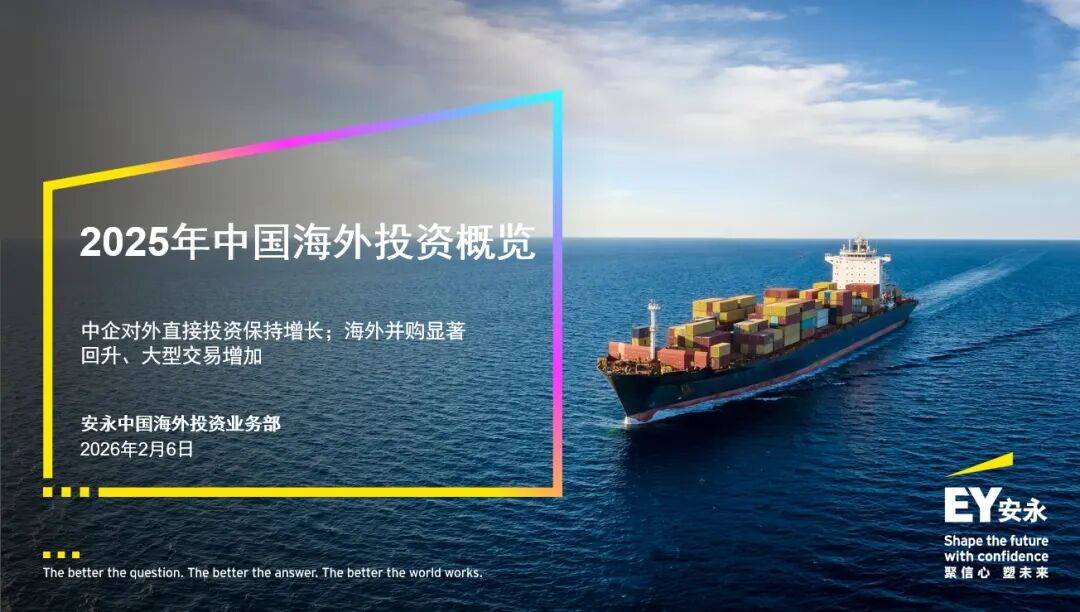
安永发布《2025年中国海外投资概览》
Sou Hu Cai Jing· 2026-02-09 08:46
Group 1: Industry Overview - The acquisition of brands and channel integration is accelerating, making consumer goods the hottest industry, surpassing TMT (Technology, Media, and Telecommunications) [2][13] - In 2025, the total overseas mergers and acquisitions (M&A) announced by Chinese companies reached $43.6 billion, a nearly 40% year-on-year increase, with large transactions over $1 billion rising from 7 to 13 [3][10] - The consumer goods sector saw significant growth, with the largest two transactions totaling $6.7 billion, driving the industry to grow over three times year-on-year [13] Group 2: Regional Analysis - Asia and Europe are the most popular destinations for M&A, each accounting for approximately 30% of the total; North America and Latin America also recorded significant growth in transaction amounts [16][18] - In 2025, Asian M&A amounted to $15.7 billion, a 15% year-on-year increase, while European M&A reached $13.8 billion, with increased momentum in the second half of the year [18] - North American M&A surged nearly threefold to $6.4 billion, with its share rising from 5% in 2024 to 15% in 2025 [18] Group 3: Direct Investment and Engineering Contracts - In 2025, China's total foreign direct investment (FDI) reached $174.4 billion, a 7.1% year-on-year increase, with non-financial FDI at $145.7 billion, growing by 1.3% [3][8] - The new contracts signed for overseas engineering projects by Chinese companies reached $289.2 billion, an 8.2% increase year-on-year, with "Belt and Road" contracts at $258 billion, up 10.8% [17] - The completed operating revenue for overseas engineering projects was $178.8 billion, a 7.7% increase, with "Belt and Road" projects contributing $152.6 billion, a 9.3% increase [17] Group 4: Future Outlook - In 2026, Chinese companies are expected to continue high-quality overseas expansion, with a focus on expanding domestic demand and optimizing investment structures [6][19] - The global economic growth is projected at 3.1%, with developed economies facing structural challenges while emerging markets maintain steady growth [19] - Key investment areas are anticipated to include new energy equipment, automotive supply chains, critical minerals, AI applications, and financial services [19][21]
共拓智能化新场景 中韩汽车供应链深化双向奔赴
Zhong Guo Qi Che Bao Wang· 2026-02-02 03:04
Core Insights - Lenovo and SWM have announced a strategic partnership to develop and deploy next-generation L4 autonomous taxis, aiming to globalize the "Korean-style Robotaxi platform" [2][3] - The collaboration signifies a deeper interaction between the Chinese and Korean automotive industries, particularly in the autonomous driving sector, marking a new phase of cooperation [2][3] Industry Collaboration - The interaction between the Chinese and Korean automotive supply chains has evolved from simple component trade to comprehensive collaboration encompassing technology R&D, platform co-construction, and market expansion [3] - SWM has achieved Korea's first fully autonomous taxi commercial operation in September 2024, maintaining a zero-accident safety record [3] - The partnership will integrate SWM's sensor fusion algorithms and ADS systems with Lenovo's onboard computing, hardware design, and low-latency communication technology, creating a high-performance autonomous driving solution [3] Technological Advancements - The core of the collaboration is SWM's AP-700 autonomous driving platform, which is built on Lenovo's L4 autonomous driving domain controller AD1, providing over 2000 TFLOPS of AI computing power [3] - The partnership aims to define smart mobility technology standards and facilitate the global rollout of their collaborative results, starting from regions like Japan, Southeast Asia, and the Middle East [3] Market Dynamics - The cooperation extends to auxiliary driving solutions, with Chinese company Zhixing Technology receiving a mass production order from a Korean automaker for four models, projecting nearly one million units in sales over the lifecycle from 2026 to 2033 [4] - The collaboration also includes efforts in smart logistics, with New Stone Technology signing agreements to introduce autonomous delivery vehicles in Korea, marking a significant step in their global strategy [4] Competitive Landscape - China's automotive supply chain has matured, becoming a core competitive advantage for attracting Korean partnerships, particularly in the autonomous driving sector [5] - A report from Korea's Industrial Research Institute indicates that China has surpassed Korea in competitiveness in robotics, autonomous driving, electric vehicles, and even semiconductors [5] Strategic Synergies - The synergy between Chinese and Korean companies is driven by complementary advantages in technology, market demand, and policy support, fostering a collaborative environment for the automotive industry [6] - The ongoing negotiations for the second phase of the China-Korea Free Trade Agreement (FTA) and various high-level meetings between companies indicate a solid foundation for future cooperation [6] Testing and Implementation - The Korean government has designated Gwangju as a testing city for autonomous driving, planning to deploy over 200 autonomous vehicles in real-world conditions by late 2026 [7] Challenges and Adaptations - Despite the progress, challenges such as regulatory differences, cultural disparities, and potential conflicts over technology patents and data security remain [8] - Chinese companies need to adapt to local regulations and ensure data localization to succeed in the Korean market [9] Future Outlook - The collaboration between Chinese and Korean automotive supply chains is expected to create a new paradigm of efficient and mutually beneficial regional cooperation, potentially reshaping the global automotive industry [10]
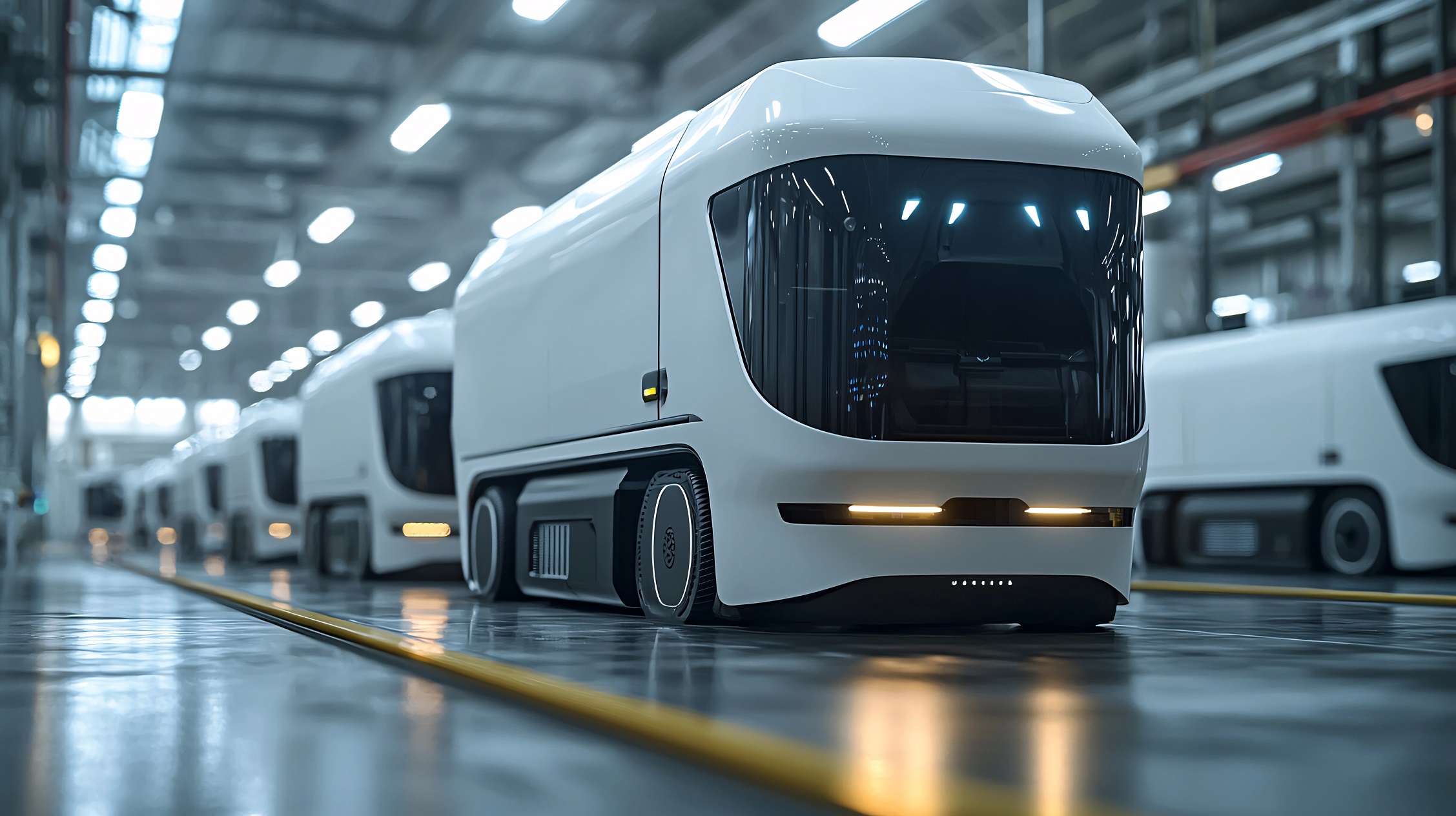
驭浪“十四五” 启航“十五五” 汽车供应链企业的新年心声
Zhong Guo Qi Che Bao Wang· 2026-01-09 01:13
Core Insights - The automotive industry is undergoing a significant transformation, with the supply chain demonstrating resilience and evolving from a follower to a leader in electric, intelligent, connected, and low-carbon technologies [2] - The "14th Five-Year Plan" period has seen various companies achieve notable advancements and innovations, setting the stage for the "15th Five-Year Plan" [3][4][5][6][8][9] Achievements and Experiences - Desay SV achieved a compound annual growth rate of 34% in R&D investment over the past five years, establishing 12 global R&D centers and successfully launching multiple innovative technologies [3] - MogoCar released the first deep understanding model, MogoMind, and secured a project for L4 autonomous buses in Singapore, marking international recognition of its technology [4] - Times Intelligent introduced an integrated intelligent chassis, achieving global-leading performance in energy management and safety [5] - Yuanrong Qixing delivered over 200,000 vehicles equipped with its urban NOA system, showcasing its mass production capabilities [6][7] - Pony.ai became one of the few companies to operate fully unmanned L4 Robotaxis, accumulating over 10 million kilometers of safe driving [8] - Baixinniu's L4 autonomous logistics vehicles are operational in over 170 cities, emphasizing the importance of understanding logistics scenarios for sustainable value creation [9] Challenges and Solutions - Desay SV faces challenges in integrating technology and brand value in diverse regional markets, implementing a "2+1+1" international organizational model to address this [10] - MogoCar's main challenge is adapting autonomous vehicles to complex urban environments, which it addresses by enhancing AI capabilities and real-time data integration [11] - Times Intelligent is working to establish trust in its innovative chassis technology amidst a lack of industry maturity [12] - Yuanrong Qixing focuses on the VLA model to handle complex urban scenarios, continuously optimizing its data collection and processing [13] - Pony.ai aims to overcome technical, policy, and market acceptance challenges through technology enhancement and collaboration [14] - Baixinniu has refined its logistics focus to address commercial viability and customer needs, establishing partnerships with major logistics companies [15] Technological Trends - Desay SV is focused on AI technology driving innovation in smart vehicles, anticipating 2025 as the year AI cockpit models will be widely adopted [17] - MogoCar emphasizes the scaling of L4 autonomous driving technology, particularly in public transport [18] - Times Intelligent is concentrating on L3 to L4 autonomous driving technology and integrated control systems [19] - Yuanrong Qixing is advancing the VLA model for enhanced understanding and reasoning in complex driving scenarios [20] - Pony.ai identifies AI as a key driver for industry development, leveraging advancements in integrated circuits and deep learning [21] - Baixinniu is focused on end-to-end architecture and world models for logistics vehicles, aiming for breakthroughs in safety and efficiency [22] Future Development Expectations - Desay SV plans to accelerate international market expansion and enhance user experience through technological innovation [23] - MogoCar aims to deepen AI model capabilities and expand its market presence, starting with Singapore [24] - Times Intelligent seeks to scale its products in passenger vehicles and promote international collaboration [24] - Yuanrong Qixing targets a cumulative delivery of 1 million vehicles by 2026, focusing on mass production of assisted driving [25] - Pony.ai aims for profitability while advancing core technology and industry collaboration [25] - Baixinniu anticipates significant growth in L4 autonomous logistics vehicles, aiming for a global market presence [25] Differentiated Competitive Advantage - Desay SV emphasizes an "open, full-stack, rapid realization" growth model to achieve resilient, high-quality growth [27] - MogoCar focuses on integrating AI capabilities with real-world data to adapt to complex urban scenarios [28] - Times Intelligent aims to build a high-barrier system capability through innovative technologies and a sustainable supply chain [28] - Yuanrong Qixing believes in a long-term, consistent technology roadmap combined with strong engineering and user understanding [29] - Pony.ai prioritizes continuous R&D investment to build a robust technological moat [30] - Baixinniu integrates various supply chain elements to create a comprehensive operational model for sustainable growth [31]

光庭信息:楷码信息是一家聚焦于汽车供应链、金融科技、医疗养老等行业的综合性的软件与信息技术服务商
Zheng Quan Ri Bao Zhi Sheng· 2026-01-07 14:12
Core Viewpoint - Guangting Information's acquisition of Kaima Information aligns with its international development strategy and aims to enhance its overseas market expansion, particularly in the automotive supply chain, fintech, and healthcare sectors [1] Group 1: Company Overview - Kaima Information is a comprehensive software and information technology service provider focused on industries such as automotive supply chain, fintech, and healthcare [1] - The company primarily offers software development testing and IT solutions to overseas clients, particularly in Japan [1] Group 2: Strategic Implications - The acquisition supports Guangting Information's strategy to accelerate its overseas market expansion, especially with strategic clients like Fengtong Information [1] - It provides a solid platform for exploring AI cross-industry empowerment, particularly in the fintech sector [1]
屏前千言万语,不如现场一见!2025中国汽车供应链大会,明天见
中汽协会数据· 2025-11-24 09:13
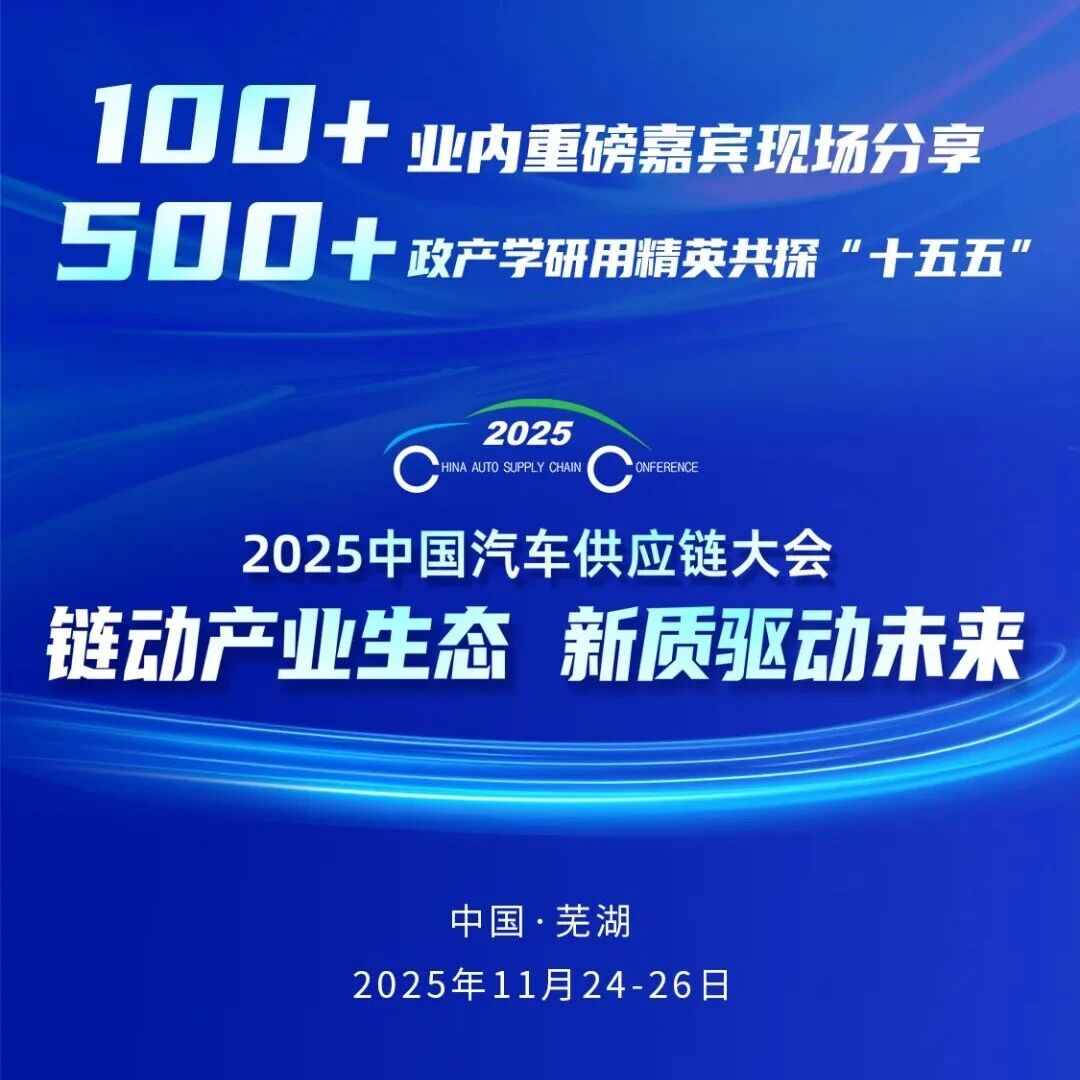
Core Viewpoint - The 2025 China Automotive Supply Chain Conference aims to explore the future of the automotive industry through collaboration among government, industry, academia, and research institutions, focusing on innovation and transformation in the supply chain [4][28]. Event Overview - The conference will take place from November 24 to 26, 2025, in Wuhu, China, featuring over 500 industry elites discussing the "14th Five-Year Plan" [2][4]. - The event includes various thematic meetings addressing key topics such as intelligent cockpit systems, automotive parts development, thermal management technologies, and intelligent chassis systems [10][15][21][29]. Thematic Meetings Intelligent Cockpit Systems - The first thematic meeting will cover the development and trends of intelligent cockpit systems, featuring presentations from industry leaders such as Chery Automobile and Beidou Zhihui Technology [12][13]. - Topics include AI's impact on cockpit systems, localization challenges for intelligent cockpit exports, and innovations in cockpit connectivity solutions [12][13]. Automotive Parts Development and Transformation - The second thematic meeting will focus on the evolution of automotive parts under the dual trends of intelligence and electrification, with insights from companies like CRRC and JD Group [19][20]. - Discussions will include the transformation paths for core automotive components and the integration of supply chains [19][20]. Thermal Management Technologies - The third thematic meeting will address key technologies in automotive thermal systems, featuring research from universities and companies on CO2 thermal management systems and alternative refrigerants [24][26]. - Presentations will cover challenges in developing thermal management systems and innovations in heat exchange technologies [24][26]. Intelligent Chassis Systems - The fourth thematic meeting will explore the collaborative development of intelligent chassis systems, with discussions on software-defined chassis solutions and key technologies in steering systems [30][32]. - Industry experts will share insights on the future of chassis technology and its integration with intelligent systems [30][32].

专家在智能新能源汽车供应链创新大会上表示:中国在全球汽车供应链中的地位加速提升
Ke Ji Ri Bao· 2025-11-23 12:10
Core Insights - China's role in the global automotive supply chain is becoming increasingly prominent, particularly in key component areas where it has become the center of global incremental automotive supply chains [1] - China's battery installation volume accounts for nearly 70% of the global total, maintaining a leading position for several consecutive years [1] - The automotive industry is undergoing unprecedented transformation, with a focus on reconstructing an open, shared, and resilient supply chain system [1] Group 1: Supply Chain Dynamics - The competition in the automotive industry fundamentally revolves around the supply chain system, with the strength of the industry being dependent on the robustness of components and the industrial ecosystem [1] - NIO emphasizes that technological innovation is essential for building core competitiveness and creating a true moat, collaborating with partners to tackle key technologies [2] - The automotive supply chain is facing challenges from shortened development cycles and demand fluctuations, with NIO having 17 partners in Huainan to reduce overall costs by 20%-30% [2] Group 2: Key Areas of Competition - Key areas of competition in the automotive supply chain include power batteries, chips, and software, which are critical for ensuring supply chain security [2] - Despite China's scale advantage in the power battery sector, challenges arise from upstream resource monopolies and rapid technological iterations [2] - The Chinese automotive chip industry is rapidly emerging, with companies like Horizon and Huawei becoming significant players, although the localization of many small chips needs to accelerate [2] Group 3: Future Outlook - The automotive supply chain is expected to evolve towards high-end, intelligent, green, and integrated directions, referred to as the "new four modernizations" [3] - By the end of the 14th Five-Year Plan, China's annual automotive production is projected to reach 40 million units, with domestic sales around 27-28 million units and overseas sales exceeding 12 million units, accounting for approximately 45% of the global total [3] - The proportion of Chinese components used in vehicles, referred to as "Chinese content," is expected to continuously increase, regardless of the vehicle's production location [3]
下周关注丨摩尔线程11月24日启动申购,这些投资机会最靠谱
Di Yi Cai Jing· 2025-11-23 01:37
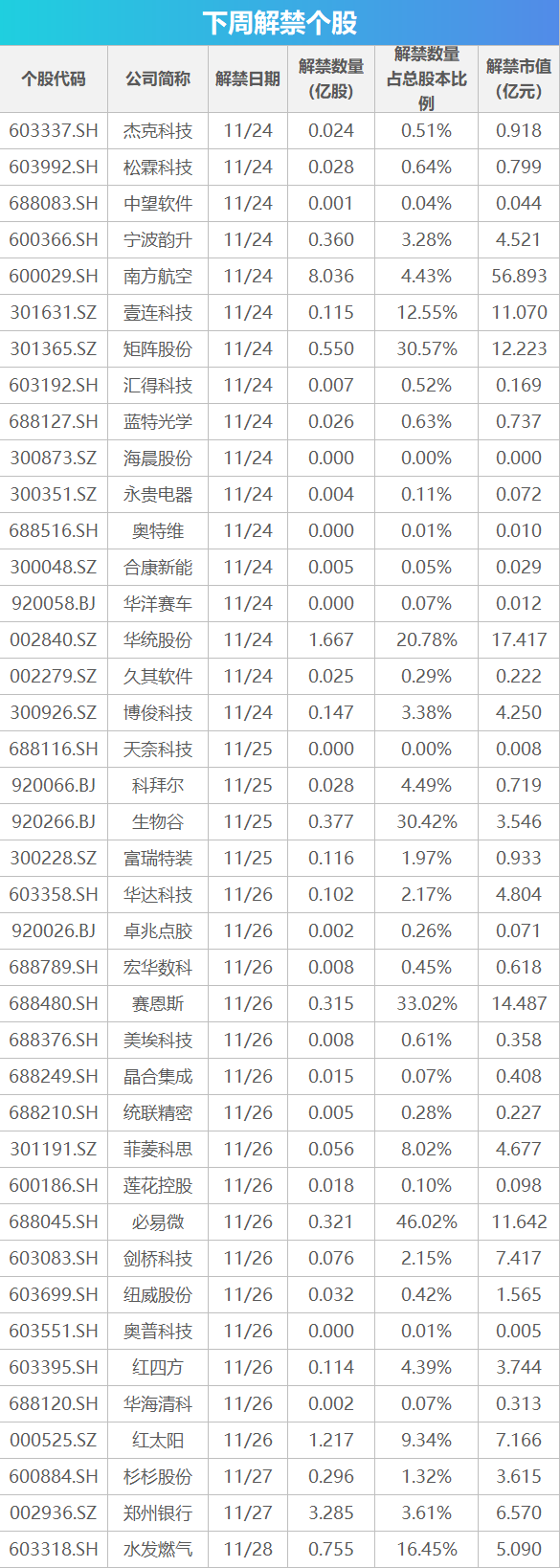
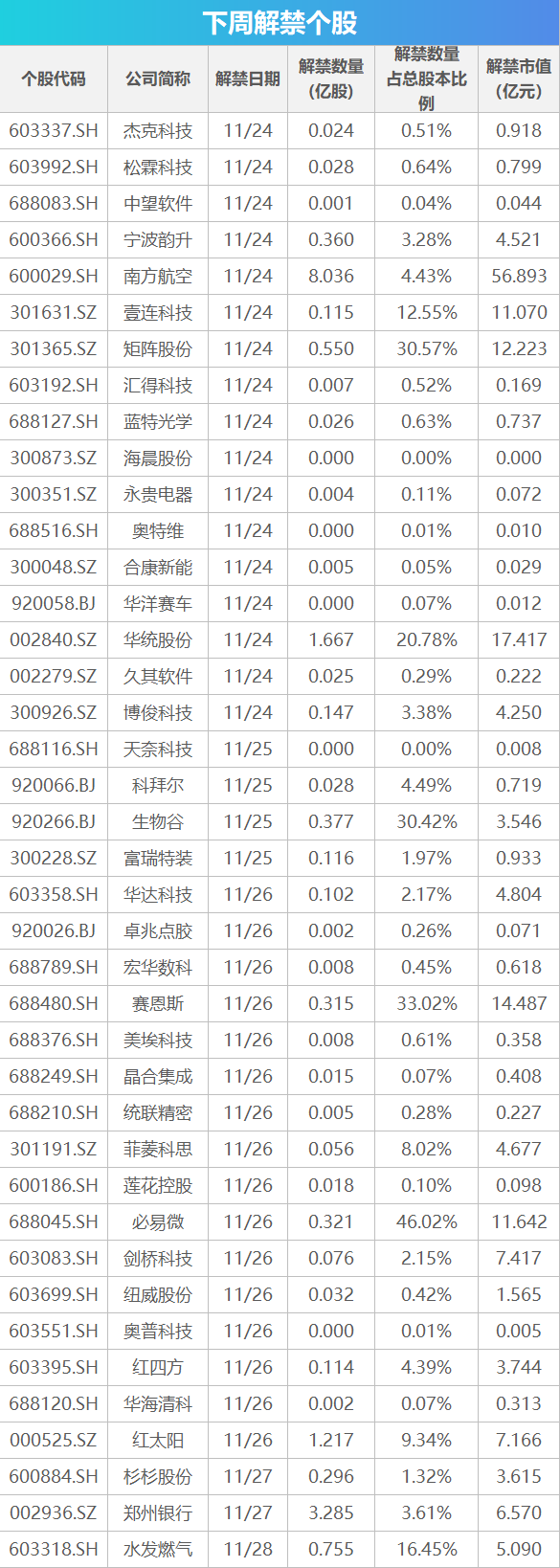
Group 1 - The domestic gasoline and diesel prices are expected to decrease by 50 yuan per ton due to a change in the average price of crude oil, which is currently at 61.83 USD per barrel with a change rate of -0.97% [1] Group 2 - MSCI announced the inclusion of 17 new stocks and the removal of 16 stocks from the MSCI China A-share Index, effective after the market closes on November 24, 2025 [2] Group 3 - Huawei is set to hold a product launch event on November 25, 2023, featuring the Mate 80 series, which includes four models: Mate 80, Mate 80 Pro, Mate 80 Pro Max, and Mate 80 RS [3] Group 4 - The 2025 China Automotive Supply Chain Conference will take place from November 24 to 26, 2025, in Wuhu, focusing on the theme "Chain Driving New Quality of Industrial Ecology" [4] Group 5 - Over 200 billion yuan worth of restricted shares will be unlocked next week, with Southern Airlines leading the way at 56.89 billion yuan [5] - The peak unlocking date is November 24, with significant unlocks from Southern Airlines (56.89 billion yuan), Huadong Holdings (17.42 billion yuan), and Sains (14.49 billion yuan) [5] Group 6 - Two new stocks will be issued next week: Moer Thread on November 24 at an issue price of 114.28 yuan per share, and Bai Ao Sai Tu on November 28 [7][8]


下周关注丨华为全场景新品发布会即将召开,这些投资机会最靠谱
Di Yi Cai Jing· 2025-11-23 01:20
Group 1 - The domestic gasoline and diesel prices are expected to decrease by 50 yuan per ton due to a change in the average price of crude oil, which is currently at 61.83 USD per barrel with a change rate of -0.97% [1] - MSCI announced the inclusion of 17 new stocks and the removal of 16 stocks from the MSCI China A-share index, effective after the market closes on November 24, 2025 [2] - Huawei is set to hold a product launch event for the Mate 80 series and other products on November 25, 2023, featuring four models: Mate 80, Mate 80 Pro, Mate 80 Pro Max, and Mate 80 RS [3] Group 2 - Over 200 billion yuan worth of restricted shares will be unlocked next week, with Southern Airlines leading the list at 56.89 billion yuan, followed by Huadong Holdings at 17.42 billion yuan and Sains at 14.49 billion yuan [5] - The peak of share unlocks will occur on November 24, 2023, with 40 companies having their restricted shares released [5][6][7] Group 3 - Two new stocks are set to be issued next week: Moer Thread on November 24 at an issue price of 114.28 yuan per share, and Bai Ao Sai Tu on November 28 [8][9]
中国汽车工业协会:2025中国汽车供应链大会将于11月24日-26日在芜湖市召开
Jing Ji Guan Cha Wang· 2025-11-06 01:55
Core Insights - The China Automotive Industry Association announced the "2025 China Automotive Supply Chain Conference" scheduled for November 24-26, 2025, in Wuhu City, with the theme "Driving Future with New Quality of Industrial Ecosystem" [1] Industry Summary - The conference aims to address the evolving dynamics of the automotive supply chain and its impact on the industry [1] - The event will serve as a platform for industry stakeholders to discuss innovations and strategies for enhancing the automotive supply chain [1]