
生成式人工智能

Search documents
去年全国新设经营主体2574.5万户
Xin Lang Cai Jing· 2026-02-27 07:05
Core Insights - The article highlights the significant growth in new business entities in China, with a total of 25.745 million new entities expected to be established by 2025, including 9.5 million new enterprises and 16.194 million new individual businesses [1] Group 1: New Business Entities - By 2025, the total number of new business entities in China is projected to reach 25.745 million, comprising 9.5 million new enterprises and 16.194 million individual businesses [1] - The trend indicates a shift towards new and high-quality development, contributing to the momentum for high-quality growth [1] Group 2: Emerging and Future Industries - There is a rapid increase in companies related to the "8 major emerging industries + 9 major future industries," with 1.134 million new entities established in 2025, marking a 9.9% increase from the previous year [1] - Notable growth is observed in cutting-edge fields such as humanoid robots, civil aviation, and generative artificial intelligence, which are leading the growth rates [1] Group 3: Consumer Sector - The consumer sector shows significant promise, driven by a robust domestic market that fosters new consumption scenarios [1] - In 2025, the number of entities related to "smart consumer device manufacturing" is expected to reach 78,000, with 5,000 new entities established [1] - The cultural tourism industry is projected to see 3.302 million new related enterprises in 2025, reflecting a 12.2% increase from the previous year [1] - The "silver economy" sector is also experiencing high growth, with 68,000 new related enterprises expected in 2025, representing a 17.1% increase [1]
新兴产业和未来产业相关企业增长迅猛 全国经营主体发展向新向优
Ren Min Ri Bao Hai Wai Ban· 2026-02-27 06:23
Group 1 - The core viewpoint of the articles highlights the significant growth in new business entities in China, with a total of 25.745 million new entities expected by 2025, including 9.5 million new enterprises and 16.194 million new individual businesses, indicating a trend towards high-quality development [1] - The emergence of new and future industries is accelerating, with 1.134 million new enterprises related to the "8 new emerging industries + 9 future industries" projected for 2025, reflecting a 9.9% increase from the previous year [1] - Key sectors such as humanoid robots, civil aviation, and generative artificial intelligence are experiencing notable growth, contributing to China's advancement in the global value chain [1] Group 2 - The consumer sector is showing remarkable highlights, with new supply creating new demand; for instance, the "smart consumer device manufacturing" sector is expected to grow to 78,000 entities, with 5,000 new establishments in 2025 [2] - The cultural tourism industry is projected to see 3.302 million new enterprises, marking a 12.2% increase year-on-year, driven by enhanced consumer experiences [2] - The "silver economy" is also expanding, with 68,000 new enterprises expected in 2025, reflecting a 17.1% growth, driven by aging population needs [2] Group 3 - The market regulatory authority emphasizes the need to focus on the development demands of business entities, aiming to improve market access and exit systems, and enhance the overall market environment to stimulate business vitality [3]
全国经营主体发展向新向优
Ren Min Ri Bao Hai Wai Ban· 2026-02-27 05:47
Group 1 - The core viewpoint of the articles highlights the significant growth in new business entities in China, with a total of 25.745 million new entities expected by 2025, including 9.5 million new enterprises and 16.194 million new individual businesses, indicating a trend towards high-quality development [1] - The emergence of new and future industries is driving rapid growth, with 1.134 million new enterprises related to "8 major emerging industries + 9 major future industries" expected by 2025, reflecting a 9.9% increase from the previous year [1] - Key sectors such as humanoid robots, civil aviation, and generative artificial intelligence are experiencing notable growth, contributing to the advancement of China's industrial system towards a higher position in the global value chain [1] Group 2 - The consumer sector is showing remarkable highlights, with new supply creating new demand; for instance, the "smart consumer device manufacturing" sector is expected to grow to 78,000 entities, with 5,000 new entities established [2] - The cultural tourism industry is also thriving, with 3.302 million new enterprises expected by 2025, marking a 12.2% increase from the previous year [2] - The "silver economy" is driving industry upgrades, with 68,000 new enterprises expected in this sector, reflecting a 17.1% growth [2] Group 3 - The quality of entrepreneurial talent remains stable, with a notable increase in young entrepreneurs in traditional sectors, particularly in wholesale and retail, reaching 1.729 million by the end of 2025, an 8.4% increase from 2021 [2] - Young entrepreneurs continue to dominate emerging fields, with 213,000 in scientific research and technical services and 526,000 in culture, sports, and entertainment [2] - The rapid growth of internet-based business entities is evident, with significant increases in new live-streaming enterprises and individual businesses expected by 2025 [2] Group 4 - The market regulatory authority emphasizes the need to focus on the development needs of business entities, aiming to improve market access and exit systems, and enhance the unified national market construction [3] - Efforts will be made to maintain a fair competitive market environment and optimize government services related to enterprises, further stimulating the vitality of various business entities [3]
发展向新向优!2025年全国新设经营主体2574.5万户
Zheng Quan Ri Bao Wang· 2026-02-26 12:17
Group 1 - The core viewpoint of the articles highlights the significant growth in new business entities in China, with a total of 25.745 million new entities expected by 2025, including 9.5 million new enterprises and 16.194 million new individual businesses, indicating a trend towards high-quality development [1] - Emerging and future industries are experiencing rapid growth, with 1.134 million new enterprises related to the "8 major emerging industries + 9 major future industries," representing a 9.9% increase from the previous year, particularly in fields like humanoid robots, civil aviation, and generative artificial intelligence [1] - The consumer sector shows notable growth, driven by strong domestic market demand, with new supply creating new demand; for instance, the "smart consumer device manufacturing" sector saw a total of 78,000 new entities, with 5,000 newly established [1] Group 2 - The scale of high-quality entrepreneurial talent remains stable, with an increase in youth entrepreneurs in traditional sectors, particularly in wholesale and retail, reaching 1.729 million by the end of 2025, an 8.4% increase from 2021 [2] - Youth entrepreneurs continue to dominate emerging fields, with 213,000 in scientific research and technical services and 526,000 in culture, sports, and entertainment [2] - The market regulatory authorities are focusing on the development needs of business entities, aiming to improve market access and exit systems, promote a unified national market, and enhance government services related to enterprises to stimulate the vitality of various business entities [2]
市场监管总局:2025年全国新设经营主体2574.5万户 发展态势向新向优
智通财经网· 2026-02-26 07:53
Core Insights - The total number of newly established business entities in China is projected to reach 25.745 million by 2025, including 9.5 million new enterprises and 16.194 million new individual businesses, indicating a trend towards quality development in the market [2][4]. Group 1: Emerging and Future Industries - The number of new enterprises related to the "8 emerging industries + 9 future industries" is expected to be 1.134 million, representing a 9.9% increase from the previous year, with significant growth in sectors such as humanoid robots, civil aviation, and generative artificial intelligence [3][4]. - The rapid growth in emerging industries is contributing to the advancement of China's industrial system towards a higher end of the global value chain [3]. Group 2: Consumer Sector Highlights - The consumer sector is experiencing notable growth, driven by strong domestic market demand, with new supply creating new demand. The number of new business entities in "intelligent consumer device manufacturing" is projected to reach 78,000, with an increase of 5,000 new entities [4]. - The cultural tourism industry is also thriving, with 3.302 million new related enterprises established in 2025, marking a 12.2% increase from the previous year [4]. - The "silver economy" is expanding, with 68,000 new enterprises related to aging population needs, reflecting a 17.1% growth, indicating a sustained high growth rate in this sector [4]. Group 3: Entrepreneurial Landscape - The scale of high-quality entrepreneurial talent remains stable, with a notable increase in young entrepreneurs in traditional sectors, particularly in wholesale and retail, which reached 1.729 million, an 8.4% increase from 2021 [5]. - Young entrepreneurs continue to dominate emerging fields, with 213,000 in scientific research and technical services and 526,000 in culture, sports, and entertainment [5]. - The growth of internet-based business models is evident, with a rapid increase in newly established live-streaming enterprises and individual businesses by 2025 [5]. Group 4: Regulatory Environment - Regulatory authorities are focusing on the development needs of business entities, aiming to improve market access and exit systems, promote a unified national market, and maintain a fair competitive environment [5].
新型储能纳入政府投资基金投向!国家首次作出系统规范
中关村储能产业技术联盟· 2026-01-13 12:15
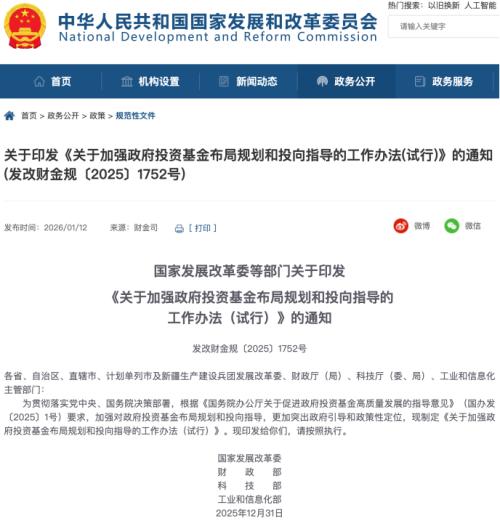
Core Viewpoint - The article discusses the implementation of a new regulatory framework for government investment funds in China, aimed at optimizing their layout and guiding investment directions to support national strategies and industrial upgrades [2][3][4]. Group 1: Government Investment Fund Overview - Government investment funds are established by various levels of government to guide social capital in supporting industry development and innovation through market-oriented methods such as equity investment [2][12]. - The new framework includes a systematic approach to fund layout and investment direction, marking the first national-level regulation of government investment funds [2][4]. Group 2: Supported Investment Areas - The framework identifies key investment areas, including: - Emerging and future industries such as information technology, new energy, advanced manufacturing, and artificial intelligence [2][3]. - Upgrading traditional industries and supporting high-quality development in manufacturing [3][4]. - Promoting the digital economy through initiatives like "AI+" and the application of 5G technology [3][4]. Group 3: Policy Measures - The framework outlines 14 policy measures focusing on three main aspects: where to invest, how to invest, and who manages the funds [3][4]. - It emphasizes early, small, long-term investments in hard technology and aims to prevent homogeneous competition and crowding out of social capital [11][12]. Group 4: Evaluation Management - An evaluation management method has been established to assess the investment direction of government funds, focusing on compliance with national planning and industry directories [4][5]. - The evaluation system includes three main indicators: policy compliance (60% weight), optimization of productivity layout (30% weight), and policy execution capability (10% weight) [6][7]. Group 5: Specific Evaluation Indicators - The evaluation indicators cover aspects such as support for new productivity, technology innovation, green development, and the promotion of private investment [29][33]. - Specific metrics include the proportion of investments in encouraged industries, the effectiveness of fund management, and the impact on social welfare [29][33][40].


重磅利好!万亿级“国家队”投向明确了
Zhong Guo Jing Ji Wang· 2026-01-13 02:32
Core Viewpoint - The Chinese government has established a systematic framework for the development and direction of government investment funds, marking the first time such guidelines have been issued at the national level [1]. Group 1: Policy Framework - The "Work Method" outlines three main aspects: where to invest, how to invest, and who manages the funds, proposing 14 policy measures [3]. - The framework emphasizes supporting major strategies and key areas, particularly in sectors where market resources are insufficient, promoting deep integration of technological and industrial innovation, and focusing on nurturing emerging pillar industries [3]. Group 2: Investment Guidance - Funds must align with national major plans and encourage industries listed in the national industrial directory, while avoiding investments in restricted, eliminated, or prohibited sectors [3]. - Provincial development and reform departments are tasked with creating lists of key investment areas to optimize fund allocation [3]. Group 3: Evaluation Metrics - The "Management Method" establishes three primary indicators: 1. Policy compliance (60% weight), assessing the fund's role in supporting new productive forces, technological innovation, and green development [4]. 2. Optimization of productive layout (30% weight), evaluating alignment with national regional strategies and effective capacity utilization [5]. 3. Policy execution capability (10% weight), focusing on fund efficiency and the professional level of fund managers [5]. Group 4: Focus Areas - The investment focus includes emerging industries such as next-generation information technology, new energy, high-end equipment, and green technology, as well as future industries like the metaverse, brain-computer interfaces, and generative artificial intelligence [5].
前11月“8+9”相关产业新设企业超百万户
Xin Lang Cai Jing· 2025-12-29 19:18
Core Insights - The "8+9" related industries in China have shown sustained growth in vitality, with a total of 1.01 million new enterprises established from January to November this year, representing a 9% increase compared to the same period last year [1][2] - The "8 emerging industries," including new generation information technology, high-end equipment manufacturing, and new materials, saw 775,000 new enterprises established, a 2.6% year-on-year increase, continuing to play a foundational role [1] - The "9 future industries," represented by future health, future intelligence, and future energy, performed exceptionally well with 283,000 new enterprises established, marking a significant 35.8% year-on-year growth, indicating substantial development potential and growth momentum [1] Industry Performance - In specific sectors, certain cutting-edge fields experienced explosive growth, with the "generative artificial intelligence" sector seeing new enterprise numbers increase by over 29 times; the "civil aviation" sector followed closely with a growth rate of 108.3%; and the "humanoid robotics" sector also showed strong activity with a 48.9% year-on-year increase [1] - These three sectors have emerged as leaders in driving growth within future industries [1] Strategic Implications - The proportion of high-tech and strategic emerging industry enterprises represented by the "8+9" industries continues to rise, facilitating the transition of Chinese enterprises towards new and stronger developments, and further advancing the country's industrial system towards the mid-to-high end of the global value chain [2] - The ongoing improvement of supporting policies and strong market demand is expected to sustain the positive development momentum of these industries [2]
新兴产业动能强劲!“8+9”相关产业新设企业超百万户
Zheng Quan Ri Bao Wang· 2025-12-26 13:12
Core Insights - The "8+9" related industries in China have shown sustained vitality in 2023, with a rapid growth in the establishment of new enterprises, totaling 1.01 million from January to November, representing a 9.0% increase year-on-year [1] - The "8 major emerging industries" saw the establishment of 775,000 new enterprises, a 2.6% year-on-year increase, while the "9 major future industries" experienced a significant growth of 35.8%, with 283,000 new enterprises established [1] - Notable sectors such as "generative artificial intelligence," "civil aviation," and "humanoid robots" have exhibited explosive growth, with new enterprise numbers increasing by over 29 times, 108.3%, and 48.9% respectively [1] Industry Trends - The proportion of high-tech and strategic emerging industry enterprises represented by the "8+9" industries is continuously increasing, driving the development of Chinese enterprises towards higher quality and stronger capabilities [2] - The ongoing improvement of supporting policies and strong market demand is expected to sustain the positive development momentum of these industries [2]
中国国家市场监管总局:新兴产业动能强劲
Xin Lang Cai Jing· 2025-12-26 12:57
Core Insights - The "8+9" related industries in China have shown sustained vitality in development, with a rapid growth in the establishment of new enterprises throughout the year [1][2] - From January to November, a total of 1.01 million new enterprises were established in the "8+9" related industries, representing a 9.0% increase compared to the same period last year [1] Group 1: Emerging and Future Industries - The "8 major emerging industries," including new generation information technology, high-end equipment manufacturing, and new materials, saw the establishment of 775,000 related enterprises, a year-on-year increase of 2.6% [1] - The "9 major future industries," represented by future health, future intelligence, and future energy, performed exceptionally well with 283,000 new enterprises established, marking a significant year-on-year growth of 35.8% [1] Group 2: Explosive Growth in Specific Sectors - Certain cutting-edge fields have experienced explosive growth, with the "generative artificial intelligence" sector seeing a staggering increase in new enterprises by over 29 times year-on-year [1] - The "civil aviation" sector followed closely with a growth rate of 108.3% [1] - The "humanoid robotics" sector also showed strong performance, with a year-on-year increase of 48.9% [1] Group 3: Strategic Implications - The increasing proportion of high-tech and strategic emerging industry enterprises is driving Chinese companies towards innovation and strength, further pushing the industrial system towards the mid-to-high end of the global value chain [2] - The continued improvement of supporting policies and strong market demand is expected to sustain the positive development momentum of these industries [2]