
电子特气

Search documents
2026年中国高纯三氯化硼行业产业链、市场规模及发展趋势研判:先进制程驱动行业开展“纯度”竞赛,攻克合成与痕量杂质核心技术成行业决胜关键[图]
Chan Ye Xin Xi Wang· 2026-02-07 01:32
Industry Overview - The high-purity boron trichloride (BCl₃) industry in China is at a critical development stage characterized by domestic substitution and industrial upgrading. The market size is projected to reach 3.222 billion yuan in 2024, representing a year-on-year growth of 6.72% [1][7] - The purity requirements for gases in advanced semiconductor processes have evolved from 5N to 5N5, 6N, and even higher levels, necessitating continuous advancements in core technologies such as anhydrous synthesis and trace impurity analysis and removal [1][7] Industry Chain - The upstream of the high-purity boron trichloride industry includes raw materials such as boron ore, chlorine gas, catalysts, adsorbents, organic solvents, and inert gases, along with production equipment like high-temperature reactors and distillation towers. The midstream involves the manufacturing of high-purity boron trichloride, while the downstream applications span semiconductor, display panels, photovoltaics, quantum computing, and new energy batteries [4] - In 2024, China's boron ore production is expected to be approximately 340,000 tons, reflecting a year-on-year increase of 13.33%. The production of high-purity boron trichloride relies on industrial-grade boron trichloride, which is derived from the reaction of boron compounds with chlorine gas [5] Market Size - The high-purity boron trichloride industry is experiencing a dual focus on domestic substitution and industrial upgrading. The market size is anticipated to reach 3.222 billion yuan in 2024, with a growth rate of 6.72% compared to the previous year [1][7] - The increasing demand for high-purity gases in semiconductor manufacturing processes is driving stable and rigid demand for high-purity boron trichloride, as it is essential for dry etching and ion implantation processes [7] Key Companies' Performance - Domestic companies like Dalian Kolid have achieved industrialization of 6.5N grade (99.99995% purity) products, which are successfully applied in advanced processes such as 12-inch 3nm technology, positioning them as key players in domestic substitution [8][9] - China Shipbuilding (Handan) Parit Special Gases Co., Ltd. reported a revenue of 1.607 billion yuan in the first three quarters of 2025, marking a year-on-year increase of 14.90%, with a net profit of 245 million yuan, up 3.98% [8] - Hubei Heyuan Gas Co., Ltd. reported a revenue of 1.232 billion yuan in the first three quarters of 2025, reflecting a year-on-year growth of 3.32%, while its net profit decreased by 1.86% to 58 million yuan [8] Competitive Landscape - The technical barriers in the high-purity boron trichloride market are continuously rising, with purity and stability becoming critical competitive factors. Companies must overcome challenges related to trace impurity analysis and removal to meet the increasing purity demands of advanced semiconductor processes [9] - Leading companies are adopting a dual strategy of vertical integration and horizontal expansion to enhance customer loyalty and adapt to complex market demands. This includes extending their capabilities in synthesis and purification technologies while diversifying into high-end product categories [10] - The market concentration is accelerating amid the domestic substitution trend, with a shift in market share towards a few technologically advanced leading companies. This consolidation is expected to result in a clear stratification of the market, with a few domestic leaders dominating the high-end market while smaller firms focus on niche segments [11]



华特气体:公司将会把德瑞科技的氟化气体产品全面纳入整个华特气体的电子气体业务体系
Zheng Quan Ri Bao Wang· 2026-02-06 13:41
Group 1 - The core viewpoint of the article is that Huate Gas's acquisition of Derui Technology enhances its product matrix and strengthens its leading position in the electronic specialty gas industry [1] - The company plans to fully integrate Derui Technology's fluorinated gas products into its electronic gas business system, leveraging its strong quality management system and marketing network [1] - The focus will be on accelerating the application promotion of products such as CLF3, B2H6, and SF4 in key downstream sectors like integrated circuits and pharmaceutical intermediates [1] Group 2 - The company aims to achieve deep collaboration and efficient empowerment in R&D, production, logistics, and management to expedite the transformation and industrialization of electronic-grade fluorinated gas technology [1] - There are uncertainties regarding the potential integration effects and synergy not meeting expectations, as well as risks related to future market development and goodwill impairment [1]

2026年中国四氟化碳行业理化性质、市场规模、重点企业及发展趋势分析:高纯替代与新兴领域需求双轮驱动,行业进入国产替代关键窗口期[图]
Chan Ye Xin Xi Wang· 2026-02-04 01:30
Industry Overview - The Chinese tetrafluoromethane (CF₄) industry is currently undergoing a phase of technological upgrades and market expansion, with a projected market size of approximately 2.079 billion yuan in 2024, representing a year-on-year growth of 7.44% [1][7] - The domestic low-temperature distillation-adsorption coupling process is maturing, improving the first-pass yield of 6N-grade products and narrowing the technology gap with international giants to a single purity level, laying a solid foundation for domestic substitution [1][7] - The demand for high-purity CF₄ is rapidly increasing due to the continuous expansion of downstream emerging industries such as semiconductors, photovoltaics, and panels [1][7] Industry Chain - The upstream of the CF₄ industry chain includes raw materials such as hydrofluoric acid, methanol, fluorine gas, carbon sources, and electricity, as well as production equipment like fluorocarbon reactors and distillation towers [4] - The midstream involves the production and manufacturing of CF₄, while the downstream applications are primarily in semiconductor, flat panel display, photovoltaic, and optical fiber manufacturing processes [4] Market Dynamics - The price of hydrofluoric acid, a core raw material for CF₄ production, is expected to reach 11,873 yuan per ton by the end of 2025, reflecting an increase of 8.87% year-on-year, driven by tightening supply and mining policies [5] - The production capacity of integrated circuits in China is projected to reach approximately 484.3 billion pieces by 2025, with a year-on-year growth of 7.28%, which will drive the demand for electronic-grade CF₄ in etching and wafer cleaning processes [7] Key Enterprises - The competitive landscape of the CF₄ industry is characterized by a concentration of leading firms driven by technology, with companies like Kemet, Fujian Del Technology, and Huate Gas rapidly emerging [8] - Huate Gas, established in 1999, has achieved high-purity CF₄ mass production and has been certified by major semiconductor clients, covering top global semiconductor companies [9] - Fujian Yongjing Technology, founded in 2007, focuses on fluorochemical production and has a capacity of 600 tons/year, utilizing advanced purification technologies [10] Future Trends - The growth of the CF₄ industry is primarily driven by the semiconductor and photovoltaic sectors, with increasing purity requirements pushing CF₄ products from mainstream 5N (99.999%) to 6N and beyond [12] - The competition in the industry is shifting towards a concentration of leading firms, with a focus on technological and capital advantages, as smaller firms face significant survival challenges [13] - Environmental regulations are expected to drive technological innovations in the industry, with a focus on green production processes and the development of efficient end-of-pipe treatment and recycling technologies [14]


黄渤海新区高纯乙硅烷实现自主量产
Da Zhong Ri Bao· 2026-01-28 02:03
Core Insights - Yantai Wanhua Electronic Materials Co., Ltd. has achieved large-scale and stable production of high-purity silane, marking a significant advancement in China's high-end electronic specialty gases sector [1][2] - The production of silane, a critical material for advanced processes below 14nm, has historically relied on imports, highlighting the importance of this development for domestic semiconductor manufacturing [1] - The company has developed a proprietary magnesium silicide method that stabilizes the silane synthesis rate above 30%, with product purity exceeding 99.998% (4.8N) [1] Company Developments - Wanhua Electronic Materials aims to establish a one-stop service platform while continuing to focus on silane and expand into electronic specialty gases, contributing to the growth of China's semiconductor industry [2] - The company has built the largest single production capacity facility for silane globally, reinforcing its technological leadership in the domestic electronic specialty gas industry [1][2] Industry Context - The advancement in silane production is seen as a crucial step in addressing bottlenecks within the semiconductor supply chain, showcasing a successful integration of technology, industry, and market [2] - The demand for high-purity silane is expected to grow due to its advantages in deposition temperature, rate, and film quality, making it a core material for advanced chip structures like 3D NAND and FinFET [2] - The Yantai Yellow Bohai Sea New Area has prioritized the development of specialty semiconductors as a strategic emerging industry, focusing on optoelectronic and power semiconductors to create a complete industrial chain [2]
半导体材料:电子特气的国产替代(附77页PPT)
材料汇· 2026-01-10 15:49
Core Viewpoint - The article discusses the industrial gas sector, focusing on the classification, applications, and market dynamics of bulk gases and specialty gases, particularly in the semiconductor industry, highlighting the increasing demand for high-purity electronic gases and the challenges faced by domestic companies in achieving technological advancements and market competitiveness [7][10][39]. Group 1: Industrial Gas Classification - Industrial gases are categorized into bulk gases and specialty gases based on purity and usage. Bulk gases are used in large quantities with purity levels less than or equal to 99.99% (4N), while specialty gases are used in specific applications requiring higher purity [7][9]. - Bulk gases include air separation gases (oxygen, nitrogen, hydrogen) and synthetic gases (acetylene, carbon dioxide), which are essential in various industries such as metallurgy, chemical, and food processing [9][10]. Group 2: Applications of Specialty Gases - Specialty gases are critical in semiconductor manufacturing, particularly in processes like chemical vapor deposition (CVD), etching, and cleaning, where high purity and stability are paramount [12][16]. - The semiconductor industry accounts for 71% of the global demand for electronic specialty gases, with domestic demand in China at 42%, indicating a significant growth opportunity as the industry evolves [40][41]. Group 3: Market Dynamics and Challenges - The electronic specialty gas market is characterized by high entry barriers due to technological, certification, and qualification requirements, making it a capital-intensive and technically demanding industry [20][34]. - Domestic companies are actively pursuing research and development to achieve technological breakthroughs and reduce reliance on foreign suppliers, as many electronic specialty gases are still imported [23][39]. Group 4: Purity and Quality Requirements - The purity of specialty gases is a critical parameter, with requirements often reaching 5N to 6N (99.999% to 99.9999%), which significantly impacts the yield and performance of semiconductor products [25][32]. - The production process for high-purity gases involves complex techniques such as distillation and adsorption, which require advanced technology and expertise [27][29]. Group 5: Customer Relationships and Certification - The certification process for electronic specialty gases is lengthy, with strong customer loyalty due to the critical nature of these gases in production processes, leading to high switching costs for suppliers [30][33]. - Companies must navigate strict regulatory requirements and obtain various certifications to operate in the industrial gas sector, which adds to the complexity of market entry [35][36].
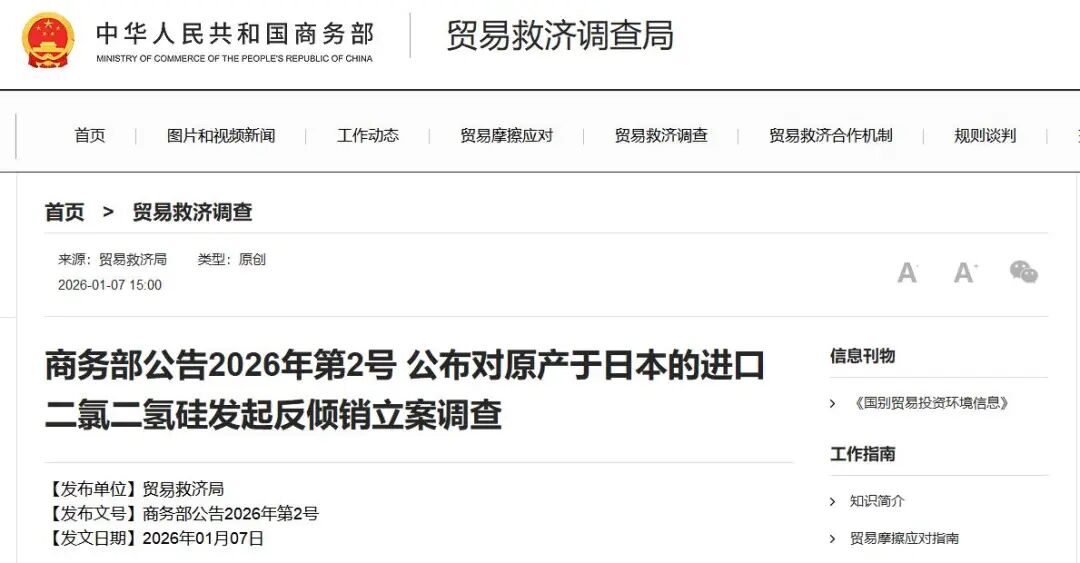
对日二氯二氢硅反倾销立案!国产电子特气迎来拐点 三孚股份、金宏气体站上风口
Xin Lang Cai Jing· 2026-01-08 11:36
Core Viewpoint - The Ministry of Commerce of China has initiated an anti-dumping investigation into imports of dichlorosilane from Japan, which is expected to impact the domestic market and local manufacturers significantly [6][3]. Group 1: Investigation Details - The anti-dumping investigation period is set from July 1, 2024, to June 30, 2025, with the damage investigation period from January 1, 2022, to June 30, 2025 [6][3]. - The investigation officially commenced on January 7, 2026, and is expected to conclude by January 7, 2027, with a possible extension of six months under special circumstances [6][3]. Group 2: Market Impact - The quantity of dichlorosilane imported from Japan has been increasing, while prices have dropped by 31% from 2022 to 2024, leading to a decline in domestic manufacturers' capacity utilization from 82% to 61% [3][7]. - If dumping is confirmed, it may lead to anti-dumping duties, increasing import costs and narrowing the price gap with domestic products, which would benefit local companies [9][4]. Group 3: Domestic Production Capacity - China's total production capacity for dichlorosilane is approximately 190,000 tons per year, with 150,000 tons for industrial grade and 40,000 tons for electronic grade [8][4]. - Major players in the market include: - Hoshine Silicon Industry: 125,000 tons total capacity [9] - Xin'an Chemical: 20,000 tons electronic grade capacity [9] - Yake Technology: 5,200 tons electronic grade capacity [9] - Sanfu Technology: 5,000 tons electronic grade capacity [9] - Dongyue Group: 15,000 tons combined capacity [9]. Group 4: Market Growth Projections - The market size for dichlorosilane in China is projected to reach 2.58 billion yuan in 2024, with an expected compound annual growth rate of 12.3% from 2025 to 2030, potentially exceeding 5 billion yuan by 2030 [9][4]. - The anti-dumping investigation is anticipated to accelerate the domestic production of electronic grade dichlorosilane, with the localization rate expected to rise from 32% in 2027 to over 45% [9][4].


A股异动丨电子特气概念股走强 三孚股份、和远气体涨停
Ge Long Hui A P P· 2026-01-08 06:57
Core Viewpoint - The Ministry of Commerce has announced an anti-dumping investigation into imported dichlorodihydrosilane from Japan, which has led to significant stock price increases for several gas companies in China, indicating a potential shift in the market dynamics for semiconductor materials [1] Group 1: Market Reaction - Stocks of Sanfu Co., He Yuan Gas, and Jin Hong Gas have hit the daily limit, with Jin Hong Gas rising over 11% and Silane Technology increasing by over 5% [1] - The announcement has positively impacted the stock performance of leading domestic companies in the gas sector, reflecting investor confidence in the potential benefits of the investigation [1] Group 2: Investigation Details - The investigation period for dumping is set from July 1, 2024, to June 30, 2025, while the period for industry damage investigation spans from January 1, 2022, to June 30, 2025 [1] - The investigation is expected to commence on January 7, 2026, and typically concludes by January 7, 2027, with a possibility of a six-month extension under special circumstances [1] Group 3: Industry Implications - Dichlorodihydrosilane is primarily used in the semiconductor manufacturing process for thin film deposition, essential for producing various types of chips, including logic, memory, and analog chips [1] - Domestic leading companies have achieved technological breakthroughs and secured orders, with Sanfu Co. notably delivering its first batch of electronic-grade DCS products to TSMC after passing quality verification [1] - Sanfu Co. has reported a steady increase in sales volume for this product among domestic clients, and its 500-ton annual production project for electronic-grade dichlorodihydrosilane has completed construction and entered trial production, indicating an imminent capacity release [1]
电子特气概念股走强 三孚股份、和远气体涨停
Ge Long Hui· 2026-01-08 06:56
Core Viewpoint - The Ministry of Commerce announced an anti-dumping investigation into imported dichlorodihydrosilane from Japan, which has led to significant stock price increases for several domestic gas companies, indicating potential growth opportunities in the semiconductor materials sector [1] Group 1: Industry Impact - The investigation period for the anti-dumping case is set from July 1, 2024, to June 30, 2025, with the damage investigation period from January 1, 2022, to June 30, 2025 [1] - Dichlorodihydrosilane is primarily used in the chip manufacturing process for thin film deposition, applicable in the production of logic chips, memory chips, analog chips, and other types of chips [1] Group 2: Company Developments - Domestic leading companies have achieved technological breakthroughs and secured orders, with Sanfu Co., Ltd. showing notable performance [1] - In December 2023, Sanfu's wholly-owned subsidiary's electronic-grade DCS product passed quality verification by TSMC and delivered its first batch of official products [1] - By September 2025, Sanfu reported successful promotion of this product in high-end applications for international clients, with increasing sales volume from domestic customers [1] - Sanfu's project for an annual production capacity of 500 tons of electronic-grade dichlorodihydrosilane has completed construction and entered trial production, with capacity set to be released soon [1]

南大光电拟7760万元增资控股子公司 深化电子特气业务布局
Zheng Quan Ri Bao Wang· 2026-01-06 06:26
Core Viewpoint - Jiangsu Nanda Optoelectronics plans to acquire approximately 16.17% equity in its subsidiary, Ulanqab Nanda, for 77.6 million yuan, increasing its ownership from 74.88% to 91.05% [1][2] Group 1: Transaction Details - The acquisition involves purchasing 13.33% equity from Suzhou Nansheng No. 3 and 2.83% from Suzhou Nansheng No. 4, with total transaction pricing based on an audit report valuing Ulanqab Nanda's net assets at 477.115 million yuan as of November 30, 2025 [2] - The transaction was approved by the board on January 5, 2026, with related directors abstaining from voting, and does not require shareholder meeting approval [2] Group 2: Strategic Implications - This acquisition is part of the company's strategic layout for its electronic specialty gas business, particularly focusing on the production of high-purity nitrogen trifluoride, which is essential for semiconductor manufacturing [2][3] - The acquisition aims to optimize the equity structure of the subsidiary and strengthen the long-term alignment of the core team with the company, enhancing governance and operational stability [3] Group 3: Financial Performance - Ulanqab Nanda reported stable financial performance, achieving 466 million yuan in revenue and 87.007 million yuan in net profit for 2024, with 414 million yuan in revenue and 44.279 million yuan in net profit from January to November 2025 [3] - Post-transaction, the equity held by Nansheng No. 4 will be eliminated, and Nansheng No. 3 will undergo a capital reduction [3] Group 4: Market Positioning - The acquisition aligns with the company's expansion plans for 2025, focusing on high-end markets and ensuring resource allocation and strategic coordination for production capacity upgrades [4] - The current market for nitrogen trifluoride is characterized by low-end competition and insufficient high-end supply, positioning the company to capture more market share in the high-end semiconductor materials sector [4]

南大光电(300346.SZ):拟收购乌兰察布南大的部分股权
Ge Long Hui A P P· 2026-01-05 10:28
Group 1 - The company Nanda Optoelectronics (300346.SZ) announced a cash acquisition of equity held by employee stockholding platforms in its subsidiary, Ulanqab Nanda [1] - The acquisition involves purchasing 13.3333% equity from Nansheng No. 3 (registered capital of 40 million yuan) and 2.8333% equity from Nansheng No. 4 (registered capital of 8.5 million yuan) [1] - Following the acquisition, Nansheng No. 3 will undergo a corresponding capital reduction, and Nansheng No. 4 will no longer hold equity in Ulanqab Nanda and will proceed with business deregistration [1] Group 2 - According to the audit report by Zhongshun Yatai Accounting Firm, Ulanqab Nanda's net assets were 47.7115 million yuan as of November 30, 2025 [2] - The total transaction price for the acquisition was determined to be 77.6 million yuan based on the audit results and mutual agreement among the parties involved [2]