红酒

Search documents
二锅头也不好卖了!顺鑫农业去年亏损最多近2亿元
Sou Hu Cai Jing· 2026-01-30 11:10
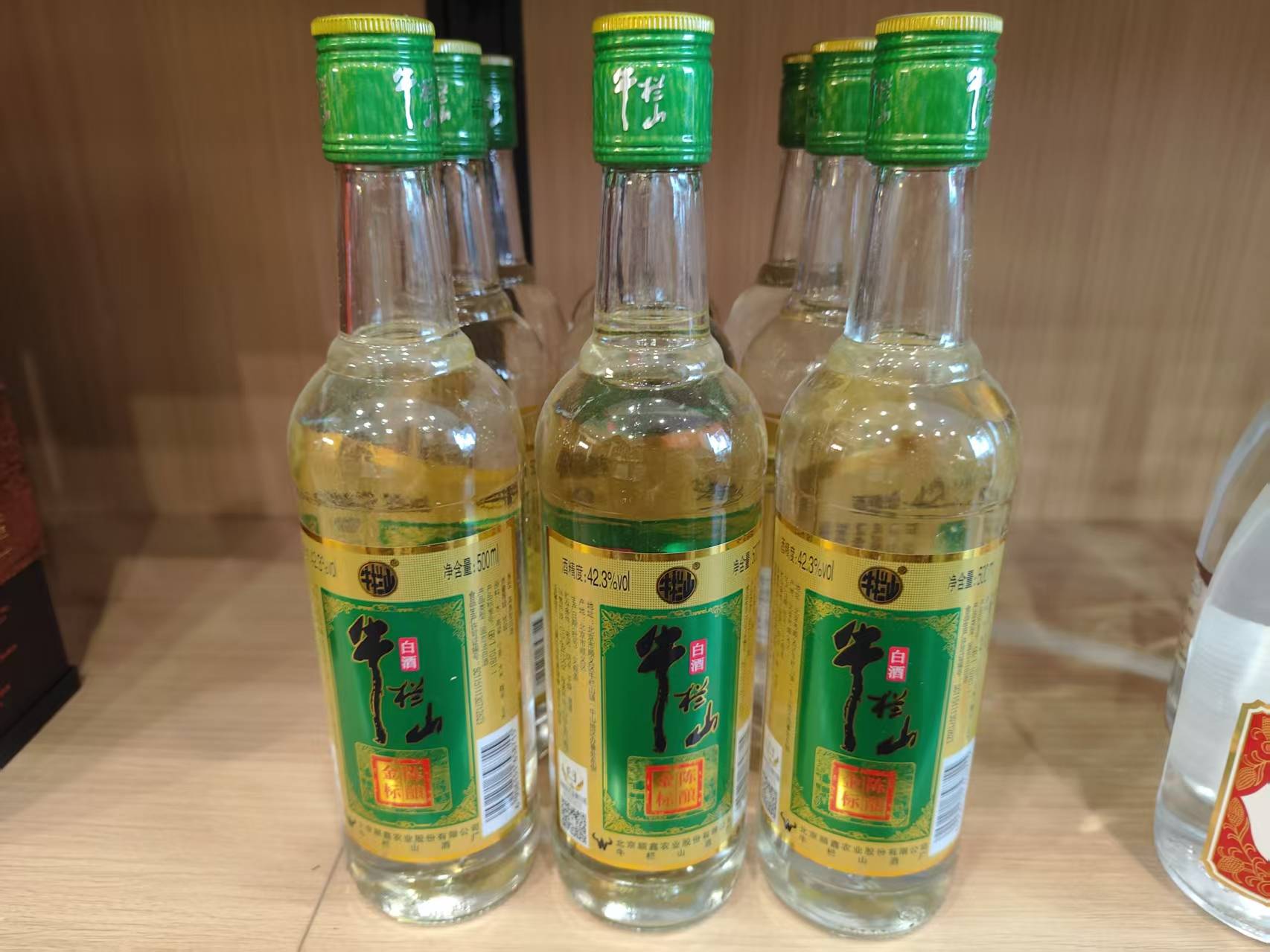
Core Viewpoint - Shunxin Agriculture's stock price dropped by 6.6% on January 30, following the announcement of a projected net loss of 116 million to 188 million yuan for 2025, marking a significant decline of 150.18% to 181.33% year-on-year due to intensified competition and a downturn in the liquor industry [1]. Company Summary - Shunxin Agriculture attributes its performance decline to a deep adjustment in the liquor industry and increased market competition, particularly affecting its core product, the "Niulanshan" series, which saw a decrease in sales [1]. - The company launched a new product, the "36% Jinbiao Niulanshan" white liquor, priced at 78 yuan per bottle, aiming to enter the high-end market [2]. - The "Niulanshan" brand, known for its affordable products, has struggled to maintain its previous sales levels, with the flagship product "Bai Niu Er" experiencing over a 40% decline in sales since being reclassified as a flavored liquor under new national standards [4]. Industry Summary - The low-end liquor market is becoming increasingly competitive, with major brands like Fenjiu and Wuliangye entering the light bottle liquor segment, leveraging their brand strength and distribution channels to capture market share [6]. - Young consumers are shifting towards more cost-effective and health-oriented alternatives, such as domestic red wine and yellow wine, which are gaining popularity in the market [7]. - The liquor industry is transitioning from a focus on scale expansion to value cultivation, with the low-end market now requiring a comprehensive approach to consumer psychology, scene adaptation, and brand storytelling [7].


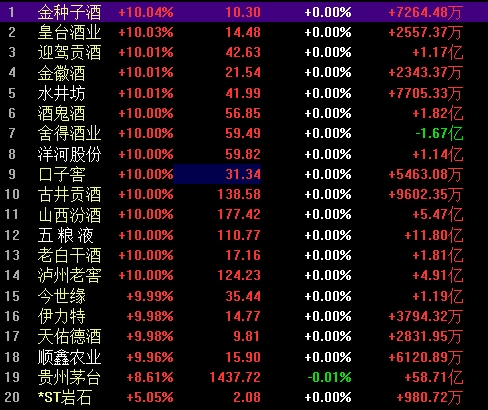
20只白酒股中19只涨停,贵州茅台大涨8.61%,“老登”酒类股重回A股舞台中央!白的、黄的、啤的、红的全线大涨,超过600亿元资金疯狂涌入白酒板块
Jin Rong Jie· 2026-01-29 08:45
Core Viewpoint - The liquor sector, including core liquor stocks, yellow wine, beer, and red wine, has experienced a significant surge, with many stocks hitting their daily limit up, indicating a strong market interest and potential recovery in the sector [1][2]. Liquor Sector Performance - On the afternoon of the 29th, the core liquor stocks continued to rise, with multiple stocks such as Shui Jing Fang, Shanxi Fenjiu, Wuliangye, and others reaching their daily limit up. Kweichow Moutai saw an increase of over 9% at one point [1]. - A total of 19 out of 20 core liquor stocks hit the daily limit up, while Kweichow Moutai, which did not, still rose by 8.61%. Over 600 billion yuan flowed into the liquor sector, with total trading volume reaching 614.2 billion yuan [2][3]. Price Movements - The price of Feitian Moutai has risen above 1,600 yuan per bottle, with the price on January 29 showing an increase of 20 yuan to 1,610 yuan per bottle. This price increase is attributed to strong demand during the upcoming Spring Festival [5]. Market Sentiment and Future Outlook - Analysts from CITIC Securities suggest that the liquor sector is poised for a recovery as the Spring Festival marketing activities approach, with stable sales expected. The report indicates that the current stock prices reflect market expectations, and the sector's valuation is relatively low, making it an attractive investment opportunity [6]. - The report from Guotai Junan Securities highlights that the current public fund holdings in the liquor sector are at a historical low of 3.93%, suggesting that the conditions for a new cycle in the sector are in place [6]. Broader Market Trends - The real estate sector also saw a significant rise, with stocks like Dayuecheng and Sanxiang Impression hitting their daily limit up, indicating a rotation in market interest towards liquor and real estate sectors [4]. - The A-share indices showed divergent trends, with the Shanghai 50 Index rising over 1% while the Sci-Tech 50 Index fell over 3% [4]. Investment Perspectives - Notable investor Duan Yongping commented on Kweichow Moutai, suggesting that while short-term fluctuations are uncertain, the long-term outlook remains positive, indicating that the current price is not expensive when viewed over a decade [8].

“AAA”评级落地 中信国安实业信用实力获市场肯定
Xin Lang Cai Jing· 2026-01-07 10:05
Group 1 - The core viewpoint of the news is that China Chengxin International Credit Rating Co., Ltd. has assigned a "AAA" credit rating to CITIC Guoan Industrial Group Co., Ltd. for its first phase of medium-term notes in 2025, reflecting strong market recognition of the company's comprehensive credit strength and debt repayment ability [1][3]. Group 2 - CITIC Guoan Industrial has received recognition for its core advantages, including strong support from its controlling shareholder, CITIC Group, in strategic planning, resource coordination, and financial backing, which lays a solid foundation for stable operations and long-term development [3]. - The company has a diversified business model covering advanced materials, new consumption, information services, cultural tourism, and real estate operations, effectively mitigating operational risks associated with single industry fluctuations [3]. - The "salt lake lithium extraction" business is highlighted as a significant growth driver within the advanced materials sector, benefiting from leading technology and cost advantages [3]. - Financially, the company maintains a reasonable level of financial leverage, with manageable short-term debt pressures and a robust overall financial structure, providing reliable financial support for ongoing operations [3]. Group 3 - Potential risk factors identified include significant price volatility in the chemical industry and intense competition in the wine sector, which may impact the company's profitability stability [3]. - The company needs to monitor the progress and financial balance of its molybdenum mine acquisition project closely [3]. Group 4 - In asset management, there has been a reduction in the scale of pledged assets and litigation cases, but the company faces challenges with large inventories and receivables, which occupy working capital and have led to substantial impairment losses [4]. - The progress of real estate project sales may also affect the company's operations and overall credit status, warranting close attention [4]. Group 5 - CITIC Guoan Industrial has established a scaled operation, achieving total revenue of 15.364 billion in 2024, and the "AAA" rating not only recognizes its current strength but also facilitates broader financing channels, lower costs, and enhanced market influence [5]. - The company is expected to achieve higher quality development through collaborative growth across its diversified businesses and effective risk management [5].

刚回国就翻脸!马克龙对华下最后通牒:中企必须投资欧洲,否则就加征关税!中方反制已在路上
Sou Hu Cai Jing· 2025-12-13 03:25
Core Viewpoint - Macron's visit to China initially appeared positive, but he quickly shifted to a confrontational stance upon leaving, indicating a focus on France's economic interests and trade imbalances with China [2][5][19]. Group 1: Macron's Initial Visit - Macron's delegation included over 80 members from various sectors such as technology and agriculture, reflecting a broad interest in cooperation with China [4]. - During the visit, Macron expressed satisfaction and support for China's one-China principle, indicating a willingness to engage positively [2][4]. Group 2: Post-Visit Shift - Upon returning to France, Macron threatened China with higher tariffs if it did not adhere to his demands, showcasing a stark change in tone [5][19]. - This shift is attributed to underlying economic pressures in France, particularly a trade deficit with China, which has led to a desire for increased Chinese investment in Europe [9][11]. Group 3: Trade Imbalance Concerns - The trade deficit between the EU and China was nearly 300 billion RMB in the first two months of the year, highlighting the economic concerns driving Macron's rhetoric [9]. - Macron's demands for China to invest in Europe and share core technologies reflect a strategy to address these trade imbalances, despite the complexities of the actual trade dynamics [13][15]. Group 4: European Context - The broader European context reveals that many countries, including Germany, are also seeking to engage with China, indicating a competitive landscape for influence and trade [19]. - Macron's approach may be seen as an attempt to bolster his domestic support amid economic challenges, but it risks alienating potential partners [17][21].

年轻人集体戒酒,让“老登”酒企的天快塌了
商业洞察· 2025-12-04 09:23
Core Viewpoint - The article discusses the challenges faced by the Chinese liquor industry, particularly focusing on the declining sales and changing consumer preferences among younger generations, highlighting the need for companies to adapt to these shifts in order to survive [5][6][12]. Group 1: Maotai and the Liquor Market - Duan Yongping, a notable investor, expressed strong confidence in Maotai, stating that investing in Maotai does not require consideration of macroeconomic conditions [6][8]. - Despite Maotai's stock price being at a high point, Duan remained unfazed, indicating a lack of comparable alternatives in the market [8]. - Maotai's third-quarter report showed a single-digit revenue growth, with the wholesale price of its flagship product dropping below 1700 yuan, marking a historical low [8][10]. Group 2: Overall Liquor Industry Performance - The third quarter of this year saw A-share liquor companies report their worst performance in a decade, with total revenue down 18.42% year-on-year and net profit declining by 22.03% [10][15]. - The average inventory turnover days for the liquor industry reached 900 days, indicating significant overstock issues [18]. - The decline in sales is attributed to reduced business banquets and a shift towards more practical gifting, alongside a growing disinterest in liquor among younger consumers [20][23]. Group 3: Young Consumers and Changing Preferences - Young consumers are increasingly favoring casual drinking settings over traditional formal occasions, with family gatherings and friend meet-ups becoming the most common consumption scenarios for liquor [23]. - Liquor companies are attempting to appeal to younger audiences by diversifying their product offerings, such as launching lower-alcohol beverages and engaging in cross-industry collaborations [26][28]. - The shift in consumer behavior indicates that liquor must transition from being a "social currency" to a "consumer product" to resonate with younger generations [30][62]. Group 4: Beer Industry Insights - The beer industry is experiencing a decline in production, with last year's output at only about 70% of its peak a decade ago, and revenue down by 5.7% [31][33]. - Despite the overall decline, some beer companies are achieving growth by focusing on high-end products, with premium beer sales significantly outpacing regular offerings [37]. - The shift in purchasing channels, particularly the rise of instant retail, has allowed many Chinese beer companies to better connect with younger consumers [41]. Group 5: Wine Market Challenges - The domestic wine market has seen a drastic reduction in production, with output down over 77% from its peak in 2015 [55]. - The wine industry is struggling to maintain relevance, as it is perceived as overly formal and difficult for average consumers to appreciate [58]. - Wine companies are now attempting to reposition their products in more casual settings to attract younger drinkers, moving away from traditional high-end contexts [60][62].