
酒店住宿业

Search documents
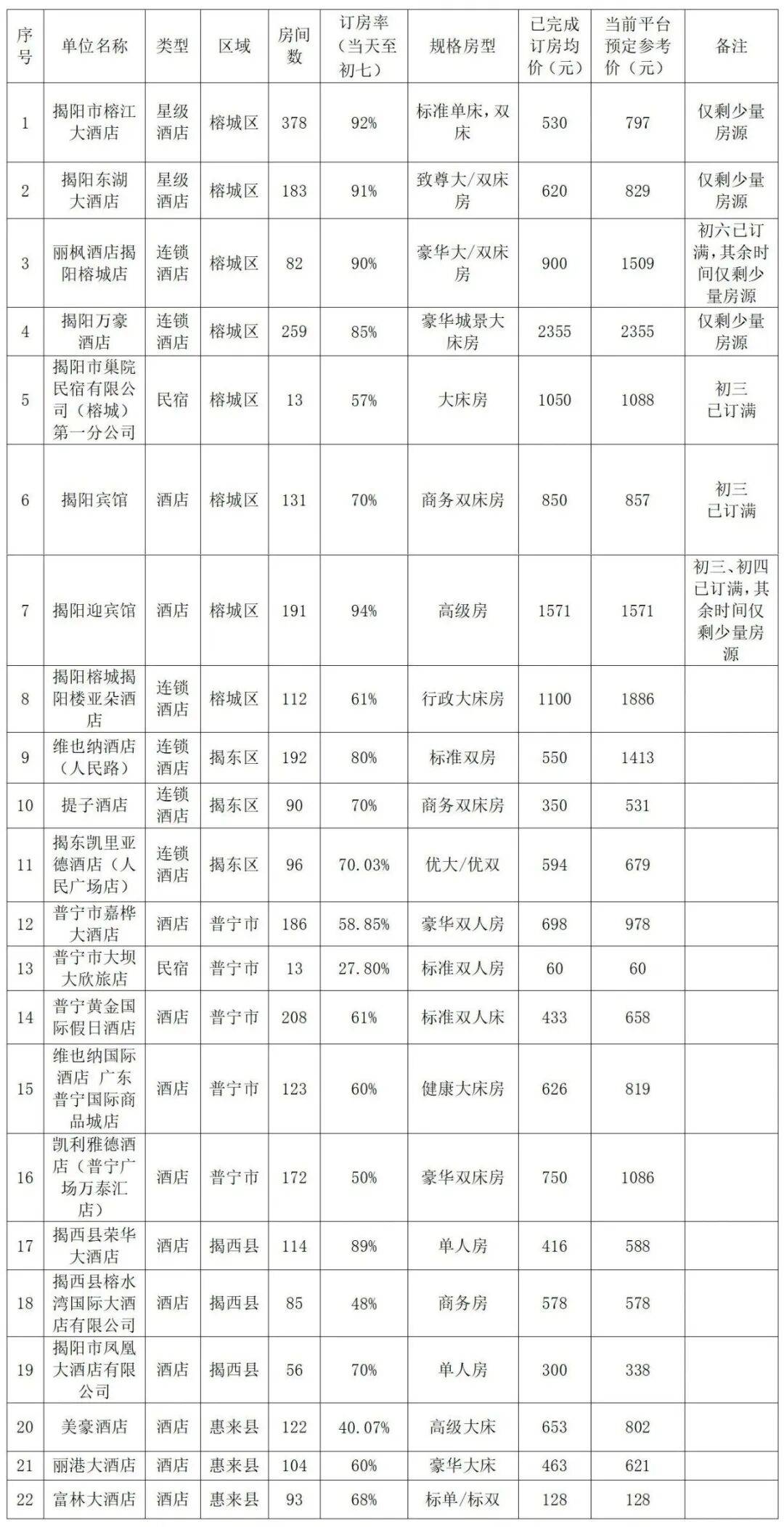
揭阳市消委会发布春节期间部分住宿订房率、价格抽查实时监测情况及消费提示(第三期)
Sou Hu Cai Jing· 2026-02-20 02:17
Core Insights - The article highlights the updated assessment of hotel and accommodation booking rates and prices in Jieyang City during the Spring Festival, aimed at enhancing consumer experience [1] Group 1: Booking Rates and Availability - As of February 19, 2026, the overall booking rate in Rongcheng District exceeds 90%, while in Jiedong District it exceeds 80%, indicating a high demand for accommodations during peak days [3] - The peak booking days (from the third to the sixth day of the lunar new year) have seen major room types fully booked, leading to a shortage of available rooms [3] - In contrast, booking rates in Puning, Jiexi, and Huilai counties are around 70%, with some inventory still available [3] Group 2: Estimated Room Availability - Estimated unbooked room inventory during peak days includes approximately 6,900 rooms in Puning, 2,000 in Huilai, 1,800 in Jiexi, 1,000 in Jiedong, and 500 in Rongcheng, varying by peak day [3] - The total number of registered accommodation providers in the city is 1,818, with an estimated total of 70,000 rooms available [3] Group 3: Pricing Information - The average booking prices for various room types are provided, with some hotels showing limited availability and higher prices due to demand [2][3] - The pricing is subject to market regulation, and the published prices reflect completed bookings rather than real-time transaction prices [4] Group 4: Consumer Recommendations - Consumers are advised to plan their travel and accommodation in advance, utilizing legitimate booking platforms to secure rooms at reasonable prices [4] - In case of disputes or rights violations during travel, consumers are encouraged to retain relevant evidence and report issues through designated hotlines [4]

可调价不可欺诈,汕头查处酒店价格违法明示边界
Nan Fang Du Shi Bao· 2026-02-14 01:13
Core Viewpoint - The Shantou Municipal Market Supervision Administration has initiated a special inspection to address price fraud and other pricing violations in the hotel industry, particularly during the holiday season, emphasizing a "zero tolerance" approach to illegal pricing practices [1][2]. Group 1: Market Dynamics - The tourism market in the Chaoshan region (Shantou, Jieyang, Chaozhou) has seen significant growth during the Spring Festival, with tourism order increases of 186%, 162%, and 135% respectively, making it a top domestic destination [1]. - The surge in hotel prices has sparked discussions on social media, but public sentiment appears to be relatively calm, attributing the price increases to normal market supply and demand dynamics due to a spike in visitors and returning locals [1][2]. Group 2: Regulatory Actions - The Shantou Municipal Market Supervision Administration is focusing on ensuring compliance with regulations regarding clear pricing, price fraud, and consumer rights violations, highlighting that hotel pricing is subject to market regulation [1][2]. - Specific illegal pricing practices have been identified, including failure to display prices clearly, misleading cancellations, and deceptive pricing strategies, which the enforcement agency aims to address through detailed case studies [2][3]. Group 3: Legal and Ethical Considerations - The enforcement agency emphasizes the importance of respecting market rules and maintaining legal boundaries in regulatory actions, advocating for a cautious approach to price interventions in the hotel industry [3]. - Discussions on the capacity of local tourism infrastructure and potential expansions in hotel accommodations are encouraged, but any regulatory actions must adhere to legal principles and respect market dynamics [3].
一批国内外知名酒店落户沈城
Xin Lang Cai Jing· 2026-02-04 18:26
Core Viewpoint - The hotel industry in Shenyang is experiencing rapid growth driven by a surge in tourism, with numerous domestic and international hotel brands establishing a presence in the city, enhancing its accommodation capacity and supporting high-quality tourism development [1][2][3]. Group 1: Hotel Brand Expansion - Shenyang is witnessing the entry of several well-known hotel brands, including Hilton Garden Inn, VOCO, and the first Fairfield by Marriott, indicating a strong interest from international hotel groups [1][2]. - The number of operating accommodation businesses in Shenyang has reached 2,401, with 385 new establishments opened in the past year, reflecting a robust growth trend in the hospitality sector [2]. Group 2: Tourism Demand and Trends - The increase in hotel occupancy rates is attributed to Shenyang's rich cultural resources and winter tourism, with a reported 65% rise in bookings for hotels and attractions compared to the previous month [3][4]. - Popular tourist areas are experiencing high demand, leading to instances of "room shortages" during peak periods, showcasing the city's growing appeal as a travel destination [4]. Group 3: Consumer Behavior and Market Dynamics - The hospitality sector is benefiting from a shift towards diversified and personalized consumer experiences, with hotels offering unique products such as wellness retreats and cultural experiences [5]. - The integration of technology and sustainability is becoming a key focus, with innovations like contactless check-in and energy management systems being adopted to enhance guest experiences and operational efficiency [6]. Group 4: Future Outlook - The hotel industry in Shenyang is expected to evolve towards brand differentiation, smart services, and unique cultural experiences, with new accommodation concepts likely to emerge [5][6]. - The government and businesses are exploring new models that combine tourism with rural revitalization and industrial heritage, aiming to create a diverse tourism ecosystem [6].
多部门联合发力 塔城市筑牢宾馆酒店安全生产防线
Zhong Guo Shi Pin Wang· 2026-01-29 05:04
Core Viewpoint - The article discusses the establishment of a joint inspection team by various departments in Tashkent City to conduct comprehensive safety checks on hotels and guesthouses, aiming to enhance safety measures and ensure the well-being of travelers during the holiday season [1] Group 1: Safety Inspection Measures - The joint inspection team includes the Market Supervision Administration, Fire Rescue Brigade, Housing and Urban-Rural Development Bureau, Health Commission, Industry and Information Technology Bureau, Emergency Management Bureau, and Public Security Bureau [1] - The inspection adopts a "law enforcement + service" model to strengthen safety defenses and ensure safe travel and accommodation for the public [1] Group 2: Focus Areas of Inspection - The Market Supervision Administration focuses on the safety management of special equipment, verifying elevator operation maintenance records, special equipment inspection reports, and operator qualification certificates [1] - Strict measures are taken against violations such as overdue inspections and illegal operations of special equipment [1] - Food safety management systems are also checked to ensure the dietary safety of guests [1] Group 3: Future Actions - Tashkent City will continue to deepen the collaborative mechanism among departments, regularly conducting joint safety inspections and guidance for key locations [1] - There will be ongoing tracking and supervision of hazard rectification to enhance overall safety management in the industry [1] - The goal is to create a safe, stable, and reassuring environment for the public during the holiday season, ensuring a peaceful and harmonious Spring Festival [1]
住宿业步入高质量发展的关键阶段
Xin Lang Cai Jing· 2026-01-07 23:23
Core Viewpoint - The hotel accommodation industry in China is transitioning from "quantitative growth" to "qualitative breakthroughs," driven by a joint initiative from nine government departments to promote high-quality development in the sector by 2025 [3][4]. Group 1: Industry Transformation - The accommodation sector is evolving from basic lodging to becoming a key component of a high-quality lifestyle and cultural expression, meeting the increasing demands of consumers [3][4]. - The focus on revitalizing existing assets is crucial for high-quality development, with hotel groups innovating through brand, product, engineering, and financial enhancements to transform old hotels into cultural theme hotels [3][4]. Group 2: Investment Trends - New investments are primarily directed towards mid-to-high-end, specialty, lifestyle, and theme hotels, which integrate various business models to create new consumer experiences [4][5]. - Hotels are increasingly becoming lifestyle service providers, with offerings that include immersive experiences and new retail spaces, catering to the preferences of the younger generation [4][5]. Group 3: Modernization Features - The accommodation industry is advancing towards smart, integrated, and internationalized operations, with AI being utilized to enhance customer experiences and operational efficiency [6][7]. - Cultural elements are being incorporated into hotel experiences, such as themed environments and local cultural integration, to create immersive stays [6][7]. Group 4: Mergers and Acquisitions - There is an increasing trend of resource integration through mergers and acquisitions, with large tourism groups acquiring hotel brands to expand their market presence and enhance operational standards [8][9]. - Local tourism groups are also consolidating hotel assets within their regions to create specialized brands, addressing market fragmentation and competition [8][9]. Group 5: Future Outlook - The hotel industry is expected to see a rise in asset securitization, supported by national policies that encourage IPOs for service-oriented enterprises, providing new financing avenues for innovative projects [9]. - Investment in human resources is becoming a priority, recognizing the irreplaceable value of skilled employees in delivering superior service [9].

“熊患”加剧,日本伤亡数字创历史纪录
第一财经· 2025-12-12 06:25
Core Viewpoint - Japan is experiencing a significant increase in bear attacks, with 235 reported injuries and 13 fatalities since April, marking a historical high for the country [3][6]. Impact on Tourism Industry - The bear attacks have adversely affected the tourism sector, particularly in Nagano Prefecture, where a historic inn lost over 300 bookings due to safety concerns [6]. - The presence of bears in populated areas has led to school closures and warnings from foreign embassies to their citizens traveling in rural Japan [6][8]. Reasons for Bear Activity in Winter - Climate change is identified as a key factor disrupting the ecological balance, with average temperatures in Hokkaido rising by 2.4 degrees Celsius over the past 30 years, shortening the hibernation period of bears [8][9]. - A poor harvest of beech and oak acorns in 2025 has left Asian black bears without sufficient fat reserves for winter, leading to increased activity [8][9]. - Japan's declining population and abandoned farmland have blurred the boundaries between forests and human habitation, resulting in more frequent bear encounters [8][9]. Bear Population Growth - The bear population in Japan is increasing at an annual rate of 15%, with numbers rising from approximately 15,000 in 2012 to around 54,000 this year [9][10]. - If left unmanaged, the bear population could double in five years, posing further risks to human safety and the tourism industry [9][10].

日本“熊患”加剧,伤亡数字创历史纪录,波及旅游业
Di Yi Cai Jing· 2025-12-12 05:40
Core Viewpoint - Japan is facing a significant increase in bear attacks, attributed to climate change and demographic issues, leading to heightened concerns in tourism and public safety [1][4]. Group 1: Bear Attacks and Statistics - Since April, at least 235 people have been injured in bear attacks across Japan, with 13 fatalities, marking a historical high in casualties [1]. - In a single day on December 4, multiple bear attacks resulted in injuries to at least 5 individuals, highlighting the severity of the situation [3]. - The Nagano Prefecture recorded its first winter bear attack since tracking began in 1977, indicating a troubling trend [3]. Group 2: Impact on Tourism - The bear attacks have adversely affected the tourism industry, with over 300 bookings canceled at a historic inn in Akita due to safety concerns [3]. - The presence of bears in populated areas has led to school closures and residents avoiding outdoor activities after dark, further impacting local tourism [3]. Group 3: Climate Change and Ecological Factors - Climate change is disrupting the ecological balance, with average temperatures in Hokkaido rising by 2.4 degrees Celsius over the past 30 years, leading to shorter hibernation periods for bears [6]. - A significant food shortage for Asian black bears is anticipated in 2025, as key food sources like beech and oak acorns are expected to fail, exacerbating the bears' search for food [6]. Group 4: Demographic Issues - Japan's declining population and increased abandonment of farmland are contributing to the blurred boundaries between bear habitats and human settlements, leading to more frequent bear encounters [6]. - The mechanization of agriculture has reduced the workforce needed to manage farmland, making it easier for bears to invade [6]. Group 5: Bear Population Growth - The bear population in Japan is increasing at an annual rate of 15%, with estimates rising from approximately 15,000 bears in 2012 to around 54,000 in the current year [7]. - Without intervention, the bear population could double in five years, posing a significant risk to human safety and local ecosystems [7].

喧嚣背后“暑运”市场悄然变革 大众休闲度假将取代集中出游
Hua Xia Shi Bao· 2025-08-29 12:33
Core Insights - The 2025 summer travel season has shown strong growth in demand for travel services, with online travel agencies (OTAs) reporting increased order volumes and diverse consumer preferences [1][2] - The travel industry is entering a transformative phase driven by market maturity, changing consumer habits, and demographic trends such as declining birth rates [1][8] Group 1: Market Performance - Alibaba's travel platform, Fliggy, reported a 9.9% year-on-year increase in average order value, indicating a shift towards quality travel experiences [2] - Ctrip's report highlighted that nearly half of domestic travelers opted for long-distance trips during the summer, reflecting a more rational consumption structure [2] - The average temperature in July reached record highs, leading to a surge in demand for cool vacation spots, with orders for popular destinations like Guizhou and Yunnan increasing by over 80% [2] Group 2: Regional Trends - Xinjiang's tourism orders grew over 20% during the summer, with significant interest from southern regions like Jiangsu, Zhejiang, and Shanghai [3] - The popularity of cultural and entertainment experiences has driven a 380% increase in search volume for scenic spots featured in popular media [3] - Outdoor activities such as camping and hiking have seen over 100% growth in search volume, indicating a shift in consumer preferences towards nature-based experiences [3] Group 3: Aviation Industry Insights - The civil aviation sector is expected to reach a record 150 million passengers during the summer, with domestic flights seeing a 3% increase in passenger volume [6] - Despite increased passenger numbers, average ticket prices for domestic flights have decreased, with a 7.5% drop in July compared to the previous year [7] - The trend of "price for volume" in the aviation industry is evident, as lower ticket prices have made air travel more accessible, particularly for first-time flyers [7][8] Group 4: Hotel and Accommodation Trends - High-star hotels are experiencing significant growth, with increased demand for quality accommodations during family trips [8] - The hotel industry is witnessing a shift towards higher-value offerings, with mid to high-star hotels seeing a faster growth rate compared to budget options [7][8] - The long-term trend suggests that the traditional peak summer travel season may decline due to demographic changes and evolving consumer preferences [8]
