
《封神2》

Search documents
横店影视6天5板,六部大片鏖战春节档!谁能成为A股影视股的年度爆款密码?
Sou Hu Cai Jing· 2026-02-05 06:11
Group 1 - The core viewpoint of the article highlights the competitive nature of the film industry during the Chinese New Year, where each movie ticket represents not only audience preferences but also significant financial stakes for A-share film companies [1][2] - This year's Spring Festival features several major films, including "Flying Life 3," "Silent Awakening," and "Panda Plan," with companies like Hengdian Film and Bona Film seeing substantial stock price increases [1] - The trend of collaboration among multiple investors is prevalent, with films like "Silent Awakening" involving 32 investment firms and "The Courier" attracting 34 companies, indicating a cautious approach to risk [1] Group 2 - The film industry is experiencing a downturn, with predictions for this year's Spring Festival box office around 75 billion, significantly lower than last year's record of nearly 95 billion [2] - Content quality is crucial for success, as evidenced by Light Media's projected net profit of over 1.5 billion in 2025 due to the success of "Nezha 2," while Beijing Culture faced a loss of over 350 million due to the failure of "Fengshen 2" [2] - Companies like Bona Film and Huayi Brothers have suffered significant financial losses, with Bona reporting a projected loss of over 1.2 billion due to "Dragon Action," highlighting the risks associated with poor content choices [2]

《飞驰人生3》冲刺26年春节档,韩寒已成投资大佬
Sou Hu Cai Jing· 2026-01-13 04:10
Group 1 - The only confirmed films for the Spring Festival slot are "Boonie Bears: Year of the Bear" and "Fast and Furious 3" [1] - Han Han maintains a consistent filmmaking schedule, with "Fast and Furious 3" expected to follow a pattern of successful releases [1] - Han Han's films, except for "The Four Seas," have been profitable, indicating a strong potential for "Fast and Furious 3" to perform well [1] Group 2 - Tingdong Film, controlled by Han Han, relies on the "Fast and Furious" franchise for recovery, especially after Bona's significant losses [3] - Bona, a major shareholder in Tingdong, has faced financial difficulties, even resorting to selling shares to raise funds [3] Group 3 - A loan agreement between Zhejiang Bona and Shanghai Tingdong includes a debt restructuring plan, indicating a strategic financial maneuver to manage liabilities [4] - Tingdong Film has strong cash flow, positioning Han Han as a rare profitable investor in the current challenging film market [4] Group 4 - Han Han is not only a director but also an investor in several successful films, contributing to his influence in the industry [6] - Tingdong Film has emerged as the fourth largest private film company, surpassing traditional players like Huayi Brothers and Bona [8] Group 5 - The domestic film market shows significant disparities, with a few blockbusters dominating box office revenues while many films underperform [10] - The Spring Festival period is crucial for box office success, with several films expected to compete for high earnings [11] Group 6 - The market for martial arts films appears to be declining, with historical data suggesting a low ceiling for box office performance in this genre [13][14] - Despite the star power associated with martial arts films, the current market trends indicate a challenging environment for such releases [14][16]


年轻人不去电影院了
投资界· 2025-09-20 13:35
Core Viewpoint - The article discusses the declining audience attendance in Chinese cinemas despite the expansion of cinema infrastructure, highlighting a disconnect between the number of theaters and the willingness of audiences to watch films in theaters [3][10][21]. Group 1: Audience Trends - In 2024, the national cinema attendance rate dropped to a historical low of 5.7%, indicating that in a 100-seat theater, only five to six people might be watching a film [7]. - The overall box office revenue in 2024 was only 425 billion yuan, a decrease of one-third compared to the 641.49 billion yuan peak in 2019, despite having more than double the number of theaters and screens [4][10]. - The average age of cinema-goers has increased from 27.7 years in 2021 to 32.5 years in 2025, suggesting that younger audiences are not replacing older viewers [27]. Group 2: Cinema Experience - Many viewers are deterred by poor cinema experiences, including uncomfortable seating, distractions from other audience members, and low-quality film presentations [21][25]. - The average ticket price in first-tier cities reached 49.6 yuan by August 2025, a 16% increase from 2014, making cinema visits less appealing compared to other entertainment options [21][27]. Group 3: Box Office Dynamics - The box office revenue is increasingly concentrated among a few blockbuster films, with the top 20 films accounting for 60-80% of total box office revenue, compared to 80-90% for the top 50 films in 2014 [18][20]. - The Spring Festival box office has become a dominant force, with the 2025 Spring Festival box office expected to be heavily reliant on a few high-investment films, creating a competitive environment where only a few films succeed [14][18].

外国人爱上中国视听作品(体验“中国味儿”)
Ren Min Ri Bao Hai Wai Ban· 2025-09-05 22:22
Core Insights - The increasing popularity of Chinese audiovisual works, such as films and TV dramas, among international audiences highlights the cultural allure of contemporary China [4][5][9] - Foreign influencers and students express their admiration for Chinese culture through engagement with various media, leading to deeper cultural connections [5][9][14] Group 1: Cultural Engagement - International audiences, including foreign bloggers and students, are drawn to Chinese dramas like "Empresses in the Palace," which serve as gateways to understanding traditional Chinese culture [5][8] - The exploration of Chinese history and language through media has become a significant aspect of cultural exchange, with individuals sharing their experiences and insights on social platforms [8][9] Group 2: Impact of Chinese Variety Shows - Chinese variety shows have gained traction among foreign viewers, providing a window into contemporary Chinese pop culture and societal issues [9][10] - The diverse formats and themes of these shows resonate with audiences, fostering discussions and connections across cultural boundaries [10][12] Group 3: Film Appreciation - The rise of Chinese cinema, including notable films and the emergence of female directors, showcases the industry's growth and diversity [14][15] - Understanding the subtleties of Chinese films, such as cultural references and narrative techniques, enhances the viewing experience for international audiences [15][16]

北京文化上半年净利润暴跌610.29%亏损超过营收 《东极岛》票房惨淡、口碑崩盘 是否会重蹈《封神2》覆辙?
Xin Lang Zheng Quan· 2025-08-25 02:28
Core Viewpoint - Beijing Culture reported a significant increase in revenue for the first half of 2025, but also recorded a substantial net loss, indicating severe financial distress and challenges in the film industry [1][2]. Financial Performance - The company achieved a revenue of 158 million yuan in the first half of 2025, a year-on-year increase of 1944.24%, but reported a net loss of 233 million yuan, a year-on-year decline of 610.29% [1]. - In Q2 2025, revenue was 60 million yuan, a year-on-year increase of 3837.81%, but a quarter-on-quarter decline of 38.98% [1]. - The first quarter of 2025 saw a revenue of 98 million yuan against a cost of 315 million yuan, resulting in a gross margin of -221.43% [10]. Film Performance - The film "Feng Shen 2" was released on January 29, 2025, grossing 1.238 billion yuan by March 31, 2025, but this was significantly lower than its predecessor, "Feng Shen 1," which grossed 2.636 billion yuan [3]. - "Feng Shen 2" received a low rating of 5.8 on Douban, with a high percentage of negative reviews, indicating poor audience reception [3][9]. - The film's production cost was substantial, with total investment in the "Feng Shen" trilogy reaching 3 billion yuan, and the break-even point for each film estimated at 1.8 billion yuan [9]. Market Trends - The overall film market in China saw a box office of 29.231 billion yuan in the first half of 2025, a year-on-year increase of 22.91%, but faced challenges such as a decline in the number of new projects and uneven box office distribution [2]. - The number of new films released in the first half of 2025 was 200, a decrease of 38 films compared to the previous year, with only 22 films grossing over 100 million yuan [2]. Recent Releases - The film "Dong Ji Dao," co-produced by Beijing Culture, was released on August 8, 2025, but has underperformed with a cumulative box office of only 368 million yuan by August 24, 2025, significantly lower than competing films [14][17]. - The film's reception has been poor, with negative audience feedback reflecting dissatisfaction [18]. Company Response - Beijing Culture stated that its investment in "Dong Ji Dao" was not significant and would not have a major impact on its financial performance [23].

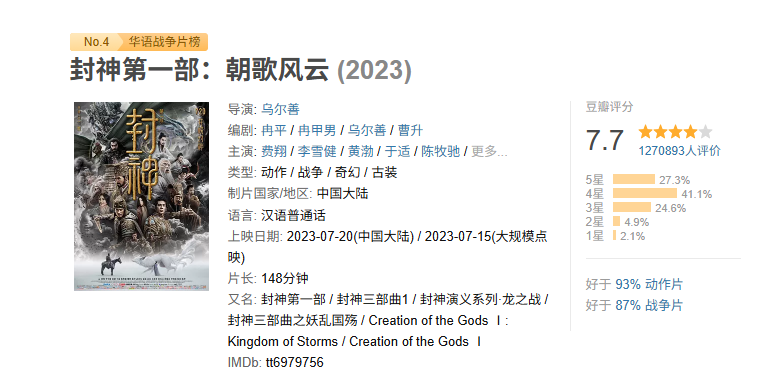
《封神2》票房口碑双崩塌成“吞金兽” 北京文化累亏30亿资金链告急 离披星戴帽还有多远?
Xin Lang Zheng Quan· 2025-04-22 09:40
Core Viewpoint - Beijing Culture has reported a significant decline in its financial performance for 2024, with total revenue of 317 million yuan, a decrease of 46.2% year-on-year, and a net loss of 156 million yuan, although the loss has decreased by 44.4% compared to the previous year [1] Financial Performance - The company's film business has seen a drastic reduction, with revenue plummeting by 90% compared to 2023, and a gross margin dropping to -83.18%, indicating no profitability [1][7] - As of March 31, 2025, Beijing Culture's accumulated losses exceeded 3 billion yuan, raising concerns about its financial viability and potential delisting [1][2] Historical Context - Beijing Culture transitioned to the film and entertainment industry in 2013, achieving significant success from 2016 to 2019 with blockbuster films, but has since faced severe financial and operational challenges [3][4] - The company has been involved in financial misconduct, including profit inflation through shell companies and falsified contracts, leading to regulatory penalties and criminal convictions for key executives [4][6] Recent Developments - The release of "Fengshen 2" in early 2025 initially boosted revenue by nearly 15 times, but the associated costs surged by 385 times, resulting in a gross margin of -195.43% and a loss exceeding 200 million yuan in just three months [10] - The company has transferred investment shares in the "Fengshen Trilogy," complicating its financial recovery as potential profits may not benefit Beijing Culture directly [11] Audit and Compliance Issues - Concerns have arisen regarding the quality of financial audits, with the previous auditor facing penalties for inadequate diligence, casting doubt on the reliability of Beijing Culture's financial statements [12][19] - The new auditor, Zhongrui Cheng, has limited experience in the film industry, raising further questions about the adequacy of financial oversight [16][17] Liquidity and Debt Concerns - As of March 31, 2025, Beijing Culture's cash reserves were only 47 million yuan, with short-term borrowings reaching 250 million yuan, indicating a significant liquidity gap [19] - The company's current and quick ratios have fallen to 0.79 and 0.75, respectively, highlighting increasing short-term financial pressures [19] Project Status - Currently, Beijing Culture has several film and television projects in various stages of development, but the ability to finance these projects remains uncertain given the company's precarious financial situation [20]
假的
猫笔刀· 2025-01-29 14:18
韩国那边也有很多闭麦对嘴型的演出,但通常是女团或者男团的唱跳演出,成员有剧烈的舞蹈动作和队形变换,这个时候实力不稳的成员唱出来的歌声犹 如杀猪,确实开不了麦。 但韩国也有一个潜规则,就是纯歌手(没有舞蹈动作,就是站着唱歌)基本都是现场live,因为你所有的表演内容就是唱歌,如果歌声还是假的你站那里 就没意义了。 春晚歌曲节目的预制菜含量高这是众所周知的,曾经有那么几年也尝试大力推行现场live,结果事故频发,比如王菲2012年和陈奕迅的《因为爱情》是真 唱,你们去搜,节目效果一言难尽。王菲的嗓子早就不太好了,每次唱高音都让人提心吊胆,昨晚那首突然稳如老狗当然是预制菜了。 昨晚我说某菲的节目是预制菜,底下有一些可能是粉丝给我一顿数落,我当然不是乱讲了,哪些是预制菜,哪些是现炒的,这对我来说不难分辨。 我有个二十多年的爱好,就是看kpop的打歌舞台,这么多年下来看了得有几千个了,哪些是闭麦演出,哪些是半开麦,哪些是全开麦,听多了就知道。 这次的人物塑造有亮点,我出人意料的喜欢上了申公豹这个角色,虽然只是几笔简单着墨,但一下子让这个惯常在封神故事里打酱油的配角立体丰满了起 来,影片结尾埋下了他的故事线,所以肯定会继 ...