《满江红》

Search documents
385亿票房背后:沈腾凭啥让三四线观众心甘情愿掏钱?
Sou Hu Cai Jing· 2026-02-26 13:29
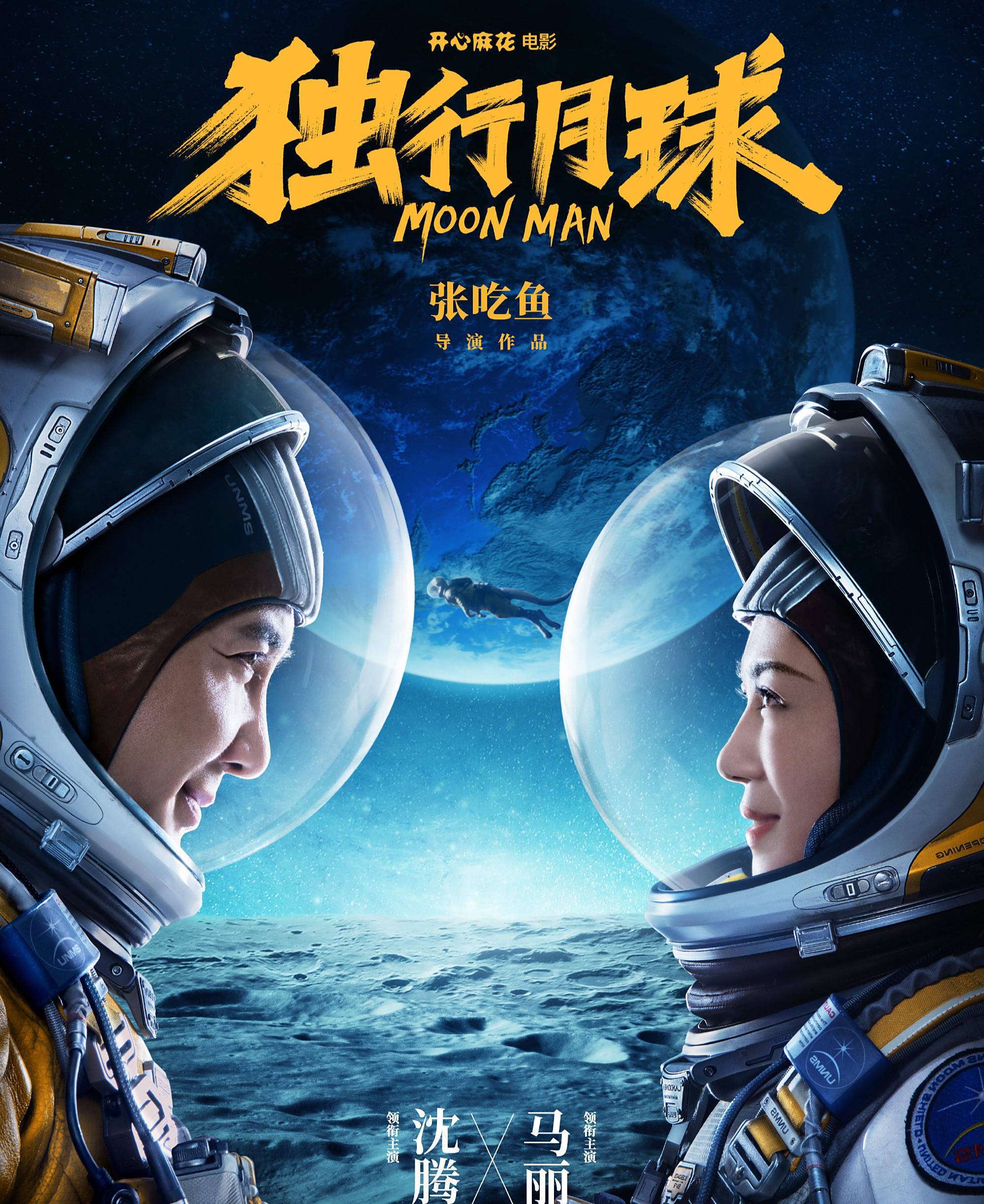
Core Insights - The film "Fast and Furious 3," starring Shen Teng, has surpassed a box office of 38.5 billion, making him the highest-grossing male lead in Chinese cinema with an average of 1.3 billion per film across 29 works [1][4] Group 1: Box Office Performance - Shen Teng's films have collectively grossed over 38.5 billion, with an average of 1.3 billion per film, establishing him as the highest-grossing male lead in China [1] - His success is attributed to genuine support from audiences in lower-tier cities, rather than artificial hype or marketing strategies [1] Group 2: Character Portrayal and Audience Connection - Shen Teng's characters resonate with ordinary people, reflecting their struggles and aspirations, such as the relatable figures in "West Rainbow City Rich" and "Lone Moon" [7] - His roles often depict the everyday challenges faced by common individuals, allowing viewers to see themselves in his characters [7] Group 3: Industry Trends and Shen Teng's Approach - The current film market has shifted away from a "celebrity-driven" model to one that values authentic storytelling that resonates emotionally with audiences [10] - Shen Teng's dedication to character development, including extensive preparation for roles, has earned him a reputation for delivering value to viewers, contrasting with other stars focused on short-term fame [10]

400亿,沈腾彻底飞驰
Xin Lang Cai Jing· 2026-02-25 06:07
Core Viewpoint - The article highlights the remarkable success of actor Shen Teng, who has become the first male actor in China to surpass 40 billion RMB in cumulative box office earnings, establishing himself as a leading figure in the comedy genre and the film industry overall [1][8]. Group 1: Shen Teng's Career Milestones - Shen Teng's film "Flying Life 3" has surpassed 3 billion RMB in box office revenue as of February 24, making it the highest-grossing film of the Spring Festival season [1]. - Since his debut on the Spring Festival Gala in 2012, Shen Teng has evolved from a comedic character to a prominent actor, gaining recognition through various performances [2][4]. - His film "Summer Charlotte" was produced with a budget of 50 million RMB and grossed 1.4 billion RMB, showcasing his ability to deliver high returns on investment [6]. Group 2: Box Office Performance Comparison - Shen Teng has starred in 25 films, achieving an average box office of 1.6 billion RMB per film, significantly outperforming peers like Xu Zheng and Huang Bo [8][10]. - Compared to other actors, Shen Teng's cumulative box office is 5.8 times that of Xu Zheng, 3.6 times that of Huang Bo, and 2.8 times that of Wang Baoqiang [10]. - His box office earnings surpass those of Wu Jing, who has 48 films with a total of nearly 36 billion RMB, indicating Shen Teng's unique market position [11]. Group 3: Artistic and Commercial Balance - The article discusses the ongoing debate in the entertainment industry regarding the balance between quantity and quality of work, with Shen Teng exemplifying that "better is more" [11]. - Shen Teng's experience with commercial pressures has led him to become more involved in the business side of filmmaking, establishing multiple companies to gain greater creative control [15][16]. - His strategic decisions reflect a shift towards understanding the importance of commercial viability in achieving artistic goals [15]. Group 4: Audience Engagement and Future Directions - Shen Teng's performances are noted to be more engaging when he has a significant role in the film, indicating a correlation between his involvement and the film's success [18]. - He has taken a deliberate approach to his career, choosing roles carefully and preparing extensively, which has led to successful films like "West Rainbow City Rich" and "Flying Life" [18]. - Shen Teng continues to explore diverse genres beyond comedy, indicating a desire for artistic growth and audience engagement [19].
沈腾,传来好消息
Xin Lang Cai Jing· 2026-02-24 12:07
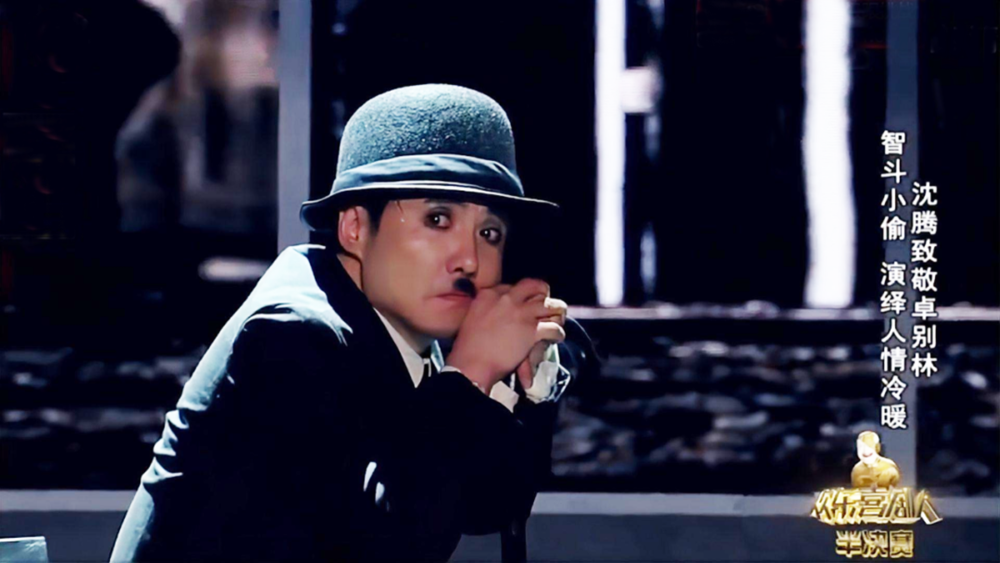
Core Insights - Shen Teng has become the first actor in history to have his films surpass a total box office of 40 billion yuan, with 25 films contributing to this milestone [1][4] - His latest film, "Fast Life 3," released on the first day of the Lunar New Year, achieved a box office of 3.016 billion yuan within just eight days, leading the Spring Festival box office [1] Group 1 - Shen Teng was born on October 23, 1979, in Qiqihar, Heilongjiang Province, and is a well-known Chinese comedian, actor, director, and screenwriter [4] - He transitioned to film acting in 2015 with the comedy "Charlotte's Trouble," which earned him the "Best Chinese Actor of the Year" award at the Macau International Film Festival [4] - Since 2018, he has starred in several high-grossing films, including "The Richest Man in Xihong City," "Fast Life," and "Crazy Alien," receiving accolades such as the "Best Actor" award at the 17th Pyongyang International Film Festival [4] Group 2 - In 2021, Shen Teng made his directorial debut with the comedy film "My Father and Me" [4] - From 2022 onwards, his films "Moonfall," "Full River Red," and "Fast Life 2" consistently ranked among the top two in annual box office earnings in China [4] - By 2024, he is expected to be recognized as the actor with the highest box office earnings in Chinese film history, with his comedy film "Catching Dolls" projected to be the summer box office champion [4]
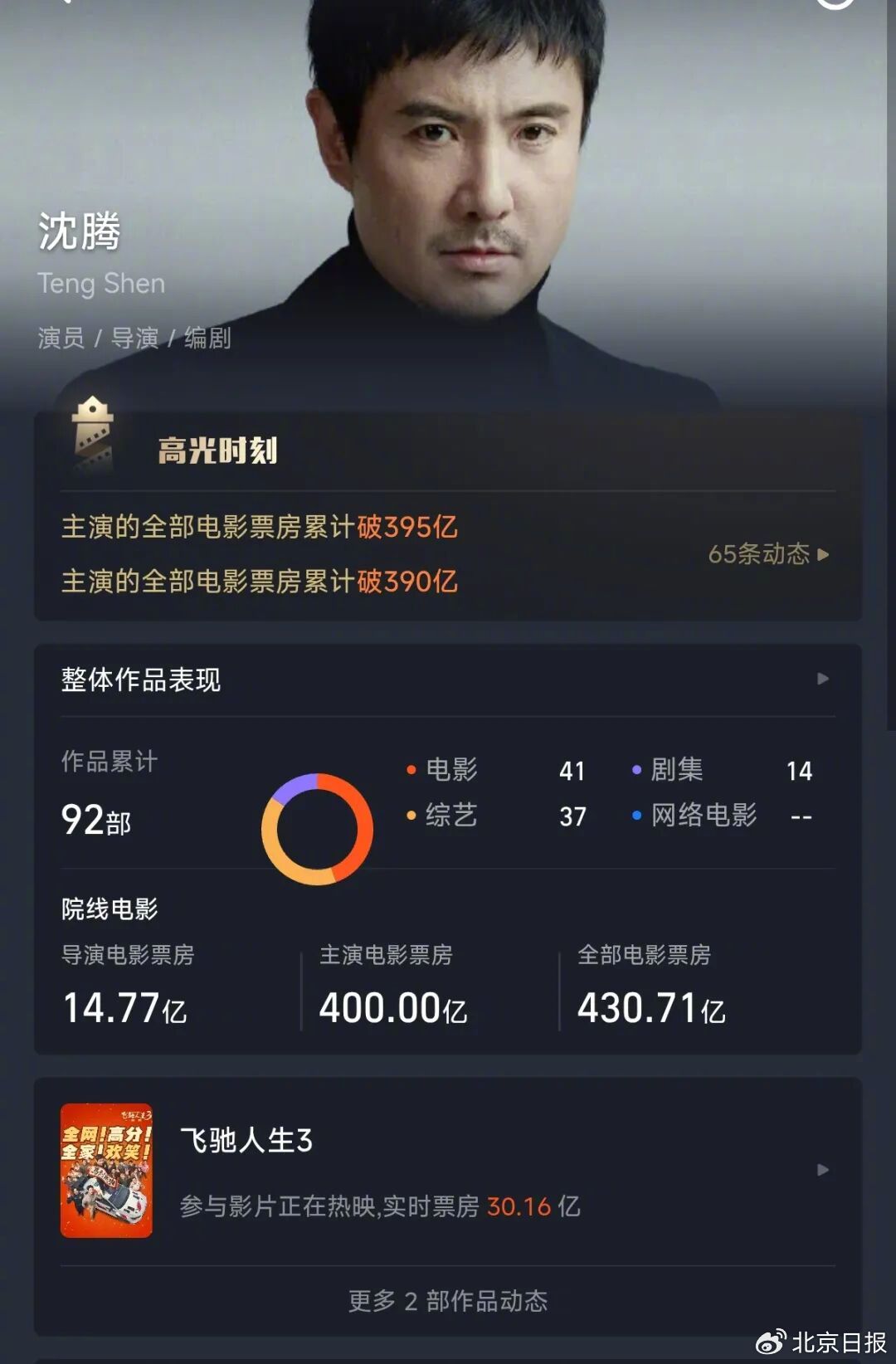
沈腾成首位主演电影票房破400亿演员
Bei Jing Ri Bao Ke Hu Duan· 2026-02-24 11:11
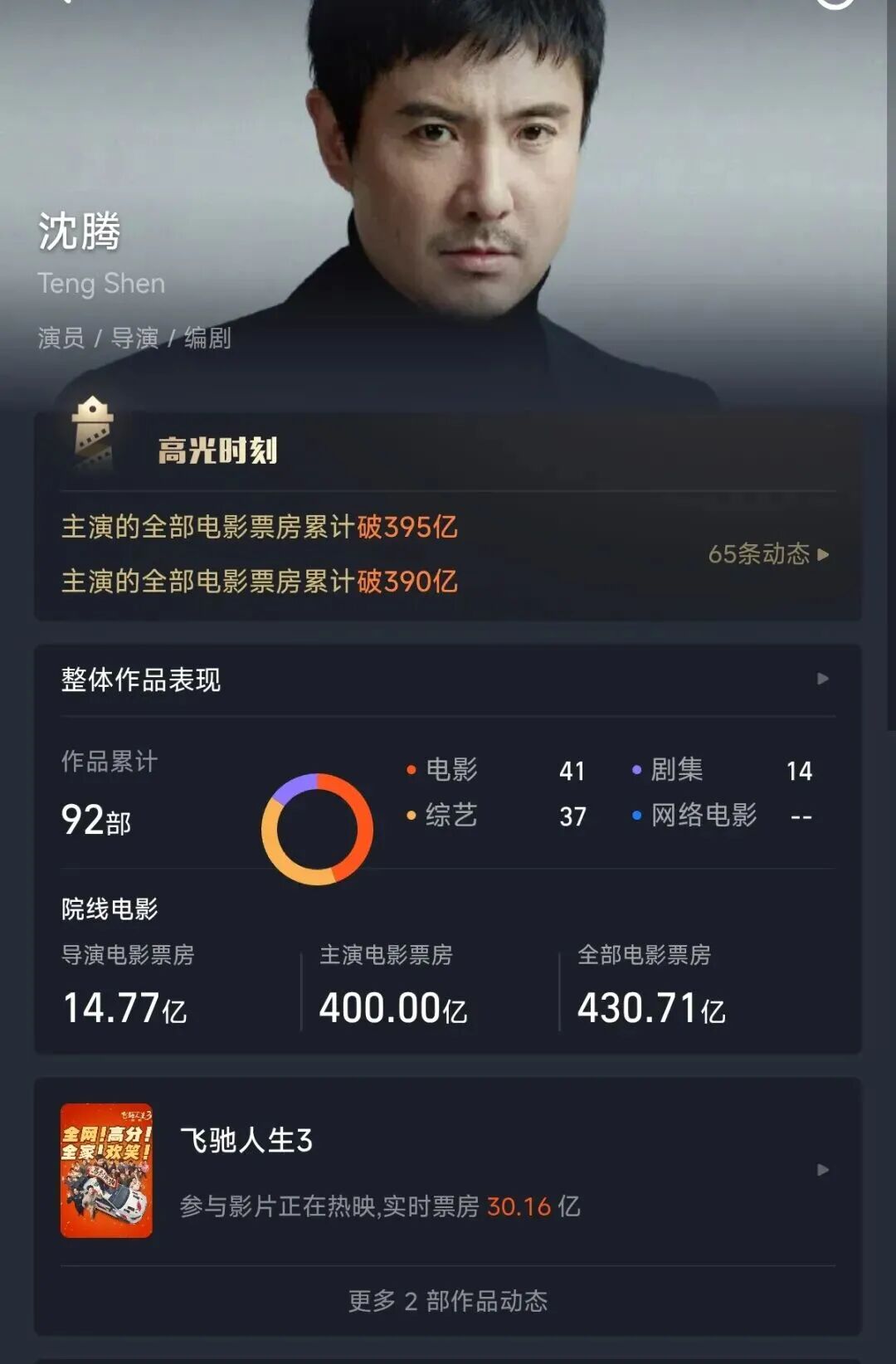
Core Insights - Shen Teng has become the first actor in history to have a total box office exceeding 40 billion yuan from his films, with 25 movies to his credit as of February 24, 2026 [1][4][7] - His latest film, "Fast Life 3," released on the first day of the Lunar New Year, achieved a box office of 3.016 billion yuan within just eight days, leading the Spring Festival box office [1][4][7] Group 1: Actor's Background - Shen Teng was born on October 23, 1979, in Qiqihar, Heilongjiang Province, China, and is a well-known comedian, film director, and screenwriter [4][7] - He graduated from the Drama Performance Department of the Military Culture Academy of the People's Liberation Army [4][7] Group 2: Career Milestones - In 2015, he transitioned to film acting with the comedy "Charlotte's Trouble," which earned him the "Annual Chinese Actor Award" at the Golden Sheep Awards and received both critical acclaim and box office success [4][7] - After 2018, he starred in several high-grossing films, including "The Richest Man in Xihong City," "Fast Life," and "Crazy Alien," winning the "Best Actor Award" at the 17th Pyongyang International Film Festival for the second film [4][7] - In 2021, he made his directorial debut with the comedy "My Father and Me" [4][7] Group 3: Recent Achievements - From 2022 onwards, his films "The Moonwalkers," "Full River Red," and "Fast Life 2" consistently ranked among the top two in the annual box office in China [4][7] - In 2024, he became the highest-grossing actor in Chinese film history and his comedy "Catching Dolls" was the box office champion of the summer season [4][7]
2026年吉林卫视春晚将于2月13日播出
Xin Lang Cai Jing· 2026-02-12 13:25
Core Viewpoint - The 2026 Jilin Satellite TV Spring Festival Gala, themed "Returning Home for the New Year," will be broadcast on February 13 at 19:30, showcasing the vibrant culture and hospitality of Jilin province [1][12]. Group 1: Event Overview - The gala continues the core theme of "Returning Home for the New Year," featuring innovative arrangements and warm presentations to create a festive atmosphere [3]. - The event invites participants from across the country to showcase Jilin's development and the warmth of its people, blending Northeast cultural elements into the performances [3][8]. Group 2: Program Highlights - Performances include lively songs and dances such as "Black Horse Arrives," "Fortune Comes," and "Full Power," reflecting the happiness and aspirations of the Jilin people [5]. - The gala features emotional performances like "Snow in the Changbai Mountains" and "Dreaming of Ice Flowers," highlighting the beauty of Jilin through creative staging [5][6]. - Comedy sketches and interactive segments aim to resonate with younger audiences, incorporating contemporary themes and humor [8][10]. Group 3: Special Features - The gala includes a unique character, "Seeking the Horse Officer," to guide viewers in exploring Jilin's charm and vitality [12]. - Notable actors and comedians will participate, bringing a mix of nostalgia and humor to the performances, enhancing the overall entertainment value [10][12].

春节档催化,影视板块逆势大涨!影视ETF(516620)涨超2%,传媒景气度持续上升
Mei Ri Jing Ji Xin Wen· 2026-02-05 14:06
Core Viewpoint - The Chinese film industry is experiencing a significant boost due to the Spring Festival box office, with the film sector showing resilience and growth potential as indicated by the rise in the film ETF [1] Group 1: Spring Festival Impact - The Spring Festival period is expected to catalyze box office performance, enhancing the elasticity of individual films [1] - Historical data shows that the Spring Festival box office revenues from 2021 to 2025 are projected to be 78 billion, 60 billion, 68 billion, 82 billion, and 95 billion yuan, accounting for approximately 17%, 20%, 12%, 19%, and 19% of the annual box office respectively [1] - Six out of the top ten films in the Chinese box office rankings are from the Spring Festival period, including "Ne Zha" with a total box office of about 15.5 billion yuan and "The Wandering Earth" with approximately 4.5 billion yuan [1] Group 2: ETF and Index Performance - The film ETF (516620) has risen over 2%, reflecting the increasing optimism in the media sector [1] - The ETF tracks the CSI Film Index (930781), which selects stocks from the Shanghai and Shenzhen markets related to video, live streaming, gaming, and film, focusing on companies involved in film content production and distribution [1]
年轻人是中国电影的未来(人文茶座)
Ren Min Ri Bao· 2026-01-02 22:11
Core Viewpoint - The evolution of Chinese cinema over the past 120 years reflects the spirit of the times and the dedication of filmmakers, emphasizing the importance of rooting artistic creation in reality and connecting with the audience [1][2]. Group 1: Development of Chinese Cinema - The journey of Chinese cinema has transitioned from silent films to sound, black and white to color, and traditional to digital formats, showcasing the collective effort of filmmakers [1]. - The integration of commercial films and art films is crucial for the growth of the film industry, particularly for young directors who should consciously explore this combination [2]. Group 2: Filmmaking Philosophy - Successful artistic creation must draw inspiration from social realities, as seen in works like "The 20th Article," which combines humor with serious legal themes to convey important messages [1]. - The exploration of various genres, such as suspense, war, and comedy, while infusing humanistic care and positive energy, is essential for innovative storytelling in cinema [2]. Group 3: Focus on Youth and Future of Cinema - The future of Chinese cinema relies on the contributions of young directors, actors, and creative talents, rather than solely on established directors [3]. - Initiatives like the "Green Plan" for supporting young directors highlight the industry's commitment to nurturing new talent and ensuring the vitality of Chinese cinema [3].

年轻人不去电影院了
投资界· 2025-09-20 13:35
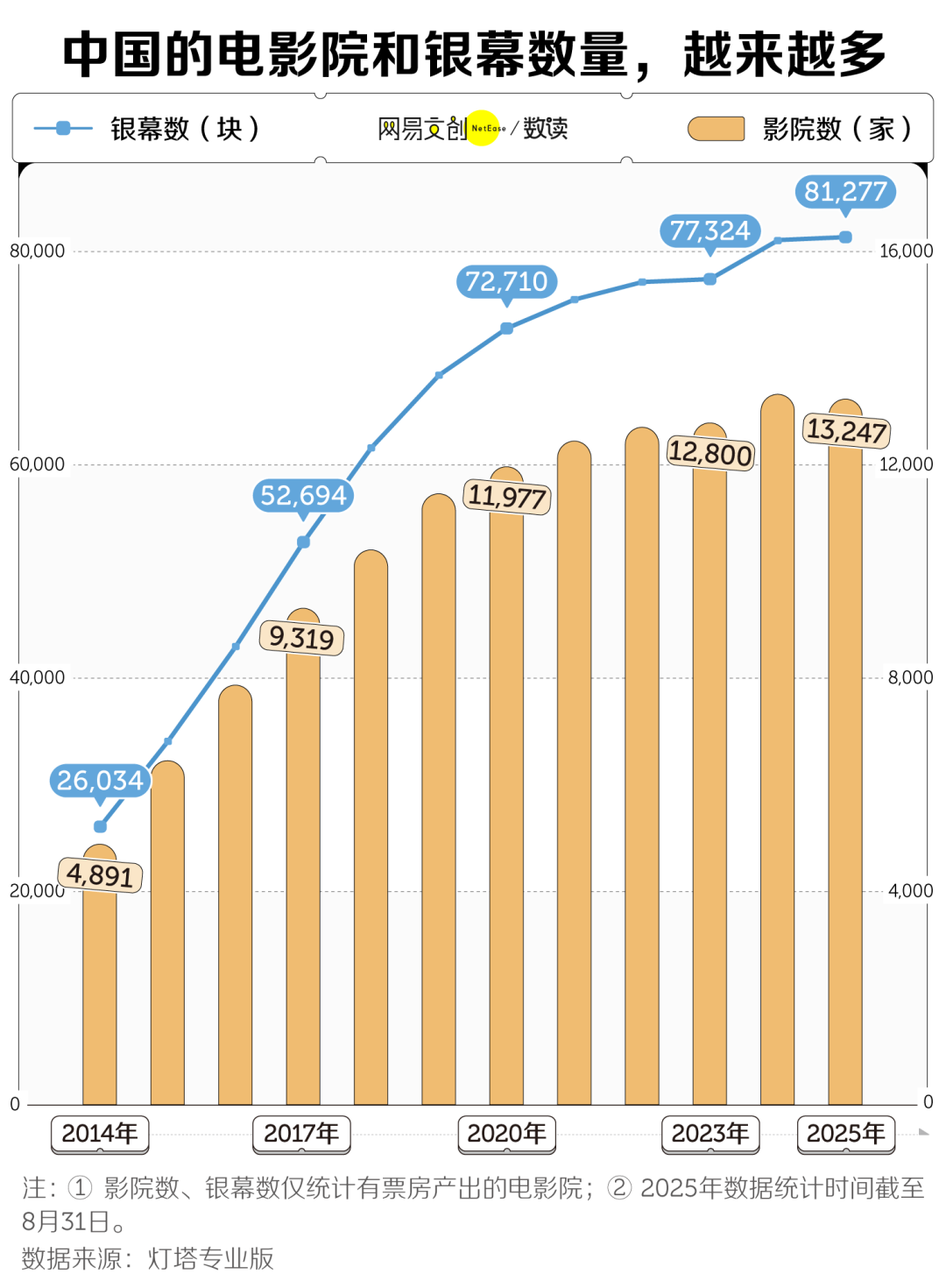
Core Viewpoint - The article discusses the declining audience attendance in Chinese cinemas despite the expansion of cinema infrastructure, highlighting a disconnect between the number of theaters and the willingness of audiences to watch films in theaters [3][10][21]. Group 1: Audience Trends - In 2024, the national cinema attendance rate dropped to a historical low of 5.7%, indicating that in a 100-seat theater, only five to six people might be watching a film [7]. - The overall box office revenue in 2024 was only 425 billion yuan, a decrease of one-third compared to the 641.49 billion yuan peak in 2019, despite having more than double the number of theaters and screens [4][10]. - The average age of cinema-goers has increased from 27.7 years in 2021 to 32.5 years in 2025, suggesting that younger audiences are not replacing older viewers [27]. Group 2: Cinema Experience - Many viewers are deterred by poor cinema experiences, including uncomfortable seating, distractions from other audience members, and low-quality film presentations [21][25]. - The average ticket price in first-tier cities reached 49.6 yuan by August 2025, a 16% increase from 2014, making cinema visits less appealing compared to other entertainment options [21][27]. Group 3: Box Office Dynamics - The box office revenue is increasingly concentrated among a few blockbuster films, with the top 20 films accounting for 60-80% of total box office revenue, compared to 80-90% for the top 50 films in 2014 [18][20]. - The Spring Festival box office has become a dominant force, with the 2025 Spring Festival box office expected to be heavily reliant on a few high-investment films, creating a competitive environment where only a few films succeed [14][18].

中国年轻人,不去电影院了?
Hu Xiu· 2025-09-07 01:02
Group 1 - The cinema industry is expanding, but audience attendance is sharply declining, with a significant drop in box office revenue compared to pre-pandemic levels [5][9][10] - In 2024, the total box office revenue was only 425 billion yuan, a decrease of one-third from 2019, despite having 1.3 million cinemas and 81,000 screens [9][10] - The annual attendance rate for cinemas fell to a historical low of 5.7% in 2024, indicating that a typical screening may have only five to six viewers in a hundred-seat theater [12] Group 2 - The film industry has relied heavily on major holiday periods and blockbuster films for revenue, with holiday box office accounting for over 70% of total revenue since 2022 [20][21] - The Spring Festival box office has become the dominant force, with the 2018 Spring Festival achieving a record of 5.771 billion yuan in just seven days [22] - However, the success of blockbuster films is not guaranteed, as evidenced by recent films that failed to perform despite strong marketing and star power [37] Group 3 - The average ticket price in first-tier cities reached 49.6 yuan by August 2025, a 16% increase since 2014, while prices in lower-tier cities have also risen significantly [47] - The average age of moviegoers has increased from 27.7 years in 2021 to 32.5 years in 2025, indicating a shift in the demographic of cinema audiences [50] - For many young people, going to the cinema is no longer a social necessity or a standard date option, but rather one of many entertainment choices [51]
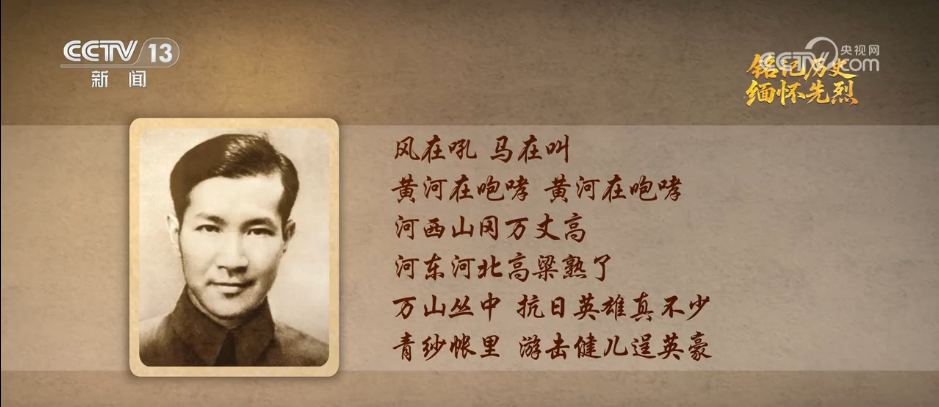
抗日英雄谱 | 音符为枪炮 乐谱成武器 他是以音乐救国的人民音乐家
Yang Shi Wang· 2025-08-14 02:46
Core Viewpoint - The article highlights the life and contributions of Xian Xinghai, emphasizing his role as a musician who used music as a weapon for national resistance during the Anti-Japanese War, particularly through his iconic work "Yellow River Cantata" [1][3][5]. Group 1: Background and Early Life - Xian Xinghai was born on June 13, 1905, in a poor family in Macau and studied music at various institutions including Lingnan University and the National Music Academy in Shanghai [3]. - He developed a deep sympathy for the working class and questioned the purpose of music, advocating for music that serves the common people rather than the elite [3]. Group 2: Involvement in Anti-Japanese War - After returning to China in 1935, Xian joined the Shanghai Drama Association's anti-Japanese efforts and participated in a series of performances to promote national resistance [5]. - Following the outbreak of the full-scale war, he organized mass singing movements and created numerous anti-Japanese songs, with "To the Enemy's Rear" being one of the most popular [5][7]. Group 3: Creation of "Yellow River Cantata" - Inspired by the poem "Yellow River Ode," Xian composed "Yellow River Cantata" over six days and nights during the Wuhan Campaign, which became a powerful anthem for the Chinese people's resistance [7][9]. - The cantata premiered in April 1939 and was met with strong acclaim, symbolizing the collective spirit of the Chinese people during the war [9]. Group 4: Later Life and Legacy - In 1940, Xian participated in the production of a documentary in Moscow and later integrated Kazakh musical elements into his works while in Kazakhstan [11]. - He passed away in Moscow in 1945, and his contributions were honored in both China and Kazakhstan, with a street named after him in Almaty, symbolizing the enduring friendship between the two nations [13].