国家消费品以旧换新政策

Search documents
国补发力点燃元旦手机市场 OPPO涨幅32.4%领跑行业
Sou Hu Cai Jing· 2026-01-05 07:13
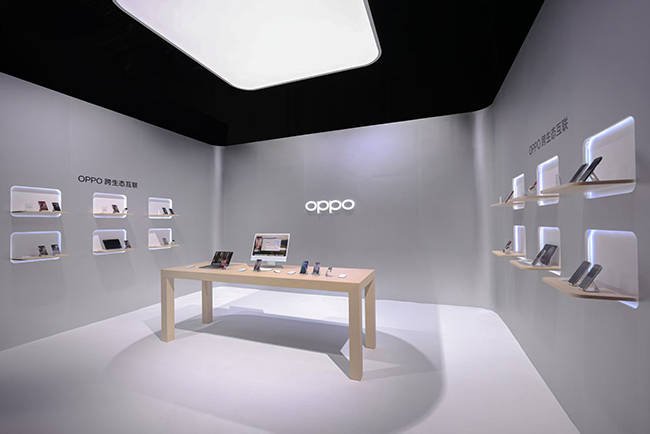
Core Insights - The domestic smartphone market experienced a significant boost during the New Year holiday, driven by the government's trade-in policy, with a year-on-year sales increase of 16.2% [1][3] - OPPO emerged as a major beneficiary of this policy, achieving a remarkable year-on-year growth of 32.4%, leading the growth chart among mainstream smartphone manufacturers [1][5] Government Policy Impact - The national subsidy policy, implemented by the National Development and Reform Commission and the Ministry of Finance, provides a 15% subsidy on eligible products, with a maximum subsidy of 500 yuan per phone [3] - The policy simplifies the application process through an "immediate purchase and subsidy" approach, significantly reducing consumer costs and time [3] - The subsidy covers a wide range of products, from budget to flagship smartphones, effectively countering the cost pressures from rising storage chip prices and stimulating consumer demand for upgrades [3] OPPO's Performance - OPPO's growth was particularly strong in two key price segments: the 2.5K-4K segment, which saw a 60% year-on-year increase, and the 4K-6K high-end segment, which achieved a 94.3% increase [5][7] - The X9 series and OnePlus 15 are highlighted as core drivers of growth in the high-end segment, showcasing flagship features and advanced technology [5][7] - The Reno15 series and OnePlus Ace6 led the mainstream segment by addressing diverse consumer needs, with the Reno15 focusing on lightweight design and balanced imaging, while the OnePlus Ace6 targeted performance and battery life [7] Strategic Positioning - OPPO's dual-brand strategy, with Reno15 and OnePlus Ace6 targeting the value market and X9 series and OnePlus 15 focusing on the high-end market, effectively meets varying consumer demands [9] - The combination of the subsidy policy and OPPO's strategic product positioning has successfully activated consumer interest across different price tiers [9]

2026年“国补”,有这些调整,周知!
Sou Hu Cai Jing· 2025-12-30 13:59
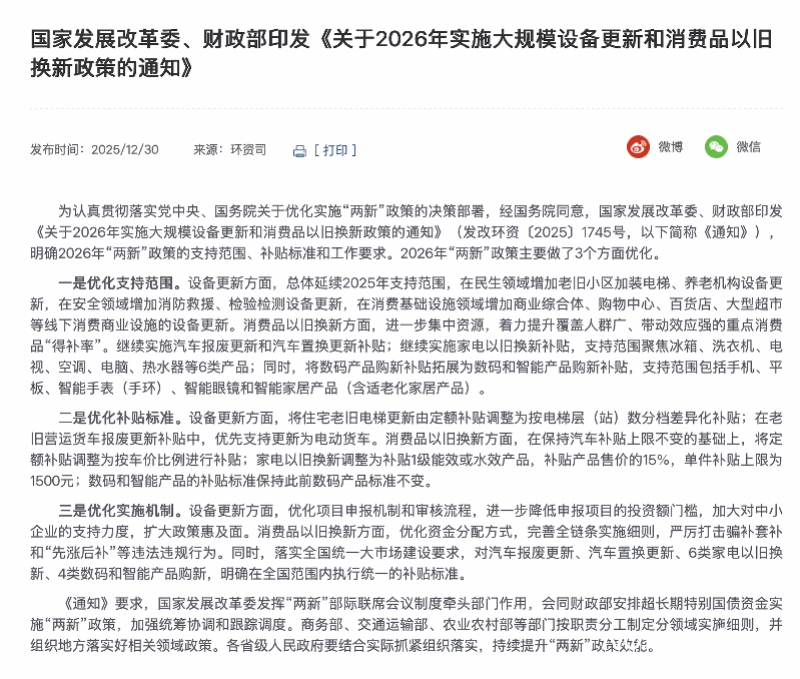
Core Viewpoint - The new "National Subsidy" policy for replacing old consumer goods will continue in 2026, with adjustments to the scope and intensity of subsidies [2][6]. Group 1: Policy Overview - The National Development and Reform Commission and the Ministry of Finance issued a notification on December 30, outlining the continuation of the consumer goods replacement policy for 2026 [2]. - The policy aims to boost consumption, as highlighted in the 14th Five-Year Plan, which emphasizes actions to stimulate consumption and enhance the supply of quality consumer goods and services [4]. Group 2: Changes in Subsidy Categories - The 2026 "National Subsidy" will focus on four main categories: vehicle scrapping, vehicle replacement, home appliances, and digital/智能 products, excluding home decoration and electric bicycles [6]. - The number of home appliance categories eligible for subsidies will decrease from 12 in 2025 to 6 in 2026, specifically targeting energy-efficient products [8]. Group 3: Specific Subsidy Details - Consumers purchasing eligible home appliances (refrigerators, washing machines, televisions, air conditioners, computers, and water heaters) will receive a subsidy of 15% of the product price, capped at 1,500 yuan per item [8]. - The digital product category for 2026 includes smartphones, tablets, smartwatches, and smart glasses, with the latter being a new addition compared to 2025 [10]. Group 4: Funding and Implementation - The funding for the "National Subsidy" program will continue to be sourced from long-term special government bonds, with 150 billion yuan issued in 2024, increasing to 300 billion yuan in 2025, and continuing in 2026 [11]. - The government has allocated 62.5 billion yuan in special bonds for the first batch of 2026 to support the consumer goods replacement policy, aiming to meet demand during peak consumption periods [11].
财政部明确2026年继续支持消费品以旧换新,调整补贴范围标准
Sou Hu Cai Jing· 2025-12-30 05:47
Group 1 - The core viewpoint of the article is that the "National Subsidy" policy for consumer goods trade-in will continue in 2026, with adjustments to the subsidy scope and standards to boost consumption [1][2] - The "National Subsidy" policy has shown a clear trend of expansion since its implementation in 2024, initially focusing on vehicle scrappage and eight categories of home appliances, with significant increases in support for 2025 [1] - The subsidy standards have also been enhanced, with the scrappage subsidy for purchasing new energy vehicles set at 20,000 yuan and for fuel vehicles at 15,000 yuan, maintaining these high standards into 2025 [1] Group 2 - The funding for the "National Subsidy" policy is primarily sourced from the issuance of ultra-long-term special national bonds, with the issuance amount increasing from 150 billion yuan in 2024 to 300 billion yuan in 2025 [2] - Experts suggest that future policy directions should focus on optimizing implementation methods and expanding the scope from goods consumption to service consumption, including cash subsidies and support for childcare and employment [2] - The recommendation includes a gradual shift from product subsidies to service consumption subsidies to better align with the evolving consumer demand structure [2]
2026年“国补”继续!如何调整?
Jing Ji Guan Cha Bao· 2025-12-28 15:42
Core Viewpoint - The "National Consumption Upgrade" policy, aimed at boosting consumer spending, will continue into 2026 with adjustments to subsidy scope and standards, as announced by the Minister of Finance at the national fiscal work conference [1] Group 1: Policy Evolution - The "National Consumption Upgrade" policy originated during the 2008 global financial crisis to stimulate consumption through subsidies for major consumer goods, focusing on rapid market activation [1] - The 2024 reintroduction of the policy marks a shift from short-term emergency measures to long-term empowerment, with three major upgrades compared to earlier versions [1] Group 2: Coverage and Standards - The coverage of the policy will expand from single categories to multiple scenarios, with the 2024 focus on vehicle scrappage and eight types of household appliances, and a broader scope for 2025 that includes digital products and home decoration [2] - Subsidy standards will transition from a uniform approach to differentiated optimization, such as increasing subsidies for new energy vehicles from 10,000 yuan to 20,000 yuan [2][3] - The funding source will shift from annual budgets to long-term special government bonds, with 150 billion yuan allocated in 2024 and 300 billion yuan in 2025, ensuring stable support for the policy [2][3] Group 3: Systematic Design - The expansion of subsidy categories and optimization of standards are coordinated with strengthened funding sources, creating a systematic design that transforms the policy from an emergency stimulus tool to a normalized consumption promotion mechanism [3] - Despite the policy's effectiveness, challenges remain, such as the temporary suspension of subsidies in some regions due to faster consumption of funds than bond issuance, necessitating a focus on existing funds rather than increasing the budget [3] Group 4: Implementation Challenges - The increase in subsidy categories may lead to local protectionism, where local brands receive preferential treatment, potentially distorting market competition [4] - Complicated application processes may deter consumers, particularly older individuals or those in rural areas, from accessing subsidies, undermining the policy's universality [4] - To ensure the policy effectively stimulates consumption, precise efforts are needed in coverage, standard design, and supporting mechanisms, including the establishment of a unified information platform for the entire process [5]
2026年“国补”继续!
Sou Hu Cai Jing· 2025-12-28 14:54
Core Insights - The "National Subsidy" policy for consumer goods recycling will continue in 2026, with adjustments to subsidy scope and standards to boost consumption [2][3] Group 1: Policy Evolution - The "National Subsidy" policy originated during the 2008 global financial crisis to stimulate consumption by providing financial subsidies for major consumer goods [2] - The 2024 version of the policy marks a shift from short-term emergency measures to long-term empowerment, expanding the scope from single categories to multiple scenarios [3] - The subsidy standards will transition from a uniform approach to a differentiated optimization, with increased subsidies for electric vehicles and fuel vehicles [3] Group 2: Funding and Implementation - Funding sources will shift from annual budgets to long-term special government bonds, with 150 billion yuan allocated in 2024 and 300 billion yuan in 2025, ensuring policy sustainability [4] - The 2025 policy will include digital products and home decoration, with specific subsidies for smartphones to stimulate the market for products under 6,000 yuan [4] Group 3: Challenges and Recommendations - Despite the policy's effectiveness, challenges such as regional disparities in subsidy distribution and bureaucratic hurdles need to be addressed to maintain fairness and accessibility [5] - To enhance the policy's impact, a unified information platform for recycling and subsidy verification should be established, along with regular evaluations of policy effectiveness [6] - The evolution of the "National Subsidy" from an emergency measure to a systematic approach is crucial for sustaining consumer confidence and market vitality [6]
明年“国补”范围和标准将调整
第一财经· 2025-12-28 11:48
Core Viewpoint - The article discusses the new developments in China's "National Subsidy" policy for consumer goods, emphasizing the continuation and optimization of the subsidy program in 2026 to boost consumption [3][4]. Group 1: Policy Continuation and Adjustments - The "National Subsidy" policy will continue in 2026, with adjustments to the scope and standards of subsidies [4]. - Since the implementation of the "National Subsidy" policy in 2024, the range of eligible products has been continuously optimized, expanding from 8 categories in 2024 to include additional products in 2025 [5]. - The subsidy standards for certain consumer goods have been adjusted, such as increasing the subsidy for scrapping and updating cars from 10,000 yuan to 20,000 yuan for eligible new energy vehicles [5]. Group 2: Funding and Financial Support - The funding for the "National Subsidy" primarily comes from the issuance of ultra-long-term special government bonds, with the amount increasing from 150 billion yuan in 2024 to 300 billion yuan in 2025 [5]. - The Ministry of Finance has confirmed that it will continue to issue ultra-long-term special government bonds in 2026 to support the "National Subsidy" [5]. Group 3: Recommendations for Future Implementation - Experts suggest that the effectiveness of the "National Subsidy" has declined due to previous demand being pulled forward and recommend shifting the focus from product subsidies to service consumption [6][7]. - There is a call for the inclusion of cash subsidies, digital currency, and support for childcare and employment in future subsidy programs [6].