
不间断电源(UPS)

Search documents
锐明技术(002970):2025年业绩高增,服务器电源、海外前装等新兴业务后续有望多点开花
GF SECURITIES· 2026-03-31 05:09
Investment Rating - The investment rating for the company is "Buy" with a current price of 66.21 RMB and a fair value of 84.92 RMB [5]. Core Views - The company has achieved significant growth in its annual performance, with emerging businesses such as server power supplies and overseas pre-installation expected to flourish in 2025 [2][3]. - The company is projected to maintain rapid growth in 2025, with a revenue forecast of 2.477 billion RMB, despite a year-on-year decline of 10.8% due to asset disposals. The net profit attributable to shareholders is expected to reach 383 million RMB, reflecting a year-on-year increase of 32.0% [8][12]. - The server power supply business is progressing rapidly, having entered the supply chains of international first-tier brands, with batch deliveries already achieved [12]. - The traditional main business shows promising prospects, particularly in the European pre-installation market, which is expected to generate an annual incremental space of 1-1.5 billion USD due to new EU regulations [12]. Financial Summary - The company’s revenue is projected to grow from 2.777 billion RMB in 2024 to 5.446 billion RMB in 2028, with growth rates of 63.5%, -10.8%, 29.3%, 32.8%, and 28.0% respectively [4][21]. - EBITDA is expected to increase from 390 million RMB in 2024 to 1.182 billion RMB in 2028, indicating strong operational performance [4]. - The net profit attributable to shareholders is forecasted to grow from 290 million RMB in 2024 to 1.073 billion RMB in 2028, with growth rates of 184.5%, 31.9%, 34.6%, 51.6%, and 37.4% respectively [4][21]. - The earnings per share (EPS) is projected to rise from 1.64 RMB in 2024 to 5.90 RMB in 2028 [4][21]. - The company’s price-to-earnings (P/E) ratio is expected to decrease from 29.1 in 2024 to 11.2 in 2028, indicating improving valuation metrics [4][21].
高盛闭门会-电网基础设施-从全球到本地的对标分析
Goldman Sachs· 2026-03-04 14:17
Investment Rating - The report indicates a strong growth outlook for Hitachi's grid infrastructure business, with a projected investment of $6 billion globally from 2024 to 2027, focusing on the US and European markets [1][3]. Core Insights - Hitachi's grid business has shown robust performance, with sales growth of nearly 25% year-on-year in the first three quarters of 2026 and a backlog of orders amounting to $57 billion, reflecting a 30% increase year-on-year [1][2]. - The demand for power infrastructure is being driven by the rise of AI data centers, which necessitate more stable power supply systems, leading to increased demand for grid construction and equipment [2][4]. - Hitachi plans to expand its workforce significantly, with an increase in employees in the US, Europe, South America, India, and China to support its growth strategy [3][5]. - The company is adopting a localization strategy to mitigate tariff risks, with most products already produced domestically in the US [1][8]. - Hitachi's profitability is improving, with an adjusted EBITDA margin reaching 13.6%, despite rising raw material costs, due to effective cost pass-through mechanisms [5][9]. Summary by Sections Business Structure and Importance - Hitachi operates in four main segments: Digital Systems and Services, Energy, Mobility, and Connected Industries, with the Energy segment being critical, accounting for approximately 25% of sales and adjusted EBITDA [2]. Performance and Demand Drivers - The energy-related business has experienced strong sales growth, particularly in Europe, North America, and the Middle East, driven by AI and data center demands [2][4]. Capacity Expansion and Supply-Demand Dynamics - Hitachi is investing $6 billion globally to expand capacity, with significant investments in the US and Europe, while monitoring supply-demand dynamics to avoid overcapacity risks [3][4]. Market Positioning and Competition - The company maintains a cooperative relationship with Chinese transformer manufacturers, integrating their products into its HVDC systems rather than competing directly [9]. Profitability and Revenue Quality - The report highlights that while profit margins are expanding, future growth in profitability may be constrained by high capital expenditures and depreciation [5][6]. Digital Strategy and Applications - Hitachi is leveraging its digital capabilities to enhance grid operations and create sustainable revenue streams, with a focus on optimizing supply and demand through its LumaDa system [5][7]. Tariff Impacts and Responses - The company has limited exposure to tariff impacts due to its domestic production strategy in the US, allowing for better price transmission in a tight supply environment [8][9].
未知机构:高盛闭门会详解中国工业的三大主题机器人aidc电力太空光伏20260201dl36-20260205
未知机构· 2026-02-05 01:40
Summary of Conference Call Records Industry or Company Involved - Humanoid Robotics Industry - Electric Power Supply Sector - Data Center Electrical Equipment - Space Solar Energy Industry Key Points and Arguments Humanoid Robotics Industry - **Cautious Outlook**: The humanoid robotics sector is viewed with caution as optimistic long-term growth expectations are already reflected in current stock prices. The rating for Sunwah Intelligent Control Asia will be downgraded from neutral starting November 2025 due to this concern [1][2] - **Challenges in Development**: Achieving general humanoid robot capabilities is more challenging and time-consuming than anticipated. For instance, Tesla's Optimus has a long-term shipment target of one million units, which is already priced into related stocks. The release of Optimus 3 has been delayed from February to the coming months, and it is still in early development stages [1][2] - **Market Demand and Growth**: The global humanoid robotics market is still in its early stages, with an expected shipment of approximately 15,000 units by 2025, which is only 3% of the annual shipment of industrial robots. Domestic leading companies are expected to achieve tens of thousands of units shipped by 2025 [3] - **Application Trends**: The demand structure is evolving, with 2025 focusing on early research applications. Future demand will shift towards specialized scenarios like guided tours, which require lower navigation and interaction capabilities [4] Electric Power Supply Sector - **Investment Logic**: The mainstream solutions for power shortages face significant bottlenecks, with 60% of AIDC power demand in the U.S. potentially met by natural gas. However, OEM manufacturers are at full capacity, leading to limited short-term expansion [5] - **Growth Projections**: INL is expected to see a 40% compound annual growth rate (CAGR) in EPS and a 25% CAGR in revenue over the next five years, driven by product structure optimization and improved profit margins [6] - **Market Share Growth**: By 2030, INL aims to achieve a revenue of 10 billion yuan, with significant contributions from partnerships with major companies like Siemens Energy and Baker Hughes [5][6] Data Center Electrical Equipment - **K Star's Competitive Edge**: K Star is a leading UPS supplier and the only Chinese company in the U.S. AI data center supply chain, with a projected 60% year-on-year profit growth in 2025. The company is expected to see a significant increase in orders from core clients [9] - **MKM's Transition Challenges**: MKM is transitioning to the global AI server power market but faces execution challenges, including managing complex supply chains and meeting project-based demands [9] Space Solar Energy Industry - **Demand Logic**: Elon Musk's plans for solar satellites have sparked expectations for increased demand in space solar energy. If Tesla and SpaceX's production plans materialize, the Chinese solar sector is expected to benefit significantly [10] - **Market Trends**: Domestic solar demand is projected to decline by 25% in 2026 but is expected to rebound by 14% in 2027, marking a critical turning point for the industry [15][19] Other Important but Possibly Overlooked Content - **Data Acquisition Challenges**: The humanoid robotics industry faces significant challenges in acquiring training data, which is crucial for AI development. Solutions include data factories and simulation training, but achieving high success rates remains a challenge [12][16] - **Electric Power Equipment Cycle**: The current cycle is driven by AI demand, contrasting with previous cycles driven by domestic policies. This shift presents new opportunities for Chinese companies in high-value markets like the U.S. [13][17] - **Execution Risks**: INL's capacity expansion plans face execution risks related to equipment yield and the need for skilled labor. MKM's transition to mass production is also under scrutiny due to potential delivery challenges [14][18]

高盛闭门会-详解中国工业的三大主题-机器人aidc电力太空光伏
Goldman Sachs· 2026-02-02 02:22
Investment Rating - The investment rating for Xinhua Intelligent Control Asia has been downgraded to Neutral due to market expectations already reflecting long-term prospects [2] Core Insights - The report highlights three major themes in the Chinese industrial sector: AI robots, AIDC power solutions, and space solar power [1] - The global humanoid robot shipment is expected to reach approximately 15,000 units by 2025, representing only 3% of the annual industrial robot shipments [3] - Significant growth is anticipated in the AIDC power sector, particularly for Chinese power solution providers, as they address urgent bottlenecks in AI infrastructure [2] Summary by Sections Humanoid Robots - The humanoid robot market is still in its early stages, with major shipments coming from Chinese companies. Future growth is expected to be exponential, with delivery targets increasing to thousands or even tens of thousands of units [3] - Current technology capabilities in humanoid robots have reached 80%-90% in terms of control, with rapid product iterations occurring every 6 to 8 months [3] AIDC Power Solutions - The report emphasizes the potential for Chinese power solution providers in the AIDC sector, particularly those capable of scaling delivery and supporting the transition to 800V DC systems [1][2] - Companies like Siyi Electric are expected to see a 40% increase in overseas orders, driven by product quality and global grid upgrades [8] Tesla Optimus Robot - Tesla's Optimus robot is still in early development, with potential sales not expected until late 2027. Current stock prices may reflect these expectations, and further evidence of effective AI models is needed for price support [4][5] Gas Turbine Blade Suppliers - INL, a gas turbine blade supplier, is positioned to benefit from power shortages and OEM capacity constraints, with a projected revenue CAGR of 25% by 2030 [6][7] Market Opportunities in Space Solar Power - The report discusses potential opportunities in space solar power, particularly with Tesla and SpaceX's plans to increase solar capacity significantly, which could benefit Chinese photovoltaic companies [13] Other Companies - KOSTA, a leading UPS supplier, is expected to see a 60% increase in net profit by 2025, driven by significant orders from the U.S. AI data center supply chain [9][10] - MKM is transitioning into the global AI server power market but faces execution challenges and is rated Neutral due to high valuation and recent losses [11][12]


AIDC深度报告:AI浪潮已至,电力设备有望迎来新机遇
Guotou Securities· 2025-12-28 08:31
Investment Rating - The industry investment rating is "Outperform the Market - A" [1] Core Insights - The artificial intelligence (AI) industrialization wave is approaching, leading to a rapid increase in demand for Artificial Intelligence Data Centers (AIDC) [4][11] - Power distribution equipment is a crucial component of AIDC and is expected to benefit significantly from the high demand in AIDC [36] - Major companies involved in the AIDC sector are highlighted, indicating potential investment opportunities [3] Summary by Sections Section 1: AI Industrialization and AIDC Demand Growth - AI is at a critical turning point for commercial deployment, driving a rapid increase in demand for intelligent computing power [4][11] - AIDC serves as the physical carrier for intelligent computing power, benefiting from the AI industrialization wave [12] - AIDC is evolving towards high energy consumption and high density, necessitating continuous upgrades in power distribution equipment [30][35] Section 2: Power Distribution Equipment in AIDC - Power distribution equipment is a vital part of AIDC, accounting for approximately 13% of initial investment costs [42] - AIDC's power supply architecture typically employs redundancy designs to ensure high reliability [43][44] - Diesel generator sets are the most common backup power solution for AIDC [56][60] - The transition from UPS to high-voltage direct current (HVDC) systems is anticipated, with HVDC becoming the mainstream architecture in the future [68][86] - The market for server power supplies is projected to exceed 100 billion, with supercapacitors and battery backup units (BBU) being key growth areas [113]



科士达 AIDC和BESS推动增长加速,首次覆盖评为买入
2025-12-20 09:54
Company and Industry Summary: Kstar (科士达) Company Overview - Kstar is a leading manufacturer of uninterruptible power supplies (UPS) in China, established in 1993 and listed on the Shenzhen Stock Exchange in 2010. The company has expanded its business into inverters, energy storage systems, and electric vehicle charging piles [doc id='12'][doc id='11']. Key Points Industry and Market Dynamics - The company is expected to benefit from the increasing capital expenditure in the AIDC (Automated Identification and Data Capture) sector, particularly in the data center market, where Kstar's UPS products are gaining traction [doc id='14'][doc id='49']. - The global demand for battery energy storage systems (BESS) is anticipated to recover significantly, with a projected CAGR of 31% from 2025 to 2030, driven by various market factors including power shortages and government subsidies [doc id='43']. Financial Performance and Projections - Kstar's projected EPS CAGR for FY2025-2027 is 44%, which is higher than the market consensus of 29% [doc id='1']. - The company’s revenue from data center products is expected to grow at a CAGR of 40% during the same period, supported by strong demand and order backlog [doc id='9']. - The revenue from the BESS segment is expected to rebound with a CAGR of 30% from 2025 to 2027, primarily due to demand recovery and inventory normalization [doc id='10']. Product Development and Innovation - Kstar is focusing on new product development, including high-voltage direct current (HVDC) systems and solid-state transformers (SST), which are expected to support long-term profitability [doc id='1'][doc id='27']. - The company has established strategic partnerships with key clients through ODM (Original Design Manufacturer) models, enhancing its market presence in overseas markets [doc id='15']. Valuation and Investment Rating - Kstar has been rated as a "Buy" with a target price of RMB 60.1, implying a PE ratio of 39x for 2026E, which is close to the industry average [doc id='4']. - The current stock price of RMB 47.0 reflects a PE ratio of 30x for 2026E, which is below the average of 42x for AIDC power equipment manufacturers [doc id='48']. Risks and Catalysts - Potential catalysts for growth include accelerated order accumulation from the US market, positive developments in HVDC product certification, and recovery in energy storage demand [doc id='4'][doc id='50']. - Risks include reliance on key customers and market fluctuations that could impact demand for UPS and BESS products [doc id='50']. Conclusion - Kstar is well-positioned to capitalize on the growth in the AIDC sector and the recovery in the energy storage market. With strong financial projections and ongoing product innovation, the company presents a compelling investment opportunity in the power equipment industry [doc id='11'][doc id='1'].
从UPS到800V HVDC:下一代数据中心供电产业趋势与SST机遇
Sou Hu Cai Jing· 2025-12-18 11:13
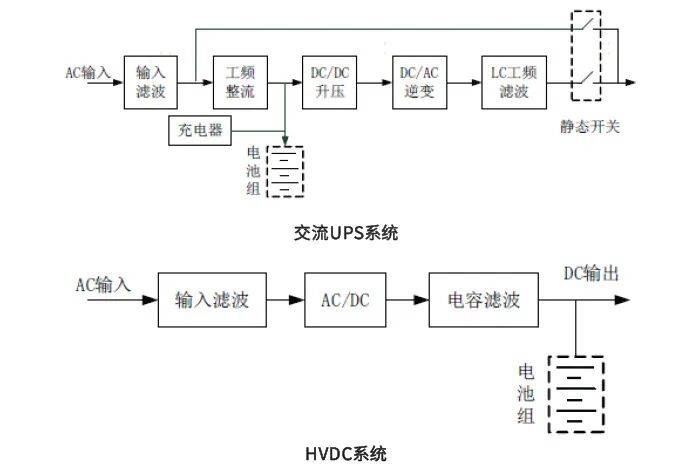
Core Insights - The explosive growth in computing power demand driven by artificial intelligence is pushing data centers towards a "power density revolution" [1] - Traditional uninterruptible power supply (UPS) systems face limitations in efficiency, heat dissipation, and space, which are critical constraints for large-scale data center development [1] - High Voltage Direct Current (HVDC) systems, particularly the 800V architecture, are emerging as mainstream solutions due to their significant energy efficiency and cost advantages [1][4] HVDC vs. Traditional UPS - HVDC systems are simpler and more reliable compared to traditional UPS systems, which require multiple conversion stages [4][6] - The transition from AC to DC in HVDC systems reduces energy loss and enhances reliability, as fewer components mean lower failure rates [6] - A 100kW HVDC system can save approximately 28% in space, 49% in construction costs, and 14% in operational costs compared to a traditional 120kVA UPS [7] Market Dynamics and Adoption - The domestic HVDC market is currently concentrated among leading companies like Zhongheng Electric and Weidi Technology, but the rapid growth in AI demand is accelerating innovation across the industry [8] - Major internet companies in China, such as Alibaba and Tencent, are adopting HVDC solutions in their data centers, with 240V HVDC systems becoming the mainstream technology due to compatibility with existing 220V AC equipment [8][9] 800V HVDC Technology - The 800V HVDC technology is gaining attention as AI server power density continues to rise, with NVIDIA and other companies forming a supplier alliance to promote its large-scale application by 2027 [9] - The advantages of 800V HVDC include a 45% reduction in copper usage, lower cooling costs by 30%, and a 70% decrease in maintenance costs due to fewer power supply unit failures [9] Solid-State Transformer (SST) Development - The development of solid-state transformers (SST) is crucial for the implementation of 800V HVDC systems, enabling efficient AC/DC conversion [10] - Companies entering the SST market need expertise in power electronics, high-frequency transformer technology, and experience in data center projects [10] Company Profiles - China West Electric reported a revenue of 16.959 billion yuan in the first three quarters of 2025, with a 19.29% increase in net profit, and is actively involved in the development of SST for data centers [11] - Delta Electronics, with a revenue of approximately 393.2 billion NTD in the first three quarters of 2025, launched a new 800V HVDC system aimed at enhancing efficiency and safety for AI data centers [12] - TBEA, a leading transformer manufacturer, is also developing SST products, although their current application is limited [15] Future Trends - The transition from UPS to 800V HVDC and the integration of SST represents a significant evolution in data center power supply technology, driven by the pursuit of efficiency [16] - The HVAC sector is expected to face new opportunities for electrification, with a growing need for DC-compatible cooling equipment as 800V HVDC systems become more prevalent [16] - The entire energy chain of data centers is undergoing profound changes, with Chinese companies poised to achieve technological breakthroughs in emerging fields like SST and DC HVAC equipment [16]

金字塔脚下的光与电
中国能源报· 2025-11-10 00:34
Core Viewpoint - The Grand Egyptian Museum (GEM) represents a significant advancement in integrating modern energy systems with cultural heritage, showcasing a commitment to sustainability through innovative energy supply strategies and low-carbon design principles [4][14]. Energy Supply System - GEM has developed a new energy supply system that incorporates various designs to address low-carbon challenges, ensuring stable environmental conditions for artifact preservation while minimizing carbon emissions and enhancing energy efficiency [4][12]. - The museum's solar energy system is expected to generate approximately 2.24 GWh annually, making it one of the first large museums in Africa and the Middle East to rely significantly on solar power [5][14]. Localized Solar Power Strategy - The solar panels installed on the museum's roof and parking area follow a "localized" approach, optimizing land use and blending with the museum's architecture [7]. - The solar power system is designed to prioritize energy for lighting, air conditioning, and exhibit control, with excess energy either fed back into the grid or stored for peak load management [7][14]. Continuous Power Supply - GEM employs a robust power distribution and automation system to ensure uninterrupted power supply, crucial for protecting valuable artifacts from potential damage due to power outages [10]. - The museum is equipped with uninterruptible power supplies (UPS) and high-capacity backup generators, providing a multi-layered power supply strategy that is standard for large international museums [10][11]. Energy Efficiency and Water Conservation - The museum has achieved over 60% energy savings through passive and active energy design strategies, and it has reduced water usage by approximately 34% [12][13]. - Specific measures include high-sealing display cases, LED lighting with sensors, and efficient HVAC systems, all contributing to reduced energy consumption and enhanced artifact preservation [12][13]. Sustainable Operations - GEM promotes low-carbon transportation options, such as electric vehicle charging stations, and implements green procurement and waste management practices, creating a sustainable operational framework [13][14]. - The museum has been recognized as one of the first advanced green museums in Africa and the Middle East, reflecting both technological achievements and collaborative governance efforts [13][14]. Future Challenges - Despite its advancements, GEM faces ongoing challenges, including the need for energy storage solutions to balance solar power intermittency and further reduce operational carbon emissions [14].
“AI闭环”假期刷屏!一文读懂北美数据中心供应链
硬AI· 2025-10-08 05:33
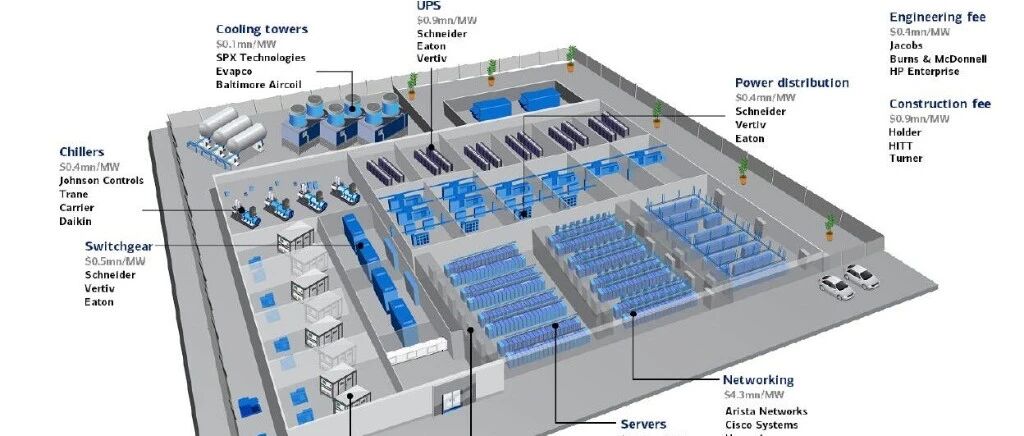
Core Insights - The article emphasizes that the AI-driven data center market is experiencing unprecedented growth, with key players in cooling and power supply technologies poised to benefit significantly from this trend [2][4][54] Data Center Market Overview - The global capital expenditure for data centers is projected to exceed $400 billion in 2024 and reach $506 billion in 2025, driven by AI demand, with a compound annual growth rate (CAGR) of 23% expected from 2024 to 2028 [3][4] - The data center market is shifting from traditional self-built models to cloud service providers and colocation companies, with major players like Amazon AWS and Microsoft Azure leading the way [8] Supply Chain Dynamics - The supply chain for data centers is complex, with significant opportunities for "shovel sellers" in the AI boom, particularly in thermal and electrical systems [4][35] - The cooling system market is expected to reach approximately $10 billion by 2024, with companies like Vertiv, Johnson Controls, and Carrier being key players [37] - The electrical system market is projected to be around $18 billion in 2024, with Schneider Electric leading the sector [39] Infrastructure Transformation - The article discusses a "density revolution" in data centers, where the power density of server racks is increasing dramatically, necessitating upgrades in cooling and power supply systems [16][18] - Traditional air cooling systems are becoming inadequate, leading to a shift towards liquid cooling technologies, particularly direct-to-chip cooling [24][28] - The transition to high-voltage direct current (HVDC) power systems is highlighted as a critical evolution in data center infrastructure, reducing energy loss and material costs [30][31] Financial Metrics and Investment Returns - A typical wholesale colocation data center project can generate annual rental income of $2 million to $3 million per megawatt, with EBITDA margins typically reaching 40% to 50% [12][13] - The total cost of constructing a next-generation AI data center is expected to rise by 33% to $52 million per megawatt, driven by the need for advanced infrastructure [36] Conclusion - The article concludes that the ongoing AI revolution is not just a technological advancement but also a significant infrastructure investment opportunity, with companies that provide essential cooling and power technologies set to emerge as the true winners in this evolving landscape [54][50]
科华数据:AIDC及储能业务双引擎,有望支撑长期增长
2025-09-15 13:17
Summary of Kehua Data Conference Call Company Overview - Kehua Data is the second-largest uninterruptible power supply (UPS) manufacturer in China, with a market share of 13%, following Huawei's 18% [doc id='12'] - The company was founded in 1988 in Fujian Province and went public in 2010 on the Shenzhen Stock Exchange [doc id='62'] - Kehua has expanded its sales network to over 30 countries and established long-term partnerships with major clients, including leading hyperscale cloud providers [doc id='62'] Industry Insights - The global AIDC (AI Data Center) capital expenditure is expected to accelerate, benefiting UPS and energy storage sectors [doc id='9'] - The global UPS and HVDC (High Voltage Direct Current) market is projected to reach $8.4 billion by 2028 [doc id='9'] - The global energy storage demand is forecasted to grow at a CAGR of 22% from 2025 to 2027, reaching 338 GWh by 2027 [doc id='3'] Key Financial Projections - Kehua's earnings per share (EPS) is expected to grow at a CAGR of 37% from 2025 to 2027, driven by increased AIDC capital expenditures and new product launches [doc id='12'] - Revenue from data center products is projected to grow at a CAGR of 37% during the same period [doc id='2'] - The company's renewable energy business, which includes energy storage and photovoltaic inverters, is expected to achieve a CAGR of 19% from 2025 to 2027 [doc id='3'] Product and Market Strategy - Kehua is focusing on expanding its overseas market presence, particularly in the energy storage sector, to capture strong demand [doc id='3'] - The company has established a strong relationship with major hyperscale cloud providers, with 50% of its UPS sales coming from these clients [doc id='13'] - Kehua's new HVDC products are expected to penetrate overseas markets, enhancing its competitive position [doc id='21'] Valuation and Investment Rating - Kehua is rated as a "Buy" with a target price of RMB 78.5, implying a 40x PE ratio for 2026E, which is considered reasonable compared to industry peers [doc id='4'] - The current stock price is RMB 57.05, reflecting a PE ratio of 29x for 2026E, which is below the average of 40x for similar companies in the A-share market [doc id='46'] Risks and Catalysts - Potential risks include market fluctuations and the impact of policy changes on domestic demand for energy storage [doc id='36'] - Positive catalysts for stock price appreciation include increased orders from hyperscale cloud providers and successful commercialization of new products [doc id='48'] Conclusion - Kehua Data is well-positioned to benefit from the growing demand for UPS and energy storage solutions driven by the AIDC investment boom and its strong relationships with major clients [doc id='12']
