东方红一号

Search documents
“两弹一星”辉煌之路专题展开幕,亲历者讲述在金银滩的奋斗岁月
Xin Lang Cai Jing· 2026-01-07 12:04
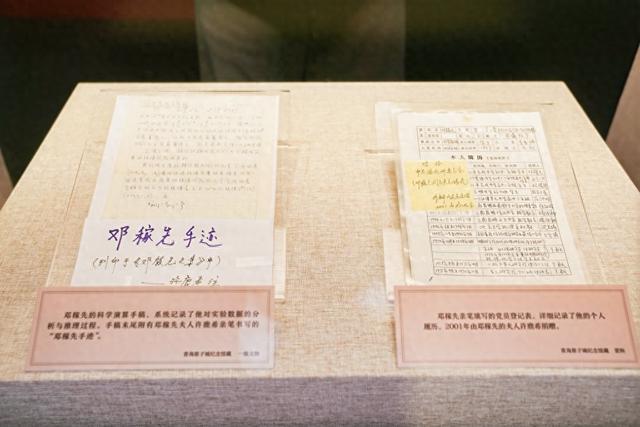
Core Viewpoint - The exhibition "Forging Dreams at Jinyintan: The Glorious Path of China's 'Two Bombs, One Satellite'" highlights the historical significance and achievements of China's nuclear and space programs, showcasing the dedication and sacrifices of the scientists involved in these endeavors [1][12]. Group 1: Exhibition Overview - The exhibition is organized by the Propaganda Department of the CPC Haibei Prefecture Committee, the Memorial Hall of the First National Congress of the Communist Party of China, and the Qinghai Atomic City Memorial Hall [1]. - It features 69 selected cultural relics, including manuscripts by Yu Min, resumes of Deng Jiaxian, and artifacts from the first atomic bomb explosion [4][6]. Group 2: Historical Context - The exhibition focuses on the Jinyintan area in Haibei Prefecture, Qinghai Province, where significant developments in China's nuclear program took place [3][4]. - It recounts the arduous journey of scientists and technicians who worked under extreme conditions at an altitude of 3,300 meters, emphasizing their commitment and bravery [3][6]. Group 3: Thematic Structure - The exhibition is divided into four sections: "Mission Call," "Climbing New Heights," "Great Achievements," and "Building Dreams for Revival," which collectively narrate the evolution of China's "Two Bombs, One Satellite" initiative [6]. - It illustrates the spirit of innovation and perseverance embodied by pioneers like Deng Jiaxian, Wang Ganchang, and Guo Yonghuai [7]. Group 4: Visual Representation - The first floor of the exhibition recreates the scene of General Li Jue leading a team to Jinyintan in August 1958, marking the beginning of the 221 Base construction [9]. - The second floor showcases models of China's first atomic bomb, hydrogen bomb, and the "Dongfanghong-1" satellite, alongside significant achievements in space exploration [9]. Group 5: Significance and Legacy - The exhibition serves as a spiritual dialogue across time and space, connecting the origins of the CPC's founding spirit to the development of the "Two Bombs, One Satellite" spirit [10]. - It aims to inspire visitors by highlighting the historical struggles and achievements of the scientists, reflecting a deep sense of national pride and dedication [10].

336877号小行星,以他的名字命名!
Huan Qiu Wang Zi Xun· 2025-12-18 05:39
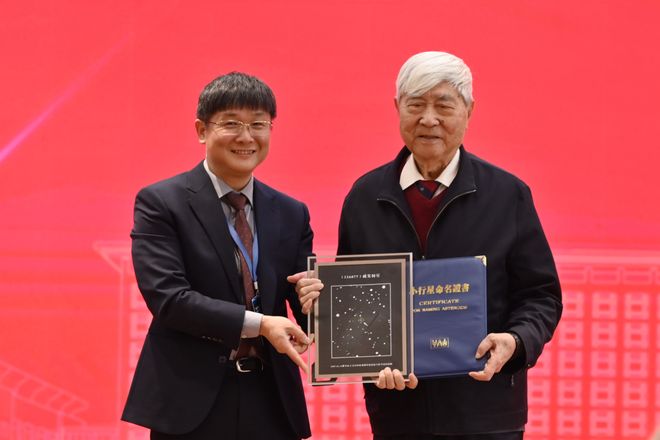
Core Viewpoint - The "Qifa Run Star" naming ceremony and academic report on space exploration were held by the China Aerospace Science and Technology Corporation's Fifth Academy, marking the official naming of an asteroid discovered by the Purple Mountain Observatory of the Chinese Academy of Sciences as "Qifa Run Star" [1][3]. Group 1 - The asteroid, internationally numbered 336877, received its name following approval from the International Astronomical Union [1]. - The ceremony included the reading and presentation of the international naming announcement and certificate for "Qifa Run Star" [1]. Group 2 - Academician Qifa Run reflected on three significant events in his aerospace career: participation in the first artificial Earth satellite "Dongfanghong-1," involvement in the "331 Project" which launched China's first communication satellite "Dongfanghong-2," and contribution to the Shenzhou-5 mission, making China the third country with human spaceflight capability [3]. Group 3 - Qifa Run, born in April 1933 in Liaoning Province, is an academician of the Chinese Academy of Engineering, the first chief designer of the Shenzhou spacecraft, and a member of the International Academy of Astronautics [5].
哈工大航天馆:在浩瀚星河中找到青春坐标
Ren Min Ri Bao· 2025-12-03 03:41
Core Insights - The Harbin Institute of Technology (HIT) is fostering a strong interest in aerospace among its students, as evidenced by their engagement with the university's Aerospace Museum and various projects [2][3][5]. Group 1: Student Engagement and Inspiration - The Aerospace Museum at HIT features significant exhibits such as the "Dongfanghong-1" satellite model, which has inspired students like Lin Chenyu to pursue aerospace studies [3][4]. - Lin Chenyu's journey from being a high school student captivated by space education to a university student reflects the impact of innovative teaching methods like the "Tian Gong Classroom" [3][4]. - The emotional connection students feel towards the achievements of past aerospace pioneers motivates them to contribute to future advancements in the field [4]. Group 2: Research and Development Projects - The "Astou Friendship" microsatellite project, involving nearly 50 students, showcases HIT's commitment to practical aerospace applications and new technology validation [5][6]. - The project faced challenges during its launch, particularly with the solar panels, which required innovative solutions from the ground control team to stabilize the satellite's power supply [5][6]. - Students like Yu Zhuowei are actively involved in developing power distribution systems for multiple satellites, emphasizing the importance of teamwork and legacy in aerospace engineering [6].
航天强国建设的四重逻辑
Si Chuan Ri Bao· 2025-11-30 21:04
Core Viewpoint - The article emphasizes the strategic importance of building a strong aerospace nation as part of China's "14th Five-Year Plan," highlighting its historical significance and the need for innovation and development in the aerospace sector [1][4][6]. Theoretical Logic - Science is identified as a core driver of social progress and productivity, with historical perspectives from Marx and Deng Xiaoping underscoring the importance of technological advancement in national development [2][3]. Historical Logic - The aspiration to build a strong aerospace nation is rooted in China's rich cultural heritage and historical achievements in space exploration, from ancient myths to modern technological milestones [4][5]. Realistic Logic - The necessity of developing a strong aerospace sector is framed as a response to global changes and national needs, with an emphasis on enhancing self-innovation capabilities and addressing international competition in space [6][7]. Practical Logic - Building a strong aerospace nation is positioned as essential for achieving a modern socialist country, requiring a focus on institutional support, innovation, talent development, and international cooperation [8][9]. Regional Focus - The article highlights the role of Sichuan province in supporting national aerospace development, leveraging local resources and capabilities to contribute to the broader goals of building a strong aerospace nation [10].
航天vlog|寻访“东方红”升起的地方
Xin Hua She· 2025-11-14 12:38
Core Viewpoint - The article highlights the historical significance of the "Dongfanghong 1" satellite as a symbol of China's space exploration journey, marking the transition from zero to one in the country's aerospace achievements [2]. Group 1 - "Dongfanghong 1" has been restored and transformed into an educational base that connects history with the future, showcasing the stories of China's early space pioneers [2]. - The return of the Shenzhou 20 astronaut crew coincides with a reflection on the origins of China's space dream, emphasizing the emotional and historical context of the space program [2].
神舟二十一号|神舟弦鸣不辍 天地共谱长歌——写在神舟二十一号载人飞船成功发射之际
Xin Hua She· 2025-10-31 16:31
Core Points - The successful launch of the Shenzhou 21 manned spacecraft marks a significant milestone in China's space exploration efforts, with a total of 28 astronauts and 44 missions to date [1][5] - The launch is part of China's broader strategy to establish itself as a space power, as outlined in the 14th Five-Year Plan and the upcoming 15th Five-Year Plan [1][4] - The Long March rocket family has demonstrated rapid advancements in launch capabilities, reflecting China's growing technological prowess and commitment to space exploration [2][3] Group 1: Launch and Mission Details - The Shenzhou 21 mission is the sixth manned flight to the Tiangong space station, concluding China's manned space launch tasks for 2025 [1] - The Long March 2F rocket, which has a payload capacity of approximately 8.6 tons to low Earth orbit, successfully lifted off from the Gobi Desert [2] - The mission includes a diverse crew of astronauts, who will conduct various scientific experiments during their six-month stay in space [6][7] Group 2: Technological Advancements - The Long March rocket family has achieved significant milestones, with the time taken to reach successive launch milestones decreasing dramatically over the years [2][3] - China's space program has evolved from its inception to now include a fully operational space station, showcasing advancements in space science and technology [3][4] Group 3: Future Plans and Collaborations - The National Space Science Medium- and Long-term Development Plan (2024-2050) will guide future space exploration efforts, with a focus on scientific research and international collaboration [4][10] - China has signed nearly 200 intergovernmental space cooperation agreements with over 50 countries, indicating a commitment to global partnerships in space exploration [10] - The upcoming 15th Five-Year Plan aims to achieve significant milestones, including the first Chinese landing on the Moon and the participation of astronauts from Hong Kong and Macau [10]
马英九一行参访酒泉卫星发射中心 点赞大陆航天科技
Zhong Guo Xin Wen Wang· 2025-06-24 12:32
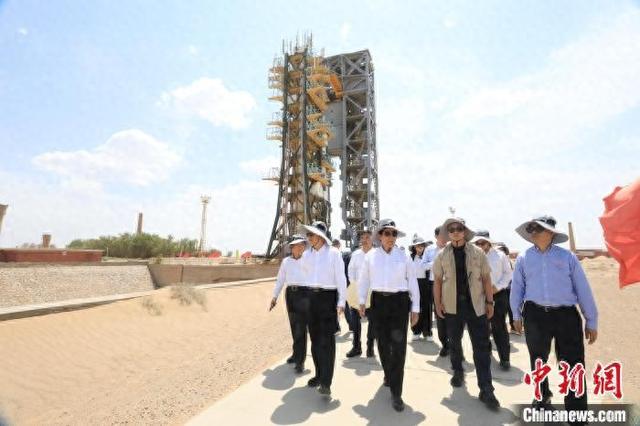
Group 1 - Former Kuomintang Chairman Ma Ying-jeou led a delegation of Taiwanese youth to visit the Jiuquan Satellite Launch Center, showcasing China's advancements in space technology [1][3] - The Jiuquan Satellite Launch Center is notable for being the first satellite launch site in mainland China, having launched a total of 33 satellites from 1966 to 1996, including the first artificial Earth satellite "Dongfanghong 1" [1] - Ma Ying-jeou expressed admiration for the impressive structure of the launch tower, which exceeds 100 meters in height, and highlighted the significance of China's space achievements, such as the Chang'e 6 mission to the far side of the moon [3][5] Group 2 - The visit included insights into China's advanced space technology and its global leadership in the field, as noted by the executive director of Ma Ying-jeou's foundation, who emphasized the importance of sharing technological advancements between the two sides of the Taiwan Strait [5] - The delegation also visited significant cultural sites in Gansu Province, including the Leitai Han Tomb and Jiayuguan, and learned about advanced medical facilities such as the world's best heavy ion hospital [5]

跑好探索宇宙的接力赛
Jing Ji Ri Bao· 2025-04-27 00:05
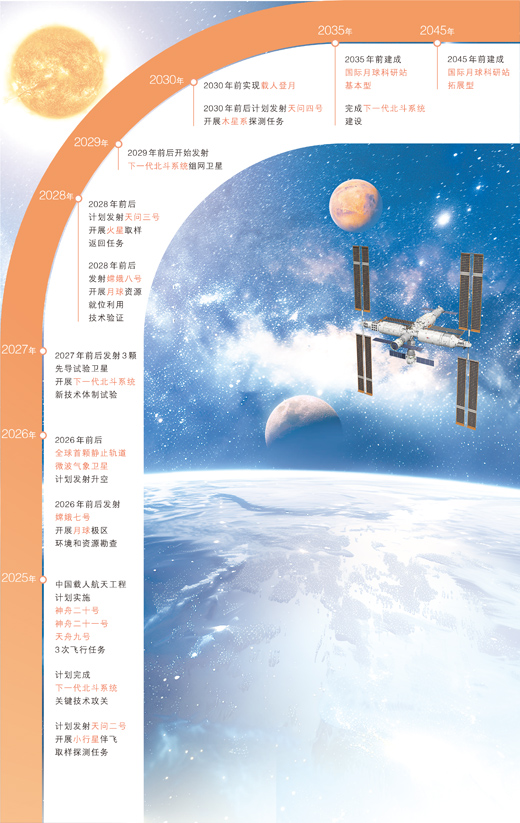
Core Viewpoint - The 10th "China Space Day" marks significant milestones in China's space exploration, celebrating achievements and setting ambitious future goals for human spaceflight and lunar exploration [2][3][4][5] Group 1: Historical Achievements - The successful launch of China's first artificial satellite "Dongfanghong-1" 55 years ago initiated the country's journey into space, leading to numerous milestones such as the Chang'e lunar missions and the construction of the Tiangong space station [2] - China has completed 20 astronaut extravehicular activities, with the longest single activity lasting 9 hours, setting a world record and demonstrating advanced capabilities in complex space operations [3] Group 2: Current Developments - The Chinese space program has achieved significant advancements, including the successful implementation of over 200 scientific and application projects in orbit, and the ongoing development of technologies for manned lunar missions by 2030 [3] - The number of commercial space enterprises in China has surpassed 500, with increasing satellite launches and advancements in satellite manufacturing and rocket recovery technologies, indicating a shift towards a robust space economy [3] Group 3: Future Aspirations - The future vision includes not only manned lunar missions but also fostering international cooperation in space exploration, as evidenced by the announcements regarding the Chang'e 5 lunar sample sharing and the Tianwen-3 Mars sample return mission [4] - The ongoing efforts to build a strong space nation are seen as a continuous journey, requiring persistent innovation and collaboration to overcome challenges and achieve shared human aspirations in space [5]

豫论场 | 这一次,太空又来俩河南人
He Nan Ri Bao· 2025-04-24 11:08
Group 1 - The successful launch of Shenzhou 20 marks a significant milestone in China's space exploration, coinciding with the 55th anniversary of the launch of the first artificial satellite, Dongfanghong 1 [1] - The mission features three astronauts, including Chen Dong, who is the first astronaut from the second batch to fly three times, and Chen Zhongrui, who is embarking on his first flight [1][2] - Innovation is highlighted as the primary driving force behind the development of the aerospace industry, with advancements in various missions showcasing China's commitment to space exploration [1] Group 2 - Chen Dong's previous missions included significant achievements such as the construction of the Chinese space station, where he and his team completed multiple docking and separation tasks, earning the title of the "busiest crew" in China's manned spaceflight history [2] - The aerospace sector is increasingly contributing to economic and social development, with applications in meteorology, communication, navigation, and commercial space ventures [3] - Henan province is actively integrating into the national strategy of building a strong aerospace nation, developing a comprehensive commercial aerospace industry chain that includes satellite manufacturing and data application [3]
星辰大海 再启新程
Ren Min Ri Bao· 2025-04-23 22:07
Group 1 - The core viewpoint emphasizes China's continuous advancements in space exploration and technology, marking significant milestones such as the Shenzhou 20 mission and the achievements of the Chang'e lunar exploration program [2][3][4] - The successful launch of the Shenzhou 20 manned spacecraft coincides with the 10th "China Space Day," celebrating 55 years since the launch of China's first artificial satellite, Dongfanghong 1 [2] - China's space program has achieved critical technological breakthroughs, including manned spaceflight and docking capabilities, leading to the establishment of its own space station [3] Group 2 - Recent achievements in space science include the Chang'e 6 mission, which successfully returned samples from the far side of the moon, setting a world record for lunar exploration [3] - The development of space science has accelerated, with significant contributions from satellites like Wukong, Mozi, and Huiyan, enhancing our understanding of the universe [3] - The application of space technology in various sectors, such as agriculture and manufacturing, is driving high-quality development and creating new economic opportunities [3]