买方投顾服务

Search documents
从"我想卖什么"到"客户需要什么":国海证券贺春明谈财富管理服务理念转变
Xin Lang Cai Jing· 2026-01-16 09:18
Core Viewpoint - The transformation of wealth management has become an industry consensus, with a shift from traditional brokerage and distribution services to differentiated services, primarily through the establishment and development of a buy-side advisory model [3][7]. Group 1: Buy-Side Advisory Model - The buy-side advisory model represents a fundamental change in the business model, distinguishing itself from the sell-side model, which charges product issuers, by directly providing professional services to clients and charging them accordingly [3][7]. - The buy-side advisory model is seen as a key direction for companies to create differentiated advantages in the wealth management industry [3][7]. Group 2: Rationale for Buy-Side Advisory - The buy-side advisory model addresses client pain points, focusing on providing tailored solutions that meet clients' actual needs rather than merely selling products [4][8]. - The long-term commercial value of the buy-side advisory model is significant, as traditional channel businesses are experiencing a decline, with recent trading volumes reaching over 30 trillion, reflecting a 3-4 times increase compared to the previous year, yet retail brokerage revenues have not grown at the same pace [4][9]. - The current financial asset ownership among the Chinese public is only 15%, comparable to the state of the U.S. market 20-30 years ago, indicating substantial future growth potential for wealth management services [4][9]. Group 3: Industry and Client Demand - There is a mutual drive between industry transformation and increasing client demand for professional advisory services, as market rules become more complex [5][9]. - The commitment to developing the buy-side advisory model aligns with deep client needs and presents significant commercial value and strategic opportunities for the wealth management industry [5][9].


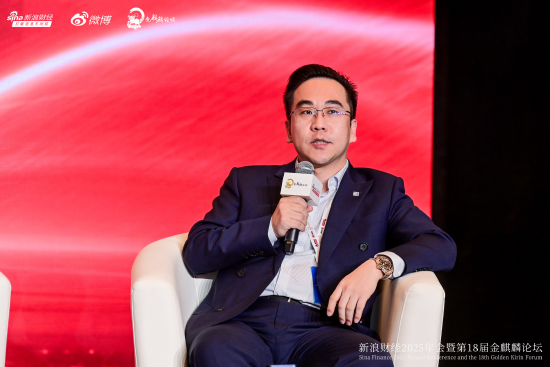
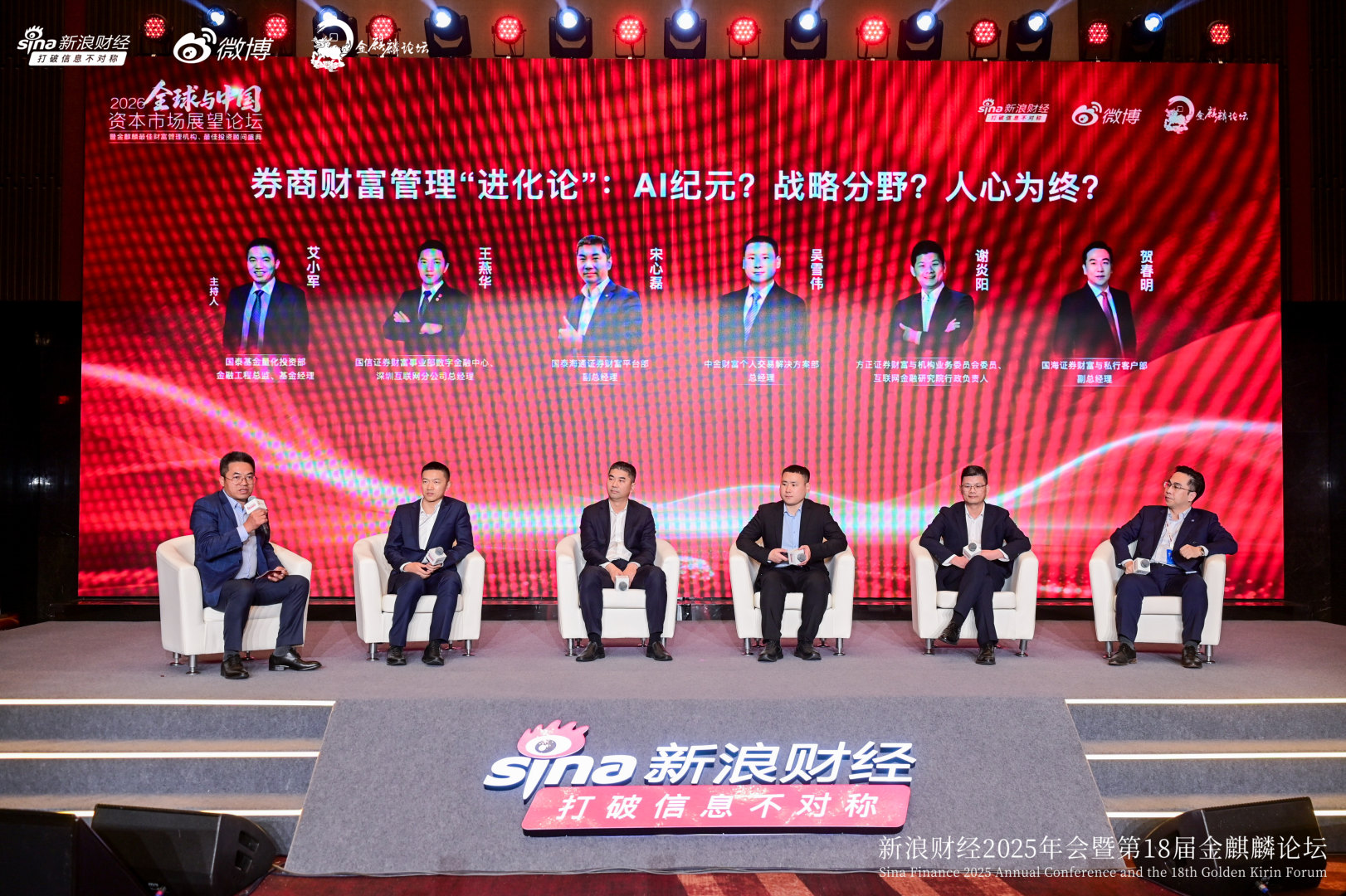
吴雪伟:中金财富买方投顾资产规模突破1300亿,创新交易服务签约的客户整体收益率比未签约客户提高28%
Xin Lang Cai Jing· 2026-01-15 10:35
Core Insights - The core focus of the article is on the future direction of CICC's wealth management services, particularly emphasizing the importance of buy-side advisory services in the next 2-3 years [1][5]. Group 1: Buy-Side Advisory Services - CICC's buy-side advisory services have successfully surpassed an asset scale of 130 billion yuan, indicating significant achievements in this area [1][5]. - The scope of buy-side advisory services extends beyond public and private fund configurations to include stock and ETF trading, highlighting a growing demand for these services [6]. - Two key criteria define true buy-side advisory services: solutions must align with actual client needs rather than sales targets, and the services must create substantial value for clients [6]. Group 2: Service System and Client Engagement - CICC is developing a systematic trading service framework centered on client needs, integrating research information, securities advisory, multi-scenario trading, and smart trading tools [2][6]. - The trading service system has signed up 450,000 clients, reflecting increasing market recognition [2][6]. - Clients participating in CICC's innovative trading services have seen an overall account return that is 28 percentage points higher than non-participating clients, demonstrating the professional value of buy-side advisory services [2][6]. Group 3: AI Technology Integration - AI technology is seen as having significant potential in the buy-side advisory sector, aiding in demand insight and service implementation [3][7]. - The integration of AI allows for more efficient identification of client needs and supports the core service-oriented philosophy of buy-side advisory [7]. - AI's dual empowerment value in securities advisory includes enhancing content production efficiency and providing support in client-facing scenarios [3][7].
从短期博弈到长期共赢,“买方投顾”藏着怎样的投资新体验?
Nan Fang Du Shi Bao· 2025-12-29 03:55
Core Insights - The "buy-side advisory" model has become a core direction for the transformation of the wealth management industry in China, with Guangzhou positioning itself as the "first city for advisory" [2] - The model fundamentally differs from traditional advisory by restructuring the profit orientation, service logic, and fee mechanisms, leading to a significant change in the commercial model of wealth management services [3] Group 1: Buy-Side Advisory Model - The buy-side advisory model prioritizes client interests, linking advisor income directly to the long-term appreciation of client assets, thus shifting from product-based fees to client-based fees [3] - This model promotes a "full-cycle companion service," integrating client needs assessment, risk tolerance, and long-term financial goals into asset allocation strategies [3] - The evaluation metrics for advisors have shifted from product sales to client asset retention rates, account profitability, and client satisfaction, creating a virtuous cycle of "client profit - advisor income - institutional development" [3] Group 2: Impact on Investor Behavior - The buy-side advisory model has reduced irrational investment behaviors, with advisory clients showing a 40% decrease in chasing market trends [5] - Risk management capabilities have improved, with only 0.7% of advisory clients experiencing losses exceeding 20%, compared to 10% for self-directed investors [5] - Advisory clients have a higher cumulative profit rate of 76.9%, outperforming self-directed clients by 13.5 percentage points, attributed to optimized asset allocation [6] Group 3: Market Growth and Client Engagement - The market for buy-side advisory services has grown significantly, with over 8 million clients and an estimated asset management scale exceeding 200 billion RMB by the end of 2024 [7] - The client re-investment rate has increased from 12.1% in 2022 to 38.2%, indicating a growing trust in advisory services [8] - The average holding period for advisory clients has extended to nearly 2 years, reducing market volatility impacts [8] Group 4: Challenges in Trust and Perception - Four main challenges affect investor trust in advisory services, including unclear service value perception, lack of transparency, inconsistent service quality, and short-term performance expectations [9] - Investors often confuse "independent advice" with "return guarantees," leading to misaligned expectations regarding advisory performance [11] - There is a structural shortage of qualified advisory professionals, with a demand for over 1 million advisors in China, highlighting the need for comprehensive training programs [12] Group 5: Talent Development and Industry Standards - The Guangzhou Investment Advisory Academy has proposed the "ASK" model for talent development, focusing on attitude, skills, and knowledge [12] - The academy aims to establish a professional capability training system and has developed standards for buy-side advisory services to enhance service quality [13] - Recent regulatory guidelines are expected to further standardize performance assessments and sales behaviors in the asset management industry, promoting the growth of buy-side advisory services [14]

《拥抱金融健康》白皮书发布:持续提升金融素养 优化资产配置结构
Zheng Quan Shi Bao Wang· 2025-11-18 08:53
Core Insights - The white paper titled "Embracing Financial Health: Wealth Management Supporting the High-Quality Development Path and Practice of Inclusive Finance" was jointly released by China International Capital Corporation Wealth Management and the China University of Political Science and Law's China Inclusive Finance Research Institute, focusing on wealth management for residents and financial empowerment for small and medium-sized enterprises (SMEs) [1] Group 1: Resident Financial Health - The survey indicates that nearly 70% of respondents have a good level of financial health, but there are shortcomings in financial control, money management, future investment capabilities, and risk prevention [1] - Residents show a long-standing tendency to favor real estate over financial assets, with low participation in equity markets due to factors like insufficient financial knowledge, high investment costs, limited opportunities, and information asymmetry [2] - Behavioral biases among resident investors include excessive trading, short-term holding, chasing gains, familiarity bias, and concentrated asset allocation, which negatively impact investment returns and financial health [2] Group 2: SME Financial Health - The financial health of SMEs is crucial for the overall quality and sustainability of economic development, with many SMEs overly reliant on bank loans, leading to high financial leverage [3] - A significant portion of SME owners (31.4%) struggle to separate personal and business finances, with 28.4% facing challenges in achieving financial isolation [3] - Only 18.5% of SME owners report effectively managing personal and business finances separately, indicating a need for improved financial management practices [3] Group 3: Recommendations for Improvement - Recommendations include enhancing financial literacy and seeking professional support, optimizing asset allocation to share in economic growth, and improving financial management and financing structures for SMEs [4] - Residents are encouraged to participate in equity market investments within their risk tolerance and focus on long-term investments while avoiding frequent trading [4] - SMEs should establish comprehensive financial management and risk isolation systems to enhance financing capabilities and broaden financing channels [4]
中金财富亮相安徽“以创促长”行动 共筑买方投顾新生态
Zheng Quan Ri Bao Wang· 2025-10-28 07:48
Core Insights - China International Capital Corporation Wealth Securities (CICC Wealth) is actively promoting its "CICC Wealth 1018 Brand Month" initiative across multiple regions, focusing on enhancing market confidence and showcasing the professionalism and people-oriented nature of financial institutions [1][2] - CICC Wealth has been a pioneer in the buy-side advisory model transformation since 2019, prioritizing client interests and reshaping service models to address the disconnect between fund performance and investor returns [1] Group 1 - CICC Wealth's buy-side advisory service is designed to start from client needs, focus on professional asset allocation, and provide long-term support, aiming to foster rational and long-term investment philosophies among investors [1] - The company has established a dedicated buy-side advisory experience center in its Anhui branch and launched a "100 Buy-Side Advisory Client Experience Recruitment Plan" to offer core services such as wealth planning and asset allocation to the first 100 registered investors [1] Group 2 - CICC Wealth aims to leverage the "Innovation Promotes Growth" initiative to deepen its buy-side advisory service capabilities and promote the concepts of rational, value, and long-term investment as industry consensus [2] - The company plans to enhance communication and collaboration with regulators, peers, and investors to build a new wealth management ecosystem centered on clients and long-term value [2]
这五年,向新而行的申万宏源!——“十四五”时期高质量发展答卷
申万宏源证券上海北京西路营业部· 2025-10-27 03:05
Core Viewpoint - The article highlights the significant achievements and strategic direction of Shenwan Hongyuan during the "14th Five-Year Plan" period, emphasizing its commitment to high-quality financial development and comprehensive financial services for various sectors, including technology and green enterprises [1][3]. Group 1: Financial Services and Achievements - Shenwan Hongyuan has supported a total financing scale of 1,367.5 billion yuan for enterprises during the "14th Five-Year Plan," with 101.8 billion yuan for technology innovation enterprises and 29.6 billion yuan for green enterprises [3]. - The company has issued green bonds totaling 52.5 billion yuan, positioning itself as a leader in serving the real economy and promoting financial innovation [3]. - The company has established a comprehensive service system covering the entire lifecycle of enterprises, particularly in the New Third Board business, where it ranks second in the number of companies it has sponsored [3][4]. Group 2: Corporate Growth and Financial Performance - By the end of 2024, the total asset scale of the company reached 697.6 billion yuan, with a net asset scale of 133.3 billion yuan, reflecting a compound annual growth rate of 9.17% and 10.33% respectively during the "14th Five-Year Plan" [14]. - The average annual operating income during this period reached 1.3 times that of the previous five years, indicating a steady improvement in profitability [14]. - The company has successfully completed several significant projects, including a 115.62 billion yuan transaction for TCL Technology, marking the largest issuance of shares for asset acquisition in the electronics industry since 2021 [6]. Group 3: Investor Relations and Corporate Governance - Shenwan Hongyuan has implemented cash dividends totaling 8.739 billion yuan during the "14th Five-Year Plan," actively engaging in mid-term dividends to share development benefits with investors [23]. - The company has focused on enhancing corporate governance and risk management, establishing a comprehensive risk management framework that exceeds regulatory standards [23][27]. - The company has received multiple awards for its best practices in corporate governance, investor relations, and sustainable development, reflecting its commitment to high-quality operations [31][33]. Group 4: Cross-Border Financial Services - The company has established a comprehensive cross-border financial service platform, attracting 3 billion yuan in foreign capital since 2021 and organizing nearly 1,000 overseas roadshows annually [20]. - Shenwan Hongyuan has successfully issued the first panda bond for the Sharjah government, supporting the internationalization of the renminbi and contributing to the Belt and Road Initiative [20]. Group 5: Cultural and Talent Development - The company has initiated a cultural renewal campaign to enhance its internal culture and brand recognition, aiming to foster a cohesive corporate identity [29]. - Talent development is prioritized as a key resource for high-quality growth, with a focus on performance-based promotion and organizational reform [27].

新财观|买方投顾在中国的长期价值实现路径
Xin Hua Cai Jing· 2025-09-28 12:24
Core Viewpoint - The article discusses the evolution of the buy-side advisory market in China, highlighting its distinct characteristics compared to the mature U.S. market, emphasizing the need for a unique approach to meet local demands and challenges [2][4]. Group 1: Comparison with U.S. Market - The U.S. buy-side advisory market is characterized by a regulatory framework established by the Investment Advisers Act of 1940, which mandates fiduciary duty, ensuring client interests are prioritized [2][3]. - Key features of the U.S. market include standardized development through regulatory oversight, structural segmentation with both small and large advisory firms, and professionalized services that evolve from basic portfolio management to comprehensive financial planning [3]. Group 2: China's Unique Approach - In China, the rise of buy-side advisory is driven by a "demand-driven" model, where investors face new realities of risk and uncertainty, leading to a need for guidance in navigating market complexities [4][6]. - The primary task for Chinese buy-side advisors is to become "explorers of clients' life goals," focusing on understanding clients' aspirations to create tailored investment strategies [6][7]. Group 3: Milestones in China's Development - The first milestone is establishing trust through deep communication and professional support, which is essential for building long-term client relationships [6][7]. - The second milestone involves creating value through advisory services that not only optimize asset allocation but also act as a stabilizing force during market fluctuations, shifting the focus from short-term gains to long-term life goals [8][9]. - The third milestone emphasizes the application of technology, particularly AI, to enhance client insights and improve service delivery, ensuring that technology serves to empower human advisors rather than replace them [9]. Group 4: Future Outlook - The long-term value of buy-side advisory in China lies in its ability to help investors understand the significance of investing in relation to their life goals, ultimately providing a solid foundation for a stable and fulfilling life [10][11].
A股万2佣金将告破
Sou Hu Cai Jing· 2025-08-03 11:40
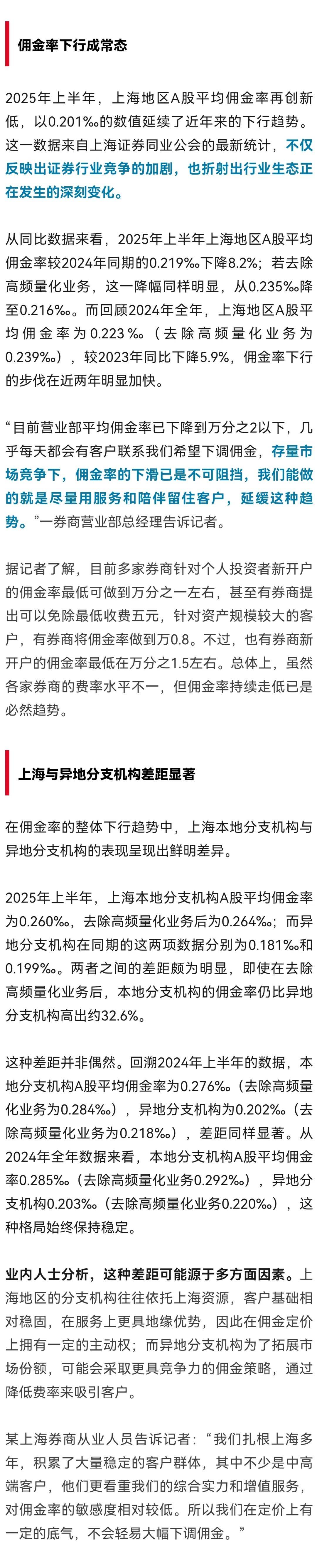
Core Insights - The average commission rate for A-shares in Shanghai reached a new low of 0.201‰ in the first half of 2025, continuing a downward trend observed in recent years [1] - The commission rate decreased by 8.2% year-on-year compared to the same period in 2024, with a notable decline of 5.9% for the entire year of 2024 compared to 2023 [1] - Several brokerage firms have set the commission rate for new individual investor accounts as low as 0.01%, with some even waiving the minimum fee of 5 yuan [2][3] Commission Rate Trends - The average commission rate for local branches in Shanghai was 0.260% in the first half of 2025, significantly higher than the 0.181% for branches located outside Shanghai, indicating a 32.6% difference even after excluding high-frequency quantitative trading [5] - Monthly data from January 2024 to June 2025 shows a gradual decline in the average commission rate, with fluctuations but a clear overall downward trend [7] - The commission rates for 2025 have stabilized in a lower range, consistently below 0.221%, reflecting a more competitive market landscape [9] Market Dynamics - The relationship between market activity and commission rates is evident, as higher trading volumes tend to enhance brokers' bargaining power, leading to potential increases in commission rates during active market periods [8] - The commission rate decline exhibits a "stair-step" pattern rather than a straight line, indicating gradual adjustments in response to market conditions [9] Strategic Responses from Brokerages - Brokerages are enhancing their service offerings to counteract declining commission revenues, focusing on buyer advisory services and bundling additional services with commission rates [11] - Innovative strategies include linking commission rates to value-added services such as market insights and proprietary research reports, allowing firms to differentiate themselves in a competitive environment [11] - The introduction of smart algorithm tools, such as T0 trading algorithms, aims to meet diverse client needs while increasing trading frequency and, consequently, commission income for brokerages [12]
“十四五”期间证券行业发展趋势分析:收入规模稳定增长,业务板块表现分化
Guoyuan Securities· 2025-07-29 12:10
Investment Rating - The report does not explicitly state an investment rating for the securities industry Core Insights - The securities industry in China is experiencing stable revenue growth, with a clear path for high-quality development during the "14th Five-Year Plan" period [2][14] - The capital market reforms are deepening, leading to accelerated consolidation within the securities industry [3][41] - The competitive landscape is being reshaped, with significant differentiation in performance across various business segments [4][42] Summary by Sections 1. Capital Market Reform and Development - Continuous improvement in the capital market system is evident, enhancing the ability to serve the real economy [14][19] - The "New National Nine Articles" issued in April 2024 outlines a clear development blueprint for the capital market over the next five years [15][16] 2. Industry Revenue and Growth - The securities industry is showing a "two rises and two falls" trend, with an increase in company scale and revenue, but a decrease in operating leverage and ROE compared to the beginning of the "14th Five-Year Plan" [23][29] - The number of listed securities firms has increased from 44 in early 2021 to 47 by the end of 2024, with total assets growing from 8.55 trillion to 12.75 trillion yuan [29] 3. Competitive Landscape and Mergers - The leading securities firms maintain a strong profitability advantage, although the gap is narrowing [34][37] - Mergers and acquisitions are accelerating, with a notable increase in significant asset restructuring transactions since September 2024 [38][41] 4. Business Segment Performance - The revenue share of heavy asset businesses has significantly increased, with investment income becoming the main driver for leading firms [43][44] - IPO business is under pressure, reflecting a "stock-bond seesaw" trend, while traditional brokerage business is declining, necessitating a shift towards advisory services [4][5][42] - Asset management business faces dual pressure on scale and income, while international business revenue share is increasing [5][42] 5. Financial Technology and Innovation - Financial technology is expected to enhance service quality and efficiency across the securities industry, with AI driving innovation in business ecosystems [4][11]
广发证券(000776) - 2025年7月15日投资者关系活动记录表
2025-07-15 10:00
Group 1: Business Strategy and Development - The company focuses on integrating into national development, serving the real economy, and maintaining high-quality development as its main line of work [2] - Key areas of focus include deepening business transformation, optimizing business structure, and accelerating digital transformation to enhance operational efficiency [2] - The company aims to strengthen its comprehensive financial service capabilities, maintaining leading positions in research, asset management, and wealth management [2] Group 2: Wealth Management Business - The company adheres to its main responsibilities, aligning with high-quality development and focusing on wealth brokerage business targeting high-quality clientele and efficient online operations [3] - It emphasizes a dual approach of online and offline customer service, standardizing operations, and ensuring compliance [3] Group 3: Investment Banking Business - The company implements national strategies and regulatory requirements, prioritizing financial services for the real economy [4] - It focuses on resource accumulation, client development, and professional capability building in key sectors, particularly in the Greater Bay Area [4] - The company is committed to enhancing integrated services and accelerating the digital transformation of investment banking [4] Group 4: Investment Management Business - The investment management segment includes asset management, public fund management, and private fund management, with a focus on creating a diverse product supply system [5] - The company aims to enhance its active management capabilities and product innovation, leading to growth in asset management scale [5] - As of March 2025, the public fund management scale of Guangfa Fund and E Fund ranks third and first, respectively, excluding money market funds [5]