
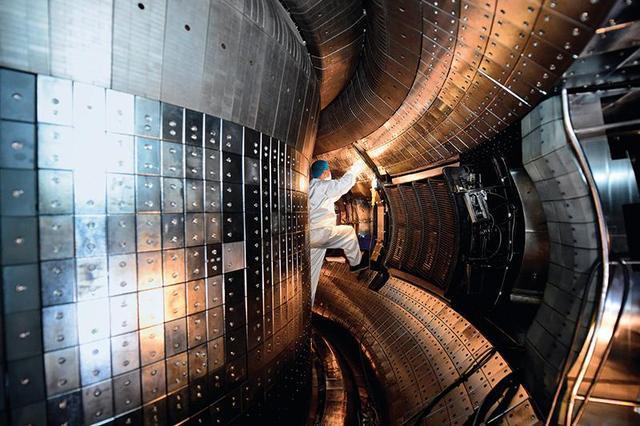
人造太阳

Search documents
7 以新质生产力为高质量发展注入澎湃动力
Xin Lang Cai Jing· 2026-02-24 22:23
Core Viewpoint - The article emphasizes the importance of new productive forces in driving high-quality development in China, highlighting advancements in technology and industry that are expected to shape the future economy. Group 1: Industrial Upgrading - The transition from mechanization to electrification, and then to information and intelligence, signifies the ongoing industrial revolution, with China's annual production of new energy vehicles projected to rise from approximately 1.4 million in 2020 to over 16 million by 2025 [2] - Traditional industries such as metallurgy, chemicals, and machinery are accelerating their high-end, intelligent, and green transformations, with the global share of newly installed industrial robots in China expected to exceed 50% during the 14th Five-Year Plan period [2] - The new productive forces are anticipated to create an additional market space of around 10 trillion yuan during the 15th Five-Year Plan period, with high-tech industries expected to double in scale over the next decade [2] Group 2: Supply and Demand Coordination - The new productive forces are driving disruptive innovations on the supply side, leading to a significant increase in exports, with integrated circuit exports projected to reach 1.444 trillion yuan in 2025, a year-on-year increase of 27.4% [3] - The automotive sector, including chassis, is expected to see exports amounting to 1.018 trillion yuan, reflecting a 22% year-on-year growth, with electromechanical products making up over 60% of total exports [3] Group 3: Green Transformation - The shift towards sustainable development is underscored by the increasing share of non-fossil energy, which is expected to become the second-largest energy type by 2025, with clean energy accounting for 35.2% of industrial power generation [4] - The implementation of energy-saving and carbon reduction initiatives is projected to save approximately 150 million tons of standard coal and reduce carbon dioxide emissions by about 400 million tons during the 15th Five-Year Plan period [4] Group 4: Regional Optimization - The development of new productive forces requires a tailored approach, fostering unique regional advantages and complementary competition, as demonstrated by collaborative efforts in the Yangtze River Delta and the utilization of green energy in the Northwest [4] Group 5: Technological Self-Reliance - The focus on self-reliance in key technologies is crucial for high-quality development, with significant investments in areas such as 5G communication, ultra-high voltage transmission, and new energy batteries, leading to the establishment of independent intellectual property rights [5] - The ongoing efforts to overcome "bottleneck" issues in critical sectors are expected to enhance resilience against external risks, contributing to the overall strength of China's economy and technological capabilities [5]
一往无前,我们快马扬鞭!
Xin Lang Cai Jing· 2026-02-17 02:52
Core Viewpoint - The article reflects on the cultural significance of the Year of the Horse in China, emphasizing themes of vitality, success, and the transformation of lifestyles over the years, highlighting the progress and prosperity of the nation. Group 1: Cultural Transformation - The Year of the Horse symbolizes speed and success, resonating with the aspirations of the Chinese people for a prosperous future [1] - Traditional celebrations have evolved from simple customs to diverse experiences, including travel and cultural events, indicating a shift in societal values and lifestyles [2] Group 2: National Progress - The achievements in various sectors, such as technology and agriculture, showcase a transformed China, with advancements like the "artificial sun" and automated farming methods [3] - The government's initiatives, such as direct financial support for childcare and improved social safety nets, reflect a commitment to enhancing the quality of life for citizens [3] Group 3: Public Engagement in Culture - The rise of "new public literature" and grassroots sports events illustrates a growing engagement of ordinary citizens in cultural and athletic activities, fostering a sense of community and shared identity [4][5] - The enthusiasm for knowledge production and dissemination among the public signifies a cultural renaissance, where academic discussions become widely accessible and participatory [4] Group 4: Aspirations and Dreams - The article highlights a range of aspirations from citizens, reflecting both personal and national ambitions, which collectively drive the country's progress [6] - The symbolism of the horse represents resilience and determination, encouraging individuals to pursue their dreams and contribute to the nation's advancement [6]
【社论】一往无前,我们快马扬鞭!
Xin Lang Cai Jing· 2026-02-16 22:33
Group 1 - The article emphasizes the cultural significance of the Year of the Horse in China, symbolizing speed and success, reflecting a vibrant and prosperous society [1][2] - It highlights the transformation in lifestyle and cultural practices over the years, moving from traditional celebrations to modern experiences such as travel and diverse entertainment options [1][2] - The narrative showcases advancements in various sectors, including technology, agriculture, and social welfare, indicating a significant improvement in the quality of life for the population [3][4] Group 2 - The rise of new forms of cultural expression among ordinary people, such as poetry and sports, illustrates a growing engagement in the arts and community activities, contributing to a vibrant cultural landscape [4][5] - The article notes the importance of individual aspirations and collective dreams, which drive the nation's progress and innovation, reflecting a strong sense of community and shared goals [6] - It concludes with a motivational message about perseverance and ambition, symbolized by the horse, encouraging continuous effort towards achieving greater heights [6]
打造高能级科创平台矩阵
Xin Lang Cai Jing· 2026-02-08 00:58
Core Viewpoint - Anhui Province is advancing its technological innovation efforts during the "14th Five-Year Plan" period, aiming for significant achievements by 2025, including a notable rise in its innovation status and integration into the Shanghai (Yangtze River Delta) International Science and Technology Innovation Center [1][2] Group 1: Technological Innovation Achievements - By 2025, Anhui's R&D investment will rank 9th nationally, with R&D intensity at 7th [1] - Three major achievements have been recognized among the top ten technological advancements in China, including breakthroughs in quantum computing and a world record in nuclear fusion [1] - The number of technology-based enterprises in Anhui ranks 6th for listed companies, 5th for small and medium-sized tech firms, and 8th for high-tech enterprises [1] Group 2: Future Plans and Strategic Initiatives - In 2026, Anhui will focus on strengthening strategic initiatives and advancing the co-construction of the Shanghai (Yangtze River Delta) International Science and Technology Innovation Center [1] - The province plans to implement over 100 provincial-level technology innovation projects targeting key and frontier technologies [2] - A classification and cultivation system for technology-based enterprises will be established, alongside the development of verification centers and incubators to enhance technology transfer [2]
积极布局未来产业,各地有何“密码”?
Xin Lang Cai Jing· 2026-02-06 06:35
Group 1 - The concept of "future industries" has gained significant attention in 2026, with a focus on development during the "14th Five-Year Plan" period, emphasizing the importance of strategic planning and innovation in emerging sectors [1][2] - Future industries are defined as emerging sectors driven by cutting-edge technologies, currently in the early stages of development, characterized by strategic significance and potential for disruptive innovation [1][2] - China is transitioning from a phase of technological catch-up to proactive layout in future industries, with a mix of leading, parallel, and following positions in various sectors such as quantum technology and 6G [1][2] Group 2 - Shanghai is leveraging its comprehensive advantages to develop future industries, with specific plans to cultivate sectors like brain-computer interfaces and fourth-generation semiconductors by 2026 [1][2] - Anhui province has established itself as a leader in quantum technology, with a significant concentration of quantum enterprises and a complete industrial chain in both quantum and nuclear fusion energy sectors [2] - Other provinces like Beijing, Guangdong, and Jiangsu are also making strides in future industries, focusing on their unique strengths and aligning with national strategic goals [2] Group 3 - The Chinese government is implementing various measures to support future industry development, including the establishment of investment funds and the promotion of innovative ecosystems [2] - The emphasis is on creating a supportive environment for potential disruptive technologies, ensuring that local policies align with national strategies while fostering regional characteristics [2]
积极布局未来产业,各地有何通关“密码”?
Yang Shi Xin Wen· 2026-02-06 05:58
Group 1 - The concept of "future industries" has gained significant attention in 2026, with a focus on development and strategic planning at various governmental levels [1][3] - Future industries are defined as emerging sectors driven by cutting-edge technologies, currently in the early stages of development, characterized by strategic significance and potential for disruption [2][3] - The "14th Five-Year Plan" emphasizes the importance of forward-looking layouts for future industries, aiming to explore diverse technological routes and typical application scenarios [2][3] Group 2 - China's future industry development is transitioning from technology catch-up to proactive layout, with a mix of leading, parallel, and following positions across different sectors [4][5] - Key regions like Beijing, Guangdong, and Jiangsu are making strides in future industries, with specific focuses on quantum technology, biomanufacturing, and 6G communications [12][14] - Shanghai and Anhui are highlighted as leaders in future industry development, with Shanghai leveraging its comprehensive advantages and Anhui focusing on quantum technology and fusion energy [5][8] Group 3 - Shanghai's strategic initiatives include a dynamic cultivation system for future industries, supported by a fund of approximately 15 billion yuan, aimed at reducing costs and accelerating product commercialization [7][10] - Anhui has established a robust ecosystem for quantum technology and fusion energy, with a significant concentration of enterprises and research institutions [9][11] - The development of future industries is not limited to coastal regions, as demonstrated by Anhui's success in quantum technology and its plans for commercializing fusion energy [8][10] Group 4 - Local governments are encouraged to create open and inclusive innovation ecosystems to support the growth of future industries, emphasizing the importance of regional characteristics and market orientation [17][18] - The national government is implementing major strategic projects and increasing investment in future industries to foster a competitive environment across regions [15][16] - Future industries are expected to thrive through proactive planning, localized development strategies, and supportive policy measures [18]
向广大官兵和优抚对象致慰问信
Xin Lang Cai Jing· 2026-02-03 19:46
Core Viewpoint - The letter expresses sincere greetings and best wishes to military personnel, veterans, and their families, highlighting the achievements and contributions of the People's Liberation Army (PLA) and the armed forces in the past year [1][2][3] Group 1: Achievements and Contributions - In 2025, under the strong leadership of the Party Central Committee, significant progress was made in various sectors, including high-quality economic development and increased grain production [2] - The PLA and armed forces demonstrated political loyalty, engaged in military preparedness, and contributed to disaster relief efforts, showcasing their reliability and dedication to the nation [3] Group 2: Future Aspirations - The year 2026 marks the 105th anniversary of the Communist Party of China and the beginning of the 15th Five-Year Plan, calling for unity and commitment to the Party's leadership [3] - The letter emphasizes the importance of adhering to Xi Jinping's thoughts and enhancing national confidence and awareness to achieve future goals [3]
重大成果竞相涌现!这就是大国实力!
Ke Ji Ri Bao· 2026-01-21 09:45
Group 1 - China's "artificial sun" achieved a world record of "one billion degrees for a thousand seconds," marking a significant leap from basic science to engineering practice in fusion energy research [1] - The drilling depth of China's Shendi Chuan Ke No. 1 well has surpassed 10,000 meters, indicating a robust advancement in deep earth exploration [1] - The global first 5G-A humanoid robot "Kua Fu" successfully completed the torch relay for the 15th National Games, showcasing advancements in robotics [1] Group 2 - China ranks first globally in the number of approved innovative drugs, reflecting a successful completion of clinical trials [2] - Technological achievements are increasingly transitioning from laboratories to production lines, resulting in tangible changes in daily life [2] - The Ministry of Science and Technology emphasizes that 2026 will be a critical year for advancing the construction of a strong technological nation [4] Group 3 - The Ministry of Science and Technology will focus on innovation-driven strategies, enhancing strategic planning, policy measures, and resource platforms to improve the overall effectiveness of the national innovation system [4] - There is a commitment to increase high-quality technological supply and cultivate new driving forces to lead the development of new productive forces [4] - China's technology sector is poised for another "harvest year," reinforcing its path towards high-quality development [4]
中国科技再迎“丰收年”
Huan Qiu Wang Zi Xun· 2026-01-21 01:30
Core Insights - In 2025, China is experiencing a significant year of technological achievements, showcasing advancements in various fields such as nuclear fusion, artificial intelligence, and innovative pharmaceuticals, positioning itself as one of the fastest-growing economies in terms of innovation [1][4][9]. Group 1: Breakthroughs in Technology - The "artificial sun" project achieved a world record by maintaining plasma operation at 1 million degrees Celsius for 1066 seconds, marking a significant leap in fusion energy research [2][4]. - China Petroleum successfully drilled over 10,000 meters deep in the Sichuan Basin, demonstrating advancements in deep-earth exploration technologies through collaborative efforts among enterprises, universities, and research institutions [4][5]. Group 2: Innovation Mechanisms - The new type of national system has proven effective in overcoming technological barriers, enabling breakthroughs in critical areas such as superconducting magnets and deep-earth drilling technologies [4][5]. - The integration of resources and collaborative efforts across various sectors has been emphasized as a key strategy for achieving decisive breakthroughs in core technologies [5][9]. Group 3: Economic Transformation - The rapid expansion of 5G-A networks across over 300 cities has facilitated advancements in smart manufacturing and large-scale event support, contributing to economic growth [6][8]. - In 2025, China's production and sales of new energy vehicles exceeded 16 million units, maintaining its position as the world's largest market for such vehicles [8][9]. Group 4: Healthcare Innovations - A groundbreaking clinical trial using a domestically developed microelectrode array for precise tumor boundary localization during surgery was successfully completed, marking a significant advancement in brain-computer interface technology [10][12]. - In 2025, China approved 76 innovative drugs, leading the world in the number of new drug approvals, with total authorized transactions exceeding $130 billion [12]. Group 5: Future Directions - The Ministry of Science and Technology plans to enhance the national innovation system's overall efficiency and promote high-quality technological supply to foster new economic drivers [13].

打卡最“黑暗”小镇
Xin Lang Cai Jing· 2026-01-08 06:35
Core Insights - The town of Løkken in Norway, known as the "darkest small town in the world," has invested 5 million Norwegian Krone in a "man-made sun" to combat its long periods of darkness, attracting numerous tourists [1][2] - Løkken was historically significant as the birthplace of modern industry in Norway, with the establishment of a fertilizer plant by Hydro in the early 20th century, which transformed it from a wilderness into a thriving community [2] Investment and Economic Aspects - The installation of three large reflective mirrors in 2013 has allowed the town to receive two hours of sunlight daily during winter, increasing the temperature by 3°C, which has revitalized the local economy and improved residents' quality of life [2] - The affordable housing market in Løkken, with apartments costing only hundreds of thousands of Norwegian Krone, contrasts sharply with prices in the capital Oslo, yet the town struggles to retain its younger population [1] Cultural and Social Dynamics - The local culture is highlighted by traditional Norwegian costumes, known as Bunad, which are worn during significant life events, reflecting the community's connection to its heritage [1] - The town's charm lies not only in the "man-made sun" but also in the resilience and wisdom of its residents, who have adapted to their unique environment and continue to celebrate their natural surroundings [2]