
佳得乐

Search documents
BodyArmor减值拖累,可口可乐Q4 GAAP营业利润同比下滑32%,全年指引不及预期|财报见闻
Sou Hu Cai Jing· 2026-02-10 13:10
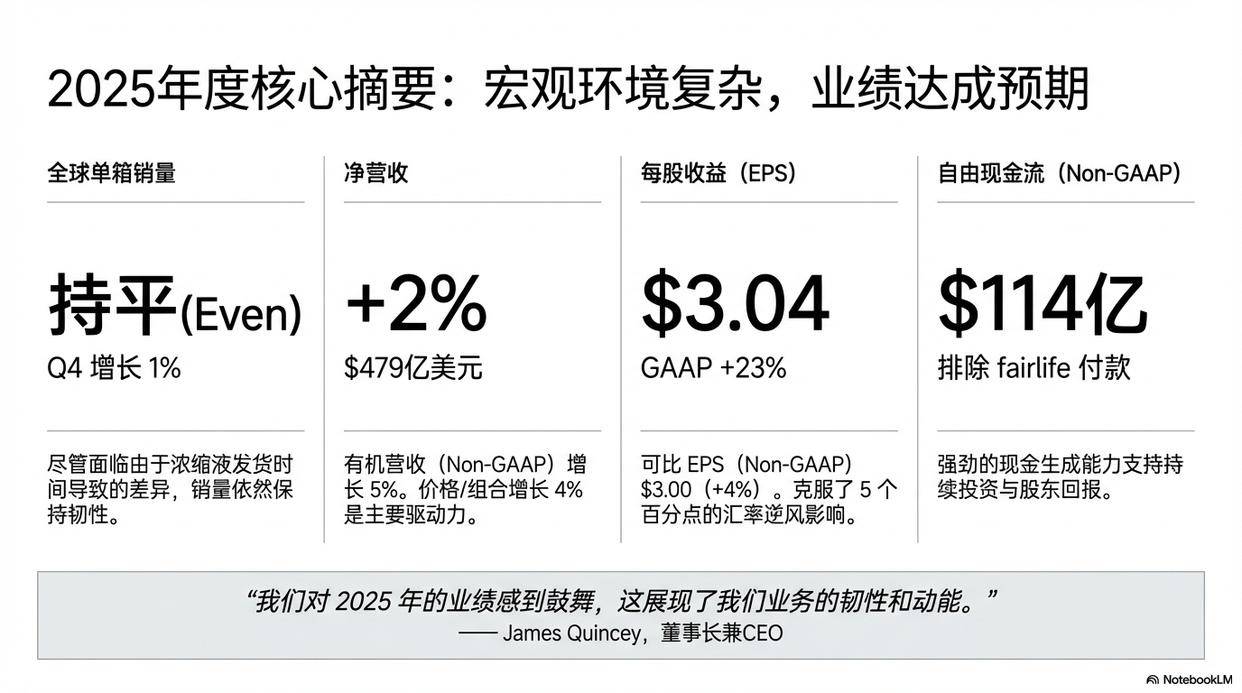
Core Viewpoint - Despite strong performance in the zero-sugar segment and slightly better-than-expected Q4 results, Coca-Cola's 2026 growth guidance appears weak, disappointing the market [1][3]. Financial Performance - Q4 revenue reached $11.82 billion, a 2% year-over-year increase, with organic revenue growth of 5% [1]. - Comparable EPS was $0.58, up 6% year-over-year, slightly exceeding analyst expectations [1]. - North America operating profit fell 65% year-over-year due to a $960 million non-cash impairment charge related to the BodyArmor brand acquisition [8]. Sales and Pricing - Global unit case volume grew by 1%, with price/mix growth of 1%, indicating maintained pricing power but at a reduced rate compared to previous years [9]. - Coca-Cola Zero Sugar was a standout product, with Q4 sales surging 13% and a 14% increase for the year [9]. - Traditional full-sugar soda sales faced pressure due to declining consumer demand, while Diet Coke remained flat for the year [9]. Future Outlook - Coca-Cola expects organic sales growth for 2026 to be between 4% and 5%, below Wall Street's average expectation of 5.01% [3][6]. - The company anticipates comparable EPS growth of 7% to 8% from a base of $3.00 in 2025, indicating a shift from the previous inflation-driven growth to a more moderate growth environment [6]. Market and Policy Challenges - The company faces increasing macroeconomic pressures, including health concerns regarding sugary drinks and state-level restrictions on soft drink purchases using food assistance benefits [5][11]. - Coca-Cola is diversifying its product portfolio to address these challenges, promoting healthier options and leveraging sports events for marketing [11].


BodyArmor减值拖累,可口可乐Q4 GAAP营业利润同比下滑32%,全年指引不及预期 | 财报见闻
Hua Er Jie Jian Wen· 2026-02-10 12:58
Core Viewpoint - Despite strong performance from the zero-sugar product line and slightly better-than-expected Q4 results, Coca-Cola's 2026 growth guidance appears weak, disappointing the market [1][4]. Financial Performance - In Q4, Coca-Cola reported revenue of $11.82 billion, a 2% year-over-year increase, with organic revenue growth of 5% [1]. - The comparable earnings per share (EPS) was $0.58, reflecting a 6% year-over-year growth, slightly above analyst expectations [1]. - However, GAAP operating profit fell by 32% year-over-year due to a $960 million non-cash impairment charge related to the acquisition of BodyArmor [4][11]. Future Outlook - Coca-Cola projects organic sales growth for 2026 to be between 4% and 5%, which is below Wall Street's average expectation of 5.01% [4][8]. - The company anticipates a 7% to 8% growth in comparable EPS from a base of $3.00 in 2025, indicating a shift from the previous high-inflation-driven growth to a more moderate growth environment [8]. Market Challenges - The company faces a complex macro policy environment, with signals from the Trump administration regarding the health implications of carbonated drinks and new state-level restrictions on soft drink purchases using food assistance benefits [7][14]. - As a result of the disappointing guidance and macroeconomic concerns, Coca-Cola's stock price dropped by 4.1% in pre-market trading [7]. Product Performance - Coca-Cola's core business showed resilience, particularly with its "no sugar" strategy, as Coca-Cola Zero Sugar saw a 13% increase in Q4 sales and a 14% increase for the year [9][12]. - In North America, despite a strong underlying performance, operating profit plummeted by 65% due to the impairment charge related to BodyArmor [11]. - Global unit case volume grew by 1%, with price/mix growth of 1%, indicating maintained pricing power but a narrowing increase compared to previous years [12]. Strategic Response - To address the challenges posed by changing consumer preferences and health trends, Coca-Cola is accelerating its diversification into non-sugar beverages, sports drinks, and water [8][14]. - The company is promoting innovative products like Powerade and Power Water and leveraging global sporting events for marketing to counteract the decline in traditional carbonated drink demand [14].
百事集团2025年赚了572亿元,美国市场产品将降价15%
第一财经· 2026-02-05 04:12
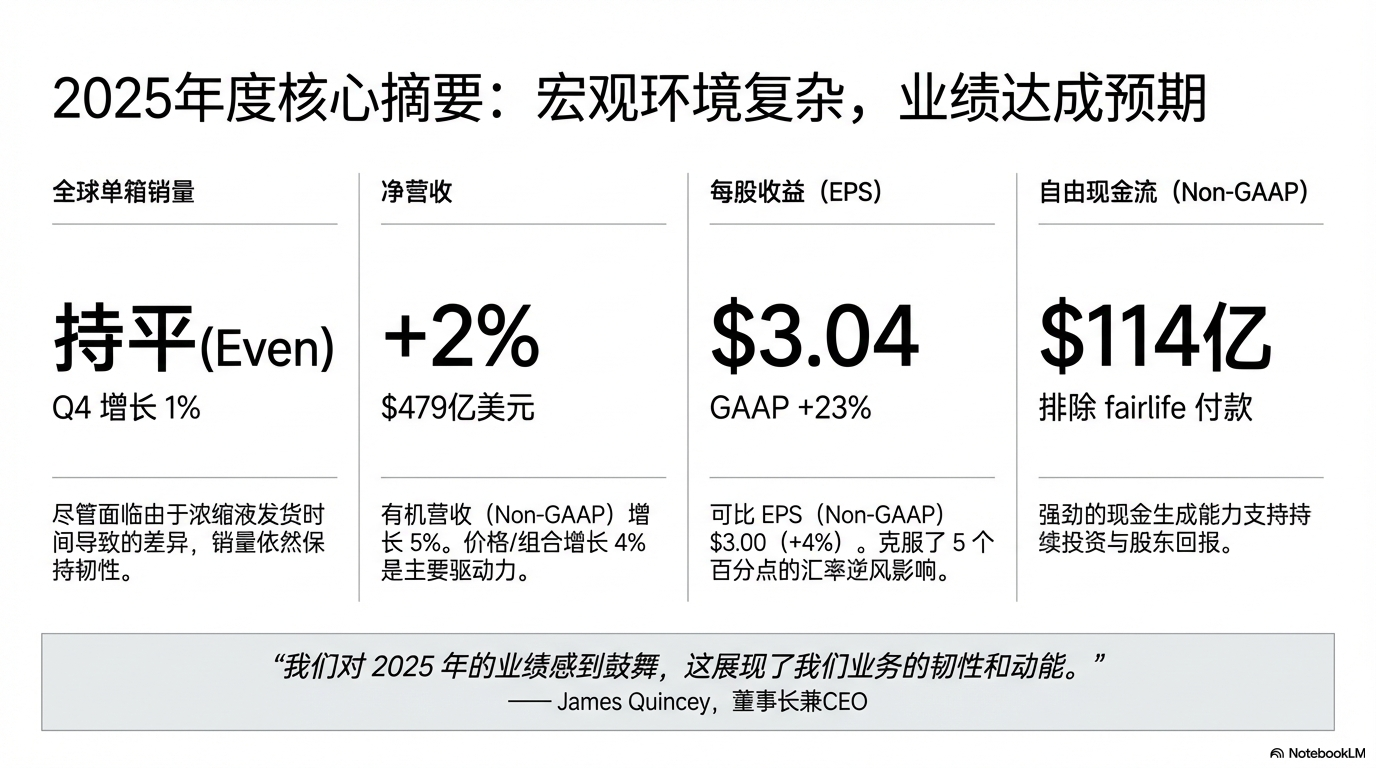
Core Viewpoint - PepsiCo reported a slight increase in annual revenue for 2025, but a significant decline in net profit, indicating challenges in managing costs and consumer demand [2][3]. Financial Performance - For the full year 2025, PepsiCo's revenue reached $93.925 billion (approximately 652.5 billion RMB), up 2% from $91.854 billion in the previous year [2]. - The net profit attributable to shareholders was $8.240 billion (approximately 57.2 billion RMB), a decrease of 14% year-over-year [2]. Quarterly Results - In Q4 2025, PepsiCo's revenue grew by 6% year-over-year, while net profit surged by 67% compared to the same quarter in the previous year [4]. Market Presence - PepsiCo operates as a multinational food and beverage company, with brands including Pepsi, Lay's, Quaker, and Gatorade. International markets contributed 44% of total revenue in 2025, with Mexico, Russia, Canada, China, the UK, Brazil, and South Africa accounting for 25% of total revenue [5]. - China ranked fifth globally in terms of revenue for PepsiCo [5]. Pricing Strategy - Prior to the earnings report, PepsiCo announced a price reduction of nearly 15% on certain snack products in the U.S. market to address consumer dissatisfaction with high prices [6]. - The CEO of PepsiCo Foods North America emphasized the importance of listening to consumer feedback regarding pricing pressures [6]. - The company noted varied performance across international markets, expressing optimism about Mexico and positive trends in China and the Middle East, while Western Europe showed signs of weakness and Brazil remained stable [6].

百事集团2025年赚了572亿元 美国市场产品将降价15%
Di Yi Cai Jing· 2026-02-05 03:16
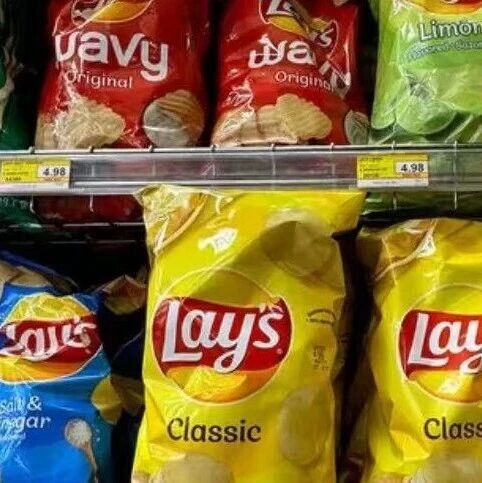
Group 1 - The core viewpoint of the news is that PepsiCo reported a slight increase in annual revenue for 2025, but a significant decline in net profit, attributed to rising operating costs and decreased sales [2] - For the full year 2025, PepsiCo's total revenue reached $93.925 billion, up 2% from $91.854 billion in the previous year, while net profit decreased by 14% to $8.240 billion [2] - In Q4 2025, PepsiCo experienced a 6% year-over-year increase in revenue and a remarkable 67% increase in net profit [3] Group 2 - PepsiCo operates as a multinational food and beverage company, with brands including Pepsi, Lay's, Quaker, and Gatorade, generating 44% of its revenue from international markets in 2025 [4] - The company announced a price reduction of nearly 15% on certain snack products in the U.S. market to address consumer dissatisfaction with high prices [5] - PepsiCo's executives noted varied performance in international markets, expressing optimism about Mexico and positive trends in China and the Middle East, while Western Europe showed signs of weakness and Brazil remained stable [5]
百事集团2025年赚了572亿元,美国市场产品将降价15%
Di Yi Cai Jing· 2026-02-05 03:07
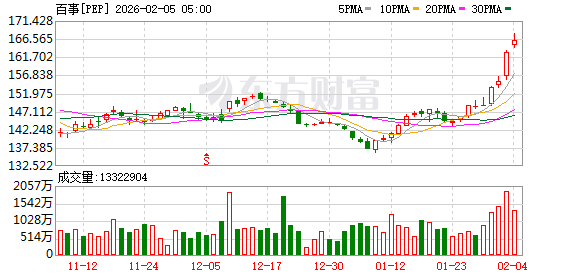
Core Insights - PepsiCo reported a 2% year-over-year increase in total revenue for 2025, reaching $93.925 billion, while net income decreased by 14% to $8.240 billion due to rising operating costs and declining sales [1] - In Q4 2025, PepsiCo experienced a 6% increase in revenue and a significant 67% increase in net income compared to the same quarter the previous year [2] Group 1: Financial Performance - Total revenue for 2025 was $93.925 billion, up from $91.854 billion in the previous year, reflecting a 2% increase [1] - Net income for 2025 was $8.240 billion, down from the previous year's figure, indicating a 14% decline [1] - Q4 2025 revenue grew by 6% year-over-year, while net income surged by 67% compared to Q4 2024 [2] Group 2: Market Dynamics - PepsiCo's international business accounted for 44% of total revenue in 2025, with key markets including Mexico, Russia, Canada, China, the UK, Brazil, and South Africa contributing 25% of total revenue [3] - The company ranked fifth in global revenue from the Chinese market [3] Group 3: Pricing Strategy - PepsiCo announced a price reduction of nearly 15% on certain snack products in the U.S. market to address consumer dissatisfaction with high prices [4] - The company emphasized that while it suggested new retail prices, the final pricing decisions rest with retailers [4] - The CEO of PepsiCo Foods North America noted the importance of listening to consumer feedback regarding pricing pressures [4] Group 4: International Market Outlook - PepsiCo executives expressed optimism about the performance in Mexico and positive trends in China and the Middle East, while noting a sluggish market in Western Europe and stable conditions in Brazil [4]
百事可乐(PEP.US)Q4营业利润大增近60% 宣布将乐事薯片等零食价格下调15%+百亿美元股票回购
智通财经网· 2026-02-03 13:26
Core Insights - PepsiCo reported stronger-than-expected fourth-quarter revenue and profit, driven by robust international market demand [1] - The company announced a $10 billion stock buyback plan and reaffirmed profit growth targets set for December 2025 [1] Financial Performance - Adjusted earnings per share (EPS) for the fourth quarter were $2.26, slightly above analysts' expectations of $2.23 and significantly higher than $1.96 from the previous year [1] - Total revenue for the quarter was approximately $29.34 billion, reflecting a year-over-year growth of 5.6%, surpassing the expected $28.97 billion [1] - GAAP operating profit for the fourth quarter was about $3.557 billion, showing a nearly 60% year-over-year increase, while GAAP net profit was approximately $2.54 billion, up about 67% [1] Strategic Adjustments - PepsiCo is under pressure from activist investor Elliott Management, which holds approximately $4 billion in shares and has urged the company to reform its product lineup and make key brands more affordable [2] - The company has agreed to reduce its U.S. product lineup by 20% and lower prices on certain key brands due to consumer complaints about high prices [2] - PepsiCo's stock has risen 8.1% year-to-date, outperforming the S&P 500 index, but has seen a 5% decline as the market anticipates a bull run in 2025, lagging behind competitor Coca-Cola [2] Market Trends - There is a growing demand for locally flavored snacks and beverages in countries like India and Brazil, contributing to sales growth [2] - The company is shifting focus towards lower-priced entry-level products and smaller packaging sizes to cater to budget-conscious consumers amid persistent inflation [3] - PepsiCo's CEO stated the company aims to promote growth by offering more competitive snack and beverage products in response to changing consumer purchasing power [3] Future Outlook - PepsiCo management reiterated its annual core EPS growth target of 4% to 6% and projected organic revenue growth of 2% to 4% for the full year [3]
?百事可乐(PEP.US)Q4营业利润大增近60% 宣布将乐事薯片等零食价格下调15%+百亿美元股票回购
Zhi Tong Cai Jing· 2026-02-03 12:34
Core Insights - PepsiCo reported strong Q4 results, with both revenue and profit exceeding Wall Street expectations, driven by robust international market demand [1] - The company announced a $10 billion stock buyback plan and reaffirmed its profit growth targets for December 2025 [1] Financial Performance - Adjusted EPS for Q4 was $2.26, slightly above the expected $2.23 and significantly higher than last year's $1.96 [1] - Total revenue for the three months ending December 27 was approximately $29.34 billion, a year-over-year increase of 5.6%, surpassing the expected $28.97 billion [1] - Q4 GAAP operating profit was about $3.557 billion, reflecting a nearly 60% year-over-year increase, while GAAP net profit was approximately $2.54 billion, up about 67% [1] Strategic Initiatives - PepsiCo is under pressure from activist investor Elliott Management, which owns about $4 billion in shares and has urged the company to reform its product lineup and make key brands more affordable [2] - The company has agreed to reduce its U.S. product lineup by 20% and lower prices on key brands to address these concerns [2] - PepsiCo plans to cut prices on products like Lay's and Cheetos by up to 15% due to consumer complaints about high prices [2] Market Trends - The company is shifting focus towards lower-priced entry-level products and smaller packaging sizes to cater to middle and low-income consumers facing inflationary pressures [3] - CEO Ramon Laguarta stated that the company aims to promote growth by offering more competitive snack and beverage products in response to changing consumer purchasing power [3] - PepsiCo is also investing in rebranding key products to meet the strong demand for cleaner and healthier ingredients, influenced by global trends and health initiatives [3] Future Outlook - The management reiterated its annual core EPS growth target of 4% to 6% and projected organic revenue growth of 2% to 4% for the full year [3]
百事可乐(PEP.US)Q4营业利润大增近60% 宣布将乐事薯片等零食价格下调15%+百亿美元股票回购
Zhi Tong Cai Jing· 2026-02-03 12:26
Core Insights - PepsiCo reported stronger-than-expected fourth-quarter revenue and profit, driven by robust international market demand [1] - The company announced a $10 billion stock buyback plan and reaffirmed its profit growth target set for December 2025 [1] Financial Performance - Adjusted earnings per share (EPS) for the fourth quarter were $2.26, slightly above the Wall Street consensus of $2.23 and significantly higher than $1.96 from the previous year [1] - Total revenue for the quarter was approximately $29.34 billion, reflecting a year-over-year increase of 5.6%, surpassing the expected $28.97 billion [1] - GAAP operating profit for the fourth quarter was about $3.557 billion, showing a nearly 60% year-over-year increase, while GAAP net profit was approximately $2.54 billion, up about 67% [1] Strategic Adjustments - PepsiCo is under pressure from activist investor Elliott Management, which holds approximately $4 billion in shares and has urged the company to reform its product lineup and make key brands more affordable [2] - The company has agreed to reduce its U.S. product lineup by 20% and lower prices on certain key brands due to consumer complaints about high prices [2] - PepsiCo's stock has risen 8.1% year-to-date, outperforming the S&P 500 index by 1.9%, although it has seen a 5% decline as the U.S. stock market continues its bull run into 2025 [2] Market Trends - There is a growing demand for locally flavored snacks and beverages in countries like India and Brazil, contributing to sales growth [2] - The company is shifting its focus towards lower-priced entry-level products and smaller packaging sizes to cater to budget-conscious consumers amid persistent inflation [3] - PepsiCo's CEO stated the company aims to promote growth by offering more competitive snack and beverage products in response to changing consumer purchasing power [3] Future Outlook - The management reiterated its annual core EPS growth target of 4% to 6% and projected organic revenue growth of 2% to 4% for the full year [3]
百事可乐(PEP.US)Q4营业利润大增近60% 宣布将乐事薯片等零食价格下调15%+百亿美...
Xin Lang Cai Jing· 2026-02-03 12:24
Core Insights - PepsiCo reported stronger-than-expected fourth-quarter revenue and profit, driven by robust international market demand [1] - The company announced a $10 billion stock buyback plan and reaffirmed its profit growth target set in December 2025 [1] Financial Performance - Adjusted earnings per share (EPS) for the fourth quarter were $2.26, slightly above the Wall Street consensus of $2.23 and significantly higher than $1.96 from the previous year [1] - Total revenue for the quarter was approximately $29.34 billion, reflecting a year-over-year increase of 5.6%, surpassing the expected $28.97 billion [1] - GAAP operating profit for the fourth quarter was about $3.557 billion, showing a nearly 60% year-over-year increase, while GAAP net profit was approximately $2.54 billion, up about 67% [1] Strategic Adjustments - PepsiCo is under pressure from activist investor Elliott Management, which holds about $4 billion in shares and has urged the company to reform its product lineup and make key brands more affordable [2] - The company has agreed to reduce its U.S. product lineup by 20% and lower prices on key brands due to consumer complaints about high prices [2] - PepsiCo's stock has risen 8.1% year-to-date, outperforming the S&P 500 index by 1.9%, although it has seen a 5% decline in stock price amid a broader market rally [2] Market Trends - Demand for locally flavored snacks and beverages in countries like India and Brazil is driving sales growth, while the company adjusts its U.S. product offerings to meet changing consumer tastes [2] - The company is focusing on lower-priced entry-level products and smaller packaging sizes to cater to budget-conscious consumers facing inflationary pressures [3] - PepsiCo aims to promote growth by providing more competitive snack and beverage products in response to changes in consumer purchasing power [3] Future Outlook - The management reiterated its annual core EPS growth target of 4% to 6% and projected organic revenue growth of 2% to 4% for the full year [3]
百事可乐汽水需求坚挺,季度营收超市场预期
Xin Lang Cai Jing· 2026-02-03 11:44
Core Viewpoint - PepsiCo's fourth-quarter revenue exceeded market expectations, driven by strong international demand for its soda products and good performance of low-sugar beverages in the U.S. [1] Group 1: Financial Performance - PepsiCo reported fourth-quarter revenue of $29.34 billion, surpassing the market expectation of $28.97 billion [1] - The company's North American beverage business is undergoing a refresh, introducing prebiotic sodas and various low-sugar and zero-sugar beverage products [1] - The core North American food business experienced a sales decline of 1% year-over-year in the fourth quarter, an improvement from a 4% decline in the previous quarter [1] Group 2: Market Trends - The demand for localized flavor snacks and sodas in markets like India and Brazil continues to drive sales growth for the company [1] - Despite adjusting its product mix in the U.S. to meet changing consumer tastes, PepsiCo maintains its annual core earnings per share growth target of 5% to 7% announced in December [1] Group 3: Competitive Landscape - The company is shifting its operational focus towards lower-priced entry-level products and smaller package sizes, similar to strategies employed by other consumer goods companies like Procter & Gamble and Coca-Cola [1] - PepsiCo's international beverage business saw a year-over-year sales increase of 3%, while the overall beverage segment experienced a 1% increase in sales [2]