公用事业ETF

Search documents
ETF研究系列之三:HALO逻辑下,哪些ETF受益?
HUAXI Securities· 2026-03-27 13:56
1. Report Industry Investment Rating - Not provided in the content 2. Core Viewpoints of the Report - Since 2026, the trading logic of AI has shifted from "light - asset" sectors such as software and games to "physical" sectors like electricity, coal, and public utilities. The market's understanding of AI is moving from a technological narrative to infrastructure - constrained pricing [1]. - The HALO strategy, based on "heavy assets and low obsolescence rate," is used to screen ETFs. After screening, ETFs are divided into four levels: core HALO, enhanced HALO, neutral HALO, and non - HALO [1]. - Core HALO ETFs have a significantly better risk - return ratio. Since 2026, the Sharpe ratio and Calmar ratio of the equally weighted core HALO portfolio have reached 5.54 and 43.71 respectively, with a maximum drawdown of only 3.42%, significantly lower than other portfolios [2]. - In the future, attention should be paid to related targets such as coal, lithium batteries, steel, and building materials [2][3]. 3. Summary According to the Directory 3.1 HALO Strategy ETF Quantitative Screening: Mapping from Individual Stock Characteristics to ETFs - A quantitative framework is constructed to evaluate whether an ETF conforms to the HALO concept. First, evaluate the HALO characteristics of all A - share individual stocks, then calculate the HALO characteristics of ETFs based on their top ten heavy - weighted stocks, and finally form a comparable, rankable, and hierarchical HALO ETF screening result [18]. - The scoring process of the HALO strategy ETF can be summarized in six steps: building a basic sample pool, scoring individual stocks' HALO, extracting the top ten heavy - weighted stocks of ETFs as penetration samples, calculating the HALO characteristics of ETFs through individual stocks' HALO characteristics, performing coverage correction and sample cleaning, and sorting and stratifying ETFs [18][19][21]. - When scoring individual stocks, the H (heavy assets) factor mainly observes the proportion of fixed assets and capital expenditure to revenue and total assets, and the LO (low obsolescence rate) factor focuses on the proportion of annualized depreciation and goodwill in revenue and total assets, and introduces industry prior scores [27]. 3.2 Future Strategy: Focus on the Supplementary Rise Opportunities of Enhanced HALO - The top - ranked HALO ETFs are mainly of the "double - high" and "balanced" types, rather than being driven by a single factor of H or LO. The top - ranked core varieties (green power - related ETFs) have H scores above 90 and LO scores above 70 [31]. - The performance of the core HALO portfolio is the best. Since 2026, the cumulative net value of the equally weighted core HALO portfolio has led other portfolios, with a maximum drawdown of only 3.42%, significantly lower than other portfolios. Its Sharpe ratio and Calmar ratio are 5.54 and 43.71 respectively, with a much higher cost - performance [33]. - In terms of specific industries, coal still has investment value as the geopolitical situation in the Middle East has not substantially eased, and the demand for coal and coal chemical industry is expected to increase. In the enhanced HALO category, the lithium - battery sector has a small increase since the beginning of the year, with a relatively low congestion level, and is expected to have a supplementary rise. Steel and building materials sectors may benefit from anti - involution policies and still have allocation value [3][34][35].
金融工程日报:沪指震荡走低,锂电池概念领涨、风电股反复活跃-20260313
Guoxin Securities· 2026-03-13 15:35
- The report does not contain any quantitative models or factors for analysis[1][2][3]
未知机构:盘前03061昨晚美股震荡调整盘中因为传美国考虑出台法规-20260306
未知机构· 2026-03-06 02:20
Summary of Conference Call Notes Industry Overview - The notes reflect the current state of the U.S. stock market, particularly focusing on the impact of geopolitical tensions and regulatory considerations on technology and energy sectors [1][2][3][4][5][6][7][8]. Key Points and Arguments 1. **U.S. Stock Market Volatility**: The U.S. stock market experienced fluctuations due to rumors of new regulations requiring global approval for AI chip purchases, leading to a significant drop in chip stocks [1]. 2. **Geopolitical Tensions**: Ongoing tensions in the Middle East have created uncertainty, with fluctuating oil prices impacting market sentiment. Initial spikes in oil prices were followed by a recovery after news of potential U.S. measures to stabilize the market [2][3][5][6]. 3. **Government Policy Response**: The recent government work report from the two sessions was largely in line with expectations, lacking new initiatives to alleviate geopolitical concerns. This resulted in a significant outflow of capital from the market, indicating a cautious investor sentiment [7]. 4. **Market Dynamics**: The A-share market followed global trends with moderate performance, suggesting limited buying interest. The market is expected to take 2-3 weeks to digest recent volatility, with no immediate expectations for a rebound [7]. 5. **Sector Rotation**: The market is experiencing a rotation between cyclical and technology stocks, with a focus on computing power and related sectors. Recent performance in mechanical and electrical equipment, as well as public utility ETFs, has been positive [7][8]. 6. **Investment Strategies**: There is a potential shift in investor focus towards mid-term asset impacts, with interest in oil and agricultural ETFs. The notes suggest that recent volatility has allowed for speculative sentiment to be digested, creating opportunities in certain sectors [8]. 7. **Technology Sector Outlook**: The technology sector is expected to see increased investment, particularly in ETFs that have experienced significant declines. Recommendations include the Science and Technology Innovation 100 ETF and others that have shown potential for recovery [8]. Additional Important Content - The notes highlight the importance of monitoring geopolitical developments and their potential impact on market dynamics, particularly in the energy and technology sectors [2][3][4][5][6][7][8]. - The mention of specific ETFs indicates a strategic approach to investment, focusing on sectors that may benefit from current market conditions and investor sentiment [8].
新建数据中心要求绿电为主,绿电ETF(562550)大涨2.7%,规模位居同指数第一
Mei Ri Jing Ji Xin Wen· 2026-02-27 07:08
Core Viewpoint - The A-share market experienced slight adjustments on February 27, with the power sector showing strong performance, particularly in green energy ETFs, amid a significant increase in electricity consumption by global data centers driven by AI computing power [1]. Group 1: Market Performance - The three major A-share indices saw minor adjustments, while the electric power sector rose against the trend [1]. - Green Energy ETF (562550) increased by 2.7%, and Public Utility ETF (159301) rose by 2.46% [1]. - Key stocks in the green energy ETF, including GCL-Poly Energy, Ganeng Co., Henan Energy, Huayin Electric Power, and Jinkai New Energy, reached their daily limit [1]. Group 2: Industry Trends - The global electricity consumption by data centers is projected to surge, with the IEA forecasting it to reach approximately 945 TWh by 2030, more than doubling from 415 TWh in 2024, reflecting a compound annual growth rate of about 15% from 2024 to 2030 [1]. - The "Special Action Plan for the Green and Low-Carbon Development of Data Centers" mandates that by the end of 2025, over 80% of the electricity used in newly built national hub data centers must come from green energy [1]. - The policy document from the Central Committee emphasizes carbon reduction targets and the development of a new energy system, indicating that companies in energy storage, wind power, and grid sectors are likely to benefit continuously from these directives [1].


政策利好出台,电网设备ETF大涨3.81%,全市场电网设备含量最高
Mei Ri Jing Ji Xin Wen· 2026-02-12 03:47
Core Viewpoint - The A-share market is experiencing a rebound, particularly in the power grid equipment sector, driven by significant investments and policy support for the electricity market and infrastructure upgrades [1][2]. Group 1: Market Performance - The power grid equipment ETF has seen a rise of 3.81%, with a trading volume reaching 984 million yuan, making it the largest ETF in the market [1]. - Key stocks in the sector, such as Hanlan Co., Ltd. and Sifang Co., Ltd., have hit the daily limit, while others like Jinpan Technology and Igor have increased by over 9% [1]. Group 2: Policy and Investment Drivers - High-level meetings have emphasized the need for state-owned enterprises to expand investments in computing power and promote the synergy between computing and electricity [1]. - The State Council has issued implementation opinions to enhance the national unified electricity market system, outlining goals for the next 5-10 years, which will benefit grid construction, electricity trading, energy storage, and renewable energy generation [1]. Group 3: Long-term Industry Outlook - The global investment in power grids is expected to grow due to the increasing share of wind and solar power, with a significant demand for grid upgrades in developed economies where equipment is often over 20 years old [2]. - Domestic power grid equipment companies are likely to benefit from an upward shift in investment growth rates, while overseas export business is expected to maintain stable growth [2]. Group 4: Related Products - The power grid equipment ETF tracks the China Securities Power Grid Equipment Index, with a high weighting of 90% in smart grid and 67% in ultra-high voltage, the highest in the market [3]. - The green energy ETF includes leading companies in clean energy, while the public utility ETF has a 90.8% weighting in the electricity sector, characterized by high dividends and stable growth [3].
懵了!金银突发暴跌 急速跳水!国投白银LOF已连续4日跌停
Zhong Guo Ji Jin Bao· 2026-02-05 05:15
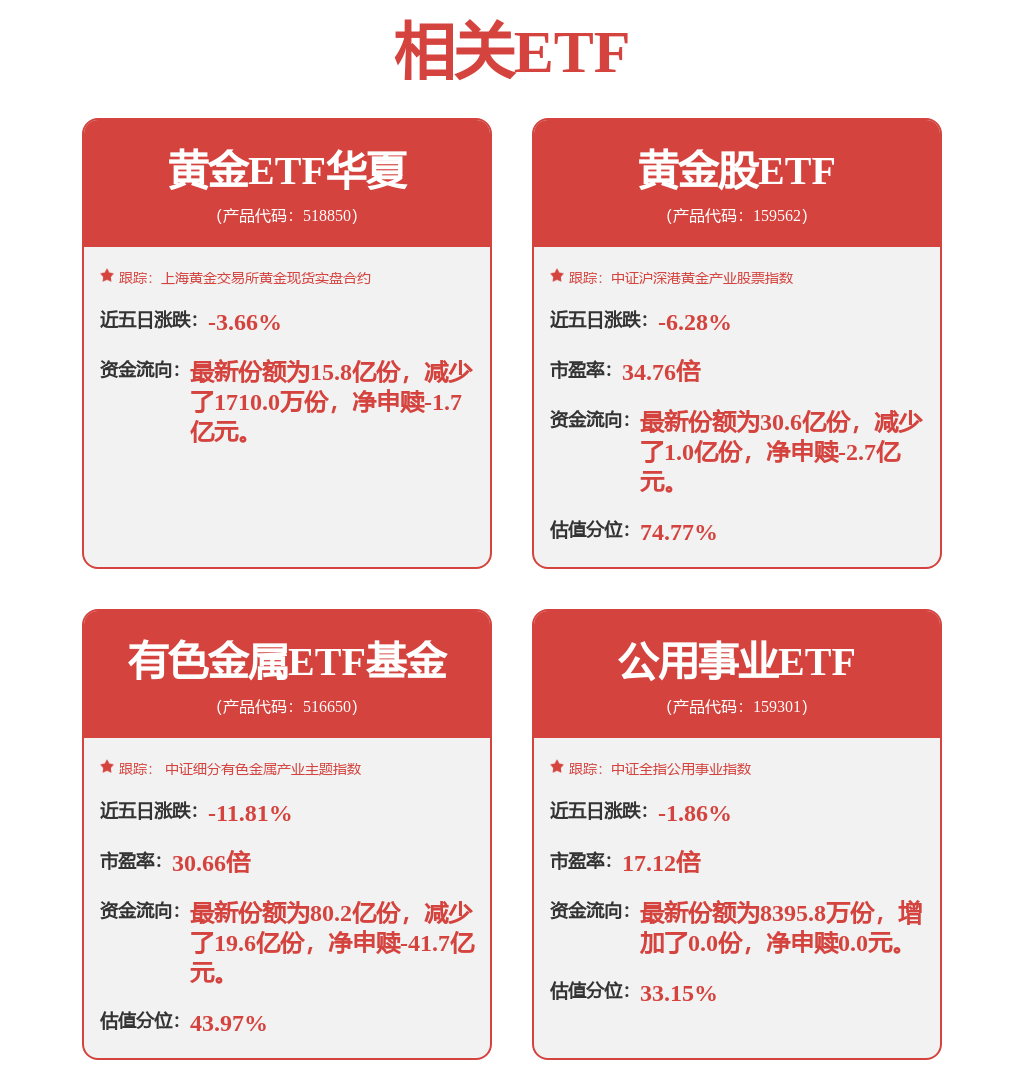
Group 1 - The core point of the news is the significant drop in precious metal prices, with spot gold falling below $4900 per ounce and spot silver dropping below $81 per ounce [1][2][3] - On February 5, spot silver reached a low of $80.562 per ounce, marking a daily decline of over 7%, and is currently reported at $82.654 per ounce [2] - Spot gold hit a low of $4893.42 per ounce, briefly falling below the $4900 mark, with a daily decline exceeding 1%, and is currently at $4913.026 per ounce [3] Group 2 - The international precious metal prices have experienced a widespread decline, impacting the A-share market where the precious metal sector opened with significant losses [4] - Companies such as Hunan Gold and Hunan Silver recorded a maximum drop limit of 10%, while other firms like Xiaocheng Technology and Sichuan Gold fell over 10% and 9% respectively [4] - The Guotou Silver LOF fund hit the trading limit down for the fourth consecutive day, with a premium rate dropping to 37.13% [4] Group 3 - The performance of related ETFs shows a negative trend, with the Huaxia Gold ETF (code: 518850) declining by 3.66% over the past five days, with a net redemption of 171 million yuan [6] - The Gold Stock ETF (code: 159562) has seen a decrease of 6.28% in the last five days, with a net redemption of 270 million yuan [7] - The Nonferrous Metal ETF (code: 516650) has dropped by 11.81% over the past five days, with a significant net redemption of 4.17 billion yuan [8]


工业金属板块2月2日跌8.41%,铜陵有色领跌,主力资金净流出82.48亿元
Zheng Xing Xing Ye Ri Bao· 2026-02-02 09:07
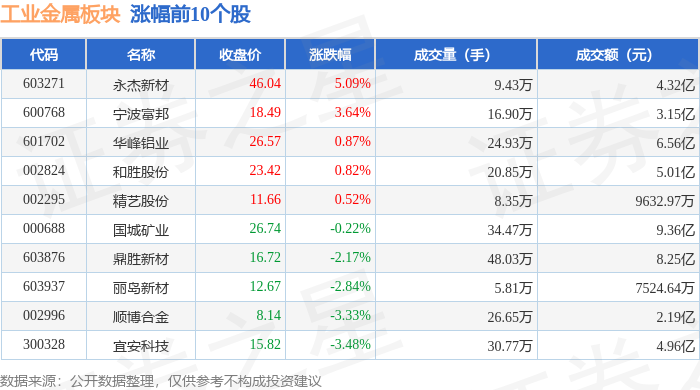
Market Overview - The industrial metal sector experienced a significant decline of 8.41% on February 2, with Tongling Nonferrous Metals leading the drop [1] - The Shanghai Composite Index closed at 4015.75, down 2.48%, while the Shenzhen Component Index closed at 13824.35, down 2.69% [1] Individual Stock Performance - Notable gainers included: - Yongjie New Materials (603271) with a closing price of 46.04, up 5.09% [1] - Ningbo Fubang (600768) at 18.49, up 3.64% [1] - Huafeng Aluminum (601702) at 26.57, up 0.87% [1] - Major decliners included: - Tongling Nonferrous Metals (000630) at 7.44, down 10.04% [3] - Zinc Industry Co. (000751) at 6.19, down 10.03% [3] - Jiangxi Copper (600362) at 57.08, down 10.00% [3] Capital Flow Analysis - The industrial metal sector saw a net outflow of 8.248 billion yuan from institutional investors, while retail investors contributed a net inflow of 7.714 billion yuan [5] - Key stocks with significant capital flow included: - Huafeng Aluminum (601702) with a net inflow of 43.07 million yuan from institutional investors [5] - Yongjie New Materials (603271) with a net inflow of 21.71 million yuan from institutional investors [5] - He Sheng Co. (002824) with a net inflow of 11.09 million yuan from institutional investors [5] ETF Performance - Gold ETF (518850) saw a 4.33% increase over the past five days, with a net subscription of 390 million yuan [7] - Gold Stock ETF (159562) experienced a significant rise of 23.06%, with a net subscription of 1.33 billion yuan [8] - Nonferrous Metal ETF (516650) had a modest increase of 2.18%, with a net outflow of 1.49 billion yuan [9]

大摩:山东黄金(01787.HK)盈利预告逊预期 目标价45.7港元
Sou Hu Cai Jing· 2026-02-02 07:06
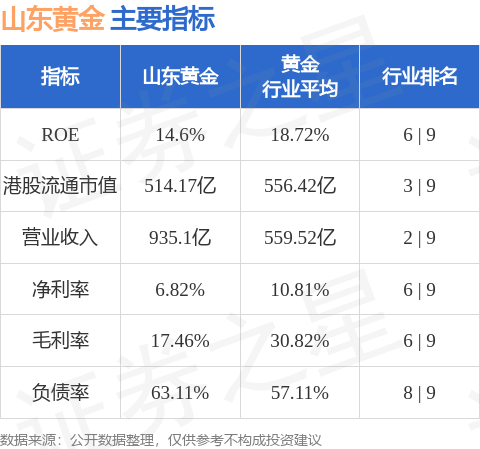
Group 1 - Morgan Stanley reports that Shandong Gold (01787.HK) expects a net profit of RMB 4.6 billion to 4.9 billion for the fiscal year 2025, representing a year-on-year growth of 56% to 66%, which is below the market forecast of approximately RMB 6 billion [1] - The target price set by Morgan Stanley for Shandong Gold is HKD 45.7, with a rating of "Overweight" [1] - Shandong Gold has a market capitalization of HKD 51.417 billion, ranking third in the gold industry [1] Group 2 - Key financial metrics for Shandong Gold compared to industry averages are as follows: - Return on Equity (ROE): 14.6% vs. industry average of 18.72%, ranking 6th - Revenue: RMB 93.51 billion vs. industry average of RMB 55.952 billion, ranking 2nd - Net Profit Margin: 6.82% vs. industry average of 10.81%, ranking 6th - Gross Margin: 17.46% vs. industry average of 30.82%, ranking 6th - Debt Ratio: 63.11% vs. industry average of 57.11%, ranking 6th [1]

贵金属板块1月30日跌8.88%,晓程科技领跌,主力资金净流出4.17亿元
Zheng Xing Xing Ye Ri Bao· 2026-01-30 08:54
Group 1 - The precious metals sector experienced a significant decline of 8.88% on January 30, with Xiaocheng Technology leading the drop [1] - The Shanghai Composite Index closed at 4117.95, down 0.96%, while the Shenzhen Component Index closed at 14205.89, down 0.66% [1] - Key stocks in the precious metals sector showed varied performance, with Hunan Shoujin rising by 9.99% to a closing price of 37.00, while several others, including Sichuan Gold and Shandong Gold, fell by 10% [1] Group 2 - The net outflow of main funds from the precious metals sector was 417 million yuan, while retail investors saw a net inflow of 1.083 billion yuan [3][4] - Specific stocks like Hunan Shoujin had a main fund net inflow of 388 million yuan, while Xiaocheng Technology faced a net outflow of 221 million yuan [4] - The trading volume for Hunan Shoujin reached 3.6441 million hands, indicating significant activity despite the overall sector decline [1][4] Group 3 - The Gold ETF (product code: 518850) tracked the Shanghai Gold Exchange spot contract and saw a 15.08% increase over the past five days, with a net subscription of 240 million yuan [6] - The Gold Stock ETF (product code: 159562) tracked the CSI Hong Kong and Shanghai Gold Industry Index, increasing by 19.52% in the last five days, with a net subscription of 1.07 billion yuan [7] - The Non-ferrous Metals ETF (product code: 516650) tracked the CSI Non-ferrous Metals Industry Theme Index, rising by 16.34% over the past five days, with a net subscription of 1.39 billion yuan [8]


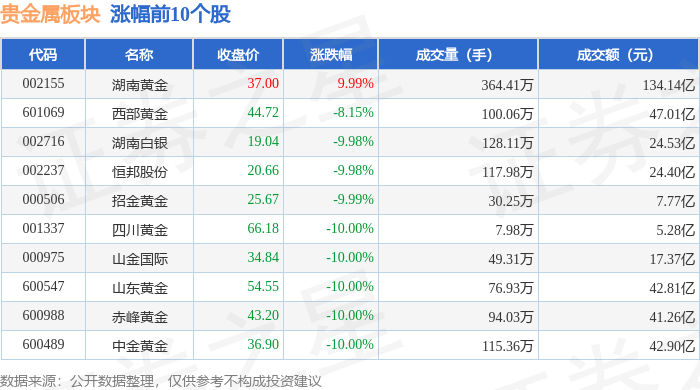
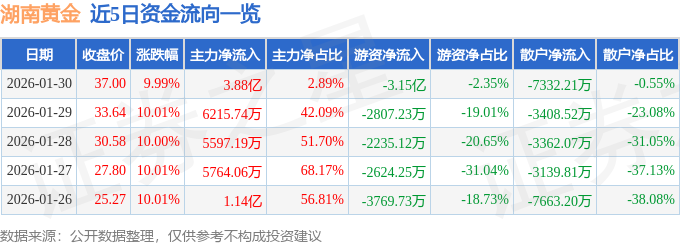
1月26日湖南黄金(002155)涨停分析:重组复牌、业绩预增、金价新高驱动
Sou Hu Cai Jing· 2026-01-30 07:58
Group 1 - Hunan Gold's stock price reached a closing price of 37.0 yuan on January 30, with a limit-up increase of 9.99% [1] - The stock was influenced by the announcement of a major asset restructuring, which includes the acquisition of 100% equity in Golden Tianyue and Zhongnan Smelting, aiming to create a closed-loop for the entire industry chain [1] - The company forecasts a 50%-90% year-on-year increase in net profit attributable to shareholders for 2025, expected to reach between 1.27 billion to 1.608 billion yuan, benefiting from rising prices of gold, antimony, and tungsten [1] Group 2 - On January 30, the net inflow of main funds was 388 million yuan, accounting for 2.89% of the total trading volume, while retail investors experienced a net outflow of 73.32 million yuan, representing 0.55% of the total trading volume [1] - Over the past five days, the stock has shown significant price increases, with a 10.01% rise on January 29 and a 10.00% rise on January 28, indicating strong market interest [2] - The stock is part of the Hunan state-owned enterprise reform and is categorized under the non-ferrous metals concept stocks, reflecting its strategic importance in the sector [2]