
凌渡L

Search documents
通用大涨,大众乏力,上汽三季报冰火两重天
Guo Ji Jin Rong Bao· 2025-11-04 16:01
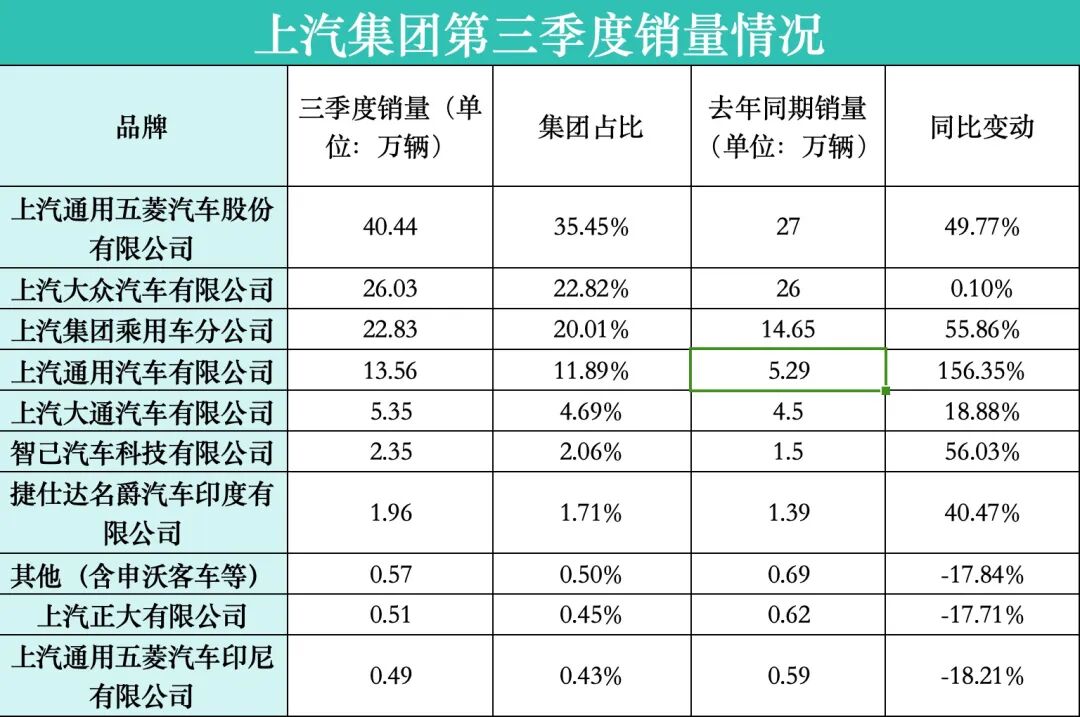
Core Viewpoint - SAIC Motor Corporation has shown a recovery in its performance due to joint ventures, but the uncertainty surrounding its transition is heightened by the underperformance of its new energy brands like IM and Hongqi [1][11]. Financial Performance - In Q3 2025, SAIC reported a revenue of 169.4 billion yuan, a year-on-year increase of 16.2%, and a net profit attributable to shareholders of 2.08 billion yuan, surging 644.9% [3]. - For the first three quarters, total revenue reached 468.99 billion yuan, with a net profit of 8.101 billion yuan and a net cash flow from operating activities of 31.94 billion yuan [3]. - The gross margin for Q3 was 8.99%, up 0.50 percentage points year-on-year, while the net margin improved to 2.21%, an increase of 1.51 percentage points compared to the previous year [4]. Sales Performance - In Q3, SAIC sold 1.141 million vehicles, a year-on-year increase of 38.7%, with SAIC-GM Wuling leading sales at 404,400 units, a 49.77% increase from the previous year [7]. - The sales performance varied significantly among different brands, with SAIC-GM achieving a remarkable growth of 156.35% [7][8]. - IM's sales were only 23,500 units in Q3, representing a mere 2.06% of total sales, indicating a struggle to establish a foothold in the market [8][9]. Strategic Developments - SAIC is expanding its partnerships to enhance its smart vehicle capabilities, collaborating with OPPO and Huawei [11]. - The launch of the Hongqi brand's H5 model saw significant pre-order interest, with 160,000 units ordered, but actual sales fell short of expectations, achieving only around 10,000 units in the first month [11]. Challenges and Outlook - Despite the recovery in sales, the performance of new energy brands like IM and Hongqi remains uncertain, contributing to the overall risk in SAIC's transition strategy [1][11].


上汽销量反超比亚迪,真实“含金量”如何
Jing Ji Guan Cha Bao· 2025-10-25 11:09
Core Viewpoint - The Chinese automotive market is experiencing a shift, with SAIC Motor Corporation regaining its position as the top-selling automaker in September, surpassing BYD. This change highlights the competitive dynamics between traditional fuel vehicles and new energy vehicles, raising questions about the underlying value of SAIC's sales growth compared to BYD's consistent performance in the electric vehicle sector [1]. Group 1: SAIC's Sales Performance - In September, SAIC Motor's sales reached 439,700 units, a year-on-year increase of 40.39%, while BYD sold 396,200 units [1]. - SAIC's joint venture segment, particularly SAIC-GM, showed significant recovery, with September sales of 49,400 units, up 124.38% year-on-year [2]. - The overall sales of SAIC-GM from January to September totaled 381,000 units, reflecting a 36.7% year-on-year growth [2]. Group 2: Joint Venture Contributions - SAIC-GM's recent product launches, including the Buick Electra L7, have contributed to its sales resurgence [2]. - SAIC Volkswagen also reported sales of 94,000 units in September, a slight increase of 0.09% year-on-year, with a notable recovery in its main fuel vehicle series [2]. Group 3: Self-owned Vehicle Segment - The self-owned vehicle segment of SAIC, which includes brands like MG and Roewe, accounted for over 60% of total sales, but profit contributions remain lower than those from joint ventures [3]. - In September, the total sales of MG and Roewe reached 93,700 units, marking a year-on-year increase of 72.36% [4]. Group 4: Strategic Shifts in Self-owned Brands - MG has shifted its strategy towards entry-level electric vehicles, with the new MG4 model achieving over 45,000 pre-orders within 24 days of its announcement [4]. - Roewe's new model, the Roewe M7DMH, launched at a competitive price, has driven a 37% increase in sales for the brand [5]. Group 5: New Brand Developments - The new smart electric brand, Shangjie, launched its H5 model with a pre-sale price starting at 159,800 yuan, aiming to compete in the market [6]. - The H5 model has already received over 160,000 pre-orders, indicating strong initial interest [7]. Group 6: Market Challenges and Future Outlook - Despite the positive sales figures, challenges remain for SAIC's self-owned brands, including the need for differentiation in a competitive market and effective marketing strategies [7]. - The performance of the new generation of models, such as the Zhiji LS6, will be crucial for the brand's future success, with over 52% of orders coming from traditional fuel vehicle users [8].

上汽销量反超比亚迪,真实“含金量”如何
经济观察报· 2025-10-25 05:56
Core Viewpoint - The article discusses the recent shift in the Chinese automotive market, highlighting SAIC Motor's return to the top of the sales rankings, surpassing BYD in September 2023, with SAIC selling 439,700 vehicles, a year-on-year increase of 40.39%, while BYD sold 396,200 vehicles [3][4]. Group 1: Sales Performance - SAIC Motor's sales recovery is attributed to the strong performance of its joint ventures, particularly SAIC-GM, which saw a 124.38% year-on-year increase in September sales, totaling 49,400 vehicles [6]. - SAIC Volkswagen also showed signs of recovery, with September sales reaching 94,000 vehicles, a slight increase of 0.09% year-on-year, driven by the resurgence of its main fuel vehicle series [6]. - The overall sales growth of SAIC's self-owned passenger vehicle segment is significant, with MG and Roewe brands achieving a combined sales of 93,700 vehicles in September, marking a 72.36% year-on-year increase [9][10]. Group 2: Strategic Shifts - SAIC's self-owned brands are shifting towards a "downward" development strategy, targeting entry-level electric vehicles to capture a broader market segment [10]. - MG's new model, MG4, has been positioned in the entry-level electric vehicle market, achieving over 45,000 pre-orders within 24 days of its announcement, with a first-month sales figure of 11,700 vehicles [10]. - Roewe's new energy sedan, Roewe M7DMH, launched in September, has seen a retail sales increase of over 37% year-on-year, indicating a successful entry into the B-segment market [10]. Group 3: New Brand Developments - The new smart electric brand, "Shangjie," developed in collaboration with Huawei, has launched its first model, Shangjie H5, with a pre-sale price starting at 159,800 yuan, aiming to leverage Huawei's technology [12][13]. - Shangjie H5 has already received over 160,000 pre-orders, indicating strong market interest, but faces challenges in differentiating itself in a competitive market [13]. - The new generation of Zhiji cars, particularly the Zhiji LS6, has been launched with a focus on both pure electric and extended-range models, but its market performance remains to be seen [14].

晚点财经丨英伟达跌回3万亿美元关口;合资品牌车也开始“百亿补贴”
晚点LatePost· 2024-07-09 12:36
英伟达跌回 3 万亿美元关口 合资品牌车也开始 "百亿补贴" 好莱坞 "五大" 变 "四大" 关注《晚点财经》并设为星标,第一时间获取每日商业精华。 英伟达跌回 3 万亿美元关口 英伟达 6 月 18 日市值登顶全球第一,但自那时起,市值已经跌了 2400 亿美元、差不多跌没了一个高 通。微软和苹果则分别涨了 4.8% 和 5.6%,重回全球第一和第二。 研究机构 New Street 的分析师皮埃尔·费拉古(Pierre Ferragu)罕见下调英伟达评级至中性,理由之一是 股价偏离基本面。但他继续看好 AMD 和台积电。另一家机构 New Constructs 的创始人大卫·特雷纳 (David Trainer)在接受媒体采访时说,英伟达估值是 "荒谬的",会遇到类似特斯拉的困境 —— 大量竞 争对手涌入市场,行业内卷、利润降低、供大于求。 尽管我们都知道英伟达今天的地位更多来自过去的持续投入,比如靠着十多年前就开始研发的运算平台 CUDA,英伟达已经绑定了数百万人工智能开发者,形成强大的软件生态 —— 这是为什么没什么公司能 挡住英伟达的理由之一。 延伸阅读:《 为什么挡不住英伟达 》《 美国芯片内战 ...
