刚性覆铜板

Search documents
东莞上市公司2024年度发展报告-东莞市上市公司协会
Sou Hu Cai Jing· 2025-08-06 08:11
Group 1 - Dongguan's capital market shows unique development trends in 2024, with 63 A-share listed companies, the highest among prefecture-level cities in the province [1] - The total operating revenue of these companies reached 127.37 billion, a year-on-year increase of 2.57%, while net profit was 6.04 billion, down 19.81% [1][2] - 37 companies reported positive revenue growth, accounting for nearly 60%, with Shengyi Technology leading at 20.39 billion, a 22.92% increase year-on-year [2][3] Group 2 - Shengyi Technology's net profit reached 1.739 billion, up 49.37%, benefiting from increased demand in AI computing and PCB product optimization [2][3] - 27 companies invested over 100 million in R&D, with Shengyi Technology leading at 1.157 billion, focusing on new server platform technologies [3] - The electronic information and advanced manufacturing sectors dominate Dongguan's listed companies, accounting for 46.77% of the capital market [3][4] Group 3 - Despite some companies showing strong performance in revenue, net profit, and R&D innovation, others face pressure from declining performance and market challenges [4] - The overall scale of listed companies remains small, indicating a need for further development and integration of the industrial chain [4] - Future strategies for Dongguan's listed companies include continuous innovation and leveraging emerging industry opportunities through mergers and acquisitions [4]


【光大研究每日速递】20250614
光大证券研究· 2025-06-13 13:29
Group 1 - The article discusses the ongoing trend of local government debt replacement, which involves replacing high-cost, short-term debts with low-cost, long-term local government bonds, thereby alleviating the debt burden and supporting economic growth [4] Group 2 - In the potassium fertilizer sector, a significant contract was established between Russian Potash Company (BPC) and Indian fertilizer importer IPL at a price of $349 per ton, marking a $70 per ton increase (25%) compared to the previous year [5] Group 3 - The North American AI sector has shown strong stock performance, with leading AI chip companies like Nvidia, AMD, and Broadcom seeing stock price increases of 54%, 38%, and 75% respectively, compared to a 26% rise in the Nasdaq index [5] Group 4 - According to the annual report, Shengyi Technology has become the second-largest global supplier of rigid copper-clad laminates, achieving a market share of 14% in 2023 [7] Group 5 - Chow Tai Fook's fiscal year 2025 report indicates a revenue of HKD 89.656 billion, a decrease of 17.5% year-on-year, with a profit attributable to shareholders of HKD 5.916 billion, reflecting a 9% decline at constant exchange rates [7]
前景研判!2025年中国刚性覆铜板行业市场发展概况分析及投资前景预测(智研咨询)
Sou Hu Cai Jing· 2025-05-30 12:19
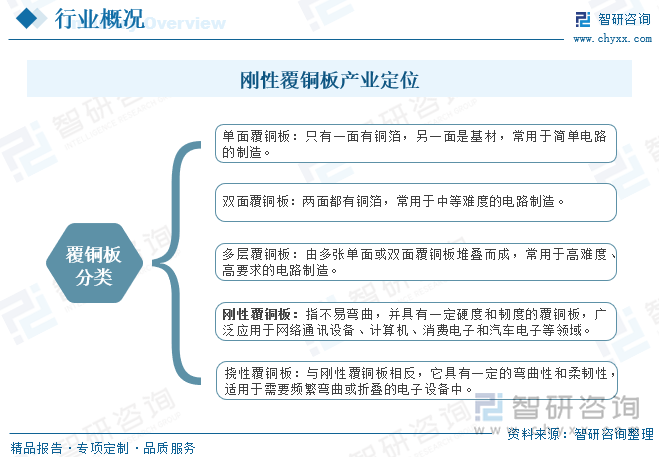
Core Insights - The rigid copper-clad laminate (CCL) industry in China experienced rapid growth from 2019 to 2021 due to accelerated 5G base station construction, surging demand for electronic components in electric vehicles, and increased consumer electronics demand driven by the pandemic. However, starting in 2022, the industry entered an adjustment phase due to global economic recession, weak consumer electronics demand, and semiconductor supply chain disruptions. In 2023, the industry continued to contract, with sales volume slightly decreasing to 524.9 million square meters and sales revenue shrinking to 9.334 billion yuan, representing a year-on-year decline of 16.3% [2]. Industry Overview - Rigid copper-clad laminates, also known as copper foil laminated boards, play a crucial role in electronic circuit manufacturing, providing conductivity, insulation, and support. They significantly impact signal transmission speed, energy loss, and characteristic impedance. Rigid copper-clad laminates are characterized by their hardness and toughness, making them suitable for applications in communication devices, household appliances, electronic toys, and computer peripherals [3]. Policy Background - China's policy support for the rigid copper-clad laminate industry is characterized by multi-level and multi-dimensional collaborative promotion, focusing on technological upgrades, intelligent equipment transformation, and green transition. Key policy areas include supporting the R&D breakthroughs of high-frequency and high-speed copper-clad laminates and high-performance substrates, optimizing production processes, and establishing standardized testing systems to enhance product reliability. Additionally, policies encourage enterprises to strengthen pilot testing capabilities through advanced equipment updates and promote sustainable development through the adoption of environmentally friendly materials and clean production processes [5][6]. Industry Chain - The rigid copper-clad laminate industry chain in China consists of upstream suppliers of key raw materials such as electronic-grade glass fiber cloth, copper foil, resin, and wood pulp paper, which provide the foundational materials for laminate manufacturing. The midstream focuses on the production and manufacturing of rigid copper-clad laminates through processes like lamination and coating. The downstream applications cover communication devices, household appliances, electronic toys, and computer peripherals, directly serving the demands of consumer electronics, communication technology, and home appliance industries [7]. Current Industry Status - In 2023, the global rigid copper-clad laminate market faced a decline due to macroeconomic fluctuations, with total sales revenue dropping by 16.3% to 12.734 billion USD and sales volume slightly decreasing by 1.1% to 656.8 million square meters. Among the product categories, conventional FR-4 maintained the largest sales revenue share at 33.38%, while special resin-based and dedicated CCL (including high-speed, high-frequency, and IC carrier boards) increased their share to 32.88%, driven by resilient high-end demand from AI servers, 5G communication, and advanced packaging technologies. The demand for halogen-free FR-4 and high Tg FR-4 has contracted due to weakened consumer electronics and automotive electronics demand, while composite and paper-based CCL accounted for less than 10% of the market, leading to a rapid exit of traditional low-end products. Notably, high-speed CCL (including halogen-free types) showed outstanding performance among the three special laminates, with sales revenue increasing by 5.5% despite market challenges, driven by rising technical barriers [9].
2024年全球和中国刚性覆铜板产业销售及企业格局现状,行业进入调整期[图]
Chan Ye Xin Xi Wang· 2025-05-19 01:20
Core Viewpoint - The rigid copper-clad laminate industry in China experienced rapid growth from 2019 to 2021 due to the acceleration of 5G base station construction, surging demand for electronic components in new energy vehicles, and increased consumer electronics demand driven by the pandemic. However, starting in 2022, the industry entered an adjustment phase due to global economic recession, weak consumer electronics demand, and semiconductor supply chain disruptions. In 2023, the contraction continued, with sales volume slightly decreasing to 524.9 million square meters and sales revenue shrinking further to 9.334 billion yuan, representing a year-on-year decline of 16.3% [1][11]. Rigid Copper-Clad Laminate Industry Overview - Rigid copper-clad laminates play a crucial role in electronic circuit manufacturing, providing conductivity, insulation, and support, which significantly impact signal transmission speed, energy loss, and characteristic impedance [2]. - The industry can be categorized into single-sided, double-sided, multi-layer, rigid, and flexible copper-clad laminates, with rigid laminates primarily used in communication devices, household appliances, electronic toys, and computer peripherals [2]. Industry Policy Background - China's policy support for the rigid copper-clad laminate industry is characterized by multi-level and multi-dimensional collaborative promotion, focusing on technological upgrades, intelligent equipment transformation, and green transition [4][5]. - Key policy initiatives include supporting the research and development of high-frequency and high-speed copper-clad laminates and high-performance substrates, optimizing production processes, and establishing standardized testing systems to enhance product reliability [4]. Industry Chain - The rigid copper-clad laminate industry chain in China consists of upstream suppliers of key raw materials such as electronic-grade glass fiber cloth, copper foil, resin, and wood pulp paper; midstream production focusing on manufacturing through lamination and coating processes; and downstream applications covering communication devices, household appliances, electronic toys, and computer peripherals [7]. Current Industry Development Status - In 2023, the global rigid copper-clad laminate market faced macroeconomic fluctuations, with total sales revenue declining by 16.3% to 12.734 billion USD and sales volume slightly decreasing by 1.1% to 656.8 million square meters [9]. - The market shows significant differentiation among product categories, with conventional FR-4 maintaining a 33.38% sales revenue share, while special resin-based and dedicated CCL (including high-speed, high-frequency, and IC carrier board materials) increased to 32.88% due to resilient high-end demand driven by AI servers, 5G communication, and advanced packaging technologies [9]. Competitive Landscape - The global rigid copper-clad laminate industry exhibits a pattern of one dominant player and multiple strong competitors, with companies like Kingboard Chemical, Shengyi Technology, and Taiyo Yuden leading the mid-to-high-end market through high-frequency and high-speed substrate research and large-scale manufacturing capabilities [13]. - Chinese leading enterprises are accelerating upgrades to low dielectric loss and high thermal conductivity products, leveraging the demand from 5G base station construction, new energy vehicle systems, and AI computing hardware [13][15]. Industry Development Trends - The rigid copper-clad laminate industry in China is rapidly advancing towards high-frequency, high-speed, high-thermal conductivity, and low-loss products to meet the stringent material performance requirements of emerging fields such as 5G communication, artificial intelligence, new energy vehicles, and data centers [17]. - The industry is also transitioning towards halogen-free and low-VOC emissions products driven by environmental policies, with a focus on green production technologies and circular economy models becoming core development directions [17].