国泰上证180金融ETF

Search documents
【ETF观察】11月28日行业主题ETF净流出24.94亿元
Sou Hu Cai Jing· 2025-11-28 22:37
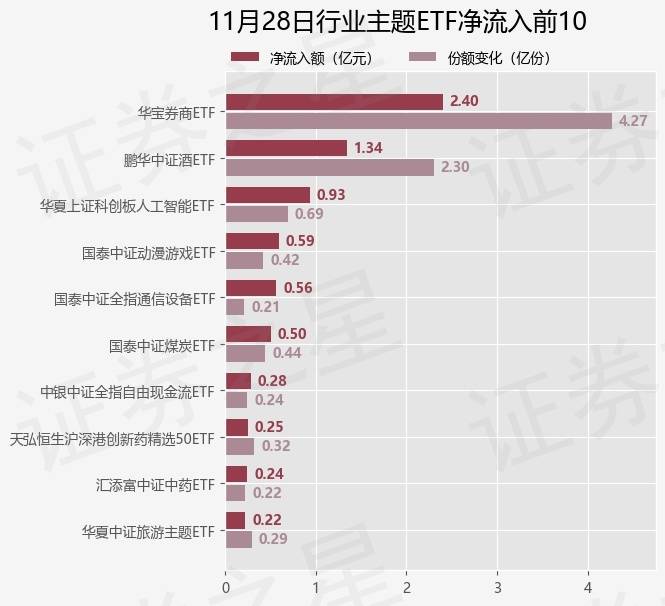
Core Insights - On November 28, industry-themed ETF funds experienced a net outflow of 2.494 billion yuan, with a cumulative net outflow of 20.054 billion yuan over the past five trading days [1] - A total of 48 industry-themed ETFs saw net inflows, with the Huabao Securities ETF (512000) leading with an increase of 427 million shares and a net inflow of 240 million yuan [1][3] - Conversely, 151 industry-themed ETFs recorded net outflows, with the Guotai Zhongzheng All-Index Securities Company ETF (512880) experiencing the largest outflow of 654 million yuan and a reduction of 556 million shares [1][4] Summary by Category Net Inflows - The Huabao Securities ETF (512000) had a net inflow of 240 million yuan, with a share increase of 427 million, bringing its total shares to 698.47 million [3][5] - Other ETFs with net inflows include: - Penghua Zhongzheng Wine ETF (512690) with a net inflow of 134 million yuan and a share increase of 230 million [3] - Huaxia Shanghai Stock Exchange Science and Technology Innovation Board Artificial Intelligence ETF (589010) with a net inflow of 93 million yuan and a share increase of 69 million [3] Net Outflows - The Guotai Zhongzheng All-Index Securities Company ETF (512880) had the highest net outflow of 654 million yuan, with a share decrease of 556 million, resulting in a total of 504.04 million shares [4][5] - Other ETFs with significant net outflows include: - Huabao Zhongzheng Bank ETF (512800) with a net outflow of 428 million yuan and a share decrease of 512 million [4] - Huaxia Zhongzheng Robot ETF (562500) with a net outflow of 163 million yuan and a share decrease of 173 million [5]

中央汇金,继续坚定持有
Zhong Guo Zheng Quan Bao· 2025-10-30 12:35
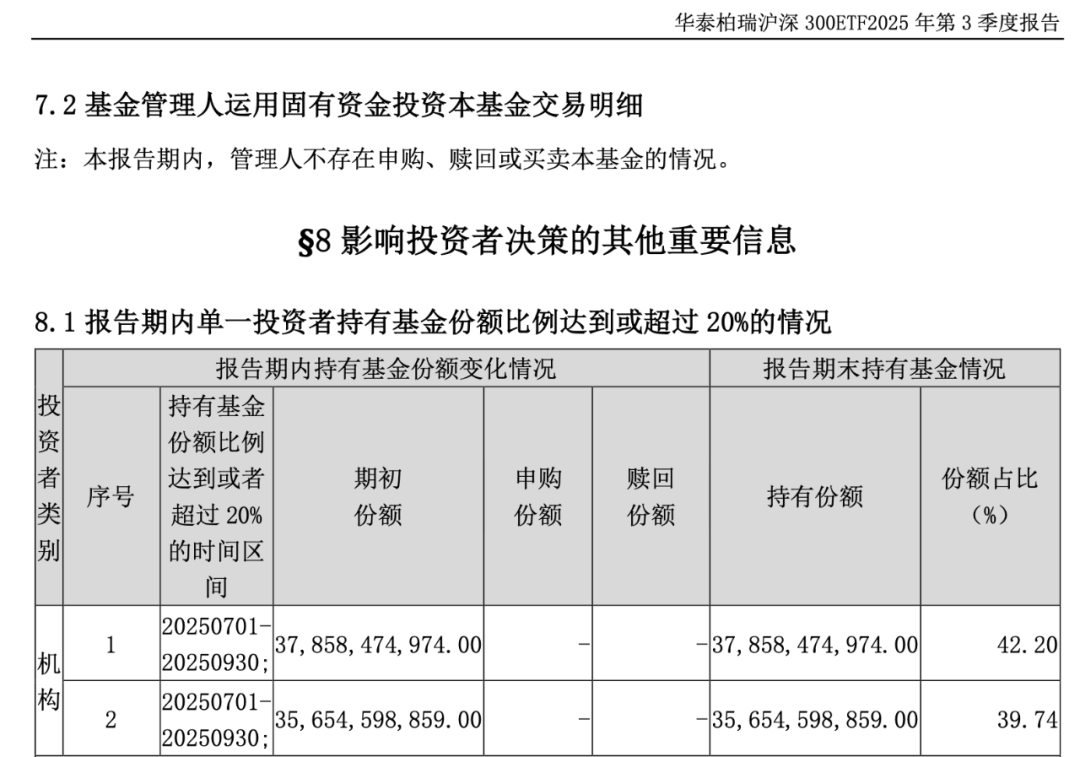
Core Insights - Central Huijin Asset Management and Central Huijin Investment maintained their holdings in several leading broad-based ETFs during Q3, indicating a strong commitment to these investments [1][2][6] - Notable adjustments were observed among some institutional investors, with Huaxia Fund's proprietary account completely liquidating its position in the Huaxia Hang Seng China Enterprises High Dividend ETF [7][8] - China Life Insurance reduced its holdings in multiple STAR Market ETFs, reflecting a strategic shift in its investment approach [11] Central Huijin's ETF Holdings - Central Huijin Asset Management held 37.86 billion shares of the Huatai-PineBridge CSI 300 ETF, while Central Huijin Investment held 35.65 billion shares, with both figures remaining unchanged from the previous quarter [2][5] - The total holdings in various ETFs, including the E Fund CSI 300 ETF and Huaxia CSI 500 ETF, also remained stable during Q3, suggesting a consistent investment strategy [6] Institutional Adjustments - Huaxia Fund's proprietary account, previously the largest holder of the Huaxia Hang Seng China Enterprises High Dividend ETF with 8.06 million shares (19.35% of total), completely exited this position in Q3 [8][10] - China Life Insurance's significant reductions in holdings of STAR Market ETFs included a drop from 753 million shares to 480 million shares in the Huaxia STAR Market 100 ETF, and from 1.23 billion shares to 679 million shares in the Bosera STAR Market 100 ETF [11]
ETF主观配置策略月报(八):以守待攻-20251020
Soochow Securities· 2025-10-20 10:29
Market Outlook and ETF Strategy - The market is expected to experience short-term fluctuations and consolidation, with a cautious funding participation due to reduced trading volume and activity levels [2][6] - The volatility of the Shanghai Composite Index over the past 30 trading days is at a relatively low historical level, indicating insufficient momentum for a significant upward movement [2][7] - The report suggests a balanced allocation strategy, focusing on broad-based, strategic, and style ETFs due to the current market's rapid rotation and limited directional consensus among funds [2] Industry and Sector Trends - The technology growth sector is currently deemed to have a low probability of success, leading to its exclusion from the current allocation strategy, with a focus on defensive sectors instead [2][4] - The report recommends increasing allocations to defensive sectors such as coal and electricity ETFs, while also considering the performance support from the non-ferrous metals sector [4] - The strategy emphasizes the importance of maintaining some exposure to large-cap growth assets, particularly in technology, if market sentiment improves towards the end of the month [4]
艾小军2025年二季度表现,国泰纳斯达克100ETF基金季度涨幅17.15%
Sou Hu Cai Jing· 2025-07-18 22:47
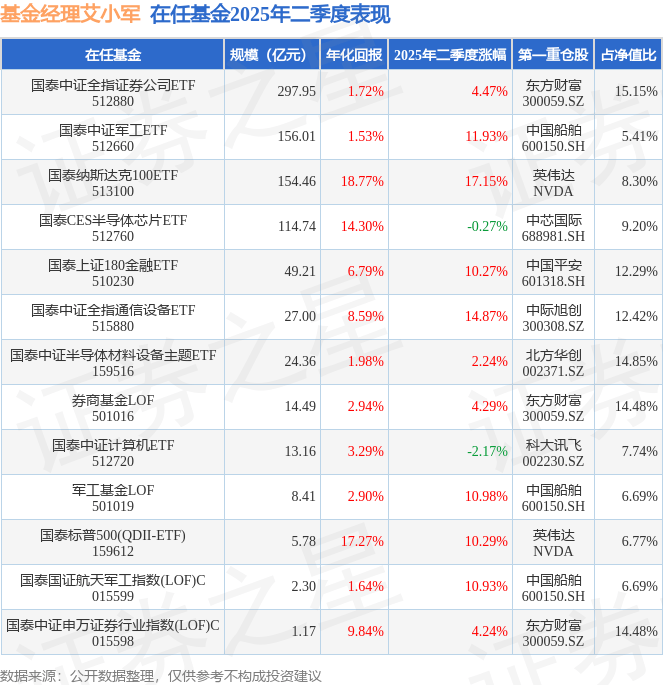
Group 1 - The best-performing fund managed by manager Ai Xiaojun in the second quarter of 2025 is the Guotai Nasdaq 100 ETF (513100), with a quarterly net value increase of 17.15% [1] - Ai Xiaojun manages a total of 13 funds, with the Guotai Zhongzheng All Index Securities Company ETF (512880) having a scale of 29.795 billion yuan and a quarterly increase of 4.47% [2] - The Guotai Nasdaq 100 ETF has an annualized return of 18.77% and a scale of 15.446 billion yuan, with major holdings including Nvidia, which has a weight of 8.30% [2] Group 2 - During Ai Xiaojun's tenure as the manager of the Guotai Shanghai Stock Exchange 180 Financial ETF, the cumulative return is 176.97% with an average annualized return of 9.25% [2] - The number of adjustments in major holdings during this period is 86, with a profit rate of 60.47% [2] - Notable successful stock adjustments include Guizhou Moutai, which yielded an estimated return of 673.28% over a holding period of over four years [4][6] Group 3 - The Guotai CES Semiconductor Chip ETF (512760) has a scale of 11.474 billion yuan and a quarterly decrease of 0.27% [2] - The Guotai Zhongzheng All Index Communication Equipment ETF (515880) has a scale of 2.7 billion yuan and a quarterly increase of 14.87% [2] - The Guotai Standard & Poor's 500 (QDII-ETF) has an annualized return of 17.27% and a scale of 578 million yuan [2]
【广发金工】AI识图关注银行
广发金融工程研究· 2025-05-11 09:07
Market Performance - The recent 5 trading days saw the Sci-Tech 50 Index increase by 0.24%, the ChiNext Index rise by 4.13%, large-cap value stocks up by 1.55%, large-cap growth stocks up by 2.05%, the SSE 50 Index up by 1.46%, and the small-cap represented by the CSI 2000 up by 3.77% [1] - The defense and military industry, as well as the communication sector, performed well, while steel and retail sectors lagged behind [1] Risk Premium Analysis - The static PE of the CSI All Index minus the yield of 10-year government bonds indicates a risk premium, which has historically reached extreme levels at two standard deviations above the mean during significant market bottoms, such as in 2012, 2018, and 2020 [1] - As of April 26, 2022, the risk premium reached 4.17%, and on October 28, 2022, it was 4.08%, with a recent reading of 4.11% on January 19, 2024, marking the fifth occurrence since 2016 of exceeding 4% [1] Valuation Levels - As of May 9, 2025, the CSI All Index's PETTM is at the 50th percentile, with the SSE 50 and CSI 300 at 61% and 47% respectively, while the ChiNext Index is close to 11% [2] - The ChiNext Index's valuation is relatively low compared to historical averages [2] Long-term Market Trends - The technical analysis of the Deep 100 Index indicates a pattern of bear markets every three years followed by bull markets, with previous declines ranging from 40% to 45% [2] - The current adjustment cycle began in Q1 2021, suggesting a potential for upward movement from the bottom [2] Fund Flow and Trading Activity - In the last 5 trading days, ETF funds saw an outflow of 17.9 billion yuan, while margin trading increased by approximately 4.4 billion yuan [2] - The average daily trading volume across both markets was 1.2918 trillion yuan [2] AI and Machine Learning Insights - A convolutional neural network (CNN) was utilized to model price and volume data, mapping learned features to industry themes, with a current focus on banking [2][7] Market Sentiment - The proportion of stocks above the 200-day moving average is being tracked to gauge market sentiment [9] Equity and Bond Risk Preference - Ongoing monitoring of risk preferences between equity and bond assets is being conducted [11]