鹏华中证酒ETF

Search documents
白酒板块上涨难掩资金分歧,拐点临近还是短期博弈?
第一财经· 2026-02-02 15:43
Core Viewpoint - The recent rebound in the liquor sector, particularly in the white liquor segment, suggests a potential turning point after four years of deep adjustments, although there are concerns about whether this is a genuine recovery or merely a short-term reaction to market conditions [3][9]. Market Performance - On February 2, the A-share market declined by 2.48%, while the white liquor sector saw a counter-trend rise, with the Wind white liquor index increasing by 3% and the food and beverage sector leading with a 1.11% gain [4][5]. - Major brands like Kweichow Moutai experienced a 1.86% increase, and several other liquor stocks hit their daily limits, indicating strong market interest despite overall market weakness [4]. Fund Holdings and Market Sentiment - As of the end of Q4 last year, public fund holdings in white liquor stocks dropped to 3.93%, down from a peak of 16% in 2020, indicating a significant reduction in market presence [7]. - There is a notable divergence in fund operations, with some funds increasing their positions in specific stocks like Shede Spirits and Yanghe Brewery, while others have reduced their holdings, reflecting mixed sentiment among investors [8]. Short-term and Long-term Outlook - The recent price increases are attributed to short-term factors such as pre-Spring Festival demand and low valuations, but there is skepticism about the sustainability of this rebound [5][9]. - Analysts suggest that while the sector may benefit from seasonal demand, the long-term outlook remains dependent on economic recovery and structural changes within the industry, with a focus on leading companies [9].


白酒板块上涨难掩资金分歧,拐点临近还是短期博弈?
Di Yi Cai Jing· 2026-02-02 12:02
Core Viewpoint - The recent rebound in the liquor sector, particularly in the white liquor stocks, is seen as a potential turning point after four years of deep adjustments, but there are concerns about whether this is a genuine recovery or merely a temporary bounce [1][4]. Group 1: Market Performance - On February 2, the overall A-share market declined by 2.48%, while the white liquor sector saw a counter-trend rise, with the Wind white liquor index increasing by 3% [2]. - Leading stocks like Kweichow Moutai (600519.SH) rose by 1.86%, and other companies such as Huangtai Liquor (000995.SZ) and Jinhuijiu (603919.SH) experienced significant gains, with some stocks hitting the daily limit [2]. - The food and beverage sector, particularly white liquor, outperformed the market, indicating a strong interest from investors despite overall market weakness [2]. Group 2: Fund Holdings and Investor Sentiment - As of the end of Q4 last year, public fund holdings in white liquor stocks dropped to 3.93%, down from a peak of 16% in 2020, suggesting a significant shift in investor sentiment [4]. - There is a notable divergence in fund operations, with some funds increasing their positions in specific stocks like Shede Liquor (600702.SH) and Yanghe Brewery (002304.SZ), while others have reduced their holdings [4][5]. - The recent increase in white liquor stock prices is attributed to short-term factors such as pre-holiday demand and low valuations, but there remains skepticism about the sustainability of this rebound [3][6]. Group 3: Future Outlook - Analysts suggest that while the current market conditions may benefit from seasonal demand, the long-term outlook for the white liquor industry remains dependent on economic recovery and consumption trends [6]. - The industry is expected to see a structural shift with increased concentration among leading companies, which could support their fundamentals and valuation recovery [6]. - The cultural significance of white liquor in China is highlighted, suggesting that it may retain its value as a core asset capable of weathering economic cycles [6].

消费主题基金业绩“掉队” “出海”成选股关键词
Zheng Quan Shi Bao· 2025-12-03 17:51
Core Viewpoint - The A-share market has been buoyed by the technology sector, aiming for the 4000-point mark, while traditional consumer stocks have underperformed, leading to significant losses for funds heavily invested in these areas [1] Group 1: Performance of Consumer Stocks - Traditional consumer sectors like liquor and home appliances have shown weak performance, with some consumer-themed funds declining over 10% this year [2] - A specific consumer-themed fund in East China saw a 17% drop in the first half due to heavy investments in Moutai and Wuliangye, and despite shifting focus to consumer electronics in the second half, performance remained lackluster [2] - New consumption stocks also faced a downturn in the third quarter, with companies like Pop Mart and Laopu Gold experiencing significant pullbacks after reaching yearly highs, impacting funds that had built positions at elevated levels [2] Group 2: Market Sentiment and Valuation - Fund managers believe that the consumer sector is showing signs of bottoming out, with the past four years of bear market attributed to declining birth rates, damaged consumer confidence, and negative wealth effects, which may stabilize by 2025 [3] - Current valuations in the consumer sector are seen as attractive, with the dynamic price-to-earnings ratio at 23.42, placing it in the 28.52% percentile over the past five years, indicating a potential for recovery [4] - Funds like the Huabao CSI Subdivision Food and Beverage ETF have seen significant inflows, suggesting a growing interest in consumer stocks despite recent underperformance [4] Group 3: Investment Strategy and Focus - Fund managers are increasingly focusing on companies with international expansion potential, emphasizing the importance of "going overseas" as a key selection criterion [6] - The competitive advantages of Chinese consumer companies in global markets are highlighted, including supply chain efficiency, product innovation, and cultural adaptability, particularly in the gaming sector [7] - The long-term growth potential of Chinese companies in international markets is viewed as significant, with many expected to stabilize their revenue structures through overseas operations [7]

ETF周报(20251124-20251128)-20251201
Mai Gao Zheng Quan· 2025-12-01 07:21
Market Overview - The performance of major indices during the sample period shows that the CSI 2000, ChiNext Index, and CSI 1000 had the highest returns of 4.99%, 4.54%, and 3.77% respectively [1][10] - Among the Shenwan first-level industries, the top performers were Communication, Electronics, and Comprehensive, with returns of 8.70%, 6.05%, and 4.43% respectively, while Oil & Petrochemicals, Banking, and Coal had the lowest returns of -0.73%, -0.59%, and -0.51% [1][16] ETF Product Overview Market Performance - QDII ETFs had the best average performance with a weighted average return of 3.38%, while Bond ETFs had the worst performance with a return of -0.22% [20][21] - The CSI 2000 and US stock corresponding ETFs performed well with weighted average returns of 5.11% and 5.01% respectively, while the CSI 300 and MSCI China A-share concept ETFs performed poorly with returns of 1.53% and 1.87% [20] Fund Flow - Style ETFs saw the highest net inflow of 4.767 billion, while Industry Theme ETFs experienced the largest net outflow of -17.934 billion [2][25] - Hong Kong stock ETFs had the highest net inflow of 9.446 billion, while ChiNext-related ETFs had the lowest net inflow of -6.817 billion [2][25] - The Consumer sector ETFs had the highest net inflow of 0.530 billion, while Technology sector ETFs had the lowest net outflow of -11.843 billion [2][28] Trading Volume - Broad-based ETFs had the highest increase in average daily trading volume, with a change rate of 3.16%, while Commodity ETFs saw the largest decrease of -20.26% [33][34] - The CSI 1000 ETF had the highest increase in average daily trading volume change rate at 29.75%, while Japanese stock ETFs had the largest decrease at -40.25% [36] New Issuance and Listing - During the sample period, a total of 2 new funds were established and 8 funds were listed [3]
【ETF观察】11月28日行业主题ETF净流出24.94亿元
Sou Hu Cai Jing· 2025-11-28 22:37
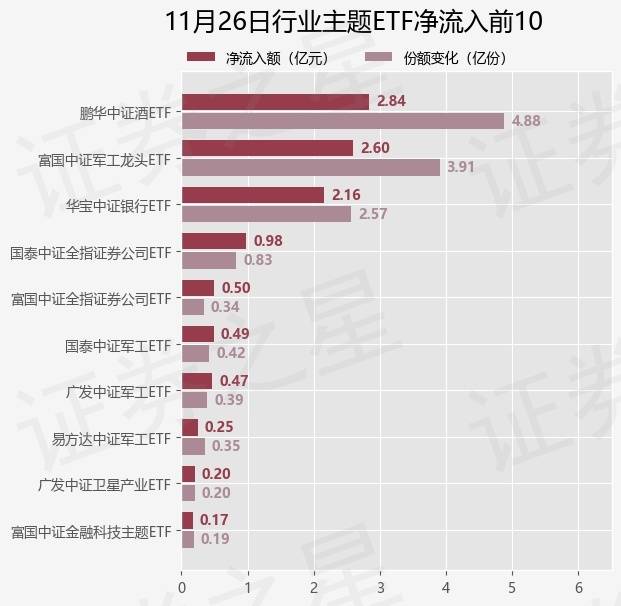
Core Insights - On November 28, industry-themed ETF funds experienced a net outflow of 2.494 billion yuan, with a cumulative net outflow of 20.054 billion yuan over the past five trading days [1] - A total of 48 industry-themed ETFs saw net inflows, with the Huabao Securities ETF (512000) leading with an increase of 427 million shares and a net inflow of 240 million yuan [1][3] - Conversely, 151 industry-themed ETFs recorded net outflows, with the Guotai Zhongzheng All-Index Securities Company ETF (512880) experiencing the largest outflow of 654 million yuan and a reduction of 556 million shares [1][4] Summary by Category Net Inflows - The Huabao Securities ETF (512000) had a net inflow of 240 million yuan, with a share increase of 427 million, bringing its total shares to 698.47 million [3][5] - Other ETFs with net inflows include: - Penghua Zhongzheng Wine ETF (512690) with a net inflow of 134 million yuan and a share increase of 230 million [3] - Huaxia Shanghai Stock Exchange Science and Technology Innovation Board Artificial Intelligence ETF (589010) with a net inflow of 93 million yuan and a share increase of 69 million [3] Net Outflows - The Guotai Zhongzheng All-Index Securities Company ETF (512880) had the highest net outflow of 654 million yuan, with a share decrease of 556 million, resulting in a total of 504.04 million shares [4][5] - Other ETFs with significant net outflows include: - Huabao Zhongzheng Bank ETF (512800) with a net outflow of 428 million yuan and a share decrease of 512 million [4] - Huaxia Zhongzheng Robot ETF (562500) with a net outflow of 163 million yuan and a share decrease of 173 million [5]
【ETF观察】11月26日行业主题ETF净流出53.28亿元
Sou Hu Cai Jing· 2025-11-26 22:33
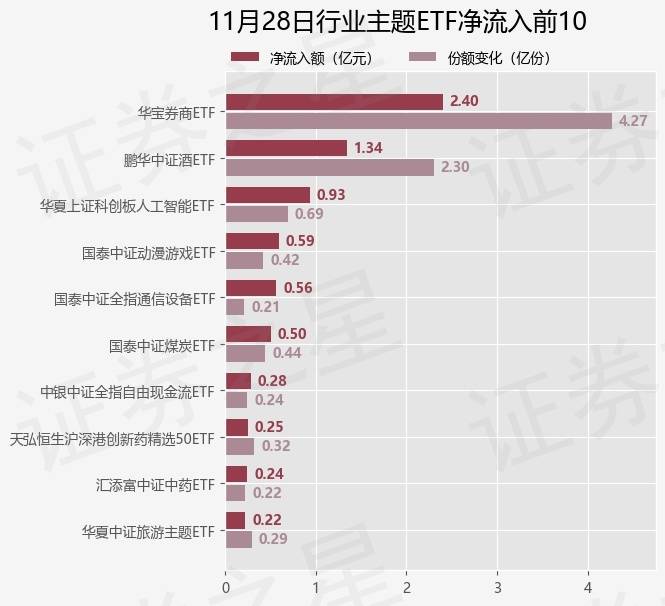
Core Insights - On November 26, industry-themed ETFs experienced a net outflow of 5.328 billion yuan, with a cumulative net outflow of 5.346 billion yuan over the past five trading days [1] - Among the 50 industry-themed ETFs, the Penghua CSI Wine ETF (512690) saw the highest net inflow, increasing by 488 million shares and a net inflow of 284 million yuan [1][3] Summary by Category Net Outflows - A total of 156 industry-themed ETFs recorded net outflows, with the top outflow being from the Harvest SSE Sci-Tech Innovation Board Chip ETF (588200), which had a reduction of 528 million shares and a net outflow of 1.167 billion yuan [4][5] - Other significant net outflows included: - Guotai CSI All-Index Communication Equipment ETF: 413 million shares, 1.085 billion yuan [4][5] - Guolian An CSI Semiconductor ETF: 386 million shares, 527 million yuan [4][5] - Huafu CSI Artificial Intelligence Industry ETF: 501 million shares, 411 million yuan [4][5] Net Inflows - The Penghua CSI Wine ETF (512690) led the net inflows with an increase of 488 million shares and a net inflow of 284 million yuan [3] - Other ETFs with notable net inflows included: - Fuguo CSI Military Industry Leader ETF: 391 million shares, 260 million yuan [3] - Huabao CSI Banking ETF: 257 million shares, 216 million yuan [3] Performance Overview - The overall performance of the industry-themed ETFs showed a mixed trend, with some ETFs experiencing positive growth while others faced declines [3][5] - The top ten ETFs with the highest net outflows included those focused on technology and communication sectors, indicating a potential shift in investor sentiment [4][5]
191只ETF获融资净买入 华夏恒生科技ETF居首
Zheng Quan Shi Bao Wang· 2025-11-26 03:11
Core Viewpoint - As of November 25, the total margin balance for ETFs in the Shanghai and Shenzhen markets is 119.68 billion yuan, showing a decrease of 1.24 billion yuan from the previous trading day [1] Summary by Category ETF Margin Balance - The ETF financing balance is 112.48 billion yuan, down by 1.44 billion yuan from the previous trading day [1] - The ETF margin short balance is 7.198 billion yuan, which increased by 196 million yuan compared to the previous trading day [1] Net Inflows - On November 25, 191 ETFs experienced net financing inflows, with the Huaxia Hang Seng Technology ETF leading with a net inflow of 122 million yuan [1] - Other ETFs with significant net inflows include the GF CSI Hong Kong Innovative Medicine ETF, E Fund CSI Hong Kong Securities Investment Theme ETF, Guotai Nasdaq 100 ETF, Yongying CSI Shanghai-Hong Kong Gold Industry Stock ETF, Penghua CSI Liquor ETF, and Pengyang 30-Year Treasury Bond ETF [1]
国泰海通|金工:大额买入与资金流向跟踪(20251110-20251114)
国泰海通证券研究· 2025-11-19 12:48
Group 1 - The report aims to track large purchases and net active purchases through transaction detail data, building relevant indicators [1] - The top five industries for large purchases in the last five trading days are: Banking, Real Estate, Steel, Comprehensive, and Textile & Apparel [2] - The top five industries for net active purchases in the last five trading days are: Banking, Transportation, Pharmaceuticals, Real Estate, and Oil & Petrochemicals [2] Group 2 - The top five ETFs for large purchases in the last five trading days are: Guotai CSI A500 ETF, Guotai SSE 10-Year Treasury ETF, Harvest S&P Oil & Gas Exploration and Production Selected Industry ETF, Southern Growth Enterprise Board AI ETF, and Hai Futong SSE Urban Investment Bond ETF [2] - The top five ETFs for net active purchases in the last five trading days are: Guotai SSE 10-Year Treasury ETF, E Fund CSI 300 Non-Bank ETF, Yinhua SSE Sci-Tech Innovation Board 100 ETF, Huabao CSI Nonferrous Metals ETF, and Penghua CSI Liquor ETF [2]

“老登”板块曙光乍现?!白酒ETF是否布局正当时?
Sou Hu Cai Jing· 2025-11-11 09:28
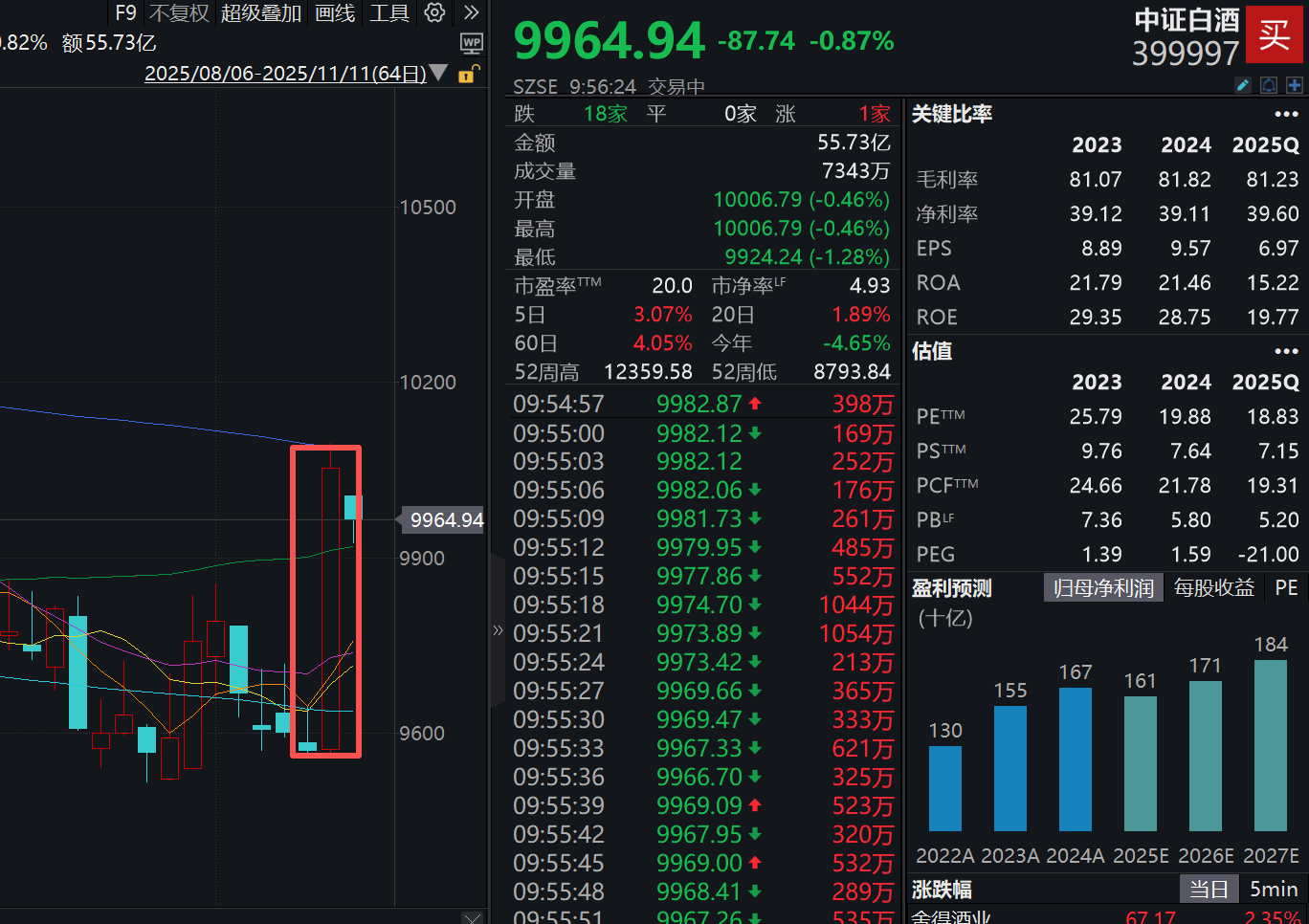
Core Viewpoint - The white liquor sector is experiencing a resurgence, with the Zhongzheng White Liquor Index showing significant gains, indicating renewed investor interest and confidence in the market [1][3]. Group 1: Market Performance - On November 10, the Zhongzheng White Liquor Index saw all constituent stocks rise, with notable gains from Shede Liquor and Jiugui Liquor, both hitting the daily limit, while leading brands like Luzhou Laojiao and Gujing Gongjiu rose over 5% [1]. - The current price-to-earnings ratio (PE-TTM) for the white liquor sector is approximately 18.7 times, which is at a low level compared to the past five years, indicating a clear valuation advantage [6]. Group 2: Economic Indicators - In October, the Consumer Price Index (CPI) rose by 0.2% month-on-month and year-on-year, while the Producer Price Index (PPI) also saw its first month-on-month increase of the year, suggesting a reduction in deflationary pressures and a mild recovery in consumer demand [3]. Group 3: Investment Opportunities - Analysts believe that the most challenging period for the white liquor industry has passed, with external constraints on consumption expected to ease, making it a favorable time for investment [6][15]. - The white liquor sector is seen as a more stable investment compared to other high-risk stocks, with expectations of steady performance and recovery in stock prices as inventory levels normalize and prices rebound [6][15].


旅游、食品饮料等消费类ETF领涨丨ETF基金日报
2 1 Shi Ji Jing Ji Bao Dao· 2025-11-11 03:19
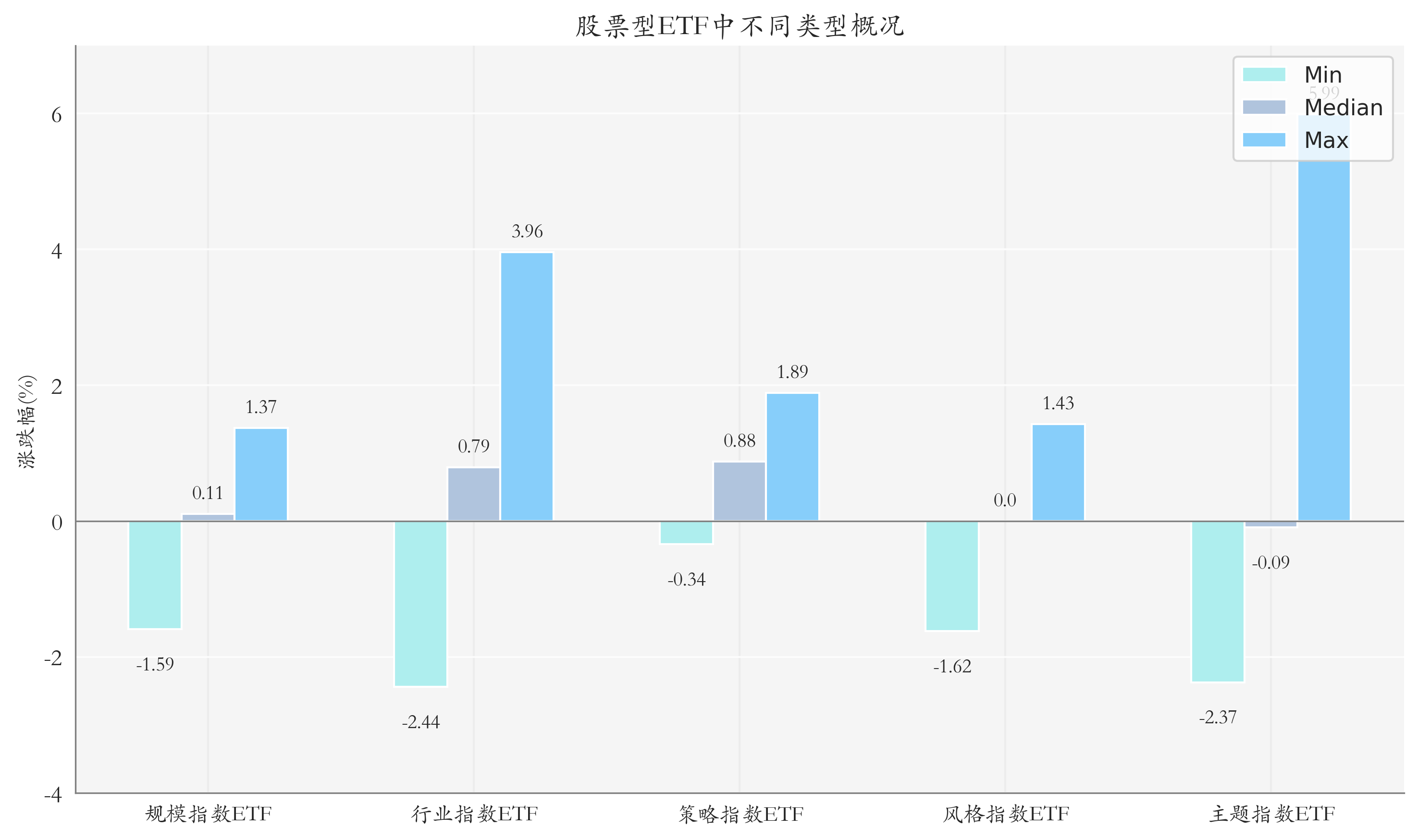
Market Overview - The Shanghai Composite Index rose by 0.53% to close at 4018.6 points, with an intraday high of 4018.7 points [1] - The Shenzhen Component Index increased by 0.18% to 13427.61 points, reaching a peak of 13502.16 points [1] - The ChiNext Index fell by 0.92% to 3178.83 points, with a maximum of 3236.61 points during the day [1] ETF Market Performance - The median return of stock ETFs was 0.22% [2] - The highest performing scale index ETF was the Penghua CSI 800 Free Cash Flow ETF, with a return of 1.37% [2] - The Tianhong CSI Food and Beverage ETF led the industry index ETFs with a return of 3.96% [2] - The highest return among strategy index ETFs was 1.89% from the ICBC Credit Suisse Shenzhen Dividend ETF [2] - The top performing thematic index ETF was the Fortune CSI Tourism Theme ETF, achieving a return of 5.99% [2] ETF Performance Rankings - The top three ETFs by return were: - Fortune CSI Tourism Theme ETF (5.99%) - Huaxia CSI Tourism Theme ETF (5.66%) - Penghua CSI Liquor ETF (4.5%) [5] - The three ETFs with the largest declines were: - Huaan SSE Sci-Tech Innovation Board New Generation Information Technology ETF (-2.44%) - E Fund National Index New Energy Battery ETF (-2.37%) - GF National Index New Energy Battery ETF (-2.36%) [6] ETF Fund Flows - The top three ETFs by fund inflow were: - E Fund ChiNext ETF (inflow of 903 million yuan) - Huitianfu CSI Major Consumption ETF (inflow of 528 million yuan) - Huaxia SSE Sci-Tech Innovation Board 50 Component ETF (inflow of 478 million yuan) [8] - The ETFs with the largest outflows were: - Penghua CSI Liquor ETF (outflow of 1.017 billion yuan) - GF National Index New Energy Vehicle Battery ETF (outflow of 741 million yuan) - Huabao CSI All-Index Securities Company ETF (outflow of 291 million yuan) [9] ETF Margin Trading Overview - The top three ETFs by margin buying were: - E Fund ChiNext ETF (626 million yuan) - Huaxia SSE Sci-Tech Innovation Board 50 Component ETF (561 million yuan) - Guotai Junan CSI All-Index Securities Company ETF (435 million yuan) [11] - The highest margin selling amounts were: - Huatai-PB CSI 300 ETF (35.1 million yuan) - Southern CSI 500 ETF (18.1 million yuan) - Huaxia SSE 50 ETF (11.4 million yuan) [12] Industry Insights - Open Source Securities forecasts a recovery in the food and beverage industry by 2026, with a correlation to macroeconomic conditions [13] - The white liquor sector is currently in a deep adjustment phase, with demand decline affecting company performance [13] - Guoxin Securities sees a bottoming out in the social service sector, supported by favorable funding, policy, and fundamental conditions [14]