
增利宝

Search documents
“固收+”爆发:33万亿理财市场新主角
Xin Jing Bao· 2026-02-09 01:38
Core Viewpoint - The increasing popularity of "fixed income +" (固收+) investment products reflects a shift in investor sentiment towards seeking stable returns amid market volatility and low interest rates, with a notable growth in demand for these products in 2025 [1][4][11]. Group 1: Market Trends - The "fixed income +" investment strategy combines stable income from fixed income assets with potential performance bonuses from equities and other assets, appealing to investors' desire for both security and growth [4][6]. - As of the end of 2025, the total size of the bank wealth management market reached 33.29 trillion yuan, marking an 11.15% increase from the beginning of the year, with "fixed income +" products contributing significantly to this growth [5][7]. - The "fixed income +" product market saw a year-on-year growth of 16%, reaching a total size of 10.8 trillion yuan, outpacing the overall growth of fixed income products [7][8]. Group 2: Investor Behavior - Investors are increasingly turning to "fixed income +" products as a response to the challenges posed by low interest rates and market volatility, indicating a shift towards more proactive wealth management strategies [6][11]. - The average annualized return of "fixed income +" products was close to 4% from January 2018 to September 2025, outperforming pure bond funds while maintaining lower volatility [8][10]. - The growth of "fixed income +" products is seen as a reflection of the evolving investment mindset among domestic residents, moving from passive to active management of their financial assets [11][12]. Group 3: Institutional Developments - Financial institutions are actively launching new "fixed income +" products, with a focus on low-risk strategies that incorporate a mix of fixed income and equity assets to enhance returns [9][10]. - Internet banks like WeBank and MyBank are expanding their "fixed income +" offerings, making these investment options more accessible to a broader audience [10][11]. - The competitive landscape for "fixed income +" products is intensifying, with various institutions vying for market share by offering innovative and diversified investment strategies [9][10].


50万亿天量存款到期,银行理财率先打响存款"争夺战"
Ge Long Hui· 2026-01-28 07:15
Core Viewpoint - The article highlights the impending expiration of a significant amount of fixed-term deposits in China, leading to a competitive landscape for banks and financial institutions to attract these funds into alternative investment products, particularly "fixed income plus" (固收+) products, as traditional savings rates decline. Group 1: Market Dynamics - By 2026, approximately 50 trillion yuan of fixed-term deposits will mature, creating a substantial opportunity for banks to capture these funds [2][4] - The banking wealth management market is projected to reach 33.29 trillion yuan by the end of 2025, with 143 million investors, marking historical highs [4] - A shift in consumer behavior is noted, with a trend towards diversified investment strategies as savings rates decrease [6][10] Group 2: Product Innovations - Financial institutions are increasingly launching "fixed income plus" products that combine low-risk assets with enhanced yield opportunities, responding to the demand for stable returns [3][8] - Internet banks like WeBank and MyBank are introducing innovative products with lower investment thresholds, making them accessible to a broader audience [5][6] - The average annual yield of "fixed income plus" products was reported at 3.00% in 2025, outperforming traditional fixed income products by 47% [11] Group 3: Competitive Strategies - Banks are intensifying marketing efforts and customer engagement through promotional activities to attract clients during the "deposit migration" trend [7][8] - Traditional wealth management firms are expanding their reach into lower-tier cities through partnerships with local banks, enhancing their distribution channels [5][6] - The competition is characterized by a focus on professional management and innovative product offerings to meet evolving consumer needs in a low-interest-rate environment [10][11]
2%的银行存款几乎绝迹
21世纪经济报道· 2026-01-26 13:33
Core Viewpoint - The article highlights the ongoing competition among banks for deposits as a significant amount of fixed-term deposits, estimated at 50 trillion yuan, will mature by 2026, leading to a shift towards alternative investment products like bank wealth management and "fixed income+" products [6][7]. Group 1: Market Dynamics - Millions of households are facing reduced interest rates on maturing fixed-term deposits, with rates dropping to below 2% from over 3% three years ago, prompting a search for stable alternative investment products [5][6]. - The trend of "deposit migration" is expected to result in 2 to 4 trillion yuan of activated funds flowing into bank wealth management and other non-fixed deposit investment areas by 2026, with "fixed income+" and mixed equity products projected to grow by 20% year-on-year [5][7]. Group 2: Product Innovation - Banks are increasingly launching mid-to-low risk "fixed income+" wealth management products that aim to enhance returns while maintaining low volatility, with internet banks like WeBank and MyBank leading promotional activities to attract customers [5][8]. - The wealth management market reached a record size of 33.29 trillion yuan by the end of 2025, with 143 million investors, indicating a robust demand for diversified investment options [7]. Group 3: Consumer Preferences - "Fixed income+" products are gaining popularity among consumers due to their ability to provide a stable base with bond assets while allowing for flexible allocation to stocks and other assets, reflecting a shift in investor preferences towards more balanced risk and return profiles [11][12]. - The average annual return for "fixed income+" products was 3.00% in 2025, outperforming traditional fixed income products by 47 basis points, showcasing their appeal in a low-interest-rate environment [11][12].

50万亿天量存款到期,银行理财率先打响存款“争夺战”
2 1 Shi Ji Jing Ji Bao Dao· 2026-01-26 10:29
Core Insights - The article highlights the impending maturity of approximately 50 trillion yuan in term deposits by 2026, leading to a competitive landscape for banks and financial products as customers seek better returns amid declining interest rates [1][4]. Group 1: Market Dynamics - Millions of households are facing reduced interest rates on term deposits, with current rates dropping below 2% compared to over 3% three years ago [1]. - The competition for these maturing deposits has intensified, with banks and financial institutions vying for customers' funds as they transition from traditional savings to more diversified investment options [2][4]. Group 2: Product Innovations - Financial institutions are launching various "fixed income plus" products that combine low-risk assets with enhanced yield opportunities, appealing to customers looking for stable returns [4][7]. - Internet banks like WeBank and MyBank are introducing innovative products with lower investment thresholds, making it easier for average consumers to access investment opportunities previously reserved for high-net-worth individuals [5][6]. Group 3: Investment Trends - The "fixed income plus" strategy is gaining traction, with average yields for these products outperforming traditional fixed income products by 24 basis points in 2025 [7][8]. - The shift towards "fixed income plus" reflects a broader market demand for investment solutions that balance stability with the potential for higher returns, catering to the evolving preferences of investors in a low-interest-rate environment [8].
这届年轻人搞钱,只求“小确盈”
Sou Hu Cai Jing· 2026-01-20 07:31
Group 1 - The core concept of the article revolves around the emerging trend of young individuals, referred to as "稳学家" (Stability Scholars), who prioritize stability and risk management in their financial and life decisions, moving away from the traditional pursuit of rapid wealth accumulation [2][5][13] - This generation is increasingly focused on "小确盈" (small certain gains) in their financial activities, reflecting a broader life philosophy that emphasizes cautious decision-making and risk control across various aspects of life, including education, employment, and family planning [2][4][5] - The shift in educational choices, such as "逆向考研" (reverse graduate school applications) and "本升专" (undergraduates opting for vocational schools), indicates a growing preference for practical and stable career paths over traditional academic prestige [3][4] Group 2 - In the employment market, the overwhelming preference for stability is evident, with a significant number of candidates applying for civil service positions, indicating a shift towards secure job roles over potentially lucrative but volatile opportunities [4][5] - Young individuals are now evaluating marriage and child-rearing through a pragmatic lens, considering economic costs and responsibilities, which reflects a more calculated approach to personal life decisions [4][5] - The financial behavior of this demographic has evolved into a defensive strategy, with a focus on preserving capital and achieving steady, reliable returns rather than aggressive wealth accumulation [5][6][9] Group 3 - The banking sector is witnessing a historic shift as young people increasingly favor bank wealth management products over traditional savings accounts, driven by declining interest rates and the need for better returns [6][8] - Products like "稳利宝" (Stable Profit Treasure) from 网商银行 (Wangshang Bank) have gained popularity due to their low-risk profiles and clear, visible returns, appealing to the cautious nature of young investors [8][9] - The concept of "新三金" (New Three Golds), which includes a balanced allocation of money market funds, bond funds, and gold funds, is becoming a preferred investment strategy among young individuals, reflecting a move towards diversified and stable asset management [9][12]

全年为小微经营者赚了118亿元 网商银行成小微普惠理财主阵地
Sou Hu Cai Jing· 2026-01-09 05:48
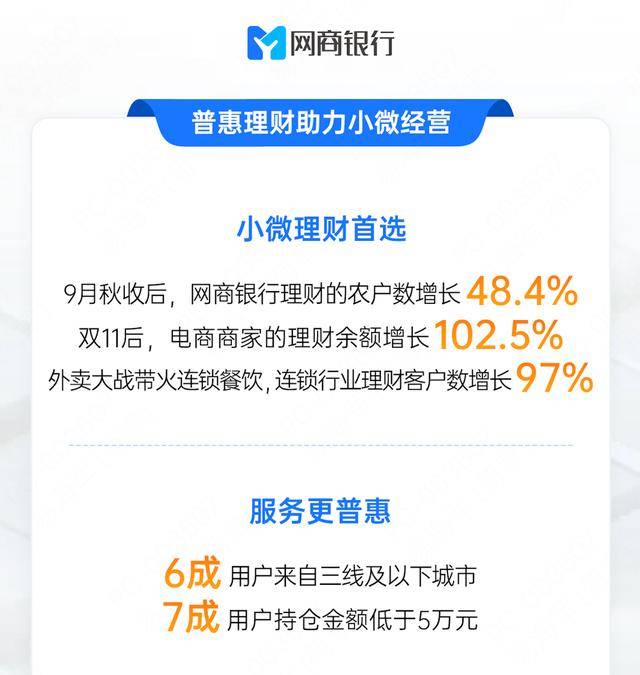
Group 1 - The core viewpoint is that the demand for financial management among small and micro business operators is rapidly increasing, creating a critical window for the adaptation of financial products [1][4] - In China, there are 52 million small and micro enterprises and 124 million individual businesses, with over 170 million small business operators needing tailored financial products to enhance capital efficiency [4] - The financial management needs of small business operators differ from ordinary investors, as their liquidity is not merely "idle money" but essential business capital, prioritizing capital safety and stable returns [4] Group 2 - The launch of the "Stable Profit" platform by MyBank offers 100% low-risk bank financial products, with an average annualized return of 2.32% in 2025, outperforming similar market products by 14% [5] - The user base of "Stable Profit" reached 4.95 million in 2025, an 84% increase from the beginning of the year, indicating strong user preference for stable and low-volatility financial products [5] - After the "Double 11" shopping festival in 2025, the financial balance of e-commerce merchants in MyBank increased by 102.5%, showcasing the trend of converting idle business funds into stable financial management [5] Group 3 - Small business operators require a flexible "financial toolbox" to manage their complex and volatile cash flow needs, necessitating a variety of financial products rather than a single option [8] - MyBank has customized a combination of products, including "Weekly Profit" and "Monthly Profit," which allow users to save daily and redeem funds automatically, providing annualized returns between 2.2% and 2.37% [8] - The combination of "long and short" financial products has gained popularity, with 2.15 million users utilizing "Weekly Profit" and "Monthly Profit," and 80% of small businesses using them alongside "Idle Profit" for more flexible cash management [8] Group 4 - As small business operators accumulate idle funds, there is a growing demand for higher returns under stable conditions, driving the rapid development of "fixed income plus" bank financial products [12] - MyBank's "Increased Profit" product, which follows this trend, achieved an average annualized return of 3.00% in 2025, nearly 50% higher than traditional fixed-income products [12] - The "fixed income plus" products, such as "Increased Profit," have shown lower volatility compared to pure equity assets, with a maximum drawdown of -0.28%, significantly better than the -10.08% drawdown of direct investments in gold ETFs [12] Group 5 - The growth in financial management among small business operators, such as a 48.4% increase in financial management among farmers post-harvest and a 97% increase in the restaurant industry, indicates that inclusive finance has become deeply embedded in the pulse of China's small micro-economy [13] - The reported 11.8 billion yuan in returns reflects the practical implementation of digital finance supporting the real economy and showcases the financial wisdom and resilience of Chinese small business operators [13]
银行理财要大变天了?
表舅是养基大户· 2026-01-08 13:33
Core Viewpoint - The article discusses the current state, issues, and future of the 30 trillion yuan wealth management market, emphasizing the impending changes in competition and business models within the industry [7][11]. Group 1: Wealth Management Market Overview - The wealth management market is facing significant challenges as the previous model of "retained earnings" is nearing its end, which has historically allowed banks to manage returns during varying market conditions [8][9]. - The "wealth management ranking" business model, which attracted customers with high short-term returns, is becoming less effective as investors become more discerning [10][11]. Group 2: Future Directions for Wealth Management Companies - Future competition in the wealth management sector will focus on three key areas: investment research capabilities, product line structuring, and channel service capabilities [16]. - Companies like Ant Bank are leading the way with a focus on transparency and quality, offering clear performance metrics to users, which is becoming increasingly important in a market where traditional models are failing [17][25]. Group 3: Importance of Research in Wealth Management - Understanding the wealth management market is crucial as it serves as a benchmark for the risk-free rate in China, influencing asset pricing across various sectors, including the stock market [15]. - The decline in risk-free rates due to lower returns on pure debt wealth management products is expected to increase valuations in the stock market, potentially leading to more capital inflows [15]. Group 4: Key Insights from Recent Articles - A recent report highlighted that only one out of eight banks displays annualized returns on their wealth management products, indicating a lack of transparency in the industry [4][23]. - The article emphasizes the need for a user-centered approach in wealth management, moving away from asset under management (AUM) focused sales systems to enhance customer trust and satisfaction [22][25].

网商银行2025年度普惠理财报告:全年为小微经营者赚118亿,助小微提升经营韧性
21世纪经济报道· 2026-01-08 09:39
Core Viewpoint - The article highlights the increasing demand for financial management products among small and micro business operators in a low-interest-rate environment, emphasizing the importance of stable returns and effective cash flow management [1][3][11]. Group 1: Financial Products and Their Performance - The report from Wangshang Bank indicates that its financial products have generated a total of 11.8 billion yuan in returns for users by 2025, positioning itself as a key player in the financial management of small and micro businesses [1][11]. - Wangshang Bank offers a range of financial products tailored to the diverse needs of small business operators, including Yulibao, Wenlibao, Zenglibao, Zhoulibao, and Yuelibao, which cater to different risk levels and investment horizons [1][3]. - Yulibao, with an average annualized return of 1.40%, outperforms the average money market fund by 6.1%, making it a popular choice for managing idle cash [20]. - Wenlibao, preferred for its stability, has an average annualized return of 2.32%, with 100% of users holding for over three months achieving positive returns [4][23]. - Zenglibao employs a "fixed income plus" strategy, achieving an average annualized return of 3.00%, which is 47% higher than the market average for fixed-income products [25][26]. Group 2: User Behavior and Trends - There is a notable increase in the number of small business operators using Wangshang Bank's financial products, with a 48.4% increase in farmers using the service after the autumn harvest and a 102.5% increase in e-commerce merchants' financial balances post "Double 11" shopping festival [9][11]. - Over 80% of small business operators prefer to use a combination of Zhoulibao and Yuelibao with Yulibao for managing their liquid funds, indicating a trend towards more sophisticated cash management strategies [10][34]. - The article illustrates that small business operators are increasingly aware of the importance of financial management, as evidenced by their proactive approach to investing idle funds for stable returns [11].

网商银行2025普惠理财报告:全年为小微经营者赚118亿
2 1 Shi Ji Jing Ji Bao Dao· 2026-01-08 07:41
Core Viewpoint - The article highlights the increasing demand for financial management solutions among small and micro business owners in a low-interest-rate environment, with a focus on the innovative financial products offered by Wangshang Bank to meet their diverse needs [1][2]. Group 1: Financial Products Overview - Wangshang Bank has launched a series of financial products such as Yulibao, Wenlibao, Zenglibao, Zhoulibao, and Yuelibao to cater to the asset management needs of small and micro business owners [1][2]. - The average annualized return for Yulibao is 1.40%, outperforming the average of money market funds by 6.1% [13]. - Wenlibao offers a 2.32% average annualized return, with 100% positive returns for users holding it for over three months [17]. - Zenglibao employs a "fixed income plus" strategy, achieving an average annualized return of 3.00%, which is 47% higher than the market average for fixed-income products [20]. - Zhoulibao and Yuelibao are designed for flexible savings, with average annualized returns of 2.22% and 2.37% respectively, allowing users to manage cash flow effectively [29]. Group 2: User Engagement and Growth - Wangshang Bank's financial products have seen significant user growth, with 495 million users choosing Wenlibao, reflecting an 84% increase since the beginning of the year [16][17]. - The number of farmers using Wangshang Bank's financial services increased by 48.4% after the autumn harvest, while e-commerce merchants' financial balances grew by 102.5% post "Double 11" sales [6][9]. - Over 80% of small business owners prefer to use a combination of Zhoulibao/Yuelibao and Yulibao for managing their liquid funds, indicating a trend towards more sophisticated financial management [30]. Group 3: Risk Management and Product Performance - Wangshang Bank employs a strict selection process for its financial products, ensuring that small business owners can access safe and stable asset management services [4]. - The maximum drawdown for Zenglibao is significantly lower than that of comparable fund products, demonstrating its resilience in volatile markets [21]. - The bank's approach to asset allocation and risk control has allowed it to maintain a competitive edge in the financial services market for small and micro enterprises [5].

全年为小微经营者带来118亿元回报,网商银行成小微普惠理财主阵地
Guo Ji Jin Rong Bao· 2026-01-08 07:36
Core Insights - The demand for wealth management products among small and micro business operators is rapidly increasing, marking a critical window for product adaptation [1][2] Group 1: Market Overview - There are 52 million small and micro enterprises and 124 million individual businesses in China, with over 170 million small business operators managing nearly 50 trillion yuan in annual liquidity [2] - The banking wealth management market in China is projected to grow to 50 trillion yuan by 2030, according to McKinsey [2] Group 2: Product Performance - The average annualized return for the "Welfare Treasure" product is 2.32%, which is 14% higher than similar market products, with 495 million users by 2025, reflecting an 84% increase from the beginning of the year [2][17] - The "Increase Treasure" product has an average annualized return of 3.00%, which is nearly 50% higher than fixed-income products, and has seen a user growth of 8.7 times in 2025 [5][22][25] Group 3: User Behavior and Preferences - After the "Double 11" shopping festival, the wealth management balance of e-commerce merchants in the bank increased by 102.5% [3][9] - 215 million users are utilizing the "Weekly Treasure" and "Monthly Treasure" products, with 80% of small businesses combining them with "Welfare Treasure" for more flexible liquidity management [4][31] Group 4: Financial Strategy - Small business operators are increasingly shifting idle funds into stable wealth management products to reduce operational costs, as evidenced by individual cases where returns cover essential expenses [3][10] - The "Welfare Treasure" and "Increase Treasure" products are designed to meet the diverse and precise financial needs of small businesses, providing a flexible "financial toolbox" [4][5]
