定制ASIC芯片

Search documents
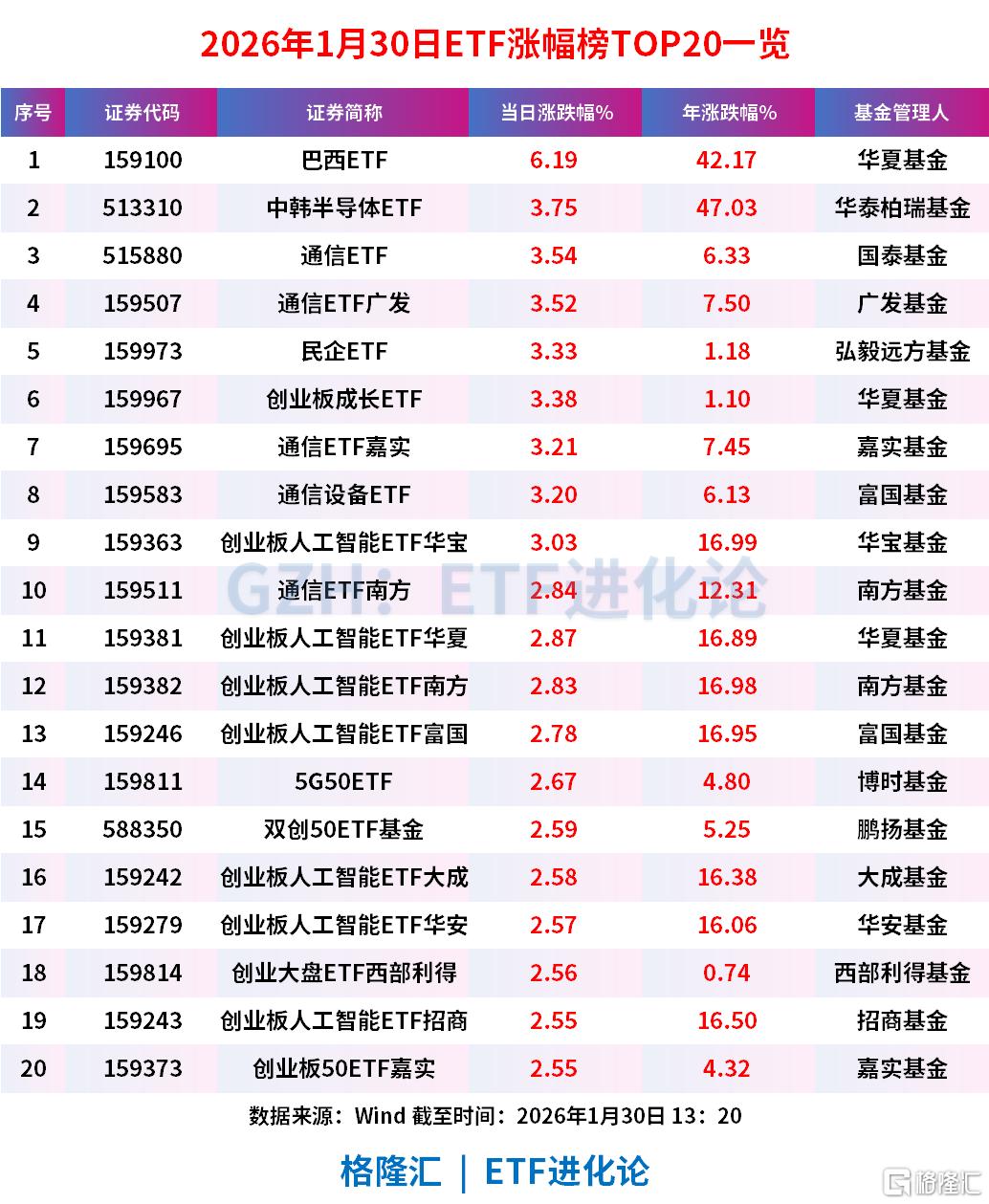
CPO概念股午后继续上攻,通信ETF、通信ETF广发、通信ETF嘉实、通信设备ETF涨3%
Ge Long Hui A P P· 2026-01-30 06:59
Group 1 - The core viewpoint of the news highlights a significant increase in the performance of computing hardware stocks, with companies like Jieput and Zhishang Technology hitting the daily limit, and Tianfu Communication reaching a historical high with a 14% increase [1] - Major ETFs related to communication and AI sectors have shown strong performance, with several ETFs recording gains between 2.56% and 3.75% [3] - Microsoft and Meta reported that the tight supply of AI computing power will persist until 2026, with both companies planning substantial capital expenditures for AI infrastructure [5][6] Group 2 - Microsoft plans to invest $80 billion in AI data centers this fiscal year to meet the surging demand for AI products, while also focusing on optimizing computing efficiency through custom ASIC chip development [6] - Industrial Fulian, a leader in the computing sector, expects a net profit of 35.1 billion to 35.7 billion yuan for 2025, representing a year-on-year increase of 51% to 54%, driven by strong growth in cloud computing services [6][7] - Jieput anticipates a net profit of 262.3 million to 309 million yuan for 2025, reflecting a year-on-year growth of 97.69% to 132.88%, supported by rising demand for laser technology and breakthroughs in optical communication [7]

微软与Meta季报回答了市场焦点问题:算力开支和AI需求,都很强!
Hua Er Jie Jian Wen· 2026-01-29 08:49
据追风交易台,摩根大通分析师Harlan Sur解读微软与Meta最新财报指出,AI基础设施的支出强度已明 确进入新一轮扩张周期。 这表明,在基础模型、AI代理及商业化应用加速部署的推动下,算力需求持续超越供给能力,驱动云 计算与超大规模企业持续加大投入。摩根大通认为,当前供需格局下,主要科技企业的资本支出仍具上 调空间,投资将重点集中于数据中心、服务器及网络基础设施,进而带动相关半导体产业链业绩。该投 资趋势预计将延续至2027年。 供应极限成为常态:需求缺口将持续 供应紧张已成为当前人工智能基础设施建设的核心瓶颈。微软与Meta在最新财报会议中均指出,算力 需求持续超越供应能力。 供需失衡的结构性原因在于基础模型、AI代理及商业化应用的加速部署,推动计算强度呈现指数级增 长。Meta透露,其用于训练生成式广告模型的GPU集群规模已实现翻倍,并正进一步扩展以支持2026 年新一代GEM模型的训练。 这种持续的供应紧缺态势,预计将继续支撑数据中心、服务器及网络基础设施在2026年至2027年间保持 高强度投资。 定制芯片开发成为战略重点 两家科技巨头在最新财报中均表示,AI算力供应紧张态势贯穿2026年。两家 ...


芯片行业,前所未见
半导体行业观察· 2025-12-10 01:50
来自 AMD、英伟达、博通和主要研究公司的越来越多的预测表明,在人工智能基础设施建设规模比 该行业历史上任何一次扩张都大数倍的推动下,半导体市场将在本十年结束前突破万亿美元大关。 Creative Strategies 的最新分析将这种转变称为"千兆周期"(Gigacycle),并指出人工智能前所未 有的需求规模正在同时重塑计算、内存、网络和存储的经济格局。2024 年全球半导体收入约为 6500 亿美元,但目前多项预测显示,2028 年或 2029 年将突破万亿美元大关。人工智能是造成这一预测 上调的主要原因。 AMD首席执行官苏姿丰(Lisa Su)近期上调了公司长期预期,称到2030年人工智能硬件市场规模将达 到1万亿美元,并预测AMD整体复合年增长率将达到35%,数据中心业务的复合年增长率将达到60% 左右。她还公开反对近几个月来盛行的人工智能泡沫论调。 与此同时,英伟达给出了更为宏大的预期,在2026年第二季度财报电话会议上,该公司将未来五年人 工智能基础设施市场规模描述为3万亿至4万亿美元。这一数字基于超大规模数据中心、自主人工智能 项目和企业集群的系统级部署。 公众号记得加星标⭐️,第一时间看推 ...


盘后大涨近9%!“ASIC芯片巨头”Marvell营收同比37%,数据中心业务指引超预期!
美股IPO· 2025-12-03 04:40
Core Viewpoint - Marvell Technology's guidance for data center business growth exceeding 25% year-over-year for the next fiscal year significantly surpassed expectations, leading to a surge in stock price, indicating investor confidence in the long-term growth prospects of AI hardware rather than short-term performance [1][4]. Financial Performance - Marvell reported a third-quarter adjusted EPS of $0.76 and revenue of $2.08 billion, slightly above analyst expectations of $0.74 EPS and $2.07 billion revenue, with data center revenue growing 38% year-over-year to $1.52 billion, slightly exceeding Wall Street's forecast of $1.51 billion [6]. - The company provided a cautious outlook for the fourth quarter, expecting adjusted EPS of $0.79 and revenue of $2.2 billion, aligning closely with analyst predictions but failing to deliver a surprise [6]. Market Reaction - Initially, the stock price fell by 5% following the earnings report due to the conservative fourth-quarter outlook, but it rebounded sharply after CEO Matt Murphy's optimistic data center growth forecast, with post-market trading showing an increase of up to 14% [3][5]. - The strong guidance for data center revenue growth acted as a catalyst for restoring investor confidence in Marvell as a specialized custom chip manufacturer [4]. Acquisition Plans - Murphy indicated that the optimistic growth forecast does not account for the recently announced acquisition of AI startup Celestial AI for approximately $3.25 billion in cash and stock [7]. Market Dynamics - Despite a significant 83% increase in stock price in 2024, Marvell's stock has declined by 16% year-to-date, reflecting market skepticism regarding its ability to secure long-term orders amid intense competition [8]. - The market's divergence centers on the outlook for custom ASIC chips, with UBS analyst Timothy Arcuri noting that investors view the situation as a binary outcome—either securing orders or facing exit [8]. - Arcuri believes that most clients are diversifying their supply chains, which could benefit companies like Marvell, and currently rates Marvell as a "buy" with a target price of $110 [8].


英伟达、AMD寡淡?博通AI业务狂飙
Hu Xiu· 2025-09-05 03:44
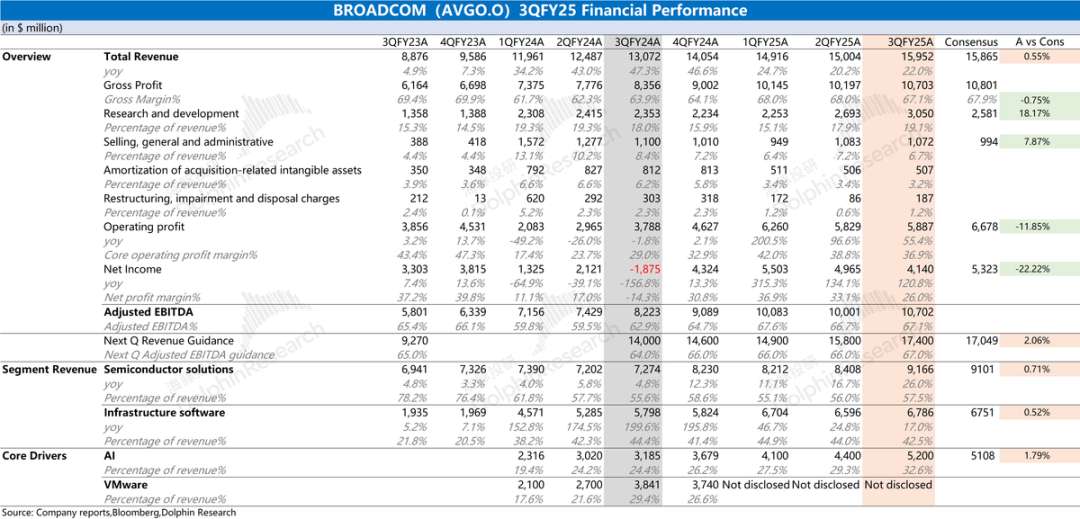
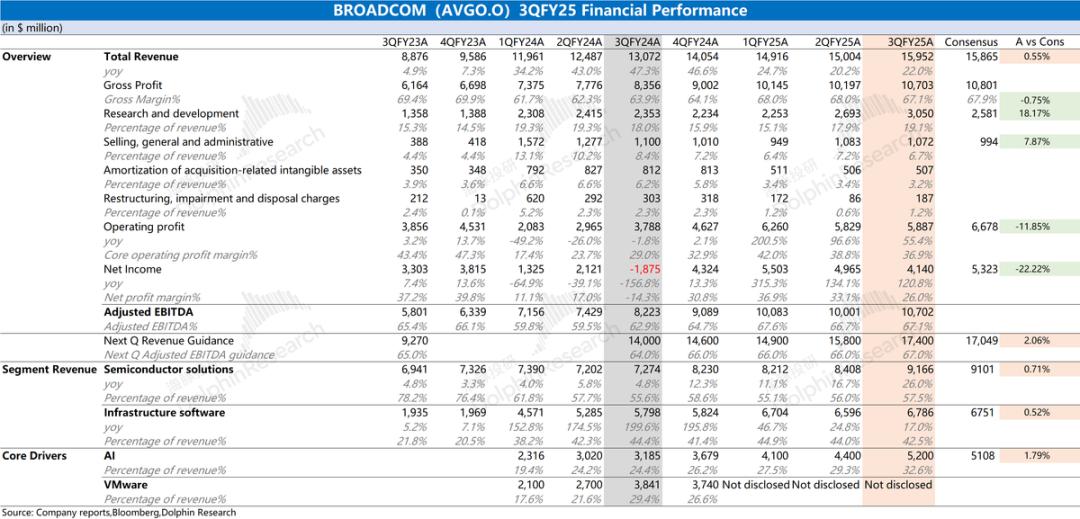
Overall Performance - Broadcom (AVGO.O) achieved revenue of $15.95 billion in the latest quarter, a year-over-year increase of 22%, meeting market expectations of $15.86 billion, primarily driven by AI business and VMware integration pricing adjustments [1][12][40] - The company's gross margin was 67.1%, while the adjusted operating gross margin, excluding acquisition amortization and restructuring costs, was 76.8%, reflecting a sequential decline due to the lower margin of custom ASIC business [2][45] Semiconductor Business - The semiconductor segment generated $9.17 billion in revenue, with a sequential increase of $760 million, largely attributed to AI business growth [3][59] - AI business revenue reached $5.2 billion, an increase of $800 million quarter-over-quarter, exceeding market expectations of $5.1 billion, driven by increased production of Google's TPU v6 [3][21] - Non-AI business revenue was $4 billion, showing a sequential decline of 1%, with wireless and industrial segments remaining flat while enterprise storage continued to decline [5][67] Infrastructure Software - The infrastructure software segment reported $6.79 billion in revenue, a sequential increase of $190 million, mainly due to VMware acquisition integration and subscription model adjustments [6][72] - The transition from perpetual licensing to subscription models is expected to benefit software business growth, although the high-growth phase has likely ended [6][72] Operating Expenses - Core operating expenses (R&D and SG&A) totaled $4.12 billion, a sequential increase of $346 million, with the core operating expense ratio around 30% [7][46] - Excluding stock-based compensation, core operating expenses were $2.05 billion, reflecting a sequential decline of $150 million, indicating ongoing cost control efforts post-VMware acquisition [8][13] VMware Integration Progress - The total debt to LTM adjusted EBITDA ratio decreased to 2.3, indicating that the impact of the VMware acquisition is being gradually absorbed [9][54] - The company is focusing on AI business growth following the integration of VMware, with significant attention on custom ASIC developments [16][74] Future Guidance - For Q4 FY2025, Broadcom expects revenue of approximately $17.4 billion, surpassing market expectations of $17 billion, with AI business projected to grow to $6.2 billion [10][21] - The company anticipates continued growth in AI revenue, supported by increased capital expenditures from major cloud providers [4][17] AI Business Insights - Broadcom's AI revenue is primarily driven by three major clients: Google, Meta, and ByteDance, with expectations for further growth as these companies increase capital expenditures [16][21] - The company has secured over $10 billion in AI-related orders from a fourth client, with deliveries expected to start in Q3 FY2026, enhancing future revenue prospects [25][64] - Broadcom's ASIC business is expected to benefit from the ongoing demand from cloud service providers, with a strong pipeline of potential clients transitioning to production [18][66] Market Position and Valuation - Broadcom's current market capitalization is approximately $1.4 trillion, with a projected core operating profit of around 36 times PE for FY2026 [29] - Compared to Nvidia's valuation, Broadcom's higher valuation reflects market expectations for growth in its custom ASIC business and AI chip market share [30][36] - Broadcom has surpassed AMD in market share within the AI chip market, achieving 9.6% compared to AMD's 6.0%, indicating a strengthening position in the custom ASIC segment [31][36]
英伟达、AMD寡淡?博通霸气接棒AI扛旗手
3 6 Ke· 2025-09-05 02:52
Overall Performance - Broadcom reported Q3 FY2025 revenue of $15.95 billion, a 22% year-over-year increase, meeting market expectations, driven primarily by AI business and VMware integration adjustments [1][18] - The gross margin for the quarter was 67.1%, with an adjusted operating gross margin of 76.8%, reflecting a structural impact from the increased share of lower-margin custom ASIC business [1][20] Semiconductor Business - The semiconductor segment generated $9.17 billion in revenue, with AI contributing significantly, achieving $5.2 billion, an increase of $800 million quarter-over-quarter [1][30] - Non-AI semiconductor revenue was $4 billion, showing a 1% decline, indicating a relatively weak performance in this area [2][30] AI Business Insights - The company expects AI revenue to reach $6.2 billion in the next quarter, reflecting a $1 billion increase, supported by rising capital expenditures from major clients like Google and Meta [2][9] - Broadcom's AI revenue is primarily derived from three major clients: Google, Meta, and ByteDance, with a fourth client recently placing over $10 billion in AI-related orders [11][30] Infrastructure Software - The infrastructure software segment achieved $6.79 billion in revenue, a $1.9 billion increase, largely due to VMware's integration and a shift to subscription pricing models [1][35] - VMware's contribution to revenue is expected to continue growing, although the high-growth phase has likely plateaued [2][37] Operating Expenses - Core operating expenses for the quarter were $4.12 billion, up $346 million, primarily due to increased stock-based compensation [2][22] - Excluding stock-based compensation, core operating expenses decreased by $150 million, indicating ongoing efforts to control costs post-VMware acquisition [2][22] Debt Management - The total debt to LTM adjusted EBITDA ratio improved to 2.3, suggesting that the impact of the VMware acquisition on the company's debt profile is being effectively managed [3][26] Future Guidance - For Q4 FY2025, Broadcom anticipates revenue of approximately $17.4 billion, exceeding market expectations, with an adjusted EBITDA margin projected at 67% [3][18]
全球芯片巨头TOP10,最新出炉
3 6 Ke· 2025-05-13 10:34
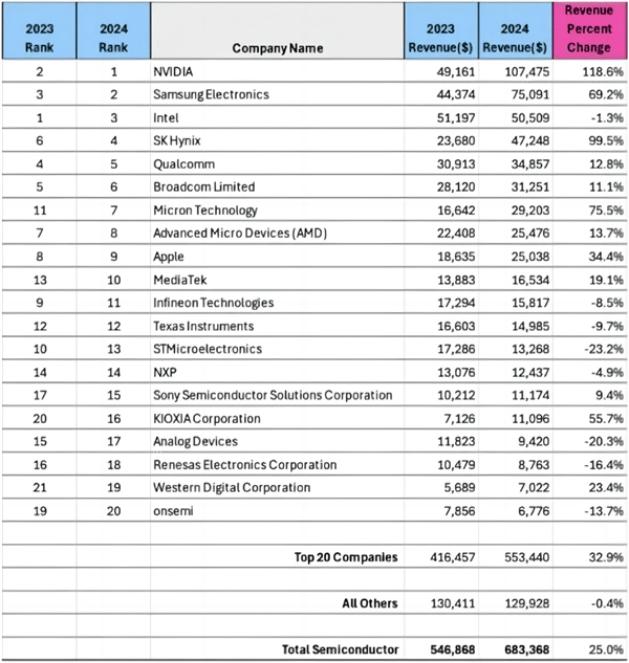
Group 1: Market Overview - The 2024 global semiconductor company rankings show significant changes, with NVIDIA rising to the top due to its strong performance in AI chips, while traditional giants like Infineon and STMicroelectronics fell out of the top ten [1][2] - The total semiconductor market revenue is projected to grow from $546.87 billion in 2023 to $683.37 billion in 2024, representing a 25% increase [2] Group 2: Company Performance - NVIDIA's revenue is expected to reach $107.475 billion in 2024, a 118.6% increase from $49.161 billion in 2023 [2] - Samsung Electronics is projected to generate $75.091 billion in revenue for 2024, up 69.2% from $44.374 billion in 2023 [2] - SK Hynix's revenue is expected to grow from $23.68 billion in 2023 to $47.248 billion in 2024, marking a significant increase [2] - Micron Technology's revenue is anticipated to rise from $16.642 billion in 2023 to $29.203 billion in 2024, a 75.5% increase [2] Group 3: Q1 Earnings Reports - NVIDIA forecasts Q1 revenue of $43 billion for 2026, exceeding market expectations [5] - Samsung's semiconductor division reported Q1 revenue of approximately $178 billion, a 9% year-over-year increase [5] - Broadcom's Q1 revenue reached $14.92 billion, a 25% increase year-over-year, driven by AI-related chip sales [5] - Intel's Q1 revenue was $12.667 billion, showing a slight decline of 0.4% [5] Group 4: Market Trends - The automotive chip market is expected to recover in the coming quarters, despite a slowdown in 2024 [14][15] - The demand for custom ASICs is on the rise, with Broadcom's AI chip revenue significantly contributing to its growth [16][17] - SK Hynix has overtaken Samsung in the DRAM market, marking a significant shift in market dynamics [11] Group 5: Future Projections - SK Hynix anticipates a 10-15% increase in DRAM bit shipments in Q2, while NAND bit shipments are expected to grow over 20% [18] - Samsung expects strong demand for AI servers in Q2, aiming to enhance its position in high-value markets [18] - Micron forecasts a record high revenue of $8.8 billion for the third fiscal quarter of 2025, driven by DRAM and NAND demand [19]


我们正在接近ASIC的顶峰?
半导体行业观察· 2025-05-06 00:57
Core Viewpoint - The article discusses the current state and future of custom ASIC (Application-Specific Integrated Circuit) design, suggesting that the industry may be nearing its peak due to rising costs and strategic considerations in chip design [1][2][3]. Group 1: Industry Trends - Over 100 companies are developing their own chips for various applications, including smartphones, automobiles, and Wi-Fi routers, indicating a significant trend towards custom silicon [1]. - The number of semiconductor suppliers has drastically decreased from around 2000 to nearly 200, leading to a loss of negotiation power for even the largest customers [1]. - The shift towards custom silicon is primarily driven by the consolidation in the semiconductor industry over the past 20 years [1]. Group 2: Economic Forces - The costs associated with chip design, particularly for advanced chips, have been steadily increasing, raising questions about the viability of custom designs [2]. - Companies like Microsoft and Meta are reportedly reassessing their custom chip design efforts, suggesting a potential slowdown in the trend [2]. - The article questions whether every company truly needs its own CPU, indicating that many may scale back their ambitions [2]. Group 3: Strategic Considerations - Custom chips are only advantageous when companies can control the software that runs on them; without this control, the benefits of custom design diminish [2]. - The article highlights that while the custom silicon industry is not yet at its peak, it is approaching it, with large AI companies and global automakers still needing to make decisions regarding custom chip development [3].

博通芯片,麻烦不小
半导体行业观察· 2025-03-24 01:23
Core Viewpoint - The article discusses the evolving relationship between Broadcom and its largest customer, Apple, particularly focusing on the potential impact of Apple switching to its own Wi-Fi chips, which could significantly affect Broadcom's revenue from this segment [2][5][8]. Group 1: Revenue Impact from Wi-Fi Chip Transition - Apple plans to replace Broadcom's Wi-Fi and Bluetooth chips with its internal Proxima chips in upcoming products, which could lead to a revenue loss for Broadcom estimated at $2.74 billion in 2025, decreasing to $3.24 billion by 2028 [7][8]. - The Wi-Fi chip segment currently contributes approximately 33.6% to Broadcom's revenue from Apple, but this is expected to drop to 4.3% in 2025 and further to 3.3% by 2028 [8][9]. - Broadcom's market share in the Wi-Fi chip market could decline from 24% to 12.5% if Apple transitions to its own chips, highlighting Broadcom's dependency on Apple for this revenue stream [9]. Group 2: RF Business Analysis - Broadcom supplies RF components to Apple, which accounted for about 65.2% of its revenue from Apple, with a previous agreement valued at $15 billion over three years [10][11]. - Despite the competitive landscape, Broadcom holds a significant position in the RF market, with a stable growth rate and a strong share of Apple's RF revenue, estimated at 32.7% [15][16]. - The RF business is crucial for Broadcom, and while it faces competition from Qualcomm and others, it has maintained a solid relationship with Apple, which is expected to continue in the near term [12][16]. Group 3: AI Chip Opportunities - Broadcom is collaborating with Apple on the Baltra AI chip, which is expected to be produced in 2026, potentially offsetting losses from the Wi-Fi chip transition [18][20]. - Apple's commitment to invest $50 billion over the next four years in AI infrastructure could create significant revenue opportunities for Broadcom, estimated at $12.53 billion annually from custom ASICs [21][22]. - The partnership with major tech companies like Google and Meta in the custom ASIC market positions Broadcom favorably to benefit from Apple's AI initiatives [19][22]. Group 4: Market Outlook and Valuation Concerns - Broadcom's optimistic market outlook, particularly in the custom accelerator space, has faced scrutiny as the company’s valuation has declined since reaching a $1 trillion market cap [24][29]. - The company’s revenue growth is projected to be strong, but there are concerns that the market's expectations for growth may be overly optimistic, particularly in light of competitive pressures from Nvidia and others [24][29]. - Broadcom's current market valuation appears high compared to its growth projections, suggesting potential downward pressure on its stock if growth does not meet expectations [28][29].