
富国医药创新A

Search documents
2025年公募基金年度成绩单出炉 富国基金权益、固收、量化业绩全面飘红
Zhong Zheng Wang· 2026-01-06 06:13
Core Viewpoint - The A-share market concluded 2025 with strong gains, characterized by a structural bull market driven by hard technology sectors like artificial intelligence, leading to significant performance in industries such as electronics and communications [1] Group 1: Market Performance - The ChiNext Index surged by 49.57% for the year, leading the market, while the Shanghai Composite Index rose by 18.41%, marking its largest annual increase in nearly six years [1] - The total scale of the public fund industry in 2025 surpassed 37 trillion yuan, indicating a new milestone for the asset management sector [1] Group 2: Equity Fund Performance - In 2025, the active equity segment of the company saw over 30 products ranking among the top performers, with 31 active equity funds achieving annual returns exceeding 50%, including 12 funds surpassing 80% and 5 funds doubling their returns [2] - The company ranked second among 13 large public fund companies in terms of active management returns for equity products over the past three years, showcasing strong mid-to-long-term performance [2] Group 3: Technology and Healthcare Investments - The "Fuguo Technology Performance Team" excelled in the technology growth sector, with the Fuguo Innovation Technology A fund achieving a return of 133.99%, ranking second in its category [3] - In the healthcare investment space, the company focused on innovative drugs and medical devices, with the Fuguo Medical Innovation A fund returning 67.70%, ranking second in its category [3] Group 4: Fixed Income Performance - The fixed income team demonstrated strong performance in a challenging market environment, with the company ranking in the top 25% of peers over three, five, and seven-year periods [4] - Notable fixed income products included Fuguo Jiuli Stable Allocation A, which achieved a return of 37.04%, ranking second in its category [4] Group 5: Quantitative Investment - The company expanded its quantitative investment tools, with over 80 ETF products and a total scale exceeding 250 billion yuan, marking a significant increase of over 120 billion yuan in 2025 [6] - Nine quantitative products ranked among the top 10 in their categories, with the Communication Equipment ETF achieving a return of 121.01%, ranking second [6] Group 6: Future Outlook - The public fund industry is entering a critical phase focused on high-quality development centered on investor interests, with the company committed to long-term investment principles and enhancing its research systems across equity, fixed income, and quantitative platforms [7]
2025年业绩收官——富国权益、固收、量化实力霸榜,超60只产品排名居前10%
Xin Lang Cai Jing· 2026-01-06 03:50
Core Insights - The A-share market concluded 2025 with strong gains, with major indices all in the green, particularly the ChiNext Index which rose by 49.57%, leading the market, while the Shanghai Composite Index increased by 18.41%, marking its largest annual gain in nearly six years [1] - The public fund industry in China saw its total scale surpass 37 trillion yuan, indicating a significant milestone for the asset management sector [1] - FuGuo Fund's performance in equity, fixed income, and quantitative products was outstanding, with 62 products ranking in the top 10% of performance according to Galaxy Securities data [1] Equity Performance - FuGuo Fund's active equity products demonstrated strong management capabilities, with over 30 products leading in performance, capitalizing on structural opportunities in the market [1] - In 2025, 31 active equity funds achieved annual returns exceeding 50%, with 12 funds surpassing 80% and 5 funds doubling their returns [1] - The "FuGuo Technology Performance Team" excelled in the technology growth sector, with several funds achieving returns over 100% and ranking in the top 2 of their categories [2] Fixed Income Performance - FuGuo Fund's fixed income team showcased strong investment capabilities amidst market volatility, ranking in the top 25% of peers over various time frames [3] - Key fixed income products, such as FuGuo JiuLi Stable Allocation A, achieved a return of 37.04%, ranking second in its category [3] - The fund's long-term performance in fixed income products has consistently ranked in the top 10% across multiple time frames, demonstrating the team's ability to generate sustainable returns [4] Quantitative Investment Performance - 2025 marked significant growth in index-based investment, with FuGuo Fund's quantitative team expanding its ETF product line, surpassing 80 ETFs with a total scale exceeding 250 billion yuan [5] - Nine quantitative products ranked in the top 10% of their categories, with notable performances from the Communication Equipment ETF and the Hong Kong Stock Medical ETF [5] - Over the long term, FuGuo's quantitative products have maintained a leading position, with several funds ranking in the top 4% to 9% of their categories [5] Industry Outlook - The public fund industry is entering a critical phase focused on high-quality development centered around investor interests, with FuGuo Fund committed to long-term investment principles and enhancing its research and investment systems [6]
医药板块,后续怎么走?
Zheng Quan Shi Bao Wang· 2025-11-30 23:35
Core Insights - The pharmaceutical sector has experienced a slowdown in momentum after a strong rally earlier in the year, with the number of "doubling funds" significantly decreasing [1][2] - As of November 28, only two pharmaceutical-themed funds maintained over 100% returns, indicating a retreat from previous high performance [2] - The industry is currently in a transitional phase characterized by increased market speculation, despite a solid long-term growth outlook supported by policy reinforcement and improved cash flow [1][3] Fund Performance - As of November 28, the only two funds with over 100% returns are Zhongyin Hong Kong Stock Connect Pharmaceutical A (up 107.69%) and Chuangjin Hexin Global Pharmaceutical Biotechnology A (up 100.32%) [2] - The average return of pharmaceutical-themed funds has retreated approximately 10% from their peak in September [2] - Major pharmaceutical ETFs have seen a decline in scale over the past three months, reflecting a shift from aggressive buying to a more cautious stance [2] Policy Environment - The policy landscape is expected to remain favorable for the pharmaceutical industry, with significant measures announced to support high-quality development [3][4] - Key policies include a comprehensive support framework for innovative drugs, scientific regulation, and standardized development of traditional Chinese medicine [3] - The upcoming negotiations for the national basic medical insurance directory are anticipated to enhance funding sources for the healthcare industry [3][4] Valuation and Market Dynamics - The pharmaceutical sector has been ranked low in relative performance over the past four years, indicating a potential for upward valuation adjustments [5][6] - The market is transitioning from short-term trading strategies to a focus on valuation recovery, with signs of performance improvement following the third-quarter earnings reports [5][6] - Positive catalysts are expected in the fourth quarter, including accelerated business development and improved cash flow for leading companies [6]
医药板块,后续怎么走?
券商中国· 2025-11-30 23:25
Core Viewpoint - The pharmaceutical sector has experienced a slowdown in its upward momentum after a strong rally earlier in the year, with the number of "doubling funds" significantly decreasing [1][2]. Group 1: Market Performance - As of November 28, only two pharmaceutical-themed funds, Zhongyin Hong Kong Stock Connect Pharmaceutical A and Chuangjin Hexin Global Pharmaceutical Biotechnology A, maintained doubling returns, with gains of 107.69% and 100.32% respectively, indicating a notable contraction compared to previous performance [3]. - In the third quarter, multiple pharmaceutical funds saw significant net value increases, but by the end of November, the average return for pharmaceutical-themed funds had retreated approximately 10% from their September peak [3]. - Major pharmaceutical ETFs, including the CSI 300 Pharmaceutical and Health Index and the CSI All Share Pharmaceutical and Health Index, have also seen a decline in scale over the past three months, reflecting a shift in investor sentiment from aggressive buying to cautious observation [3]. Group 2: Policy Environment - The policy landscape is viewed as a stabilizing factor for the pharmaceutical sector, with institutions focusing on policy and industry dynamics to gauge future trends [4]. - The National Healthcare Security Administration and the National Health Commission have issued measures to support the high-quality development of innovative drugs, providing comprehensive support across research, access, clinical application, and payment mechanisms [5]. - Regulatory improvements, such as the implementation of ICH guidelines and encouragement of real-world studies for drug safety assessments, are expected to enhance the efficiency and scientific rigor of drug approvals [5]. Group 3: Valuation and Investment Outlook - The pharmaceutical industry has ranked relatively low in terms of valuation over the past four years, suggesting significant potential for upward movement as valuations have been sufficiently digested [6]. - Following a period of correction, the relative value of the pharmaceutical sector is becoming more apparent, with a shift in investment logic from short-term trading to valuation recovery [6]. - Positive signs of recovery are emerging in the pharmaceutical sector's fundamentals, with improved performance reported in the third quarter and expectations for accelerated business development in the fourth quarter [6]. - The Federal Reserve's interest rate cuts are anticipated to facilitate a recovery in pharmaceutical financing, alongside improvements in the domestic capital market, which will likely enhance new drug research and development spending [7].


超20%收益基金曝光:富国25只霸榜,这一赛道竟成最大赢家
Hua Xia Shi Bao· 2025-07-09 09:41
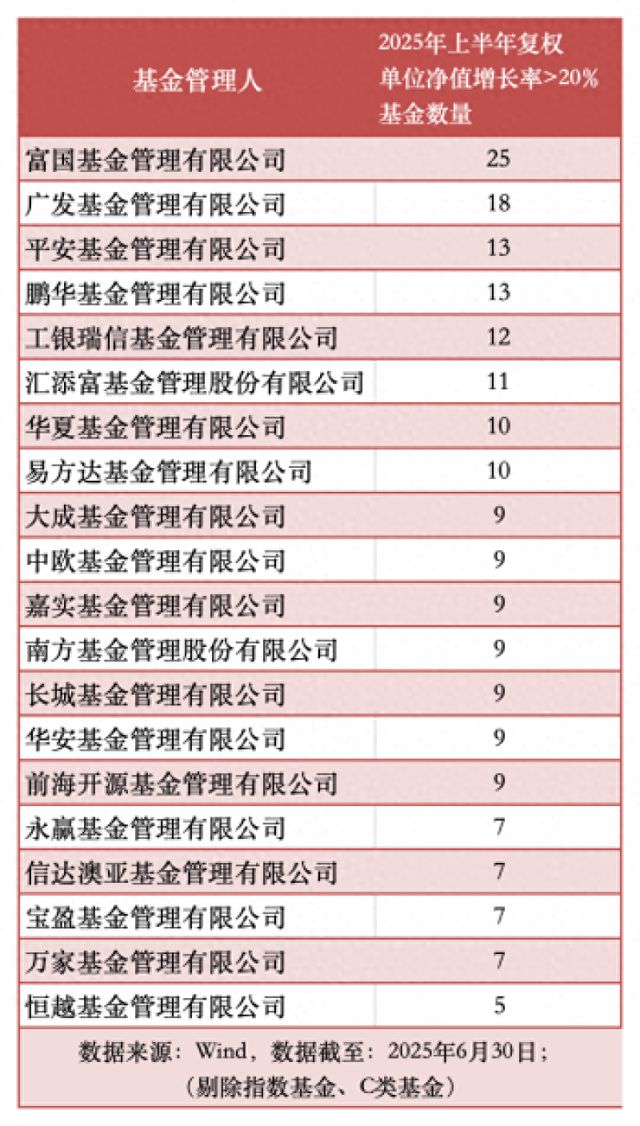
Core Insights - The performance of public funds in the first half of 2025 has been significantly influenced by the volatile A-share market, with 375 active equity funds achieving a net value growth rate exceeding 20% [2][3] - Leading fund management companies such as Fuquan, GF, Ping An, and Penghua have demonstrated strong active management capabilities, dominating the rankings with a substantial number of high-performing funds [2][3] Fund Management Performance - Fuquan Fund Management Company leads with 25 funds achieving over 20% growth, showcasing its robust overall strength [3] - GF Fund follows closely with 18 funds, with its flagship fund, GF Growth Navigator A, achieving a remarkable 68.29% growth [5][6] - Ping An and Penghua each have 13 funds on the list, while several other firms like ICBC Credit Suisse, Huatai-PineBridge, and E Fund have 10 or more funds listed [5] Sector Focus - The pharmaceutical and biotechnology sectors have emerged as the biggest winners in the first half of 2025, with a high proportion of top-ranking funds heavily invested in these areas [7] - Notable funds include Fuquan Medical Innovation A with a 55.84% increase and GF Medical Innovation A with a 36.28% increase, reflecting strong performance in the healthcare sector [4][6][9] Investment Trends - The investment landscape is shifting towards innovation and international expansion in the pharmaceutical sector, with analysts highlighting the potential for significant growth in innovative drug development and global market competitiveness [10][11] - Fund managers are advised to focus on three main investment lines: domestic market expansion, international licensing of innovative drugs, and capitalizing on industry cycles and valuation opportunities [11] Market Outlook - The outlook for the pharmaceutical industry in the second half of 2025 remains optimistic, with expectations of improved global liquidity and supportive national policies for innovation [10][12] - Fund managers emphasize the importance of fundamental research and strategic positioning to navigate potential market fluctuations and capitalize on emerging opportunities [12][13]
上半年股票型基金业绩盘点:华安医药生物A狂飙66%,港股创新药ETF平均涨57%!煤炭光伏陷滑铁卢
Xin Lang Ji Jin· 2025-07-02 09:52
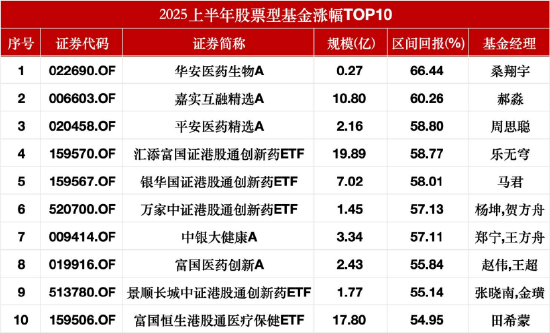
Core Insights - The A-share market in the first half of 2025 exhibited a distinct structural trend, with pharmaceutical and biotechnology-themed funds dominating performance rankings [1] - Over 120 funds were liquidated during this period, indicating significant market shifts [1] Performance Summary Top Performing Funds - The top ten stock funds saw significant returns, with the leading fund, Huaan Pharmaceutical Bio A, achieving a return of 66.44% [2] - Other notable performers included Jiashi Huron Selected A (60.26%) and Ping An Pharmaceutical Selected A (58.80%) [2] - The average return of the top ten funds was driven primarily by smaller, actively managed funds, highlighting their flexibility in capturing rapid market movements [5] Underperforming Funds - The worst-performing funds were led by Jianxin China Manufacturing 2025 A, which recorded a decline of 14.68% [4] - Other funds in the bottom tier included Huaxia Advantage Selected and Great Wall Quantitative Selected A, both with declines exceeding 12% [4] - The coal and photovoltaic sectors faced significant downward pressure, with several funds in these categories showing substantial losses [4] Sector Analysis Pharmaceutical and Biotechnology - The pharmaceutical and biotechnology sectors have seen a resurgence after a prolonged adjustment period, driven by improved valuations and supportive policies [5] - The global and domestic biotech investment climate is recovering, contributing to the strong performance of related funds [5] Coal and Photovoltaic Industries - The coal industry is experiencing a shift in supply-demand dynamics, leading to downward pressure on valuations due to economic restructuring and accelerated energy transitions [5] - The photovoltaic sector is facing intensified competition and concerns over overcapacity, impacting short-term profitability and stock performance [5] Market Outlook - The A-share market is expected to show a trend of gradual upward movement in the second half of 2025, supported by increased participation from public funds and favorable policies [6] - However, significant differentiation among sectors may lead to rebalancing pressures, particularly in pharmaceuticals and biotechnology [6] - Investors are advised to analyze macroeconomic trends and industry policies to identify opportunities amidst market volatility [6]
“投资获得感”差66倍!华安医药生物卡玛比率14.6倍 VS 景顺长城优质成长30%回撤仅换3%收益
Xin Lang Ji Jin· 2025-06-30 12:18
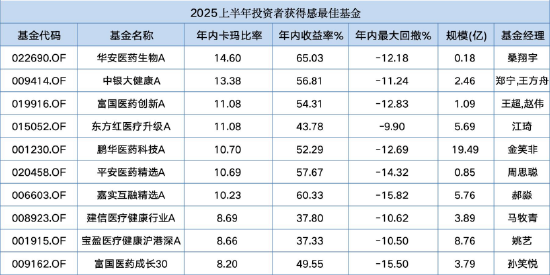
Core Insights - The performance of ordinary equity funds in the first half of 2025 shows significant differentiation, with pharmaceutical-themed funds demonstrating a comparative advantage in both returns and risk control [1][2] - The Calmar Ratio indicates a stark contrast in investor experience, with pharmaceutical funds dominating the top rankings [1][2] Performance of Pharmaceutical Funds - The top 10 pharmaceutical funds achieved an average return of 52.75%, with Huaan Pharmaceutical Biotechnology A leading at 65.03% [2] - These funds exhibited effective drawdown control, with maximum drawdowns ranging from -9.90% to -15.82%, outperforming the industry average [2] - Huaan Pharmaceutical Biotechnology A has a Calmar Ratio of 14.60, indicating a significant risk-return advantage, while Zhongyin Health A and Fuguo Pharmaceutical Innovation A also showed strong performance with Calmar Ratios of 13.38 and 11.08, respectively [2][4] Underperformance of Technology and Low-Carbon Funds - Funds focused on technology and low-carbon themes displayed a mismatch between returns and risks, characterized by low returns and high drawdowns [2][4] - The bottom 10 funds had an average return of only 3.04% with maximum drawdowns reaching -30.77% [2][3] Comparison of Fund Performance - The worst-performing fund, Invesco Great Wall Quality Growth A, had a Calmar Ratio of 0.22, with a maximum drawdown of -30.77% for a mere 3.21% return [3][4] - The average Calmar Ratio of the bottom three funds was 0.24, indicating significant risk control shortcomings [4] Defensive Characteristics of Pharmaceutical Sector - The defensive nature of the pharmaceutical sector, supported by essential consumption and policy backing, provides a natural buffer against market volatility [4] - High Calmar Ratio pharmaceutical funds tend to have smaller asset sizes (1-10 billion), allowing for more flexible adjustments, while larger funds like Invesco Great Wall Research Select A (31.77 billion) face strategic implementation constraints [4] Importance of Risk-Adjusted Metrics - The data from the first half of 2025 emphasizes that solely pursuing high returns may obscure potential risks [5] - Investors are advised to focus on risk-adjusted return metrics like the Calmar Ratio, particularly for funds with returns below 5% but drawdowns exceeding 20% [5]
同一主题业绩差高达50%: 申万菱信、永赢旗下部分医药基金缘何仍跌超10%|基金投资力测评
2 1 Shi Ji Jing Ji Bao Dao· 2025-04-15 12:32
Core Insights - The medical theme funds have shown a strong recovery this year, with over 70% reporting positive returns, driven by the performance of the innovative drug sector [1][3] - There is a significant disparity in performance among medical theme funds, attributed to differences in stock selection and timing abilities of fund managers [2][7] Group 1: Fund Performance - As of April 14, 2023, 113 out of 277 medical theme funds had returns exceeding 10%, with notable performers like Zhongyin Hong Kong Stock Connect Medicine A and Ping An Medicine Selected A achieving returns of 36.03% and 35.83% respectively [3][4] - Conversely, some funds like Yongying Medicine Health C and Shenwan Lingshin Medicine Pioneer C reported negative returns of -12.82% and -10.24% [6][9] Group 2: Investment Strategy - Successful funds typically focus on high-growth sectors such as innovative drugs and medical technology, employing concentrated holdings and active management to achieve excess returns [8][10] - Fund managers who adapt their strategies in response to market changes tend to outperform those who do not, highlighting the importance of timely adjustments in investment approaches [7][10] Group 3: Market Trends - The innovative drug sector has been buoyed by policy support and industry growth, with the Hang Seng Innovative Drug Index rising nearly 32% in the first quarter [4][12] - Despite recent market volatility, some analysts believe the current innovative drug market trend is not over, citing stable growth in medical insurance revenue and favorable policy adjustments [12][14] Group 4: Challenges and Risks - The medical sector faces significant investment challenges due to frequent policy changes and intense competition, requiring fund managers to have strong research and analytical capabilities [10][15] - There is a caution against short-term speculative trading, emphasizing the need for a focus on fundamental growth potential in the innovative drug sector [15]