
小米17 Pro Max

Search documents
多家机构披露小米手机销量波动,1月销量同比降幅达36%
Xin Lang Cai Jing· 2026-02-24 11:06
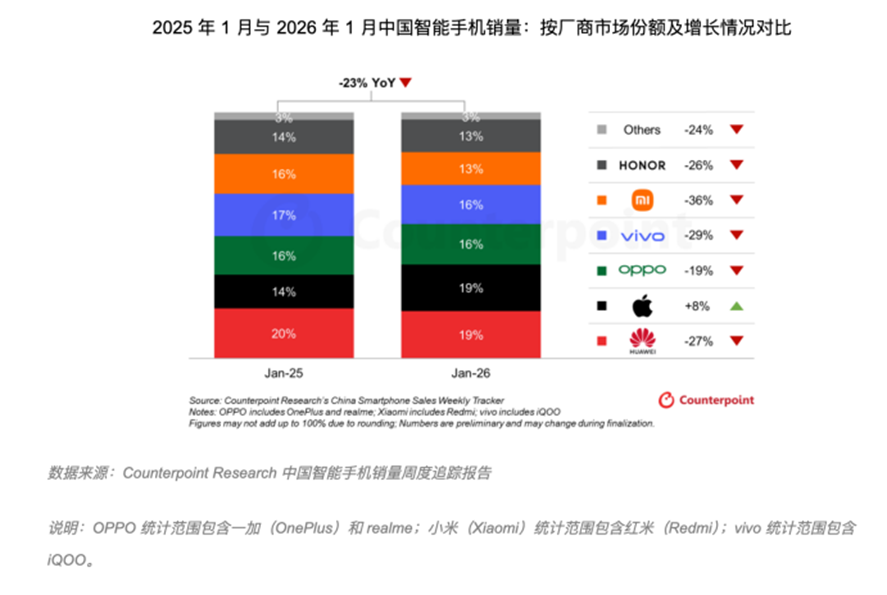
Core Insights - Xiaomi's smartphone sales have experienced significant fluctuations, with a reported year-on-year decline of 36% in January, marking the largest drop among the six major smartphone brands in China [1][8]. Group 1: Market Performance - According to Counterpoint Research, the overall smartphone sales in China decreased by 23% year-on-year in January 2026, attributed to high base effects from subsidies and changes in the Lunar New Year timing [2][10]. - In January 2026, Apple's market share increased from 14% to 19%, while Huawei's market share remained stable at 19% despite a 27% decline in sales. Xiaomi's market share fell from 16% to 13% [2][10]. - IDC reported that Xiaomi's total shipments for 2025 reached 43.8 million units, a 4.3% increase year-on-year, with market share rising from 14.7% in 2024 to 15.4% in 2025. However, in Q4 2025, Xiaomi's shipments dropped to 10 million units, an 18% decline, the largest among the top five manufacturers [3][11]. Group 2: Product Launch and Consumer Response - Xiaomi's recent product launch of the Xiaomi 17 has been controversial, particularly due to the decision to skip the Xiaomi 16, which some consumers interpreted as a response to Apple's iPhone 17 launch [5][13]. - Analyst Guo Minghao revised the expected total shipments of the Xiaomi 17 series down by 20%, citing lower-than-expected demand for the standard version, which was anticipated to account for 50%-55% of total sales but only represented 15%-20% [13]. - Xiaomi's President Lu Weibing responded to concerns about sales, stating that the initial sales of the Xiaomi 17 series were promising, particularly for the Pro Max model, and expressed confidence that overall sales would exceed those of the previous Xiaomi 15 series [13].


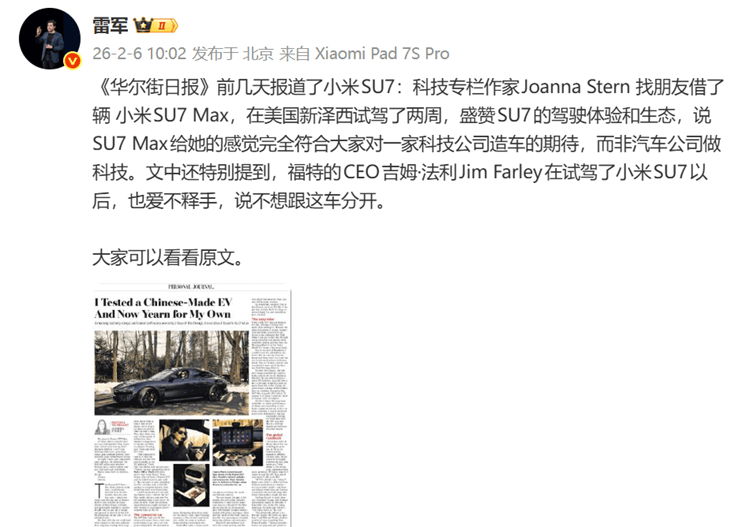
雷军:福特CEO试驾小米SU7之后,爱不释手,甚至不想跟车分开!
Sou Hu Cai Jing· 2026-02-06 06:49
Core Insights - Xiaomi's SU7 Max has garnered positive reviews for its driving experience and technology integration, positioning it as a strong competitor in the electric vehicle (EV) market despite not being available in the U.S. yet [1][8][20] - Ford's CEO, Jim Farley, expressed admiration for the Xiaomi SU7 after test-driving it, indicating a recognition of the competitive threat posed by Chinese EV manufacturers [4][9][24] Company Performance - The Xiaomi SU7 Max features advanced technology, including a 16.1-inch infotainment screen running HyperOS, and offers a battery range of approximately 500 miles (810 kilometers) [10][18] - The vehicle's pricing in China starts at 299,900 Chinese yuan (around $43,000), which is competitive with the Tesla Model Y, yet offers a more premium experience [20] Industry Trends - Chinese EV manufacturers, including Xiaomi, BYD, and Geely, are noted for delivering vehicles with longer battery ranges and superior digital platforms compared to Western competitors [8][9] - There is a growing sentiment that Chinese automakers are poised to enter the U.S. market, especially if manufacturing occurs domestically, as indicated by comments from industry executives [21][22] Competitive Landscape - Ford is exploring partnerships with various Chinese manufacturers, including Xiaomi, Geely, and BYD, to enhance its EV offerings and address the competitive gap with Chinese brands [24][26] - The current U.S. market is hindered by tariffs and restrictions on Chinese-made EVs, but these barriers may change in the future, allowing for greater competition [21][22]
小米国内激活量超苹果 卢伟冰:竞争极其焦灼
Xin Lang Cai Jing· 2026-01-22 01:23
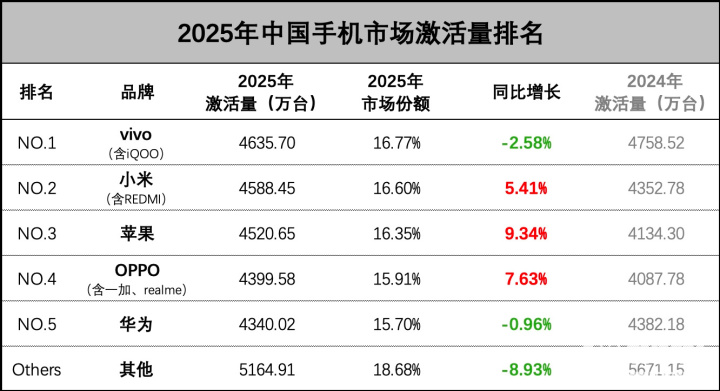
Core Insights - The top three smartphone brands in China by activation volume in 2025 are vivo, Xiaomi, and Apple, with vivo maintaining the first position despite a slight decline in activation volume [1][5] - Xiaomi surpassed Apple to claim the second position, largely due to the success of the Xiaomi 17 series, which includes models with activation volumes exceeding one million [2][6] - The activation volume gap between the top five brands is minimal, with less than 3 million units separating vivo from Huawei, indicating a highly competitive market where a single popular model can significantly influence brand rankings [1][5] Brand Performance Summary - **Vivo**: Ranked first with an activation volume of 4,635.70 thousand units, a market share of 16.77%, and a year-on-year decline of 2.58% from 4,758.52 thousand units in 2024 [2][6] - **Xiaomi**: Ranked second with an activation volume of 4,588.45 thousand units, a market share of 16.60%, and a year-on-year growth of 5.41% from 4,352.78 thousand units in 2024 [2][6] - **Apple**: Ranked third with an activation volume of 4,520.65 thousand units, a market share of 16.35%, and a year-on-year growth of 9.34% from 4,134.30 thousand units in 2024 [2][6] - **OPPO**: Ranked fourth with an activation volume of 4,399.58 thousand units, a market share of 15.91%, and a year-on-year growth of 7.63% from 4,087.78 thousand units in 2024 [2][6] - **Huawei**: Ranked fifth with an activation volume of 4,340.02 thousand units, a market share of 15.70%, and a year-on-year decline of 0.96% from 4,382.18 thousand units in 2024 [2][6] - **Others**: The remaining brands collectively accounted for 5,164.91 thousand units, with a market share of 18.68% and a year-on-year decline of 8.93% from 5,671.15 thousand units in 2024 [2][6] Market Dynamics - The competition among the top brands is extremely tight, with minor differences in activation volumes leading to significant shifts in rankings [5][9] - The timing of new product launches, such as the Huawei Mate 80 series, can greatly impact market standings, suggesting that strategic release schedules are crucial for maintaining competitive positions [5][8] - Xiaomi's Lu Weibing emphasized the intense competition in the Chinese market, indicating that the leading positions are very fragile and require continuous effort to maintain [9]

卢伟冰:17 系列是小米数字史上最畅销的产品
Huan Qiu Wang· 2026-01-12 08:11
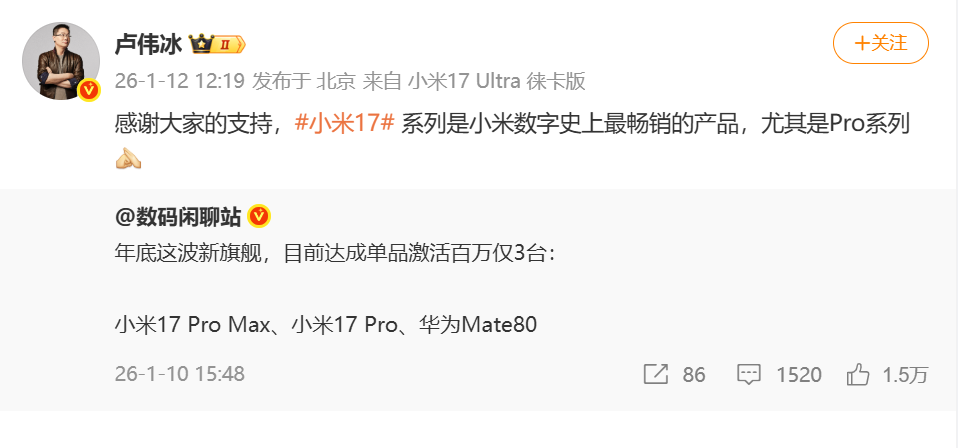
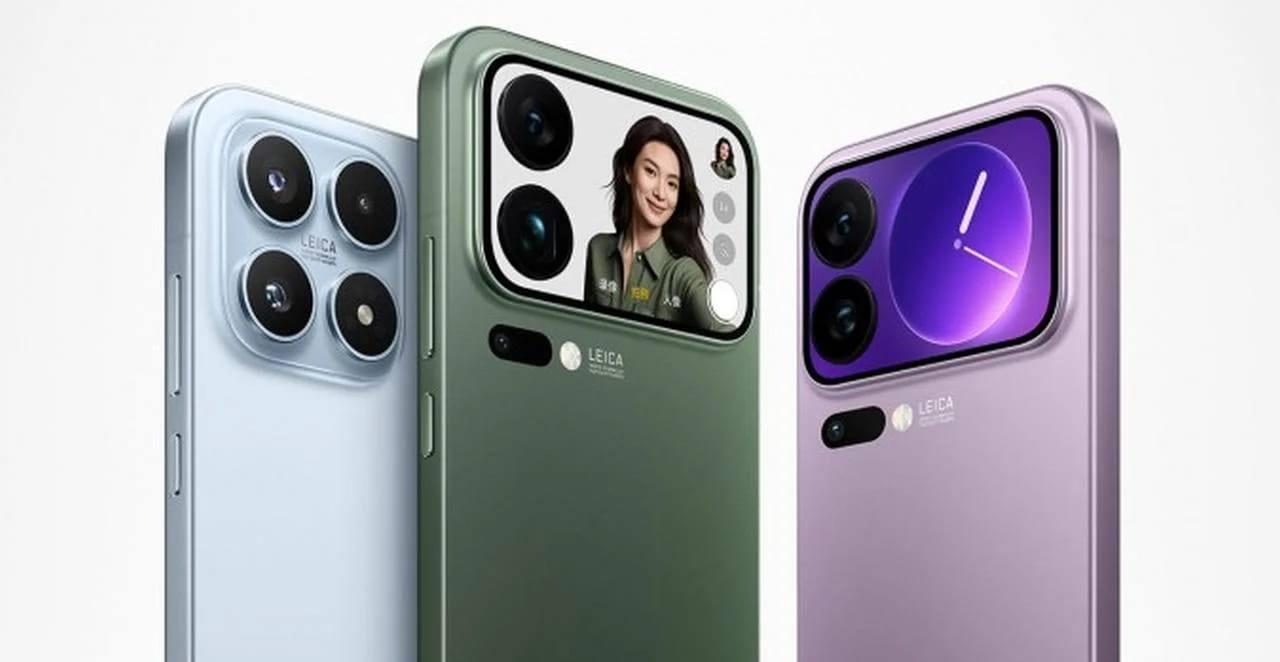
Group 1 - The core message indicates that the new flagship models, including Xiaomi 17 Pro Max, Xiaomi 17 Pro, and Huawei Mate 80, have only achieved one million activations for three models by the end of the year [1] - Xiaomi's 17 series is reported to be the best-selling product in the company's digital history, particularly the Pro series [3] - The Xiaomi 17 series will undergo significant product line adjustments in 2025, transitioning to a new high-end market matrix with standard, Pro, and Pro Max models [3] Group 2 - The Xiaomi 17 series will globally debut the fifth-generation Snapdragon 8 Supreme version, utilizing a 3nm process, with CPU performance comparable to A19 Pro and significantly improved GPU performance [3] - The "Miao Xiang Back Screen" feature in the Xiaomi 17 Pro series is highlighted as a core innovation aimed at redefining smartphone interaction experiences [3]
智能手机2025年先扬后抑 2026年AI手机市占率或过半
Xin Lang Cai Jing· 2026-01-02 20:35
Core Insights - The Chinese smartphone market experienced a "first rise, then fall" pattern in 2025, driven by initial consumer demand from the "old-for-new" subsidy policy, followed by a market cooling due to tightening subsidy policies and rising costs [1][3][5] - Industry innovation continues with advancements in battery technology, imaging capabilities, and AI integration, shifting the competition from "parameter competition" to "experience competition" [1][8][10] Market Trends - The initial success of the smartphone market in early 2025 was marked by a significant sales surge during the Spring Festival, with over 4.5 million digital products sold, and smartphone sales reaching 14.1 billion yuan, a 182% year-on-year increase [3] - However, the market faced a 4% year-on-year decline in smartphone sales in Q2 2025 due to inventory adjustments by manufacturers and the diminishing effects of subsidy policies [3][5] - The global rise in storage chip prices, driven by AI demand, has significantly increased costs, with prices for Samsung LPDDR4X memory rising from approximately $6 to $25 per unit, a more than threefold increase [3][5] Pricing and Market Segmentation - Rising costs have led to increased retail prices for smartphones, with Xiaomi's Redmi K90 priced at 2,599 yuan, up 300 yuan from its predecessor [4] - High-end flagship models can better absorb cost increases, while the low-end market faces severe pressure, as price sensitivity among consumers can lead to reduced demand for new devices [4][6] - Forecasts for 2026 indicate a conservative outlook for smartphone production and shipment, with IDC predicting a 2.2% year-on-year decline in shipments to approximately 278 million units [5][6] Structural Changes in the Market - The high-end smartphone market (priced above $600) is expected to grow its market share by 5.4 percentage points to 35.9%, while the low-end market (below $200) is projected to shrink by 4.3 percentage points to 20% [6] - The second-hand smartphone market is anticipated to grow by 20% in 2026, reaching over 100 million units, as consumers may opt for second-hand devices due to rising new device prices [7] Technological Innovations - The industry is focusing on significant upgrades in battery capacity, with major brands adopting 6,000-7,000mAh batteries, and some models featuring batteries as large as 8,300mAh [8] - Imaging technology is advancing with new models featuring 200-megapixel cameras, while AI capabilities are being integrated into devices with high-performance chips [8][10] - The competition is shifting towards AI capabilities and ecosystem integration, with brands needing to differentiate themselves through innovation and emotional engagement with consumers [9][10] Future Outlook - The year 2026 is seen as critical for the Chinese smartphone market, where success will depend on manufacturers' ability to navigate cost pressures and establish emotional connections with consumers [2][5] - IDC forecasts that the shipment of AI-enabled smartphones will reach 147 million units in 2026, representing a 31.6% year-on-year growth and accounting for 53% of the overall market [10][11]
钛媒体「年度前沿科技产品」榜重磅揭晓 | 2025 T-EDGE AWARDS
Tai Mei Ti A P P· 2025-12-22 11:39
Group 1: Industry Trends - 2025 marks a pivotal year for the global technology industry, transitioning from "smart connectivity" to "intelligent autonomy" [1] - Hardware products are entering a new era of "edge AI explosion," driven by advancements in AI technology, the proliferation of 5G-A, and sustainable development [1] - The transformation of smart hardware is shifting from "single hardware parameters" to a "full-scenario intelligent ecosystem" [1] Group 2: Consumer Electronics and Innovations - Seamless integration between different types of devices is becoming more common, enhancing user experience across smartphones, computers, and tablets [1] - The rise of smart home appliances, automotive technology, and drones is significantly transforming lifestyles and industrial models [1] - The automotive sector is redefining its role, moving beyond being just a transportation tool to becoming part of a broader economic opportunity in low-altitude airspace [1] Group 3: 2025 EDGE Awards - The 2025 EDGE Awards will recognize outstanding technological products that have made significant contributions in functionality, design, user experience, and market performance [3] - Award-winning products are expected to address industry pain points, optimize user experiences, and explore new scenarios, setting market benchmarks and driving innovation [3] - The awards will highlight the most innovative products of the year, showcasing the profound impact of technological innovation on human life [3]




明年旗舰手机将迎四杯时代:标准、Pro、Pro Max、Ultra全系布局
Xin Lang Cai Jing· 2025-12-11 10:21
Core Viewpoint - Multiple smartphone brands are expected to adopt a "four-tier" product layout next year, refining flagship series into four levels: Standard, Pro, Pro Max, and Ultra, with the Ultra version being launched separately to emphasize its premium positioning [1][4]. Group 1: Product Strategy - The flagship series will expand from three models (Standard, Pro, Ultra) to four (Standard, Pro, Pro Max, Ultra), with the first three models anticipated to launch between September and October, while the Ultra version will be delayed [1][4]. - Qualcomm's next-generation Snapdragon 8 series will be divided into standard and Pro versions, with most standard flagship models expected to use the basic chip, while Pro and above will utilize the more powerful Snapdragon 8 Pro version, enhancing differentiation within the flagship product line [1][4]. Group 2: Market Trends - The naming convention "Pro Max" is no longer exclusive to one brand, as Xiaomi and Huawei have introduced their own Pro Max models, which occupy different positions in their product lines compared to Apple's iPhone 17 Pro Max [3][5]. - The trend indicates that other manufacturers will likely focus on the configuration and price range between Pro and Ultra for their upcoming Pro Max models, creating a more comprehensive and multi-tiered flagship product system to meet high-end user demands [3][5]. Group 3: Technology and Pricing - Next year's flagship models are expected to feature chips based on a new 2nm process technology, while rising memory and storage costs are predicted to lead to a new round of price increases in the high-end smartphone market [4][5]. - The three-tier progression of Standard, Pro, Pro Max, and Ultra is set to become the mainstream model for flagship smartphones next year, reflecting manufacturers' efforts to enhance competitive barriers in the high-end market through more complex product matrices [4][5].
小米首发!RGB-OLED手机会爆发吗?
Xin Lang Cai Jing· 2025-12-10 14:00
Group 1 - The article discusses the upcoming trend of RGB-OLED technology in mobile phone displays, highlighting its advantages over traditional OLED panels [4][12][36] - Xiaomi's 17 Pro Max is the first device to feature RGB-OLED, with other models like REDMI K90 and K90 Pro Max following suit [21][36] - Major panel manufacturers are expected to adopt RGB-OLED technology by 2026, indicating a significant shift in the mobile display market [4][36] Group 2 - RGB-OLED technology retains full RGB subpixels, eliminating the pixel density reduction seen in Pentile arrangements, thus enhancing clarity and display quality [8][27][32] - The complexity of manufacturing RGB-OLED panels, including the need for precise metal masks and advanced deposition techniques, has been a barrier to widespread adoption [27][30] - The introduction of Tandem structures in RGB-OLED aims to improve brightness, longevity, and energy efficiency, making it a promising technology for future devices [30][34] Group 3 - The mobile display market is evolving, with OLED technology reaching its limits in brightness and refresh rates, making RGB-OLED a potential breakthrough [12][32] - Companies like BOE and others are also exploring new LCD technologies, such as ADS Pro, which aims to enhance clarity and performance while maintaining LCD's advantages [36][37] - The competition in display technology is intensifying, with various manufacturers focusing on improving clarity and efficiency across both OLED and LCD platforms [36][38]
引爆显示大战,RGB-OLED会成为手机的下一个“卷点”吗?
3 6 Ke· 2025-12-10 00:24
Core Insights - The article discusses the advancements in mobile display technology, particularly focusing on the emergence of RGB-OLED panels as a significant innovation in the smartphone market [1][3][12] Group 1: RGB-OLED Technology - RGB-OLED technology is set to revolutionize mobile displays by providing true independent RGB subpixels, enhancing clarity and reducing the need for high resolutions to achieve visual quality [5][13] - Unlike traditional Pentile arrangements, RGB-OLED eliminates the issue of shared blue subpixels, resulting in higher pixel density and better overall display quality [7][11] - The complexity of manufacturing RGB-OLED panels, including the need for fine metal masks and advanced deposition techniques, has limited its adoption until now [11][12] Group 2: Market Dynamics - Major panel manufacturers, including Huaxing Optoelectronics and BOE, are investing in RGB-OLED technology, indicating a competitive landscape for mobile displays [18][19] - The article highlights a potential shift in the market as manufacturers explore new technologies like ADS Pro for LCDs, which aims to enhance clarity and performance without the risks associated with OLED [19][20] - The introduction of RGB-MiniLED in the TV market is noted, but its application in mobile devices remains limited due to physical constraints and cost considerations [20] Group 3: Consumer Impact - The advancements in display technology, particularly with RGB-OLED, are expected to lead to a new wave of smartphone upgrades, benefiting consumers with improved visual experiences [16][21] - The focus on clarity and true pixel density aims to meet consumer expectations for high-quality displays without compromising on power efficiency [16][20]
卢伟冰成了小米造车的最大受益人
Tai Mei Ti A P P· 2025-11-27 07:35
Core Insights - The core message emphasizes the importance of maintaining quality during challenging times, as articulated by Lei Jun, the founder of Xiaomi, suggesting that quality is essential for survival and innovation is crucial for growth [1] Group 1: Company Strategy and Adjustments - Xiaomi is shifting its focus from aggressive store expansion to optimizing existing stores, with a new initiative led by Vice President Wang Xiaoyan to enhance the performance of Xiaomi Home stores in China [2][3] - The company aims to improve the quality of its store locations and reduce rental costs, indicating a strategic pivot in response to the diminishing returns from rapid expansion [2][3] Group 2: Automotive Business Impact - Xiaomi's automotive venture has significantly contributed to its offline store expansion, achieving 20,000 stores in just two years, with plans to stabilize operations after this rapid growth [3][4] - The automotive business has also enhanced Xiaomi's brand image, particularly in the high-end smartphone market, with a reported 5.6 percentage point increase in market share for smartphones priced between 4,000-6,000 yuan, reaching 18.9% [4][6] Group 3: Financial Performance and Market Position - Xiaomi's automotive division has achieved profitability within a year and a half, with a quarterly operating profit of 700 million yuan and a production capacity exceeding 600,000 vehicles per week [4][5] - Despite a decline in the average selling price (ASP) of smartphones to 1,062.8 yuan, the automotive business is expected to bolster Xiaomi's high-end market presence, although the global brand perception has yet to fully align with this growth [6][7] Group 4: Future Directions and Challenges - The company recognizes the need for a significant breakthrough product to redefine its market narrative, similar to the impact of the Mi MIX smartphone, which set a precedent for innovation [12][14] - Xiaomi's future success hinges on its ability to create products that resonate with consumers and establish a strong technological identity, moving beyond mere price competitiveness [14][15]