社交裂变

Search documents
元宝分10亿现金红包活动收官,月活跃用户达1.14亿
Sou Hu Cai Jing· 2026-02-24 02:12
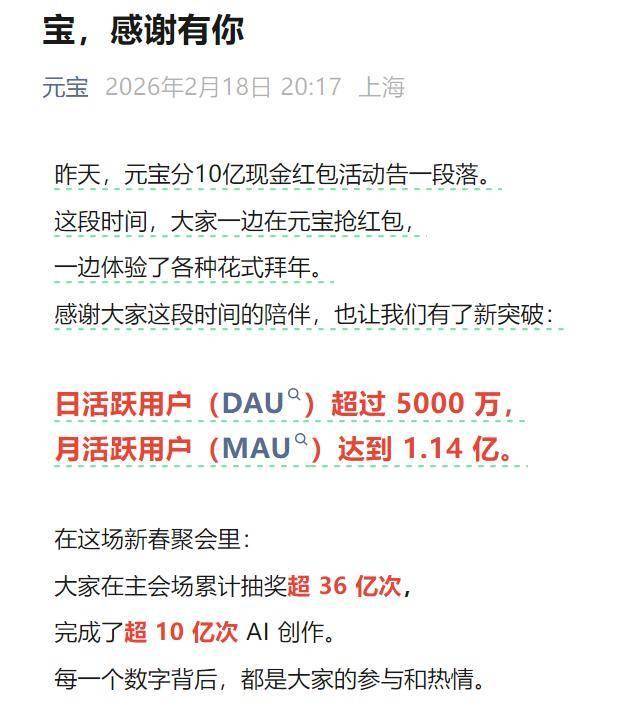
Core Insights - Yuanbao has concluded its 1 billion cash red envelope campaign, expressing gratitude for user support and highlighting new breakthroughs [3] - The platform has achieved over 50 million daily active users (DAU) and 114 million monthly active users (MAU), with 159 new features updated within 21 days [3] - The campaign, launched on February 1, aimed to reward users with cash red envelopes, with individual amounts reaching up to 10,000 yuan, generating significant attention [3] - Tencent's chairman, Ma Huateng, emphasized the goal of this campaign is to replicate the success of WeChat red envelopes from 11 years ago [3] - The core mechanism of the Yuanbao red envelope activity focuses on social sharing, allowing users to forward red envelopes via WeChat and QQ, increasing their chances of winning with each new participant [3]


腾讯音乐为啥也来卷AI红包大战?
Sou Hu Cai Jing· 2026-02-18 12:38
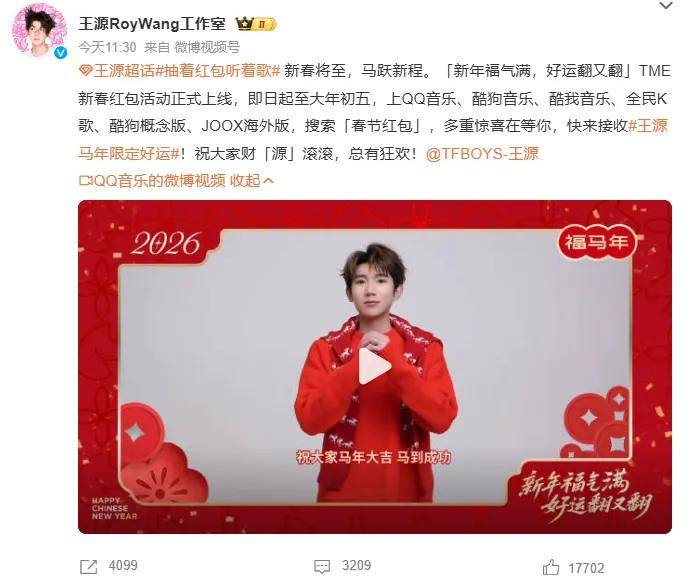
Core Insights - Tencent Music Entertainment Group (TME) has launched its Spring Festival red envelope campaign, leveraging its 550 million monthly active users to create significant social media buzz and showcase its platform's user value [1][4]. Group 1: Strategic Objectives - The campaign involves six platforms under Tencent Music, including QQ Music and KUGOU, and features Wang Yuan as the key ambassador, indicating a strategic push towards enhancing the ecosystem's value [4][5]. - The core goal of the campaign is to enrich the ecosystem's value through social interactions and emotional connections, particularly targeting the younger demographic [5][12]. Group 2: Innovative Features - The campaign incorporates various interactive elements such as celebrity engagement, social sharing, AI-generated content, and integration with e-commerce and advertising ecosystems [4][7]. - Users are encouraged to utilize AI for songwriting and sharing, positioning AI as a tool for personalized emotional expression during the festive season [7][15]. Group 3: Social Transformation - The red envelope mechanics serve as a social game, facilitating social interactions and user engagement, thus transforming QQ Music from a music tool into a social platform [8][12]. - Collaborations with platforms like Bubble and Weverse DM enhance user interaction with K-pop artists, further solidifying QQ Music's position in the social music space [10][11]. Group 4: Financial Implications - Advertising and other revenue streams are becoming the fastest-growing segments for Tencent Music, with the recent quarterly report highlighting the growth driven by diverse advertising products [14]. - The red envelope campaign exemplifies the interconnected value of content ecosystems with advertising, e-commerce, and gaming, exploring new advertising formats [14].
当红包战陷入低效狂欢,文心APP如何靠小成本收割真用户?
Xin Lang Cai Jing· 2026-02-14 15:33
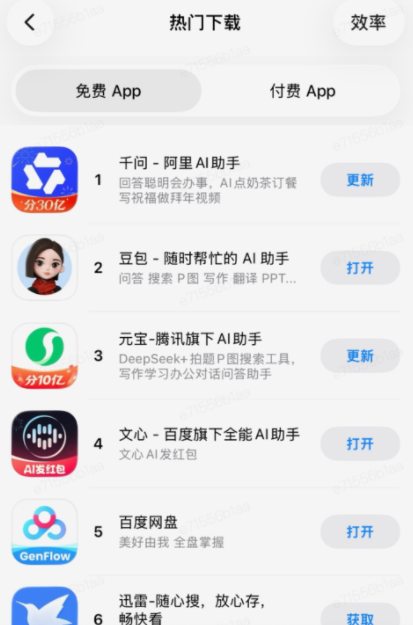
Core Insights - The annual Spring Festival marketing battle has seen internet giants invest over 8 billion in red envelopes, but user retention from this spending is reportedly below 5% [1][3] - Baidu's Wenxin APP has achieved significant success without aggressive spending, rising from outside the top 20 to 4th place on the App Store efficiency chart in just one day [1][3] Group 1: Marketing Strategies - Wenxin APP's user growth surged by 8 times daily during the Spring Festival due to a "Spring Festival Recommendation Officer" activity that encouraged social sharing and new user acquisition [3][5] - The app's innovative multi-Agent group chat feature, which allows multiple AI roles to assist users, was effectively utilized during the marketing campaign, enhancing user engagement and showcasing product capabilities [5][6] - Baidu's marketing strategy focused on product functionality and user interaction rather than merely increasing cash giveaways, demonstrating a "function as marketing" approach that provides long-term value [5][9] Group 2: Competitive Positioning - Baidu secured two spots in the top five of the App Store efficiency chart, indicating its strong market presence and user familiarity [8] - The company was the first major player to distribute red envelopes this year, effectively capturing consumer attention and leveraging low-cost, high-conversion strategies with Wenxin APP [9][10] - The success of Wenxin APP serves as a model for other companies, emphasizing that effective marketing is rooted in the product's inherent functionality and user appeal [9][10]

千问“崩了”,阿里回应
Sou Hu Cai Jing· 2026-02-06 04:15
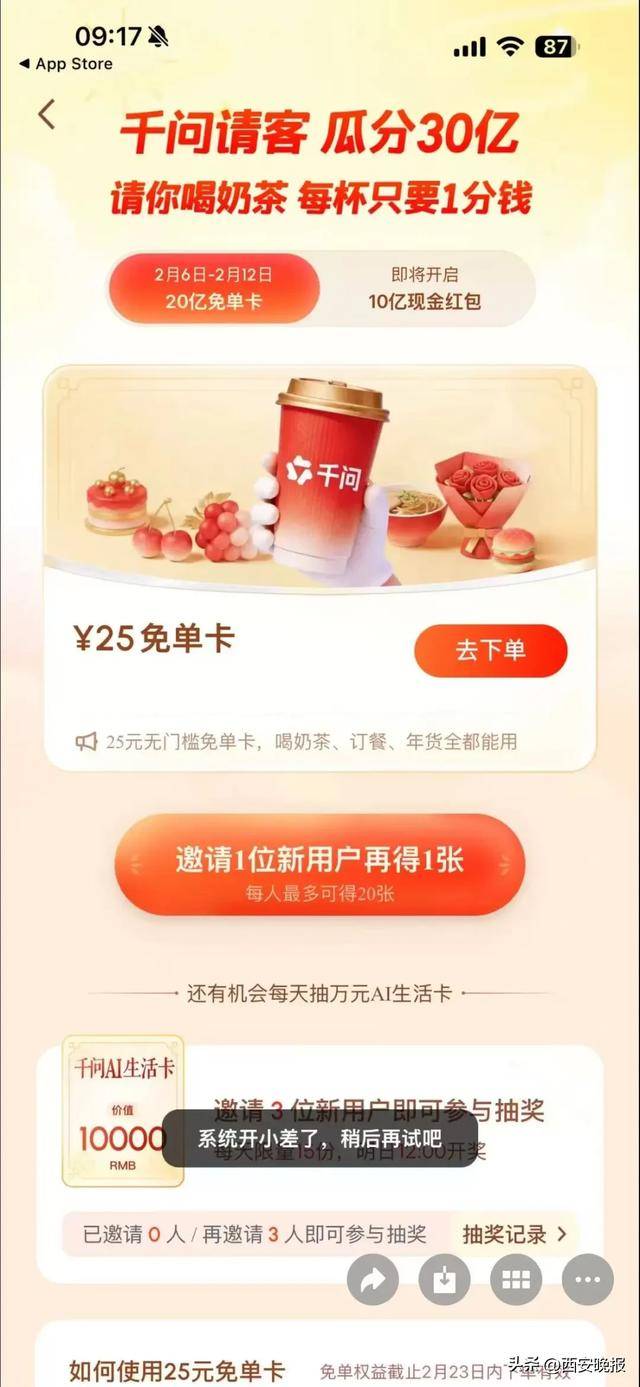
Core Insights - Alibaba's Qianwen launched a "Spring Festival 3 billion free orders" campaign, distributing free milk tea cards, but faced system issues shortly after the launch [1][4] - The app managed to deliver over 1 million milk tea orders within 3 hours of the campaign's launch, indicating strong initial engagement [4] - The campaign is part of a broader strategy to integrate Qianwen into various Alibaba ecosystem platforms, aiming to replicate successful delivery models in the AI sector [4] Group 1 - The Qianwen app experienced minor system failures, preventing some users from accessing the promotional page while other functionalities remained operational [1] - Alibaba is actively allocating resources to ensure the smooth operation of the campaign [4] - The campaign includes an incentive for existing users to invite new users, potentially earning a value of 10,000 yuan in Qianwen AI lifestyle cards [4] Group 2 - A second wave of activities is scheduled to begin on February 13, offering cash red envelopes with a maximum value of 2,888 yuan [4] - Alibaba is entering the cash red envelope market, competing with Tencent and Baidu in this promotional space [4] - The company aims to leverage social engagement strategies to enhance user acquisition, although challenges remain in surpassing Tencent's dominance in this area [4]

马化腾的元宝10亿红包背后,是买用户习惯,还是为新路径豪赌?
Sou Hu Cai Jing· 2026-02-05 14:26
Core Insights - Tencent's Yuanbao launched a significant "10 billion" Spring Festival campaign, quickly topping the Apple App Store free chart and generating massive social sharing within the WeChat ecosystem [1][3] - However, the campaign faced backlash due to user complaints about disruptive sharing practices, leading to WeChat's intervention to limit Yuanbao's links [3][6] - The campaign's design conflicts with platform rules and user experience, raising concerns about compliance and product effectiveness [6][7] Marketing Strategy - The campaign aims to replicate the success of WeChat's 2014 red envelope strategy, leveraging high traffic during the Spring Festival to drive user engagement [6][8] - Unlike the original WeChat red envelopes, which required users to bind bank cards, Yuanbao's model lacks a strong connection between cash incentives and AI functionality, making user transition difficult [7][8] - The immediate success of the campaign is driven by incentives rather than genuine interest in the AI product, leading to a surge of non-target users and subsequent service instability [8][9] User Engagement and Retention - Yuanbao's growth appears fragile, with previous data showing a significant drop in monthly active users (MAU) after reducing marketing spend, indicating reliance on capital-driven growth [8][9] - In contrast to established e-commerce platforms that have systematic promotional strategies, Yuanbao's approach lacks a long-term user engagement plan [9][10] - The campaign's reliance on cash incentives to attract users to a non-essential product raises questions about its sustainability and long-term competitiveness [10][20] Competitive Landscape - Competitors like ByteDance's Doubao and Alibaba's Qianwen are integrating AI into their ecosystems more effectively, focusing on user needs and seamless service integration [17][19] - Yuanbao's strategy heavily depends on cash rewards, while competitors are leveraging existing ecosystems to enhance user experience without large-scale cash giveaways [19][20] - The challenges faced by Yuanbao reflect broader issues within Tencent's AI strategy, particularly its slow response to market demands and lack of integration within its core social platform [20] Historical Context - Tencent has previously employed similar high-investment strategies in other products, such as Weishi and Tencent Weibo, but these efforts failed to establish lasting user engagement [12][14] - The failure of past initiatives highlights the importance of product differentiation and community building, which Yuanbao currently lacks [13][14] - The lessons from these past experiences suggest that without a compelling product value proposition, short-term user acquisition strategies will not lead to sustainable growth [13][20]

元宝撒10亿红包拉新,部分微信群主自发禁止分享链接
Jing Ji Guan Cha Wang· 2026-02-02 09:11
Group 1 - The core event revolves around Tencent's AI application "Yuanbao" launching a "10 billion" Spring Festival campaign, which led to a surge in user participation and significant sharing of red envelope links in WeChat groups [3][4] - A WeChat group leader reported that the excessive number of small Yuanbao red envelopes negatively impacted the quality of group chats, prompting the decision to prohibit sharing of these links [3] - Yuanbao achieved the top position in the Apple App Store in China on February 1, following a social media viral effect and cash rewards, surpassing competitors like ByteDance's Doubao and Alibaba's Qianwen [3][4] Group 2 - Yuanbao allocated 1 billion yuan for this campaign, aiming to replicate the success of WeChat's 2015 red envelope initiative, which significantly increased user engagement and card binding for WeChat Pay [4] - The campaign's design encourages users to share red envelopes, providing additional lottery chances for each successful claim, indicating a clear goal of user acquisition [4] - Yuanbao introduced a new feature called Yuanbao Party, which allows users to engage in shared activities like listening to music and watching movies, differentiating itself from other AI applications [4]

一个隐秘风口,微信成寡头了
虎嗅APP· 2026-01-20 04:46
Core Insights - The article highlights the rapid growth of WeChat mini-games, which have served over 1 billion users in the past year, with a monthly active user (MAU) count exceeding 500 million and a daily active user (DAU) increase of 10% year-on-year, alongside a 27% improvement in user retention [5][6]. Group 1: Market Dynamics - Mini-games are outpacing traditional app-based mobile games, with a user overlap of only 10% between the two, indicating that mini-games are attracting a new audience rather than cannibalizing existing app users [6][7]. - By mid-2024, the active user base of mini-games is expected to surpass that of app-based mobile games for the first time, with mini-games becoming a significant force in the gaming market [7]. - The advertising spending on mini-games has recently surpassed that of app-based mobile games, with daily ad spending reaching approximately 94 million yuan for mini-games compared to 90 million yuan for app games [7][8]. Group 2: WeChat's Competitive Advantage - WeChat's social attributes are deeply integrated into the mini-game ecosystem, facilitating viral growth through social connections, with social channels contributing 30%-50% of users for social mini-games [10]. - The revenue generated from social users in some IAA mini-games exceeds 80%, showcasing the high commercial value of social engagement [10]. - In 2025, the number of mini-games with over 1 million DAU is projected to increase from 60 to 70, and the number of games generating over 10 million yuan in quarterly revenue is expected to rise from 190 to 300 [10]. Group 3: User Demographics and Trends - The user base of WeChat mini-games is predominantly from first and second-tier cities, with 45% of users aged between 24 and 40 years [12]. - The gender distribution is 55% male and 45% female, with female-oriented games starting to gain traction, indicating a shift in market dynamics [12][14]. - Female players are showing a growth rate in spending that is double that of male players, suggesting a significant opportunity for female-targeted game development [14]. Group 4: Developer Support and Monetization - WeChat has implemented favorable revenue-sharing policies for developers, including aligning iOS platform fees with Android, allowing developers to retain 70% of revenue, plus an additional 15% incentive [16][29]. - The platform is simplifying commercialization policies for IAA mini-games, offering up to 90% revenue share for short-term incentives and 85% for long-term incentives [16]. - Developers are encouraged to leverage AI tools for innovation, with the potential for AI-generated content to enhance game development and user engagement [26][30]. Group 5: Future Directions - The focus for the mini-game industry is on uncovering genuine user needs behind social interactions, emphasizing the importance of creating shareable content that stimulates social behavior [25]. - WeChat aims to balance monetization with user experience by exploring non-intrusive advertising formats and ensuring that the game's value to users is prioritized over revenue generation [28]. - The platform is also looking to enhance interactive advertising and content marketing strategies to improve user engagement and retention [35][36].

传统企业破局线上:视频号小店获客全攻略
Sou Hu Cai Jing· 2025-12-09 11:46
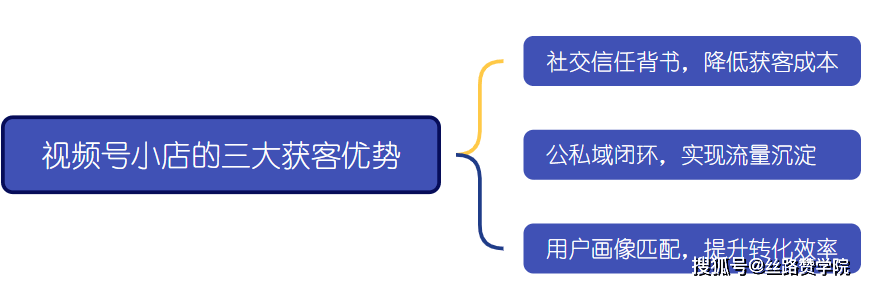
Core Insights - Traditional enterprises face challenges of offline traffic depletion and high customer acquisition costs during digital transformation. WeChat Video Accounts, with 1.3 billion monthly active users, offer a low-cost way to reach users and reshape growth trajectories [1] - The Video Account Shop serves as a key platform for transaction conversion, achieving a full-link integration from content exposure to user interaction, product sales, and private domain retention [1] Group 1: Advantages of Video Account Shop - Social trust endorsement reduces customer acquisition costs. The platform's distribution mechanism relies on friend recommendations, leading to lower acquisition costs compared to unfamiliar traffic platforms. For instance, the return rate for book orders driven by WeChat's "gift-giving" feature is under 10%, significantly lower than the 30%-50% return rate of traditional e-commerce platforms [3] - The public-private domain closed loop allows for traffic retention. The Video Account Shop seamlessly connects with enterprise WeChat, public accounts, and communities, creating a complete loop from public domain traffic to private domain retention and repurchase conversion [5] - User profile matching enhances conversion efficiency. The primary user base of Video Accounts consists of individuals aged 36 and above, with a high penetration rate in lower-tier cities. The average transaction value exceeds 200 yuan, higher than Douyin's 100-120 yuan, aligning well with traditional enterprises' target demographics [6] Group 2: Strategies for Customer Acquisition - Content-driven approach: High-quality content is essential for customer acquisition. Traditional enterprises should shift from hard advertising to value output, focusing on core business scenarios to create relevant content [8] - Live streaming as a breakthrough: Live streaming is a core scenario for customer acquisition, emphasizing interactive experiences and conversion tools. Pre-live promotions can leverage public-private domain traffic [10] - Social virality: Utilizing WeChat's social network for viral growth is a unique advantage. Enterprises can design task systems that reward users for sharing and inviting friends, effectively lowering acquisition costs [14] Group 3: Case Studies - Case Study 1: Yixing Network (health product agency) achieved a 200% monthly increase in followers and a 45% rise in repurchase rate by implementing a system of content-driven traffic, viral growth, and private domain conversion [15] - Case Study 2: Fengshang Yige (offline clothing store) saw a 75% increase in sales by synchronizing online and offline channels, utilizing live streaming for real-time interaction and establishing a distribution network [16] Group 4: Common Pitfalls - Content generalization: Traditional enterprises should avoid blindly following trends and instead focus on deepening their vertical fields [17] - Overemphasis on traffic: Merely focusing on live viewership without establishing a private domain retention system can lead to lost opportunities [17] - Neglecting after-sales experience: High trust levels are required from Video Account Shop users, necessitating timely after-sales responses [17] - Lack of long-term operational thinking: Continuous content updates and live streaming schedules are essential for sustained customer acquisition [17]
家纺货源群电商群,家纺电商供应链
Sou Hu Cai Jing· 2025-11-27 02:39
Core Insights - The home textile e-commerce industry is undergoing a transformation from traditional durable goods to experience-driven fast-moving consumer goods, reshaping product forms and the entire value chain [4] - Consumer behavior is shifting towards emotional consumption, where purchases are driven by psychological satisfaction rather than just functional needs [5] - The sleep economy is entering a precise era, with smart bedding systems enhancing customer loyalty and significantly increasing average transaction values [6] Group 1: Industry Transformation - The home textile industry is evolving into an experience-oriented sector, moving away from the traditional durable goods model [4] - The introduction of smart materials and technologies is revolutionizing product offerings, allowing for dynamic adjustments rather than static protection [8] - The shift from standardized production to personalized customization is becoming a key trend, with flexible manufacturing processes gaining traction [10] Group 2: Consumer Behavior - Emotional consumption is becoming a dominant trend, with consumers seeking products that provide psychological comfort [5] - The integration of color psychology into product design is emerging, with specific color combinations shown to alleviate anxiety and improve sleep [9] - Subscription-based services for home textiles are gaining popularity, particularly among high-end users, with acceptance rates reaching 42% [24] Group 3: Technological Advancements - The adoption of digital printing technology has significantly reduced costs for small batch customizations, enabling quicker market validation [12] - AI algorithms are being utilized to predict regional consumer preferences, leading to tailored product strategies [14] - AR/VR technologies are enhancing the shopping experience by allowing consumers to visualize products in virtual settings, resulting in improved conversion rates [17] Group 4: Market Dynamics - The competitive landscape is shifting from product-based competition to ecosystem-based competition, where comprehensive solutions are prioritized [21] - Home textile products are becoming crucial data entry points in smart home ecosystems, linking sleep data with other smart devices [22] - Cross-industry collaborations are emerging, blurring the lines between home textiles and health or beauty sectors, creating new market opportunities [25] Group 5: Future Challenges - The industry faces challenges related to data privacy, necessitating the establishment of transparent data usage rules and security systems [27] - The demand for agile supply chains is increasing, with digital supply chain management becoming a core competitive advantage [28] - There is a significant shortage of professionals who possess both home textile expertise and digital operational skills, which could hinder industry growth [29] Conclusion - The home textile e-commerce sector is transitioning from a transactional model to a lifestyle solution model, driven by a user experience-centric revolution that is fundamentally altering the industry landscape [30]
从拼多多到全民拼购:社交电商加速迭代,稳赚不亏是风口还是泡沫
Sou Hu Cai Jing· 2025-11-25 11:18
Core Insights - The article discusses how social e-commerce is reshaping the traditional retail landscape by innovatively reconstructing the "people, goods, and venue" relationship, allowing it to thrive despite challenges faced by conventional retail models [1][3]. Group 1: Social E-commerce Model - The "全民拼购" (All-People Group Purchase) model integrates social sharing and group buying, moving beyond traditional low-price competition by embedding "value sharing" into its rules [3]. - Users can participate with zero risk, as they either win products or receive a full refund along with shopping credits, creating a "zero-cost benefit" incentive [5]. Group 2: User Engagement - The model allows for flexible group purchase tiers ranging from 100 to 500 yuan, appealing to diverse user needs, particularly attracting students and mothers [7]. - Users can earn rewards by inviting friends, achieving a viral growth rate three times that of traditional e-commerce [7]. Group 3: Merchant Benefits - Merchants benefit from significantly reduced customer acquisition costs, with some brands reporting monthly revenues exceeding 30 million yuan from group purchases [7]. - The model has shown impressive results, such as a snack brand selling 200,000 orders in three days, with 70% of new customers coming from referrals [7]. Group 4: Platform Stability - The platform employs a "40-period release of points" mechanism to enhance user retention and encourage new user acquisition, ensuring system stability during peak times [8]. - Safety is ensured through third-party fund custody and anti-cheating measures, allowing the platform to handle high concurrency smoothly [8]. Group 5: Challenges and Future Directions - While the low-price strategy attracts traffic, it risks creating a perception of low quality, making it difficult to attract high-end customers and achieve high-margin product sales [10]. - To ensure sustainable growth, the model must evolve from a low-price focus to a "value upgrade" strategy, enhancing supply chain quality control and diversifying user engagement beyond cash incentives [11].