微信鸿蒙版

Search documents
欣旺达动力与威睿电动达成和解,23.14亿元争议终结;全球第四大汽车巨头Stellantis电动化转型遇压力丨智能制造日报
创业邦· 2026-02-09 04:07
Group 1 - WeChat's HarmonyOS version still utilizes Huawei's system camera capabilities, with recent updates aimed at optimizing the photo-taking interface for a more streamlined user experience [2] - Xiaomi's CEO Lei Jun reviewed the battery pack vibration testing in their automotive lab, highlighting safety and reliability tests that simulate various driving conditions [2] - XINWANDA Power and Weir Electric reached a comprehensive settlement regarding a previous sales contract dispute involving approximately 2.314 billion yuan, with XINWANDA required to pay 608 million yuan in installments by 2030 [2] - Stellantis, the world's fourth-largest automaker, is facing pressure in its electrification strategy, with a 24% drop in stock price and an announcement of $26.2 billion in expenses due to a strategic shift away from plug-in hybrids [2]



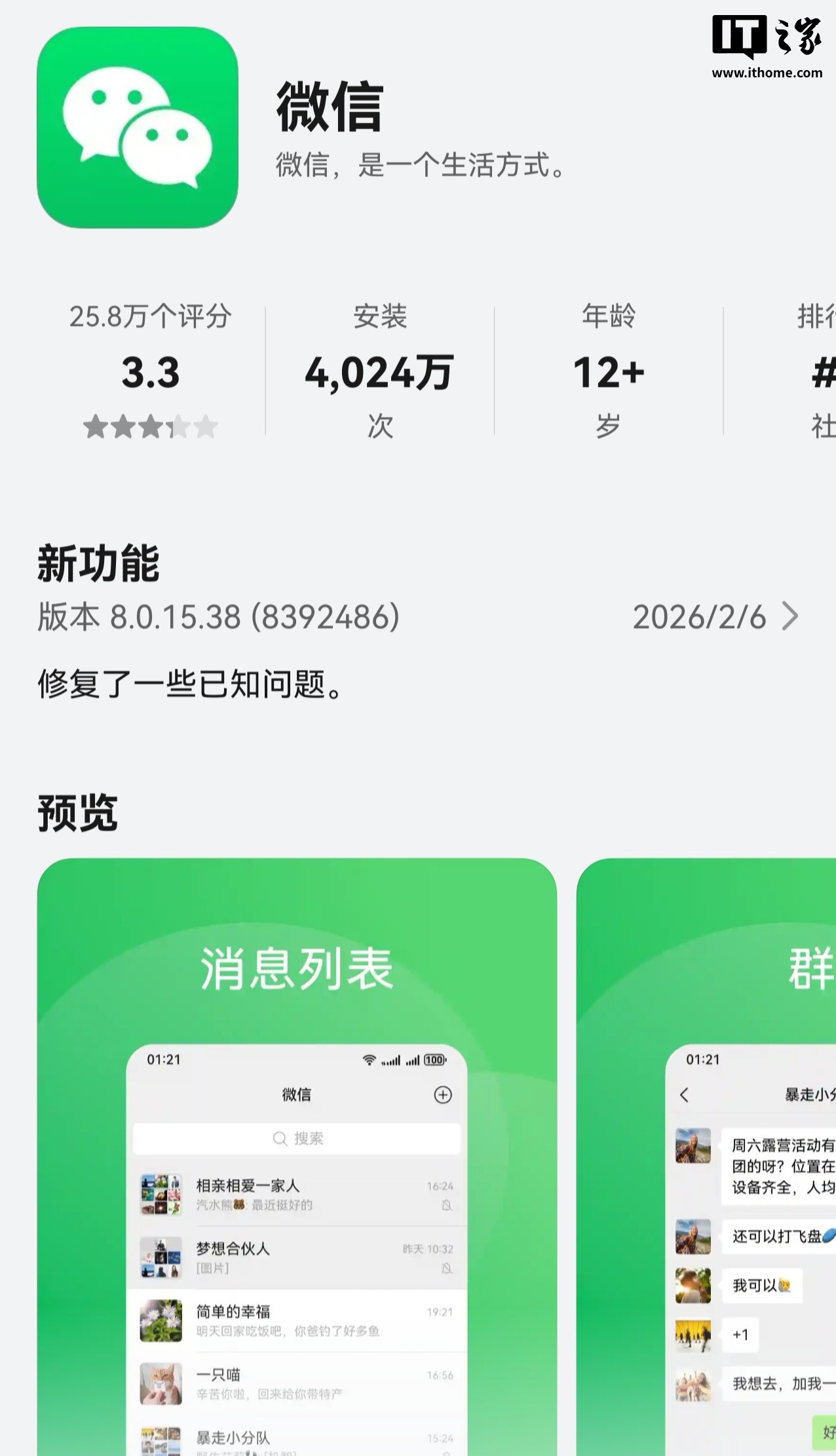
微信鸿蒙版 8.0.15.38 正式版升级,海量更新内容一览
Xin Lang Cai Jing· 2026-02-06 11:20
Core Viewpoint - The WeChat HarmonyOS version app has released its official update 8.0.15.38 on February 6, 2026, primarily focusing on fixing known issues [12][22]. Update Details - The latest version 8.0.15.38 was released on February 6, 2026, and the update log indicates that it addresses some known issues [7][14]. - The previous official update was on January 9, 2026, marking a gap of nearly one month between updates [11][17]. Installation and Features - The WeChat HarmonyOS version was officially launched in January 2021 on Huawei's App Gallery and supports essential features such as communication, social networking, WeChat Pay, public accounts, mini-programs, video accounts, and live streaming [11][22]. - The installation count for the WeChat HarmonyOS version has exceeded 40.08 million, and WeChat Pay has been integrated into the HarmonyOS 5 cash register, allowing users to use WeChat Pay for purchasing digital goods [11][22].

2025鸿蒙生态:向体验深耕加速进阶
盐财经· 2025-12-30 09:04
Core Viewpoint - The article highlights the rapid development and expansion of the HarmonyOS ecosystem, showcasing its transformation from a nascent operating system to a robust platform with over 35 million applications and services available, and a registered developer base exceeding 10 million [1][3][8]. Group 1: Ecosystem Development - HarmonyOS has demonstrated strong vitality despite its late start, with a well-structured ecosystem that enhances user experience and fosters a positive feedback loop [3][4]. - The ecosystem has evolved significantly, with over 100 system updates and 300 new features introduced in the past year, indicating a robust growth trajectory [6][8]. - By October 2024, the release of HarmonyOS 5 marked a historic breakthrough, with the ecosystem expanding to include over 35 million applications and services, achieving over 95% compatibility with major internet applications [8][12]. Group 2: Application Integration - The ecosystem features a diverse range of applications, with over 60 Tencent products and major apps from Alibaba and ByteDance fully integrated, enhancing user engagement [11][12]. - High-frequency applications serve as the backbone of the ecosystem, while niche applications cater to specific user needs, contributing to the overall diversity and resilience of the ecosystem [11][12]. - Innovative applications like Remy and 桔子账本 exemplify the unique offerings within the ecosystem, addressing specific user pain points and enhancing user experience [11][12]. Group 3: User Experience and AI Integration - HarmonyOS 6 offers deep integration between applications and system features, resulting in over 70 system-level innovations and 2,000 daily new functionalities, significantly enhancing user experience [13][14]. - The AI capabilities of HarmonyOS are designed to provide seamless interactions across devices, with the AI assistant "小艺" facilitating a unified service experience by coordinating multiple applications [14][15]. - The intelligent framework allows users to interact naturally with the system, streamlining processes such as booking flights or interpreting medical results, thus enhancing the overall user experience [15][17]. Group 4: Future Outlook - The ecosystem is positioned for sustainable growth, continuously attracting developers and fostering innovation through supportive policies and tools [17]. - The expansion of HarmonyOS is not limited to personal devices but extends into smart homes, intelligent transportation, and smart manufacturing, indicating a broadening scope [17]. - The year 2025 is anticipated to be a breakthrough year for HarmonyOS, marking a transition from functional adaptation to experiential innovation, with increasing user satisfaction and engagement [17].

第二季度国内智能手机市场同比降4% 1220万台 华为第一
Shen Zhen Shang Bao· 2025-07-29 17:23
Market Overview - The domestic smartphone market in China is projected to decline year-on-year by 4% in Q2 2025, according to multiple third-party research institutions [1][2] - Counterpoint's preliminary data indicates a year-on-year decline of 2.4% in smartphone shipments for the same quarter [1] - Canalys reports a more significant decline of 4% year-on-year in smartphone shipments [1] Company Performance - Huawei leads the market with a shipment volume of 12.2 million units, capturing 18% of the market share, an increase from 15% in the same period last year [2] - Vivo follows closely with a shipment volume of 11.8 million units, holding 17% of the market share [2] - OPPO ranks third with a shipment volume of 10.7 million units, accounting for 16% of the market [2] - Xiaomi has achieved year-on-year growth for the eighth consecutive quarter, with a shipment volume of 10.4 million units, placing it fourth [2] - Apple ranks fifth with a shipment volume of 10.1 million units [2] Key Drivers - Huawei's growth is attributed to the strong sales of its mid-range nova 14 series and significant price reductions on high-end models [1] - The installation of the WeChat Harmony version on Huawei's app market has surpassed 10 million, marking a milestone for the Harmony operating system [1]
迁徙:微信鸿蒙版的长征 | 「钛度号」作品月榜第127期
Tai Mei Ti A P P· 2025-06-16 13:28
Core Insights - The article highlights the monthly selection of outstanding works by "Titan Media" through its "Titan Degree" platform, emphasizing the importance of quality content and audience engagement in the digital media landscape [1][9]. Group 1: Top Works Summary - **Top 1**: The piece by "Brain Extreme" discusses the collaboration between WeChat and Hongmeng, likening it to a significant historical event, suggesting that this partnership is pivotal for the domestic system ecosystem [1]. - **Top 2**: "Power Plant" analyzes BYD's recent price war, indicating that maintaining rapid sales growth is crucial for alleviating debt pressure, especially in the context of high-end brand challenges [2]. - **Top 3**: "On the Mountain" reflects on Xiaomi's 15th-anniversary event, noting that the company's advancements in self-developed chips are a foundation for its future strategies [3]. - **Top 4**: "Huashang Taolue" reports on the rapid expansion of domestic tea brands like Mixue Ice City, suggesting that local brands are gaining consumer preference over international ones [4]. - **Top 5**: "Data Reading Smart Car" discusses the competitive landscape of Chinese battery manufacturers, highlighting LG Energy's struggles against rising Chinese competitors [5]. Group 2: Additional Notable Works - **Top 6**: "Technology New Knowledge" explores the transformation in the automotive industry, emphasizing the need for companies to enhance organizational efficiency to survive [6]. - **Top 7**: "Giant Wave" describes the intense competition in the chip industry, characterizing it as a "Chinese civil war" in high-tech sectors [7]. - **Top 8**: "Market Value Observation" argues that nuclear power is undervalued in the A-share market, predicting significant growth potential as part of the energy transition [8]. - **Top 9**: "Big V Business" reflects on Alibaba's challenges, questioning the company's past decisions and their impact on its current situation [9]. - **Top 10**: "Silicon Valley 101" analyzes Apple's strategies in response to global supply chain disruptions caused by tariffs, particularly its reliance on China [10].

深蓝CEO回应员工买车可离职两个月;雷军闭关准备发布会;罗永浩AI创业或合作百度;胖东来回应柴怼怼事件丨邦早报
创业邦· 2025-05-18 23:55
Group 1 - Nvidia CEO Jensen Huang announced plans to adjust the next generation of products in China, indicating that the next chip will not be from the Hopper series due to its limitations [3] - Nvidia reported that the Chinese market generated $17 billion in revenue, accounting for 13% of the company's total sales in the fiscal year ending January 26 [6] - Deep Blue CEO clarified that his comments about employees taking time off to travel were misinterpreted and emphasized that there was no intention to eliminate employees [3] Group 2 - A generous anonymous alumnus donated 100 million yuan to Fudan University to support the development of its philosophy department [3] - Xiaomi's President revealed that CEO Lei Jun is currently preparing for an upcoming product launch event [6] - WeChat's HarmonyOS version is undergoing a cautious rollout of biometric payment features, with a focus on security [8] Group 3 - Qunar's CEO announced the company's readiness for a fourth entrepreneurial phase, leveraging AI to enhance its services and maintain rapid growth [8] - The Chinese automotive industry saw a 6% year-on-year increase in exports, with several companies establishing their own ocean transport fleets to reduce costs and stabilize supply chains [18] - The data industry in China is projected to reach a scale of 7.5 trillion yuan by 2030, with a current annual data production volume of 41.06 zettabytes [24]