拓培非格司亭注射液

Search documents
国家医保药品“清单”一览
Xin Lang Cai Jing· 2026-01-12 19:03
Core Insights - The latest version of the medical insurance drug list will be implemented on January 1, 2026, with significant updates aimed at improving access to essential medications for insured individuals [1]. Group 1: New Drug Additions - A total of 114 new drugs have been added to the list, with 50 classified as first-class new drugs, marking a record high in both quantity and proportion [2]. - New drugs include treatments for critical conditions such as triple-negative breast cancer and pancreatic cancer, as well as medications for chronic diseases and rare diseases [2]. Group 2: Expanded Payment Coverage - The payment scope has been broadened for 65 drugs, with new indications included for reimbursement, such as additional targets for non-small cell lung cancer treatments and expanded age eligibility for certain rare disease medications [3]. - Adjustments have been made to align payment criteria more closely with clinical practices, such as changing the payment range for certain drugs from "previous chemotherapy" to "past chemotherapy" [3]. - Some drugs have had restrictions removed or modified, while ensuring that reimbursement is still aligned with clinical guidelines [3]. Group 3: Drug Removal and Transition Policies - A total of 29 drugs have been removed from the list, primarily those that have been clinically obsolete or not produced for an extended period [4]. - A transition policy has been established for drugs that were removed but had not successfully renewed their contracts, allowing a 6-month period for insured individuals to purchase these drugs at the original reimbursement standards [4].
做好医保药品目录的“加减法”
Zhong Guo Jing Ji Wang· 2026-01-09 12:31
Core Insights - The latest medical insurance drug list has been officially implemented on January 1, 2026, marking the eighth consecutive year of optimization by the medical insurance department, aimed at enhancing both the efficiency of fund usage and the level of medication security for the public [1][2] Group 1: Drug List Adjustments - A total of 114 new drugs have been added to the list, covering critical areas such as oncology, chronic diseases, and rare diseases, including 10 specific drugs for rare diseases, providing more treatment options for patients [1] - The average price reduction for newly added drugs exceeds 60% due to national medical insurance negotiations, significantly lowering the financial burden on patients [1] Group 2: Fund Efficiency and Clinical Relevance - The adjustments are designed to ensure that the medical insurance fund is directed towards high-efficiency and urgently needed medications, removing those that are no longer supplied or have better alternatives [2] - Specific drugs have had their payment scope adjusted to better align with clinical realities, such as the change in coverage for a drug used to increase white blood cell counts [1] Group 3: Support for Innovation and Long-term Strategy - The introduction of a commercial insurance innovative drug directory alongside the basic medical insurance aims to create a multi-layered support system for diverse patient medication needs, alleviating long-term pressure on the medical insurance fund [2] - The new drug list supports high-value innovative drugs, encouraging pharmaceutical companies to shift from marketing-driven approaches to those focused on clinical value, fostering innovation in the pharmaceutical industry [2] Group 4: Patient-Centric Reforms - The adjustments represent a patient-centered reform driven by clinical needs, emphasizing the importance of timely integration of new drugs into hospital procurement lists and addressing practical challenges faced by patients [2] - A long-term mechanism involving collaboration among medical insurance departments, medical institutions, and companies is necessary to maximize the benefits of these reforms for the public [2]
114种新药“入保”,百姓“药篮子”再升级
Zheng Quan Shi Bao· 2026-01-08 02:07
Core Viewpoint - The implementation of the "National Basic Medical Insurance, Maternity Insurance, and Work Injury Insurance Drug List (2025)" aims to optimize the drug reimbursement system, enhancing both the efficiency of medical insurance funds and the accessibility of essential medications for the public [1] Group 1: Drug List Changes - The new drug list includes 114 new drugs, with 50 being innovative first-class drugs, while 29 drugs with lower clinical value have been removed, bringing the total to 3,253 drugs [1] - The updated list covers key areas such as oncology, rare diseases, chronic diseases, and pediatric medications [1] Group 2: New Drug Characteristics - Newly included drugs exhibit three significant characteristics: they either fill clinical treatment gaps, are superior alternatives, or offer better cost-effectiveness [1] - Specific examples include new drugs for treating triple-negative breast cancer and pancreatic cancer, which improve affordability and accessibility for patients [2] Group 3: Payment Scope Adjustments - The payment scope for 65 drugs has been revised to better align with clinical realities, such as expanding the use of certain drugs to a broader patient age range [3] - New conditions have been added for some drugs to prevent misuse while ensuring that medical insurance funds are utilized effectively [3] Group 4: Cost Reduction Initiatives - The combination of price negotiations and medical insurance reimbursements is expected to lower the cost of medications for the public [3] - A new "Commercial Health Insurance Innovative Drug List (2025)" has been introduced, including 19 high-value innovative drugs, which complements basic medical insurance and addresses diverse health needs [3] Group 5: Implementation and Accessibility - The medical insurance department has mandated that medical institutions incorporate newly added drugs into their procurement lists by the end of February [4] - A transition policy allows for a 6-month period during which patients can still purchase removed drugs at previous reimbursement rates [4] - A new feature for querying the updated basic medical insurance drug list has been launched on the National Medical Insurance Bureau's WeChat public account [4]
新华鲜报|用药利好事关你我!国家医保药品“清单”一览
Xin Hua She· 2026-01-07 03:48
Core Insights - The latest medical insurance drug list will be implemented on January 1, 2026, featuring significant updates that focus on clinical needs and expand access to essential medications [1] Group 1: New Drug Additions - A total of 114 new drugs have been added to the list, with 50 classified as first-class new drugs, marking a record high in both quantity and proportion [1] - Notable new drugs include treatments for triple-negative breast cancer, pancreatic cancer, and long-acting growth hormone injections for children with growth deficiencies [3] Group 2: Expanded Payment Coverage - The payment coverage has been expanded for 65 drugs, with new indications included for existing medications, such as additional targets for non-small cell lung cancer treatments and broader age eligibility for rare disease treatments [4] - Adjustments have been made to payment criteria to better align with clinical practices, such as changing the payment range for certain drugs from "previous chemotherapy" to "past chemotherapy" [4] Group 3: Restrictions and Adjustments - New limitations have been introduced for certain drugs to prevent misuse, ensuring that insurance funds are utilized effectively [5] - Some drugs have had non-core restrictions removed, but the fundamental usage requirements remain unchanged, such as the diabetes medication semaglutide [5] Group 4: Drug List Structure and Transition Policies - The updated list has removed 29 drugs that are either clinically obsolete or have not been produced for an extended period, including several that did not successfully renew their negotiation agreements [6] - A transition policy has been established, allowing a 6-month period for patients to purchase removed drugs at previous reimbursement standards [6] - A new query function for the basic medical insurance directory has been launched on the National Medical Insurance Bureau's WeChat account for easier access to the updated list [6]


用药利好!国家医保药品“清单”一览
Xin Lang Cai Jing· 2026-01-07 00:39
Core Insights - The latest medical insurance drug list will be implemented on January 1, 2026, featuring significant updates that benefit insured individuals [1][9]. Group 1: New Drug Additions - A total of 114 new drugs have been added to the list, with 50 classified as first-class new drugs, marking a record high in both quantity and proportion [10]. - New drugs include treatments for critical conditions such as triple-negative breast cancer and pancreatic cancer, as well as medications for growth hormone deficiency in children and diabetes [12]. Group 2: Expanded Payment Coverage - The payment scope has been expanded for 65 drugs, with new indications included for several medications, such as additional targets for non-small cell lung cancer treatment and expanded age eligibility for narcolepsy treatment [4][12]. - Adjustments have been made to payment criteria to better align with clinical practices, such as changing the payment scope for certain drugs from "previous chemotherapy" to "past chemotherapy" [4][12]. Group 3: Drug Removals - A total of 29 drugs have been removed from the list, primarily those that have been clinically obsolete or not produced for an extended period [5][14]. - A transition policy has been established, allowing a 6-month period for insured individuals to purchase removed drugs at the original reimbursement standards [14]. Group 4: Accessibility and User Support - The National Medical Insurance Bureau has launched a new function on its WeChat public account for users to query the updated basic medical insurance directory [8][16].

新华鲜报丨用药利好事关你我!国家医保药品“清单”一览
Xin Hua Wang· 2026-01-06 23:41
Core Insights - The latest medical insurance drug list will be implemented on January 1, 2026, featuring significant updates that focus on clinical needs and patient benefits [1] Group 1: New Drug Additions - A total of 114 new drugs have been added to the list, with 50 classified as first-class new drugs, marking a record high in both quantity and proportion [1] - Notable new drugs include treatments for triple-negative breast cancer, pancreatic cancer, and long-acting growth hormone injections for children with growth deficiencies [3] Group 2: Expanded Payment Scope - The payment scope has been broadened to include 65 drugs with new indications, such as additional targets for non-small cell lung cancer and expanded age eligibility for narcolepsy treatment [4] - Adjustments have been made to payment criteria to better align with clinical practices, such as changing the eligibility for certain drugs from "previous chemotherapy" to "prior chemotherapy" [4] Group 3: Restrictions and Adjustments - New limitations have been introduced for certain drugs to prevent misuse, ensuring that insurance funds are utilized effectively [5] - Some drugs have had non-core restrictions removed, but the fundamental usage requirements remain unchanged, such as the diabetes medication semaglutide [5] Group 4: Drug Removal and Transition Policies - A total of 29 drugs have been removed from the list, primarily those that are clinically obsolete or no longer produced [6] - A transition period of six months has been established for patients to continue purchasing removed drugs at previous reimbursement standards [6] Group 5: Accessibility Features - The National Medical Insurance Bureau has launched a new feature on its WeChat account for users to query the updated basic medical insurance directory [6]

晚间公告|12月7日这些公告有看头
Di Yi Cai Jing· 2025-12-07 10:46
Corporate Announcements - China Pacific Insurance announced that Vice President Yu Ze is under investigation for serious violations of discipline and law, but this will not affect the company's management [2] - Guanglian Aviation reported that its controlling shareholder and chairman Wang Zengduo has had his detention lifted, allowing him to resume his duties, with normal operations continuing [3] - China Communications Construction Company clarified that it bears no repayment or guarantee obligations related to overdue financial products linked to its controlling shareholder, and its operations remain normal [4] - Annie Co. is planning a change in control, with stock trading resuming on December 8, 2025, after a share transfer agreement is signed [5] - Guoao Technology announced that its actual controller is planning a change in control, leading to a temporary suspension of its stock [6] - ST Tianrui terminated its planned change in control due to a lack of consensus, with stock resuming trading on December 8, 2025 [7] Industry Developments - Double Star New Materials noted that leading companies in the BOPET industry have reached a consensus on production cuts to balance supply and demand, although the sustainability of long-term price increases remains uncertain [8] - First Venture received a notice of administrative penalty for failing to diligently supervise a bond project, resulting in fines and warnings, but this will not significantly impact its operations [12] - China Chemical announced that its nylon new materials project has reached full production capacity, enhancing efficiency and market competitiveness [14] Pharmaceutical Sector Updates - Hengrui Medicine reported that nine of its drugs have been included in the national medical insurance directory, with a total expected sales of approximately 8.66 billion yuan for 2024 [15] - Junshi Biosciences announced that its products have received new indications and have been included in the national medical insurance directory, enhancing market accessibility [16] - Huadong Medicine's subsidiary has had its products included in the national medical insurance and commercial insurance innovation drug directories, aiding market promotion [17] - Aidi Pharmaceutical's two innovative HIV drugs have been renewed for inclusion in the national medical insurance directory, with specific pricing established [18] - ZhiXiang JinTai's monoclonal antibody has been included in the national medical insurance directory, which is expected to positively impact future sales [19] - Fosun Pharma announced multiple products have been newly included in the national medical insurance directory, which is anticipated to positively influence future performance [20] - Zejing Pharmaceutical's drug has been included in the national medical insurance directory, which will enhance affordability and market promotion [21] - Micron Biologics' product has been included in the national medical insurance directory, with no significant impact on current performance expected [22] Shareholder Commitments - Tianci Materials' controlling shareholder has committed not to reduce his shareholding in the company for six months, reflecting confidence in the company's future [23] Major Contracts - Guangqi Technology's subsidiary signed contracts worth 696 million yuan for the mass production of metamaterials, expected to impact the company's performance in 2026 [24]

复星医药(02196)药品新纳入国家医保目录及商保创新药目录
智通财经网· 2025-12-07 10:25
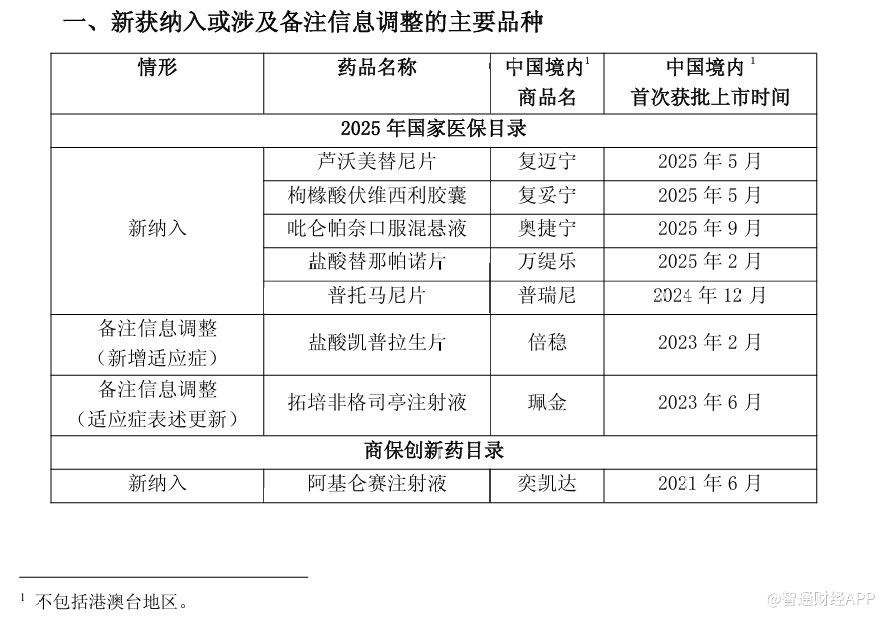
Core Viewpoint - Fosun Pharma has announced the inclusion of several of its products in the 2025 National Medical Insurance Directory and the Commercial Health Insurance Innovative Drug Directory, which is expected to enhance drug accessibility and reduce patient medication costs, positively impacting the company's future performance [1][3]. Group 1: National Medical Insurance Directory - New inclusions in the 2025 National Medical Insurance Directory include: - Luwomeitini Tablets (复迈宁), approved for market in May 2025 - Guo Xiangsu Fuwisili Capsules (复妥宁), approved for market in May 2025 - Pirfenidone Oral Suspension (奥捷宁), approved for market in September 2025 - Tofacitinib Tablets (万缇乐), approved for market in February 2025 - Putomani Tablets (普瑞尼), approved for market in December 2024 [1]. - Adjustments in remarks for existing drugs include: - Levetiracetam Tablets (倍稳), with new indications added in February 2023 - Tofacitinib Injection (珊金), with updated indication descriptions in June 2023 [1]. Group 2: Commercial Health Insurance Innovative Drug Directory - New inclusion in the Commercial Health Insurance Innovative Drug Directory: - Acalabrutinib Injection (奕凯达), approved for market in June 2021 [1]. Group 3: Financial Impact - The total sales for the newly included or adjusted drugs are approximately RMB 401 million for 2024 and RMB 892 million for the first three quarters of 2025, accounting for about 0.98% and 3.04% of the company's revenue during the same periods, respectively [3]. - The inclusion in the directories is expected to facilitate market promotion and sales of these drugs, leading to a positive impact on the company's performance in subsequent years [3].