英克司兰钠

Search documents
政策赋能创新药加速跑
Jing Ji Ri Bao· 2026-02-26 21:26
Group 1 - The core issue highlighted is the current burden of innovative drug costs, where basic medical insurance covers 44%, commercial insurance covers 7%, and nearly half is borne by patients themselves [1] - The new policies since 2026 have significantly empowered the innovative drug industry, optimizing the payment system and enhancing drug accessibility [1][2] - The 2025 updated national medical insurance drug list represents the largest expansion of innovative drugs since the inception of the list, adding 114 new drugs while removing 29 [2] Group 2 - The newly added drugs are characterized by filling clinical gaps, superior efficacy, and cost-effectiveness, addressing unmet treatment needs [2] - The first commercial insurance innovative drug list includes 19 drugs, marking a significant step in supporting innovative drugs within a multi-tiered medical insurance system [2][3] - The new policies are expected to reshape the retail drug ecosystem, enhancing the accessibility and efficiency of innovative drugs [4][5] Group 3 - The innovative drug market is anticipated to undergo a restructuring, with deeper integration between innovative drug companies and retail pharmacies [5] - The dual-channel management mechanism for negotiated drugs aims to solve the "last mile" issue in drug accessibility [4][6] - The support from the medical insurance fund has exceeded 460 billion yuan, benefiting 1 billion patients and driving sales of related drugs over 670 billion yuan [7] Group 4 - The current period is seen as a golden era for high-quality development in the innovative drug industry, with increasing support for research and development from the government [8] - The alignment of national medical needs with corporate innovation is crucial for ensuring that innovative results reach patients more quickly and broadly [8][9] - Continuous efforts in basic research and supportive industrial policies are necessary for maintaining a leading position in global pharmaceutical innovation [9]
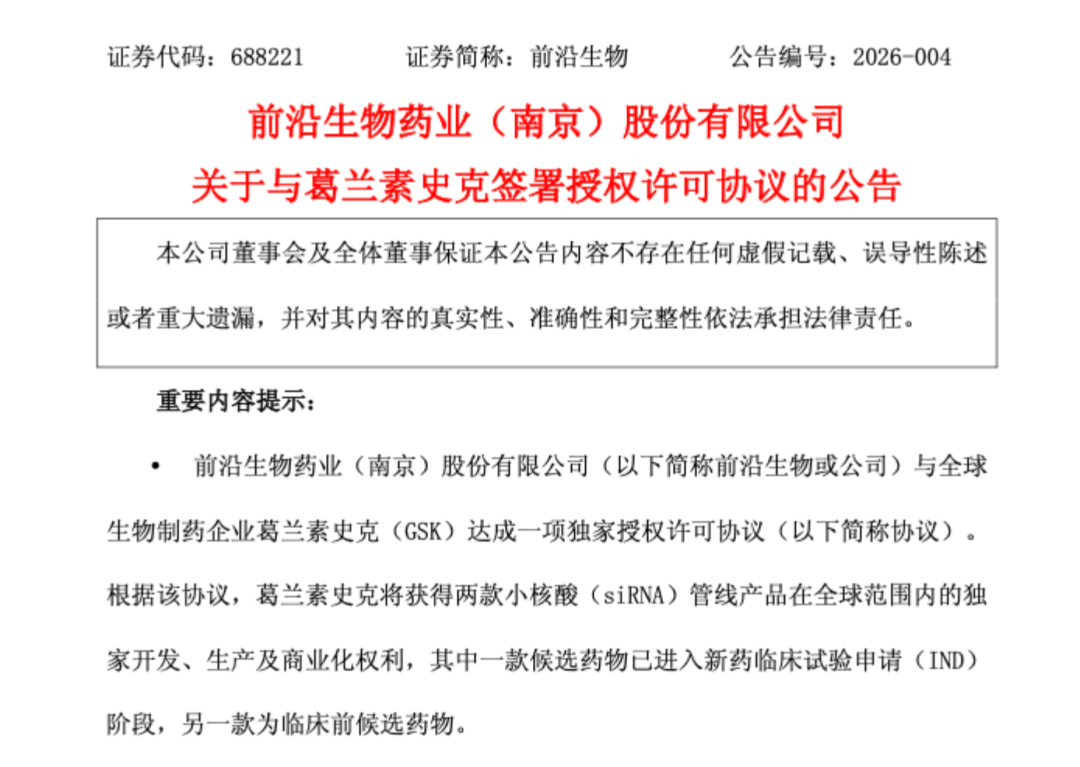
超10亿美元!688221,牵手国际巨头
Shang Hai Zheng Quan Bao· 2026-02-23 14:00
Core Viewpoint - Frontier Biotech has signed an exclusive licensing agreement with GlaxoSmithKline (GSK) for two of its small interfering RNA (siRNA) products, marking a significant step in the company's international recognition and collaboration in the field of small nucleic acid drugs [1][4]. Financial Aspects - Frontier Biotech will receive an upfront payment of $40 million and a near-term milestone payment of $13 million, with potential milestone payments reaching up to $950 million, bringing the total deal value to over $1 billion [3]. - The company will also earn tiered royalties on the global net sales of the two products [3]. Product Development and Responsibilities - One of the candidate drugs has entered the Investigational New Drug (IND) application stage, while the other is in the preclinical stage [4]. - Frontier Biotech will be responsible for advancing one product's Phase I clinical trial in China and supporting the IND research for the other product, while GSK will lead the global clinical development, registration, and commercialization efforts [4]. Industry Trends - Small nucleic acid drugs are gaining attention due to their short development cycles, broad therapeutic applications, long-lasting effects, and high success rates, expanding from rare genetic diseases to chronic diseases like cardiovascular and metabolic disorders [5]. - Since 2026, there have been numerous developments in the small nucleic acid field, including significant partnerships and acquisitions by various companies, indicating a growing interest and investment in this area [6]. Clinical Progress in China - Several domestic companies have entered clinical stages, with products targeting various diseases such as hepatitis B, cardiovascular, and metabolic disorders [7]. - Notable advancements include AHB-137 completing Phase III clinical enrollment in China and multiple pipelines from other companies progressing to global Phase II clinical trials [7]. Future Outlook - As technology matures and large pharmaceutical companies continue to invest, the application of small nucleic acid drugs is expanding from rare diseases to common chronic conditions, indicating a broad industry outlook [8]. - The collaboration between Frontier Biotech and GSK not only showcases the company's technical capabilities but also adds a new chapter to the internationalization path of Chinese small nucleic acid drug enterprises [8].


114种新药落地报销 甘肃新版医保药品目录全面执行
Xin Lang Cai Jing· 2026-01-31 02:59
Core Viewpoint - The implementation of the new medical insurance drug directory in Gansu Province aims to enhance healthcare accessibility by including 114 urgently needed drugs, with a focus on innovative treatments and chronic disease management [1][2]. Group 1: New Drug Inclusion - A total of 114 new drugs have been added to the medical insurance reimbursement list, with 50 being innovative drugs, marking a record high in both quantity and proportion [2]. - Among the new additions, 36 are anti-cancer drugs targeting various types of cancers, significantly reducing patient costs; for instance, the price of a domestic innovative drug for triple-negative breast cancer drops from nearly 10,000 yuan to over 4,000 yuan after insurance reimbursement [2]. - The total number of drugs in the Gansu medical insurance directory has increased to 3,253, including 1,857 Western medicines and 1,396 traditional Chinese medicines, while 29 low-value drugs have been removed to optimize fund allocation [2]. Group 2: Commercial Insurance Innovations - The first edition of the Commercial Health Insurance Innovative Drug Directory has been launched, including 19 high-value innovative drugs that complement basic medical insurance [3]. - These drugs cover critical areas such as cancer and rare diseases, encouraging commercial insurance companies to design new products and improve reimbursement scopes [3]. Group 3: Implementation Measures - Gansu Province has upgraded its medical insurance information system to ensure smooth reimbursement processes and accurate drug directory updates [4]. - Measures include classifying high-demand drugs for separate payment policies to reduce patient financial burdens and a 6-month transition period for drugs that are not renewed in the directory [4]. - Ongoing training and monitoring will be conducted to ensure that medical institutions comply with the new policies and that patient medication needs are met while safeguarding the insurance fund [4].
从“灵魂砍价”到“价值共赢” 医保与创新药的双向奔赴
Zhong Guo Jing Ji Wang· 2026-01-21 09:18
Core Insights - The new national medical insurance drug list and the first commercial insurance innovative drug list will be implemented nationwide starting January 1, 2026, marking the largest expansion of innovative drugs in the history of the medical insurance directory [1] - The adjustment of the medical insurance directory represents a dual benefit for the innovative drug industry in China, with significant changes in the inclusion of innovative drugs and the establishment of a commercial insurance innovative drug directory [1][2] Summary by Sections Innovative Drug Inclusion - A total of 114 new drugs have been added to the national medical insurance drug list, including 111 new products launched within the last five years and 50 Class I new drugs, both of which set historical highs in terms of quantity and proportion [1][2] - The newly included drugs generally possess three common characteristics: they either fill a treatment gap, are superior alternatives, or offer better cost-effectiveness [2] Commercial Insurance Innovative Drug Directory - The first commercial insurance innovative drug directory includes 19 drugs, covering treatments for various conditions such as CAR-T therapies for tumors, rare diseases like Gaucher disease, and Alzheimer's disease, complementing the basic medical insurance [2][3] - The selection mechanism for the commercial insurance directory emphasizes high innovation, significant clinical value, strong irreplaceability, and adaptability to a multi-tiered payment system [3] Payment System and Market Impact - The medical insurance fund has paid over 460 billion yuan for negotiated drugs by the end of October 2025, benefiting 1 billion patients and driving related drug sales exceeding 670 billion yuan [4] - The new dual-directory system aims to clarify the boundaries of basic medical insurance coverage while allowing space for commercial insurance development, thus supporting a multi-tiered payment system [3][4] Innovation Ecosystem - The integration of the commercial insurance innovative drug directory with the national medical insurance drug list is crucial for building a multi-layered medical security system, focusing on high-innovation and clinically significant drugs that exceed basic insurance coverage [5] - The successful inclusion of breakthrough therapies like Alpelisib not only provides hope for patients but also signals strong support for genuine innovation within the pharmaceutical industry [5]
国家医保药品“清单”一览
Xin Lang Cai Jing· 2026-01-12 19:03
Core Insights - The latest version of the medical insurance drug list will be implemented on January 1, 2026, with significant updates aimed at improving access to essential medications for insured individuals [1]. Group 1: New Drug Additions - A total of 114 new drugs have been added to the list, with 50 classified as first-class new drugs, marking a record high in both quantity and proportion [2]. - New drugs include treatments for critical conditions such as triple-negative breast cancer and pancreatic cancer, as well as medications for chronic diseases and rare diseases [2]. Group 2: Expanded Payment Coverage - The payment scope has been broadened for 65 drugs, with new indications included for reimbursement, such as additional targets for non-small cell lung cancer treatments and expanded age eligibility for certain rare disease medications [3]. - Adjustments have been made to align payment criteria more closely with clinical practices, such as changing the payment range for certain drugs from "previous chemotherapy" to "past chemotherapy" [3]. - Some drugs have had restrictions removed or modified, while ensuring that reimbursement is still aligned with clinical guidelines [3]. Group 3: Drug Removal and Transition Policies - A total of 29 drugs have been removed from the list, primarily those that have been clinically obsolete or not produced for an extended period [4]. - A transition policy has been established for drugs that were removed but had not successfully renewed their contracts, allowing a 6-month period for insured individuals to purchase these drugs at the original reimbursement standards [4].
114种新药“入保”,百姓“药篮子”再升级
Zheng Quan Shi Bao· 2026-01-08 02:07
Core Viewpoint - The implementation of the "National Basic Medical Insurance, Maternity Insurance, and Work Injury Insurance Drug List (2025)" aims to optimize the drug reimbursement system, enhancing both the efficiency of medical insurance funds and the accessibility of essential medications for the public [1] Group 1: Drug List Changes - The new drug list includes 114 new drugs, with 50 being innovative first-class drugs, while 29 drugs with lower clinical value have been removed, bringing the total to 3,253 drugs [1] - The updated list covers key areas such as oncology, rare diseases, chronic diseases, and pediatric medications [1] Group 2: New Drug Characteristics - Newly included drugs exhibit three significant characteristics: they either fill clinical treatment gaps, are superior alternatives, or offer better cost-effectiveness [1] - Specific examples include new drugs for treating triple-negative breast cancer and pancreatic cancer, which improve affordability and accessibility for patients [2] Group 3: Payment Scope Adjustments - The payment scope for 65 drugs has been revised to better align with clinical realities, such as expanding the use of certain drugs to a broader patient age range [3] - New conditions have been added for some drugs to prevent misuse while ensuring that medical insurance funds are utilized effectively [3] Group 4: Cost Reduction Initiatives - The combination of price negotiations and medical insurance reimbursements is expected to lower the cost of medications for the public [3] - A new "Commercial Health Insurance Innovative Drug List (2025)" has been introduced, including 19 high-value innovative drugs, which complements basic medical insurance and addresses diverse health needs [3] Group 5: Implementation and Accessibility - The medical insurance department has mandated that medical institutions incorporate newly added drugs into their procurement lists by the end of February [4] - A transition policy allows for a 6-month period during which patients can still purchase removed drugs at previous reimbursement rates [4] - A new feature for querying the updated basic medical insurance drug list has been launched on the National Medical Insurance Bureau's WeChat public account [4]
中新健康丨一针少花两千,新版医保目录调整能省多少钱
Zhong Guo Xin Wen Wang· 2026-01-08 01:45
Core Insights - The recent adjustment to the National Medical Insurance Drug List has significantly reduced the costs of long-acting growth hormone treatments, benefiting many families [1] - The new drug list includes a high proportion of innovative drugs and aims to enhance drug accessibility for patients in urgent clinical need [2] Group 1: New Drug Additions - A total of 114 new drugs have been added to the insurance list, covering critical areas such as oncology, chronic diseases, and rare diseases [2] - The average price reduction for newly added drugs exceeds 60%, significantly alleviating the financial burden on patients [2] - Notable new drugs include innovative treatments for triple-negative breast cancer and pancreatic cancer, as well as long-acting growth hormone for children [2] Group 2: Optimization of Existing Drugs - The payment scope for 65 existing drugs has been optimized, including expanded indications for certain medications [3] - Adjustments have been made to ensure that the descriptions of drug payment scopes align more closely with clinical realities [3] Group 3: Policy Measures - The government has implemented a series of policies to ensure that negotiated drugs are effectively integrated into hospitals and accessible to patients [3] - Medical institutions are required to hold pharmacy meetings to incorporate new drugs into their procurement lists by February 2026 [3] Group 4: Industry Impact - The adjustment has led to the removal of 29 drugs that have lower efficacy or better alternatives available, thereby optimizing the use of medical insurance funds [4] - The inclusion of numerous innovative drugs indicates a strengthening of domestic pharmaceutical companies' research and development capabilities [4][5] - Major companies like Heng Rui Medicine and Innovent Biologics have successfully introduced multiple innovative drugs into the new insurance list [5]
一针少花两千,新版医保目录调整能省多少钱
Zhong Guo Xin Wen Wang· 2026-01-08 01:28
Core Insights - The recent adjustment to the National Medical Insurance Drug List has significantly reduced the costs of long-acting growth hormone treatments, benefiting many families [1] - The new drug list includes a substantial number of innovative drugs, with an average price reduction of over 60%, aimed at improving patient access to essential medications [2] Group 1: New Drug Additions - A total of 114 new drugs have been added to the insurance list, covering critical areas such as oncology, chronic diseases, and rare diseases [2] - Notable new drugs include innovative treatments for triple-negative breast cancer and pancreatic cancer, as well as long-acting growth hormone for children [2][4] - The new drugs are characterized by either filling clinical treatment gaps, being superior to existing options, or offering better cost-effectiveness [2] Group 2: Existing Drug Adjustments - The payment scope for 65 existing drugs has been optimized, including expanding the target population for certain medications [3] - Adjustments have been made to align drug descriptions more closely with clinical realities, facilitating easier prescription by healthcare providers [3] Group 3: Policy and Industry Impact - The adjustment aims to optimize the use of medical insurance funds, allowing for the introduction of innovative drugs while removing less effective ones [4] - The removal of 29 drugs primarily targets those with lower cost-effectiveness or available alternatives, with minimal impact on most patients [4] - The inclusion of numerous innovative drugs reflects the strengthening of domestic pharmaceutical companies' R&D capabilities [5] Group 4: Financial Implications - The National Medical Insurance Bureau has adjusted the drug list for eight consecutive years, adding a total of 949 new drugs, with significant financial implications for the pharmaceutical market [5] - The insurance fund has spent over 460 billion yuan on negotiated drug expenditures, driving sales growth exceeding 600 billion yuan [5]
2025年医保药品目录变更情况汇总!国家医保局发布药品“清单”
Xin Lang Cai Jing· 2026-01-07 10:07
Core Insights - The latest medical insurance drug list has been officially implemented as of January 1, 2026, featuring significant updates that enhance accessibility and affordability for insured individuals [1]. Group 1: New Drug Additions - A total of 114 new drugs have been added to the list, with 50 classified as new category 1 drugs, marking a record high in both quantity and proportion [2][3]. - Notable new drugs include treatments for triple-negative breast cancer, pancreatic cancer, and various chronic conditions, such as long-acting growth hormone injections and diabetes medications [3]. Group 2: Expanded Payment Scope - The payment scope has been broadened to include 65 drugs with new indications, allowing for better access to treatments for conditions like non-small cell lung cancer and rare diseases [4]. - Adjustments have been made to align payment criteria more closely with clinical practices, such as changing the payment criteria for certain drugs to reflect actual treatment scenarios [4]. Group 3: Restrictions and Conditions - New restrictions have been introduced for certain drugs to prevent misuse, ensuring that insurance funds are utilized effectively [5]. - Some drugs have had non-core restrictions removed, but the fundamental usage requirements remain unchanged, emphasizing the need for clinical discretion [5]. Group 4: Structural Adjustments - A total of 29 drugs have been removed from the list, primarily those that have been clinically obsolete or are no longer in production [6]. - A transition period of six months has been established for drugs that were removed but were under negotiation, allowing insured individuals to continue purchasing them at previous reimbursement rates until June 2026 [6]. Group 5: User Accessibility - The National Medical Insurance Bureau has launched a new feature on its WeChat account for users to query the updated basic medical insurance drug list easily [6].

新华鲜报|用药利好事关你我!国家医保药品“清单”一览
Xin Hua She· 2026-01-07 03:48
Core Insights - The latest medical insurance drug list will be implemented on January 1, 2026, featuring significant updates that focus on clinical needs and expand access to essential medications [1] Group 1: New Drug Additions - A total of 114 new drugs have been added to the list, with 50 classified as first-class new drugs, marking a record high in both quantity and proportion [1] - Notable new drugs include treatments for triple-negative breast cancer, pancreatic cancer, and long-acting growth hormone injections for children with growth deficiencies [3] Group 2: Expanded Payment Coverage - The payment coverage has been expanded for 65 drugs, with new indications included for existing medications, such as additional targets for non-small cell lung cancer treatments and broader age eligibility for rare disease treatments [4] - Adjustments have been made to payment criteria to better align with clinical practices, such as changing the payment range for certain drugs from "previous chemotherapy" to "past chemotherapy" [4] Group 3: Restrictions and Adjustments - New limitations have been introduced for certain drugs to prevent misuse, ensuring that insurance funds are utilized effectively [5] - Some drugs have had non-core restrictions removed, but the fundamental usage requirements remain unchanged, such as the diabetes medication semaglutide [5] Group 4: Drug List Structure and Transition Policies - The updated list has removed 29 drugs that are either clinically obsolete or have not been produced for an extended period, including several that did not successfully renew their negotiation agreements [6] - A transition policy has been established, allowing a 6-month period for patients to purchase removed drugs at previous reimbursement standards [6] - A new query function for the basic medical insurance directory has been launched on the National Medical Insurance Bureau's WeChat account for easier access to the updated list [6]