
携程

Search documents
携程总裁辞职!
Zhong Guo Jing Ji Wang· 2026-02-26 10:04
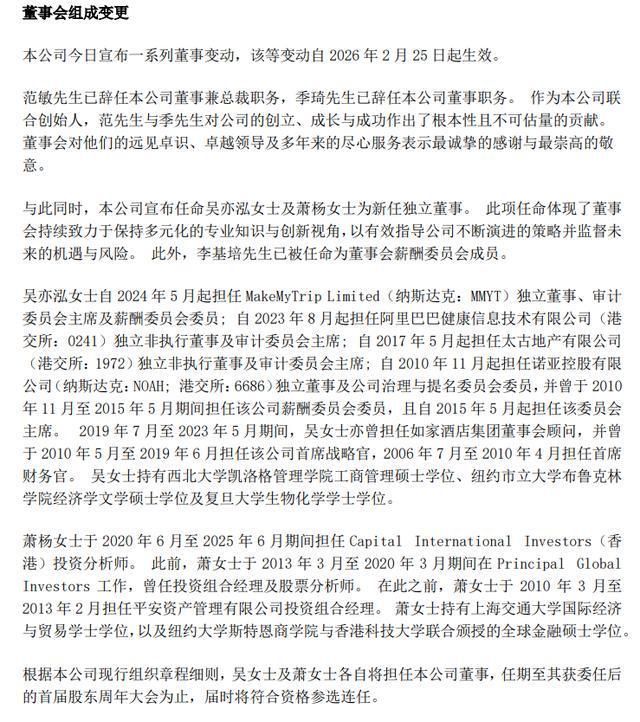
Core Viewpoint - Ctrip Group announced its unaudited financial results for Q4 2025 and the entire year, along with changes in its board of directors [1][4] Financial Performance - In Q4 2025, Ctrip Group reported a net operating revenue of 15.4 billion yuan and a net profit of 4.3 billion yuan [4] - For the full year 2025, Ctrip Group's net operating revenue reached 62.4 billion yuan, representing a year-on-year increase of 17% [4] Board Changes - Fan Min has resigned from his position as a director and president of the company, while Ji Qi has stepped down from his role as a director [1][3] - Wu Yihong and Xiao Yang have been appointed as new independent directors [1] Regulatory Investigation - Ctrip received a notification from the State Administration for Market Regulation in January 2026 regarding an investigation into alleged monopolistic behavior under the Anti-Monopoly Law of the People's Republic of China [3][4] - The company is cooperating fully with the investigation and maintaining active communication with regulatory authorities [3]

被立案的携程:日赚1.06亿,商家被掏空,梁建章套现6亿
Xin Lang Cai Jing· 2026-01-16 07:03
Core Viewpoint - The online travel industry is currently dominated by Ctrip, which faces no substantial threats from other platforms. Regulatory scrutiny has increased due to allegations of monopolistic practices, leading to a significant drop in Ctrip's stock price and market value [3][20]. Financial Performance - Ctrip's net profit for 2023 reached 9.9 billion, a 41.4% increase compared to 2019. Projections for 2024 indicate a further rise to 17.07 billion, marking a 143% growth from 2019. In the first three quarters of 2025, net profit reached 29.01 billion, surpassing the total for the previous year, averaging 1.06 billion per day [4][21]. - Ctrip's gross profit margin has exceeded 80% in five out of the last six quarters, outperforming many high-end liquor brands [4][21]. Market Position and Strategy - Ctrip holds a dominant position in the online travel agency (OTA) market, with a projected GMV market share of 56% in 2024. When combined with its affiliate platform Tongcheng, the Ctrip ecosystem commands nearly 70% of the OTA market [6][23]. - The platform has built a significant user base, making it difficult for smaller businesses to negotiate favorable terms. Ctrip has acquired major airline and hotel brands, further solidifying its market position [8][25]. Revenue Model - Ctrip's business model primarily relies on commission, with rates typically ranging from 12% to 20%, and up to 30% for scarce resources. Additional revenue is generated through tools like "Click Pay" and "Commission Ladder," which further extract fees from merchants [10][27]. - The "Price Adjustment Assistant" tool has been criticized for automatically lowering hotel prices without merchant consent, leading to complaints from businesses about unfair practices [11][28]. Regulatory Scrutiny - Ctrip has faced multiple regulatory inquiries regarding its pricing practices and market dominance. The company has been accused of manipulating prices and limiting merchant autonomy, leading to increased scrutiny from market regulators [12][30]. - Reports indicate that Ctrip's commission rates have risen significantly, causing financial strain on partner businesses, with some reporting that platform fees can consume nearly 40% of their revenue [15][32]. Competitive Landscape - Despite regulatory challenges, no other platform poses a significant threat to Ctrip's dominance. Competitors like Meituan and Fliggy have not introduced disruptive innovations to challenge Ctrip's established market practices [18][35]. - Ctrip's entrenched position and extensive user habits make it difficult for consumers to switch to alternative platforms, reinforcing its market power [16][33].

携程被立案调查 过去一年已被多次约谈
Zhong Guo Xin Wen Wang· 2026-01-14 15:45
Core Viewpoint - The State Administration for Market Regulation has initiated an investigation into Ctrip Group for alleged monopolistic practices, while the company has stated it will cooperate with the investigation and maintain normal business operations [1]. Group 1: Regulatory Investigation - Ctrip Group is under investigation for suspected abuse of market dominance according to the Anti-Monopoly Law of the People's Republic of China [1]. - The company has faced multiple regulatory discussions in 2025 regarding practices such as "forced choice" and unfair pricing interventions [1]. - Ctrip's stock price fell by 6.49% to 569.5 HKD per share following the announcement of the investigation [1]. Group 2: Market Position and Competitors - Ctrip is a leading player in the Chinese Online Travel Agency (OTA) sector, having undergone significant business development and acquisitions [2]. - The company holds a market share of 56% in the OTA sector as of 2024, maintaining a dominant position [2]. - Ctrip targets the mid-to-high-end travel market, primarily serving consumers from high-tier cities, including young professionals and business travelers [2]. Group 3: Performance Metrics - Ctrip's net operating revenue reached 18.3 billion RMB in Q3 2025, reflecting a year-on-year increase of 16% due to strong travel demand [3]. - The international OTA platform bookings grew by approximately 60% year-on-year, with inbound tourism bookings increasing by over 100% [3]. - Outbound hotel and flight bookings have risen to 140% of the levels seen in the same period of 2019 [3].
你知道投诉都有哪些渠道吗?这一篇讲清楚
Xin Lang Cai Jing· 2025-11-17 09:46
Core Viewpoint - The article emphasizes the various complaint channels available for consumers facing issues in both offline and online shopping experiences, highlighting that knowing the right channel can simplify the process of consumer rights protection [1]. Offline Complaint Channels - For in-store purchases, the most direct complaint methods include contacting the store manager, customer service desk, or on-site management personnel [2]. - Most stores typically offer refund, exchange, or compensation solutions, and it is important for consumers to keep receipts, videos, and photos as evidence [3]. - For chain brands, complaints can be directed to the brand headquarters through official customer service hotlines, brand websites, or social media platforms [4][5]. - Hotel-related issues can be addressed by contacting the hotel front desk, general manager, or brand headquarters, depending on whether the booking was made directly or through a travel platform [6][7]. Online Complaint Channels - Online shopping platforms provide a variety of complaint options, with internal complaint processes being the most common and direct method [8][9]. - For issues arising from live-stream shopping, consumers can submit complaints through the purchasing platform's app or report violations to platform customer service [10]. - For app-based services like food delivery or ride-hailing, complaints can be made directly within the app, which often leads to quick responses [11]. General Complaint Platforms - The national 12315 platform is the most authoritative channel for various consumer issues, including false advertising and refusal to refund [12][13]. - Different consumer problems have dedicated regulatory departments, such as 12300 for telecommunications and 12328 for transportation, which typically handle complaints efficiently [14]. - Social complaint platforms like Black Cat Complaints offer a transparent process for consumers to report issues, with public responses from companies, which can expedite resolution [15][16]. Summary - There are numerous complaint channels available for consumers, including offline options like store managers and customer service, online platforms for e-commerce and live-stream shopping, official channels like 12315, and third-party platforms like Black Cat Complaints [17]. - Keeping evidence and selecting the appropriate channel can lead to the resolution of most consumer disputes [18]. - The process of protecting consumer rights is framed as a means to enhance consumer confidence and encourage better business practices [19].
外卖大战后,巨头混战另一个万亿市场
Hu Xiu· 2025-10-09 06:16
Core Viewpoint - The hotel and travel industry is emerging as a new battleground for major players, similar to the recent competition in the food delivery sector, with Alibaba, Ctrip, Meituan, and Douyin being key competitors in this space [1][6]. Industry Overview - The travel industry is one of the few sunrise industries in China, with significant growth potential [7]. - During the recent 2025 National Day holiday, travel participation reached a record high, with over 2 billion people traveling [8]. - In the first half of 2025, domestic travel spending by residents reached 3.15 trillion yuan, a year-on-year increase of over 15%, outpacing China's GDP growth [9]. Company Performance - Atour Hotel reported a 37% year-on-year revenue growth in the first half of 2025, indicating strong performance in the hotel sector despite a challenging macroeconomic environment [10]. - Ctrip holds a dominant market share of 56% in the travel market, significantly higher than its competitors [13]. - Ctrip's annual profits reach around 2 to 3 billion USD, showcasing the profitability of travel platforms [14]. Competitive Landscape - The second-largest player in the travel industry is Tongcheng Travel, with a market share of approximately 15%, supported by Tencent's investment [15]. - Meituan and Fliggy rank third and fourth, with market shares of 13% and 8%, respectively [16]. - The travel industry is characterized by a fragmented supply of hotels, which increases the value that platforms can capture [20]. Consumer Behavior - Consumers heavily rely on platforms for hotel bookings, as most hotels lack direct customer acquisition capabilities [18]. - Although travel is not a high-frequency activity, the high spending associated with it makes it a significant part of annual expenditures for many consumers [23][25]. Strategic Moves - Alibaba's integration of Fliggy into Taobao signifies a serious commitment to the travel market, aiming to leverage high-frequency shopping to drive low-frequency travel bookings [27][29]. - Fliggy's previous struggles stemmed from service quality issues compared to Ctrip and a strategic misalignment focusing on outbound travel rather than domestic tourism [30][35]. Future Outlook - The integration with Taobao presents a crucial opportunity for Fliggy to enhance its service offerings and tap into the vast user base of Taobao [37]. - The collaboration with 88VIP will allow for better membership benefits, which are highly valued in the travel industry [39]. - Platforms like Taobao and Douyin have the potential to personalize travel recommendations, enhancing consumer experiences [42].


2025年Q2移动互联网行业数据研究报告
Sou Hu Cai Jing· 2025-08-29 15:08
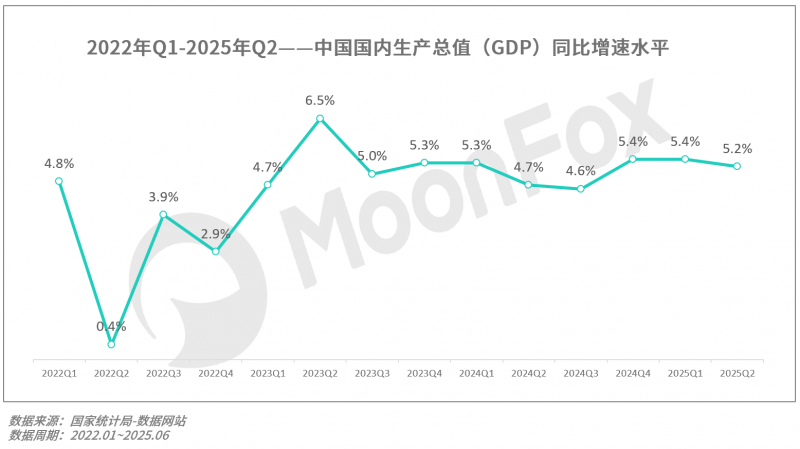
Macro Insights - The Chinese mobile internet industry continued its growth in Q2 2025, supported by a stable macroeconomic environment and ongoing policy support, with GDP growth of 5.2% year-on-year and 1.1% quarter-on-quarter [1][4] - The retail sales of consumer goods reached 24.55 trillion yuan, growing by 5.0%, with online retail sales amounting to 7.43 trillion yuan, a year-on-year increase of 8.5% [4][49] - The investment in high-tech industries showed remarkable growth, with information services, aircraft manufacturing, and computer equipment manufacturing increasing by 37.4%, 26.3%, and 21.5% respectively [4] Policy Changes - The central government emphasized stabilizing employment, businesses, and market expectations, implementing a series of policies to boost domestic demand and support economic recovery [9][11] - Key policies included the introduction of the "Private Economy Promotion Law" and measures to enhance consumer confidence and spending [10][11] Investment and Financing - The total social financing scale increased to 22.83 trillion yuan in the first half of 2025, with a notable rise in loans to the real economy [13][15] - The IPO market showed signs of recovery, with over 359 IPO applications in Q2, reflecting a significant increase compared to previous quarters [16] Mobile Traffic Overview - As of June 2025, the number of internet users in China reached 1.123 billion, with an internet penetration rate of 79.7% [18] - The average daily usage time of mobile devices approached 6 hours, indicating a growing reliance on mobile technology [18] Segment Market Insights E-commerce - The 6.18 shopping festival became a normalized event, with online retail sales exceeding 3.81 trillion yuan in Q2 2025 [49][51] - The "old-for-new" policy significantly boosted sales in the 3C digital product category, with sales surpassing 750 billion yuan [49][50] Food Delivery - The food delivery market saw intensified competition, with JD.com entering the space and implementing aggressive subsidy strategies [54][55] - JD's food delivery service achieved over 1 million daily orders within 40 days of launch, indicating rapid market penetration [55] Gaming - The gaming market maintained growth, with mobile games generating 1.253 trillion yuan in revenue in the first half of 2025, a year-on-year increase of 16.55% [64] - New game releases in Q2 included several successful titles, with some achieving over 1 billion yuan in revenue in their first month [66][67] Short Dramas - The short drama market continued to grow, with various platforms actively investing in new content and leveraging AI technology for production [72]
携程上涨4.08%,报61.76美元/股,总市值403.67亿美元
Jin Rong Jie· 2025-08-13 13:47
Core Insights - Ctrip (TCOM) opened with a 4.08% increase, reaching $61.76 per share, with a total market capitalization of $40.367 billion as of August 13 [1] - As of March 31, 2025, Ctrip reported total revenue of 13.83 billion RMB, a year-on-year increase of 16.17%, while net profit attributable to shareholders decreased by 0.81% to 4.277 billion RMB [1] - Ctrip is set to release its fiscal year 2025 mid-term report on August 25, with the actual disclosure date subject to company announcements [1] Company Overview - Ctrip Group is a leading one-stop travel platform globally, offering a comprehensive range of travel products, services, and differentiated travel content [1] - The company assists users in exploring travel options, providing inspiration and information for cost-effective travel bookings, and offering in-trip services [1] - Established in 1999, Ctrip went public on NASDAQ in 2003 and was listed on the Hong Kong Stock Exchange in 2021, operating brands including Ctrip, Qunar, Trip.com, and Skyscanner [1] Business Operations - Ctrip's accommodation services offer over 1.7 million options, including hotels, motels, resorts, residences, apartments, homestays, inns, and other properties [2] - The flight booking service provides tickets from over 600 airlines, covering more than 3,400 airports in over 220 countries and regions [2] - The company primarily serves non-mainland Chinese users through Trip.com and Skyscanner, with Trip.com offering services in 24 languages and 35 local currencies [2] - Skyscanner provides services in over 50 countries and regions, supporting more than 35 languages [2] - Ctrip employs 36,249 staff members as of December 31, 2023 [2]
携程上涨2.41%,报62.09美元/股,总市值405.82亿美元
Jin Rong Jie· 2025-08-04 14:22
Core Viewpoint - Ctrip (TCOM) shows a 2.41% increase in stock price, reaching $62.09 per share, with a total market capitalization of $40.582 billion as of August 4 [1] Financial Performance - As of March 31, 2025, Ctrip's total revenue is 13.83 billion RMB, reflecting a year-on-year growth of 16.17% [1] - The net profit attributable to shareholders is 4.277 billion RMB, showing a slight decrease of 0.81% year-on-year [1] Company Overview - Ctrip Group Limited is a leading one-stop travel platform globally, offering a comprehensive range of travel products, services, and differentiated travel content [1] - Established in 1999, Ctrip went public on NASDAQ in 2003 and was listed on the Hong Kong Stock Exchange in 2021 [1] - The company operates major brands including Ctrip, Qunar, Trip.com, and Skyscanner, and aims to provide high-quality travel booking experiences [1] Business Operations - Ctrip's accommodation services offer over 1.7 million options, including hotels, motels, resorts, apartments, and other properties [2] - The flight booking service provides tickets from over 600 airlines, covering more than 3,400 airports in over 220 countries and regions [2] - Trip.com and Skyscanner cater to non-mainland Chinese users, with Trip.com offering services in 24 languages and 35 local currencies [2] - As of December 31, 2023, the company employs 36,249 staff members [2]