无人驾驶网约车

Search documents
无人驾驶崛起,网约车司机忧心!广州市政协委员建议互补发展
Nan Fang Du Shi Bao· 2026-01-17 11:55
Core Viewpoint - The proposal submitted by Fang Ou emphasizes the need for a balanced development of the autonomous ride-hailing industry while safeguarding the rights and transition pathways of traditional ride-hailing drivers as autonomous technology rapidly expands [2]. Group 1: Industry Development - The autonomous driving technology is experiencing explosive growth, with services already covering major cities like Beijing, Guangzhou, and Shenzhen, and some companies achieving over 10 million kilometers in total autonomous driving mileage [2]. - The cost of vehicle acquisition for autonomous ride-hailing has significantly decreased, accelerating the commercialization process [2]. Group 2: Impact on Traditional Drivers - Traditional ride-hailing drivers are facing income pressure and job insecurity due to the rise of autonomous vehicles, with over 80% of drivers expressing concerns about being replaced by technology [2]. - The existing industry protection systems and transition mechanisms for traditional drivers are inadequate [2]. Group 3: Recommendations for Transition - Fang Ou suggests that the transportation department should establish an evaluation mechanism for the capacity of autonomous ride-hailing services, approving deployment in phases based on market demand and road capacity [2]. - It is recommended to clarify the service scope and business boundaries of autonomous ride-hailing to ensure it complements rather than competes directly with traditional ride-hailing services [2]. Group 4: New Job Creation and Training - The autonomous driving industry is creating new job roles such as safety operators, maintenance personnel, and data annotators, but there is a lack of unified professional standards and skill certification systems for these positions [3]. - Fang Ou advocates for the establishment of a new occupational system and the expansion of employment channels, including collaboration between vocational schools and companies to provide targeted training for traditional ride-hailing drivers [3]. - The human resources department should lead the development of new occupational standards in the autonomous driving field, creating a one-stop service platform for training, certification, and employment [3].


小马智行20260106
2026-01-07 03:05
Summary of the Conference Call for Xiaoma Zhixing Company Overview - **Company**: Xiaoma Zhixing (Pony.ai) - **Industry**: Autonomous Driving and Ride-Hailing Services Key Points and Arguments Vehicle Deployment and Market Strategy - Xiaoma Zhixing plans to add 3,000 vehicles by 2025, focusing on Beijing, Guangzhou, and Shenzhen, with Guangzhou having the highest allocation, followed by Shenzhen and Beijing [2][5] - The company currently has limited vehicle numbers in Shanghai due to government regulations requiring new vehicles to be produced by specific manufacturers, which Xiaoma's partners do not meet [2][4] Business Model and Financials - Operating under a light-asset model, Xiaoma Zhixing compensates partners based on their responsibilities and costs, adding approximately 10% gross profit [2][6] - The average daily net income per autonomous ride-hailing vehicle is 299 RMB, with annual operating costs estimated at 90,000 to 100,000 RMB, indicating a break-even point at around 100,000 RMB in revenue [2][8] - The company anticipates potential profit margins of 80,000 to 90,000 RMB per vehicle if annual revenues reach 180,000 RMB, which is the minimum required for traditional human-driven ride-hailing services in first-tier cities [2][8] Operational Efficiency - The ratio of remote support personnel to vehicles is currently 1:30, with plans to increase this to 1:50 by 2026, although the marginal cost reduction will be less significant than previous improvements [2][11][12] - The company aims to enhance service quality and reduce passenger wait times to increase vehicle utilization and revenue [2][13][15] Regulatory and Licensing - Xiaoma Zhixing has obtained L4 autonomous driving licenses in major cities and plans to conduct small-scale tests in second-tier cities like Hangzhou or Wuhan starting in 2025 [2][24] - The licensing process for autonomous vehicles involves obtaining individual permits for each vehicle, with the company responsible for ensuring compliance with safety and performance standards [2][16] Future Developments - The next-generation Room Type vehicle is expected to be introduced between 2027 and 2028, with cost reductions of at least 20% anticipated through minor updates to the current seventh-generation model [2][18] - The company is exploring international expansion, with plans to operate in several countries, although vehicle numbers will be limited due to varying regulatory environments [2][17] Cost Structure and Insurance - Vehicle depreciation accounts for approximately 45% of total costs, while insurance costs for Xiaoma's vehicles are around 5,000 RMB per year, significantly lower than traditional ride-hailing vehicles [2][20][22] - Charging costs are managed through partnerships for discounted electricity rates, averaging around 0.4 RMB per kWh, leading to annual charging expenses of approximately 10,000 to 11,000 RMB per vehicle [2][21] Industry Impact - The release of NVIDIA's open-source Volta model is seen as a positive development for the autonomous driving sector, potentially attracting more investment, although its practical application may be limited [2][19] Additional Important Information - The company is focused on increasing vehicle numbers and improving service quality to enhance profitability and competitiveness against traditional ride-hailing services [2][15] - The regulatory landscape in major cities is evolving, with increasing support for autonomous driving initiatives from the central government [2][24]
美股三大指数集体高开
第一财经· 2025-12-15 14:49
Market Overview - On December 15, US stock indices opened higher, with the Dow Jones up 0.33%, Nasdaq up 0.60%, and S&P 500 up 0.45% [1][2]. Key Stock Movements - The Nasdaq China Golden Dragon Index fell by 0.5%, with notable declines in popular Chinese stocks: Baidu down over 2%, Alibaba and Li Auto down over 1% [3]. - Tesla saw an increase of over 2%, as the company's VP confirmed the testing of a driverless ride-hailing service in Austin, Texas, after canceling the safety driver requirement [3]. - Nvidia rose by over 1% following the release of its Nemotron 3 series open-source model [3]. Company-Specific News - iRobot, a manufacturer of robotic vacuum cleaners, experienced a nearly 70% drop in stock price, triggering a trading halt. The company has filed for bankruptcy and will be acquired by its contract manufacturer, Picea Robotics [4][5].

一无人驾驶网约车华南总部落户佛山,投资1800万元
Sou Hu Cai Jing· 2025-12-12 09:41
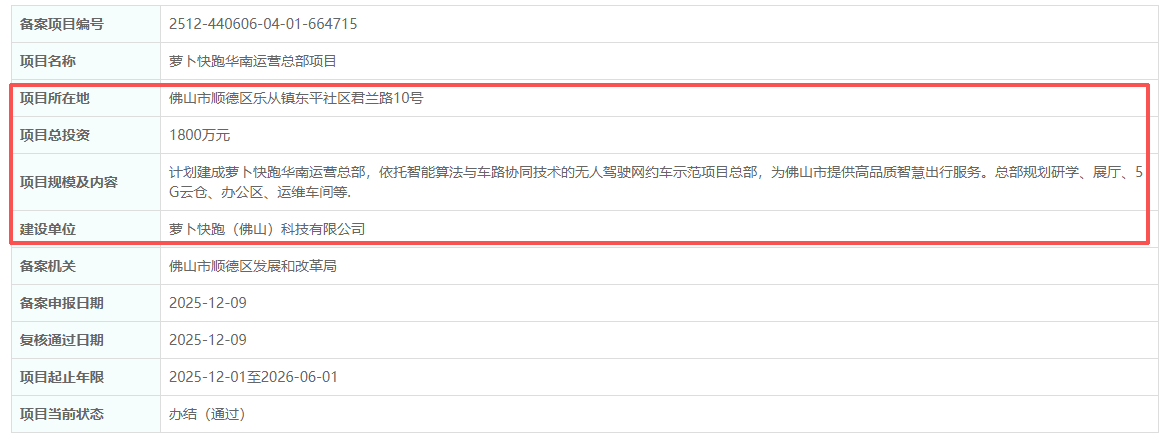
Core Insights - The "Luo Bo Kua Pao" South China Operations Headquarters project has been officially filed with a total investment of 18 million yuan [1][2]. Group 1: Project Overview - The project is located at No. 10, Junlan Road, Dongping Community, Lecong Town, Shunde District, Foshan City [1]. - The project aims to establish a headquarters for the "Luo Bo Kua Pao" autonomous ride-hailing demonstration project, leveraging intelligent algorithms and vehicle-road collaboration technology to provide high-quality smart travel services in Foshan [1][2]. - The headquarters will include research and study areas, exhibition halls, 5G cloud warehouses, office areas, and operation maintenance workshops [1]. Group 2: Project Timeline and Approval - The project is set to commence on December 1, 2025, and conclude on June 1, 2026 [2]. - The filing and review were completed on December 9, 2025, by the Foshan Shunde District Development and Reform Bureau [1]. Group 3: Autonomous Vehicle Demonstration - The Foshan Transportation Bureau announced the remote demonstration application area and time for "Luo Bo Kua Pao" on July 16, covering specific urban roads and ordinary highways until December 15, 2025 [2]. - The demonstration application will be available around the clock [2]. Group 4: Company Performance - As of August this year, "Luo Bo Kua Pao" has expanded its services to 16 cities globally, with over 14 million service trips and a total safe driving distance exceeding 200 million kilometers [4].
富临运业:暂未入选国家相关部门公布的无人驾驶网约车试点单位名单
Zheng Quan Shi Bao Wang· 2025-11-24 07:25
Core Viewpoint - The company, Fulian Transportation, is currently in the early investment and exploration phase of its long-term strategy involving autonomous driving, and it has not yet been selected as a pilot unit for autonomous ride-hailing by relevant national authorities [1] Group 1 - The company has confirmed that autonomous driving is part of its medium to long-term strategic layout [1] - The current status of the company's autonomous driving initiative is in the preliminary investment and exploration stage [1] - The company has not been included in the list of pilot units for autonomous ride-hailing published by national authorities [1]

半导体板块近期表现亮眼!产业进入复苏周期了吗?
Sou Hu Cai Jing· 2025-07-31 15:26
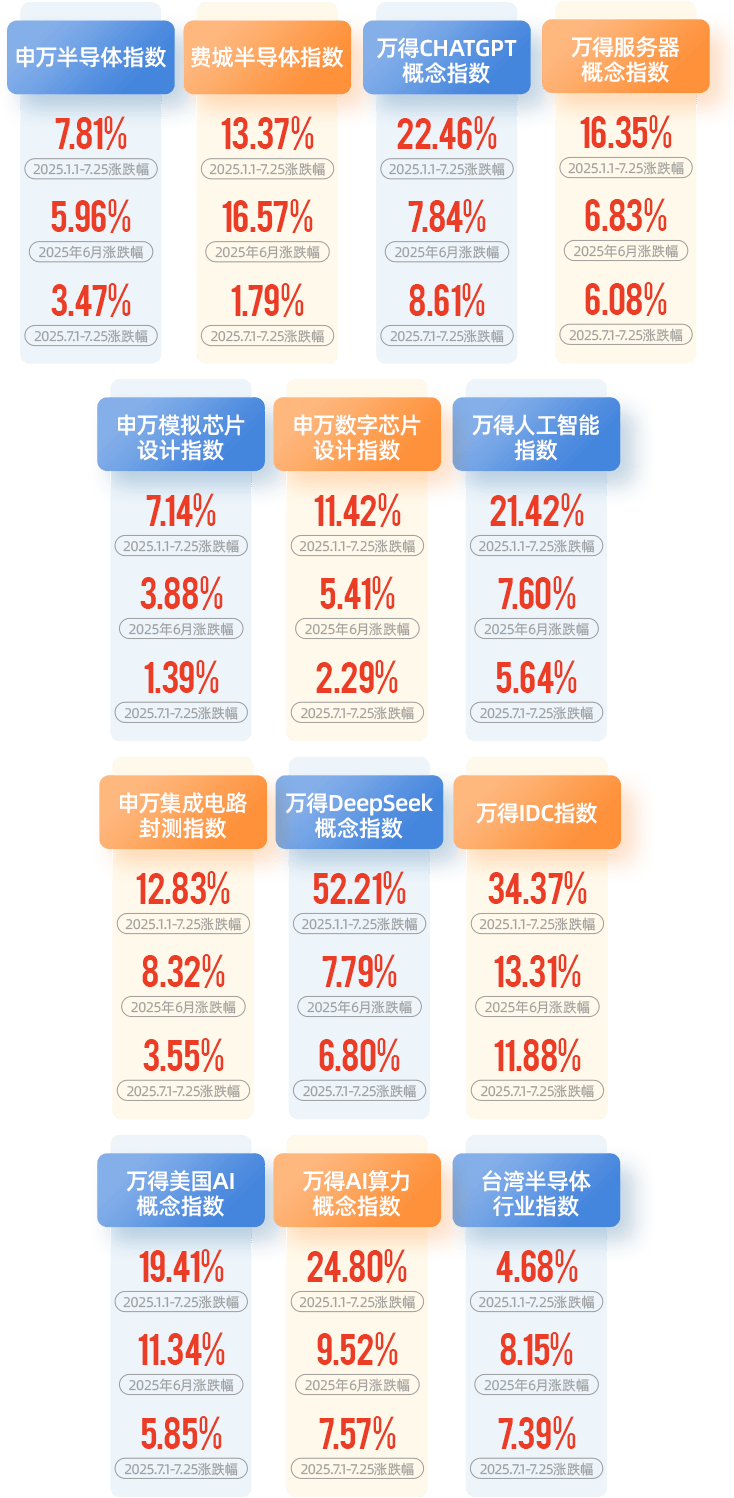
Group 1: Semiconductor Industry Outlook - SEMI predicts global semiconductor manufacturing equipment sales will reach a record $125.5 billion by 2025, a year-on-year increase of 7.4% [1] - The semiconductor sector has shown strong market performance, with the Shenwan Semiconductor Index rising 9.63% from June 6 to July 25 [1] - The AI-related concept indices have seen significant growth, with the Wind Deepseek concept index up over 52% year-to-date and the AI computing power concept index rising nearly 25% [1] Group 2: Automotive Industry Performance - In June 2025, the retail sales of passenger cars in China reached 2.08 million units, a year-on-year increase of 18.1% and a month-on-month increase of 7.6% [4] - The wholesale share of domestic brands in passenger cars was 67.1%, up 2.2% year-on-year, while the retail share was 64.2%, up 5.6% year-on-year [5] - Overall inventory of passenger car manufacturers decreased by 150,000 units in June, indicating reduced inventory pressure [5] Group 3: AI and Server Demand - AI server demand remains strong, with six Taiwanese ODM manufacturers reporting a combined revenue of NT$582.3 billion in June, a year-on-year increase of 88% [6] - Companies in downstream sectors such as chatbots and AI programming are experiencing rising average revenue rates and daily active user numbers [6] Group 4: Semiconductor Sales Growth - The global semiconductor sales reached $58.98 billion in May 2025, a year-on-year increase of 27.03%, marking a historical monthly high [7] - The Semiconductor Industry Association (SIA) forecasts global semiconductor sales to grow by 11.2% and 8.5% in 2025 and 2026, respectively [7] - The growth in both advanced and mature processes is driving strong momentum in the semiconductor industry [7]