
智能温控系统

Search documents
工信部等三部门:鼓励酿酒企业、装备制造企业、科研机构组建酿酒技术装备创新应用联合体
Mei Ri Jing Ji Xin Wen· 2026-02-14 07:49
Core Viewpoint - The Ministry of Industry and Information Technology, along with two other departments, has issued the "Guidance on Quality Improvement and Upgrading of the Brewing Industry (2026-2030)", focusing on enhancing equipment research and application levels [1] Group 1: Equipment Development - The guidance encourages brewing companies, equipment manufacturers, and research institutions to form joint innovation bodies for brewing technology and equipment [1] - Key areas of focus include the development of high-precision sensors, intelligent temperature control systems, and efficient membrane separation systems [1] Group 2: Technological Upgrades - Companies are encouraged to undertake technological transformations and utilize policies such as "first set" and "first version" to support the promotion of major technological equipment applications [1] - The guidance emphasizes the acceleration of research and application of advanced equipment, including waste heat recovery devices, mechanical vapor recompression (MVR) evaporation systems, automatic steaming robots, and high-speed integrated filling equipment [1]
延榆高铁项目建设迈入快车道
Shan Xi Ri Bao· 2026-01-22 23:04
Group 1 - The construction of the Yan-Yu High-Speed Railway is utilizing advanced intelligent technology, significantly enhancing construction efficiency and safety, with a monthly tunneling progress exceeding 600 meters [1] - The project employs a range of smart equipment, including intelligent lining and maintenance vehicles, which reduce labor intensity in low-temperature conditions and ensure the quality of concrete winter curing [1] - The intelligent processing center for steel components has achieved a precision error of less than 2 millimeters in rebar processing, with an 80% reduction in quality defect rates, showcasing the successful application of smart equipment in overcoming construction challenges [1] Group 2 - The Yan-Yu High-Speed Railway is a crucial segment of the national "eight vertical and eight horizontal" high-speed rail network, connecting key regions in Shaanxi and facilitating faster travel times, reducing the journey from Xi'an to Yulin to approximately 2 hours by 2028 [2] - The railway will enhance connectivity between the northern and southern regions of Shaanxi, contributing to regional development and tourism, particularly in revolutionary areas [2] - The project is expected to support the implementation of the Belt and Road Initiative by providing a convenient transportation route from Inner Mongolia and northern Shaanxi to the Beijing-Tianjin-Hebei region and the Shandong Peninsula [2]
当AI走进后厨:商用厨房正在发生的一次系统性升级
Di Yi Cai Jing· 2026-01-22 10:56
Core Insights - The restaurant industry is experiencing a dichotomy where consumer interest in cooking processes is rising, emphasizing "freshly cooked" and "wok flavor," while operators face increasing pressures related to costs, labor, and efficiency [3] - The kitchen, particularly the back-of-house operations, is under strain from conflicting demands for consumer experience and operational profitability, leading to a transformation in how kitchens are managed and operated [3] Industry Overview - The commercial kitchen market is substantial, with a projected revenue of 57,982 billion yuan by 2025, yet the penetration of smart technology remains below 10% [4] - The operational logic of commercial kitchens has traditionally relied on human experience, which becomes problematic as restaurants scale up, leading to challenges in consistency and rising labor costs [4][5] Technological Integration - Cooking robots are emerging as essential operational tools, addressing the most challenging aspects of kitchen standardization, such as timing and experience [5] - Companies like Boss Electric are integrating AI and systematic capabilities into their long-term strategies to address efficiency and stability issues in the restaurant industry [5][8] Strategic Moves - Boss Electric's investment in Youte Smart Kitchen signifies a shift towards a more data-driven approach in kitchen operations, allowing for the collection and calibration of cooking processes [8][11] - The focus is shifting from individual equipment to system capabilities, with the potential for significant competitive advantages for those who can create a closed loop of "equipment-data-system" [11][12] Future Directions - The commercial kitchen sector is moving towards a systematic competition phase, where understanding the entire cooking process becomes crucial for success [13][16] - The integration of AI into kitchens is not merely about automation but about creating a comprehensive management system that enhances overall kitchen efficiency and collaboration [15][18] Conclusion - The evolution of commercial kitchens is driven by the need for efficiency and consumer expectations for authentic cooking experiences, with AI technology playing a pivotal role in this transformation [18][19]


当AI走进后厨:商用厨房正在发生的一次系统性升级
第一财经· 2026-01-22 10:25
Core Viewpoint - The restaurant industry is experiencing a tension between consumer demand for authentic cooking and operational pressures on restaurant operators, leading to a transformation in kitchen operations where AI and automation are becoming integral to managing efficiency and experience [3][22]. Group 1: Market Potential - The commercial kitchen market is substantial, with a projected revenue of 57,982 billion yuan by 2025, yet the penetration of smart technology is below 10% [5]. - The operational logic of commercial kitchens has traditionally relied on human experience, which becomes problematic as restaurants scale up, leading to challenges in consistency and rising labor costs [5][6]. Group 2: Technological Integration - Cooking robots are emerging as essential operational tools, addressing the most challenging aspects of kitchen standardization, such as timing and experience [6]. - Companies like Boss Electric are integrating AI into their long-term strategies for commercial kitchens, utilizing extensive cooking data to enhance kitchen management and operational efficiency [6][9]. Group 3: Strategic Positioning - Boss Electric's investment in Youte Smart Kitchen signifies a shift towards a comprehensive kitchen system rather than merely supplying equipment, aiming to create a cohesive operational framework [12][18]. - The focus of competition in the commercial kitchen sector is shifting from individual devices to system capabilities, emphasizing the need for a holistic approach to kitchen management [12][18]. Group 4: Future Implications - The evolution of commercial kitchens is driven by the need for efficiency and consumer expectations, with AI technology playing a crucial role in this transformation [22]. - As kitchens become more systematized and managed, those relying solely on traditional methods may find themselves increasingly outpaced by more innovative competitors [22][23].


全国10辆房车1辆这里造,小车轮“转”出产旅融合大市场
Yang Zi Wan Bao Wang· 2025-10-15 06:10
Core Insights - The 2025 Second Yangzhou RV Camping Exhibition was held from October 11 to 13, showcasing over 30 well-known RV brands and nearly 100 models and camping equipment, creating an immersive experience platform for RV enthusiasts and local residents [1] - The exhibition highlighted the latest technological achievements in the RV manufacturing sector and established a "sales + experience + cultural tourism" integrated model [1][3] Industry Overview - Chenji Town, recognized as a significant RV manufacturing base in China, has developed a complete industry chain encompassing R&D, manufacturing, supporting services, and sales, featuring notable companies like Saide, Weihang, and Romantes [2] - The RV market is witnessing a trend towards lightweight and compact models, with multifunctional small RVs being introduced that combine accommodation, cooking, and storage within a length of 4-5 meters, enhancing maneuverability and flexibility [2] Sales Performance - During the three-day exhibition, a total of 41 RVs were sold, generating approximately 18 million yuan in sales [3] - In 2024, Chenji Town's RV sales are projected to exceed 1,200 units, capturing 10% of the national market share, with total invoiced sales reaching 681 million yuan, of which 577 million yuan comes from RV manufacturing [3] Market Trends - The RV camping industry in Chenji Town has established a full industry chain model from R&D and manufacturing to cultural tourism services, serving as a benchmark for the nation [3] - The RV industry in China is transitioning from a niche hobby to a mainstream choice, with domestic RV sales expected to grow over 25% year-on-year in 2024, and the number of camping sites surpassing 30,000 [3] Future Outlook - The RV industry is becoming a crucial economic growth point for Yizheng and Yangzhou, with plans to transform from a manufacturing base to an "industry brain," aiming to set standards, models, and lifestyles for the RV sector [4] - Chenji Town is anticipated to emerge as the heart of China's RV industry, facilitating connections between urban and rural areas and enhancing the overall industry chain [4]
我国80%以上大型水电站、全球50%以上水电工程由这家企业设计承建
Xin Hua Cai Jing· 2025-09-28 07:38
Core Viewpoint - China Power Construction Corporation (China Power) is making significant advancements in hydropower construction and technology, contributing to national energy security and the global green transition during the 14th Five-Year Plan period [1][3][9]. Group 1: Technological Innovations - China Power has developed an intelligent temperature control system for the Baihetan Hydropower Station, utilizing 5,774 thermometers and 75,000 meters of temperature measurement fiber, effectively controlling the concrete pouring temperature to below 27°C [1]. - The company has achieved breakthroughs in high-altitude dam construction technology, particularly at the Lihekou Hydropower Station, filling a technical gap in the industry [1][3]. - The Baihetan Hydropower Station has overcome significant technical challenges, including the stability of underground cavern excavation and temperature control for high arch dams, leading to innovations such as "mirror concrete" in spillway tunnels [6]. Group 2: Hydropower Development - During the 14th Five-Year Plan, China Power has driven a leap in hydropower installed capacity, particularly in conventional hydropower and pumped storage sectors, participating in major projects across key river basins [3][4]. - The company has designed and constructed over 80% of large hydropower stations in China and more than 50% globally, establishing itself as a renowned brand in the hydropower sector [3]. Group 3: International Cooperation - China Power actively promotes the "Belt and Road" initiative, exporting Chinese hydropower technology and standards globally, with projects in Laos, Zambia, and Bangladesh serving as examples of successful international collaboration [9][11]. - The company has been involved in the construction of the Nam Ou River cascade hydropower stations in Laos, which is the first comprehensive planning project for a river basin by a Chinese enterprise overseas [9][11]. Group 4: ESG and Social Responsibility - China Power emphasizes ESG (Environmental, Social, and Governance) practices, having published the first overseas ESG report by a Chinese contractor and recognized by domestic and international rating agencies [13]. - The company has created over 200,000 jobs through its overseas projects and has engaged in community building and training programs to strengthen ties with host countries [13].


向难题亮剑,智攻质量“难题”
Zhong Guo Neng Yuan Wang· 2025-07-30 08:35
Core Insights - The project team successfully improved the construction quality of large-volume concrete from 88.4% to 94.54% by addressing key issues related to concrete mix ratios and temperature monitoring [1][4]. Group 1: Quality Improvement Measures - A task force was established to tackle the quality issues, identifying that 70% of the problems were related to the base slab [1]. - The team focused on optimizing the concrete mix, leading to successful tests with a specific aggregate size distribution [2]. - Temperature monitoring was enhanced through the installation of multiple temperature sensors, allowing for real-time data collection and adjustments [3]. Group 2: Future Commitments - The project department aims to maintain high standards and continue addressing challenges to contribute to the company's high-quality development [4].
万亿级水电站背后的中国科技密码:五级梯级开发如何改写世界水电史
Sou Hu Cai Jing· 2025-07-20 10:48
Core Insights - The Yarlung Tsangpo River hydropower project, with an investment of 1.2 trillion yuan, is set to redefine global hydropower history by utilizing a five-level cascade system to harness a vertical drop of 2400 meters, achieving an annual power output 1.6 times that of the Three Gorges Dam [1][3] Group 1: Technical Achievements - The project has established two world records: the largest vertical drop for a cascade hydropower station group and the first single hydropower system to exceed 200 billion kilowatt-hours in annual output [3] - New nano-concrete technology has been developed to withstand extreme cold, enhancing freeze resistance to 800 cycles compared to traditional concrete's 50 cycles [3] - An intelligent temperature control system embedded in the dam utilizes geothermal resources to maintain a safe temperature range, reducing crack occurrence by 92% in extreme cold conditions [3] Group 2: Infrastructure and Efficiency - The project includes the world's first ±1100 kV ultra-high voltage direct current transmission system, which improves transmission efficiency by 40% compared to the 2014 Qinghai-Tibet power grid project, equivalent to a reduction of 1.8 million tons of coal consumption annually [5] - A network of 437 sensors has been installed for real-time monitoring of geological and hydrological changes, achieving a landslide warning accuracy rate of 92% [5] Group 3: Economic and Environmental Impact - The hydropower project is expected to create 48,000 jobs and boost Tibet's GDP growth by 2.3 percentage points annually [7] - The clean energy produced can replace 6.8 million tons of standard coal each year, equivalent to planting 370,000 hectares of trees [7] - The associated transportation network is projected to enhance Linzhi's tourism industry, with cold chain logistics expected to grow by 300% by 2025 [7]
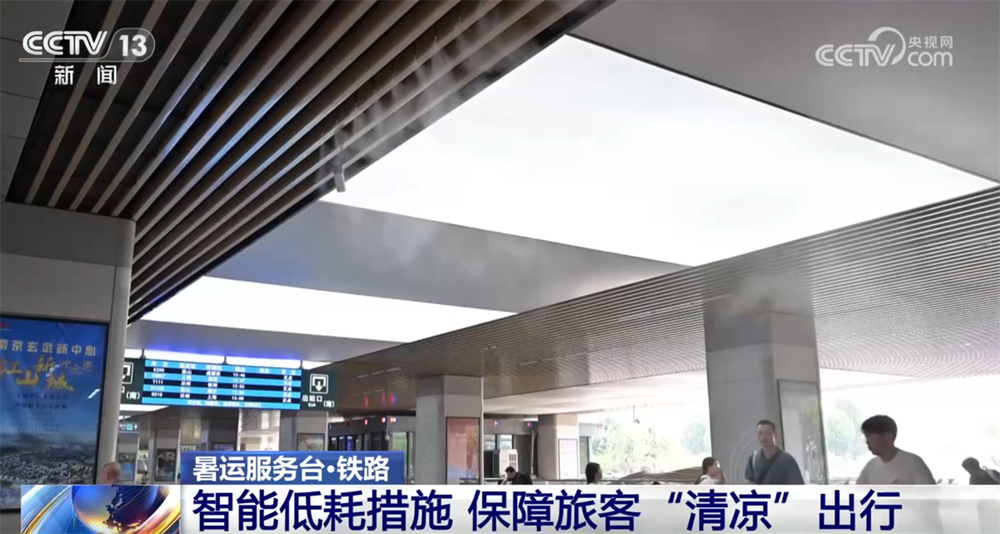
全国铁路客流持续高位运行 “智能+低耗”举措保障旅客“清凉”出行
Yang Shi Wang· 2025-07-17 04:12
Group 1 - The core point of the news is that from July 1 to July 15, during the summer transportation period, the national railway has sent a total of 218 million passengers, representing a year-on-year increase of 3.4%, with an average of 894 additional passenger trains arranged daily [1] - Major routes with high passenger flow include Beijing to Shanghai, Hohhot, Xi'an to Chengdu, and Shenzhen to Hong Kong [1] Group 2 - The railway department has implemented various intelligent low-energy measures to ensure a comfortable travel experience for passengers amid high temperatures [2] - In Nanjing Station, a mist cooling system automatically sprays every half hour for five minutes, providing relief to waiting passengers [2] Group 3 - Guangzhou Baiyun Station has seen a daily passenger volume more than double compared to normal days, with temperature sensors distributed throughout the waiting hall as part of an intelligent temperature control system [4] - This intelligent temperature control system can detect temperature changes of 0.5°C in real-time and adjust the temperature accordingly, maintaining a comfortable environment while saving energy [6] Group 4 - The Wuhan Railway Bureau has equipped its train sets with a health management system that allows for real-time monitoring of air conditioning systems, ensuring passenger comfort [8] - Additionally, smart light-dimming films have been installed on glass curtain walls to effectively block ultraviolet rays, enhancing the travel environment during high temperatures [8]
东阿吉电能源:四年实践验证供热商品化改革可行路径
Zhong Guo Jing Ji Wang· 2025-05-16 08:22
Core Insights - The "Dong'a Model" demonstrates significant energy-saving results in heating measurement, achieving an overall energy-saving rate of 34.3% for the 2024-2025 heating season, equivalent to a reduction of 15,700 tons of standard coal and a decrease of 40,900 tons of carbon dioxide emissions [1][2] Group 1: Company Innovations - Dong'a Jidian Energy Co., Ltd. has established a comprehensive "source-network-user" collaborative control system utilizing IoT, big data, and AI technologies, enhancing heating quality and user satisfaction [1] - The company has developed a unified intelligent cloud heating network management platform that integrates data and control flows, creating a closed-loop operation model [1] Group 2: User Experience and Benefits - Users are equipped with smart temperature control systems that allow them to adjust heating via a mobile app, leading to significant cost savings; for example, one user saved 671.83 yuan over four months after installing a metered heating system [2] - 92.48% of users in the Kaixuan City community reported savings on heating expenses, with the highest individual savings reaching 68.43% [2] Group 3: Industry Impact - The "Dong'a Model" has been recognized by the China Clean Industry Committee as a typical case of clean heating, showcasing an innovative mechanism that involves association guidance, enterprise leadership, and user participation [2] - Experts suggest that when heating becomes a measurable commodity, it will lead to an efficiency revolution in China's urban heating system [2]