
机场航站楼

Search documents
多地机场扩建项目接连投运
Zheng Quan Ri Bao· 2026-02-02 22:38
Core Insights - The recent launch of the T3 terminal at Sanya Phoenix International Airport marks a significant upgrade in China's airport infrastructure, reflecting a broader trend of expansion and modernization across multiple airports in the country [1][2] - The expansion of airport facilities is a direct response to the recovering demand in the civil aviation market, enhancing operational safety and service quality while laying a solid hardware foundation for the long-term development of the aviation industry [2] Infrastructure Developments - Sanya Phoenix International Airport's T3 terminal features 40 check-in counters, 23 security channels, and 7 boarding bridges, connecting with T1 and T2 terminals [1] - Guangzhou Baiyun International Airport's T3 terminal and fifth runway, with a total investment of 53.77 billion yuan, were officially put into operation on October 30, 2022, contributing to the construction of a world-class airport cluster [1] - Shenzhen Airport's third runway, measuring 3,600 meters in length, became operational on November 29, 2022, allowing for eight operational modes and improving overall efficiency [1] Market Recovery and Performance - Baiyun Airport forecasts a net profit of 1.28 billion to 1.564 billion yuan for 2025, representing a year-on-year growth of 38.21% to 68.92%, driven by the recovery in air travel demand [3] - The airport expects to handle 550,500 aircraft movements, 83.59 million passengers, and 2.4399 million tons of cargo in 2025, reflecting increases of 7.53%, 9.45%, and 2.41% respectively compared to the previous year [3] - The civil aviation industry is projected to achieve a total transport turnover of 1,640.8 billion ton-kilometers and a passenger transport volume of 770 million in 2025, with respective year-on-year growth rates of 10.5% and 5.5% [3] Future Opportunities - The aviation industry is poised to benefit from the recovery of international passenger flows, upgrades in cargo logistics, digital transformation, and the expansion of non-aviation businesses [4] - Companies are encouraged to optimize flight scheduling and transfer efficiency while developing non-aviation revenue streams such as duty-free and commercial services to improve profitability [4]


民航业稳步复苏 多地机场扩建项目接连投运
Zheng Quan Ri Bao· 2026-02-02 16:41
Group 1 - The core viewpoint of the articles highlights the rapid development of airport infrastructure in China, with multiple airports, including Sanya Phoenix International Airport, Guangzhou Baiyun International Airport, and Shenzhen Airport, launching new terminals and runways to meet the growing demand in the civil aviation market [1][2][3] - The new terminal at Guangzhou Baiyun International Airport, which opened on October 30, 2022, is part of a larger expansion project with a total investment of 53.77 billion yuan, aimed at enhancing the airport's capacity and efficiency [1] - Shenzhen Airport's new runway, which became operational on November 29, 2022, is 3,600 meters long and allows for eight operational modes, significantly improving operational efficiency and supporting the expansion of international routes [1] Group 2 - The civil aviation market in China is experiencing a sustained recovery, leading to strong growth in the performance of several companies, including Baiyun Airport, which forecasts a net profit of 1.28 billion to 1.564 billion yuan for 2025, representing a year-on-year increase of 38.21% to 68.92% [3] - The overall civil aviation industry is expected to complete a total transportation turnover of 1,640.8 billion ton-kilometers and a passenger transport volume of 770 million in 2025, with respective year-on-year growth rates of 10.5% and 5.5% [3] - Future opportunities for the airport industry include the recovery of international passenger flows, upgrades in cargo logistics, digital transformation, and expansion of non-aviation businesses, which companies should leverage to enhance operational efficiency and profitability [4]
机场大扩建爆发,“三跑道”机场今年新增5个
Di Yi Cai Jing· 2025-12-30 02:18
Core Viewpoint - The expansion of airports in China into the "three-runway era" is significantly enhancing their capacity to accommodate increasing passenger and cargo demands, with 11 airports achieving this status by the end of 2025 [2]. Group 1: Airport Expansion - As of December 25, 2025, 11 airports in China have entered the "three-runway era," with the addition of new runways at airports such as Xi'an Xianyang International Airport and Shenzhen Airport [2]. - The new southern second runway at Xi'an Xianyang International Airport, measuring 3000 meters in length and 45 meters in width, will increase the airport's annual passenger capacity to 83 million and cargo throughput to 1 million tons [2]. - The third runway at Wuhan Tianhe Airport was officially put into operation in January, making it the sixth city in China to have a three-runway airport [3]. Group 2: Future Development and Economic Impact - The development of the aviation economy and low-altitude economy is expected to enhance the cargo transport capabilities of airports, leading to a significant increase in dedicated cargo flights [3]. - The construction of transportation infrastructure must be proactive to balance supply and demand, particularly for major cities, to prevent resource overflow [4]. - Shenzhen Airport is projected to exceed 60 million passengers in 2024 and 65 million in 2025, with cargo throughput expected to surpass 2 million tons for the first time [4]. Group 3: Infrastructure Enhancements - Guangzhou Baiyun International Airport has entered a new operational phase with five runways and three terminals, capable of handling an annual passenger throughput of 120 million and cargo throughput of 3.8 million tons [4]. - The expansion projects at various airports, including the completion of the T3 terminal and the fifth runway at Guangzhou Baiyun International Airport, are crucial for meeting the growing demand for air travel and logistics [4].
西安咸阳国际机场第三跑道正式投运
Zhong Guo Min Hang Wang· 2025-12-25 06:42
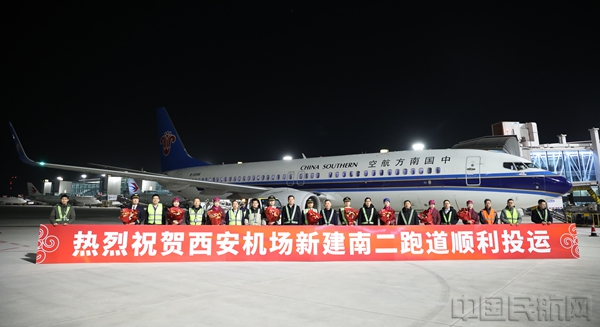
Core Insights - The successful launch of the Southern Second Runway at Xi'an Xianyang International Airport marks the airport's transition into the "three-runway" era, enhancing regional air transport capacity and supporting local economic development [1][3]. Group 1: Infrastructure Development - The Xi'an Xianyang International Airport Phase III expansion project is a key national construction project under the "14th Five-Year Plan" and is supported by the Civil Aviation Administration of China as a national aviation benchmark demonstration project [3]. - The Southern Second Runway, measuring 3,000 meters in length and 45 meters in width, is built to 4F standards and, along with the Northern Second Runway and the existing Southern First Runway, creates a "three-runway linkage" that increases the airport's annual passenger capacity to 83 million and cargo throughput to 1 million tons [3][8]. - The airport has evolved from a regional airport with one runway to an international hub with three runways and four terminals over the past 30 years [3]. Group 2: Operational Coordination - To ensure smooth operations, the Xi'an Airport Company established a specialized leadership group and a three-tier command system, coordinating efforts with various stakeholders, including the Northwest Air Traffic Management Bureau and the Airport Construction Command [5]. - Multiple rounds of joint trial operations and comprehensive simulations were conducted to enhance coordination in critical areas such as runway switching, flight scheduling, and passenger guidance [5]. Group 3: Airline Transition and Resource Optimization - Concurrent with the Southern Second Runway's launch, seven airlines successfully transitioned their domestic flights from Terminal 3 to Terminal 5, optimizing resource efficiency and adjusting flight routes [7]. - The airport strategically divided the functions of the east and west terminals and allocated resources to alleviate the long-standing pressure on Terminal 3, thereby improving passenger flow efficiency and service experience [7][8]. Group 4: Future Prospects - The successful operation of the Southern Second Runway and the optimization of airline layouts inject core momentum into the hub upgrade of Xi'an Xianyang International Airport, positioning it to enhance its hub capabilities and service levels, contributing to the high-quality development of civil aviation in Northwest China [8].

“粤”上新台阶丨大湾区机场源源不断的客流增量从何而来
Yang Shi Xin Wen Ke Hu Duan· 2025-12-16 01:30
Core Viewpoint - The recent expansion of airport infrastructure in the Greater Bay Area, including the launch of new runways and terminals, signifies a strategic enhancement of the region's future development rather than mere operational upgrades [6][10]. Group 1: Airport Developments - Hong Kong International Airport has fully operationalized its three-runway system and is gradually opening the second passenger terminal [1]. - Guangzhou Baiyun International Airport has officially launched its T3 terminal and fifth runway, which can accommodate an annual passenger throughput of 120 million, equivalent to the total permanent population of Guangdong province last year [4]. - Shenzhen Bao'an International Airport is set to enter the "three-runway era" in November [1]. Group 2: Market Dynamics - Despite the proximity of the three major airports (Guangzhou, Shenzhen, and Hong Kong), they are not experiencing competitive issues, as the annual passenger throughput collectively exceeds 50 million [7]. - The continuous increase in passenger flow is attributed to the collaborative approach among the airports, treating the Greater Bay Area as a shared market rather than competing for the same customers [13]. Group 3: Strategic Goals - Guangzhou Baiyun International Airport aims to deepen its market presence in Southeast Asia, South Asia, the Middle East, Australia, New Zealand, and Africa [10]. - Shenzhen Bao'an International Airport's new runway is designed to meet the highest standards for accommodating large cargo and passenger aircraft, facilitating the expansion of long-haul international routes [10]. - Hong Kong International Airport focuses on enhancing its competitiveness as an international aviation hub [10]. Group 4: Regional Integration - The integration of the Greater Bay Area is accelerating, leading to a shift in the relationship among the airports, which are increasingly viewing the area as a unified market [13]. - The airports are leveraging interconnectivity to explore new demand, with Guangzhou enhancing its role as a gateway to Southeast Asia and Oceania, while Shenzhen focuses on high-tech and premium manufacturing services [13].

广深港机场扩容升级,粤港澳大湾区联通全球再提速
Nan Fang Du Shi Bao· 2025-12-07 00:02
Core Insights - The third runway at Shenzhen Bao'an International Airport has officially commenced operations, increasing the total number of runways in the Guangdong-Hong Kong-Macao Greater Bay Area airport cluster to 15, making it one of the regions with the highest runway density globally [1] - The Greater Bay Area airport cluster, centered around Guangzhou, Shenzhen, and Hong Kong, has been continuously expanding and upgrading, with significant investments in infrastructure to enhance capacity and connectivity [2] Group 1 - The new runway and terminal resources are expected to upgrade the Greater Bay Area's air route network from "broad coverage" to "high density and high quality," reflecting the region's increased vitality and economic stability [1] - In 2024, the economic output of the Greater Bay Area is projected to reach 14.79 trillion yuan, with its foreign trade accounting for nearly one-fifth of the national total, driving substantial demand for air travel and logistics [1][2] - The airport cluster's expansion will attract international airlines to open and enhance routes, supporting China's high-level opening-up strategy [2][3] Group 2 - The expanded airport cluster will significantly improve cargo capacity, which is crucial for the responsiveness of supply chains and the resilience of the manufacturing sector in the Greater Bay Area [2] - The upgraded Shenzhen Bao'an Airport is expected to accommodate an annual passenger throughput of 80 million and a cargo throughput of 4.5 million tons, while Guangzhou Baiyun Airport will have a terminal capacity of 140 million passengers and 600,000 tons of cargo [2] - A more efficient global aviation network will accelerate personnel exchanges, technology transfers, and capital flows, enhancing the Greater Bay Area's status as a hub in the global city network [3]
世界级机场群要来了
Zhong Guo Ji Jin Bao· 2025-12-05 07:42
Core Insights - A significant transformation is underway in the Greater Bay Area's airport infrastructure, with multiple airports expanding their capabilities to enhance regional connectivity and competitiveness [3][11][29]. Infrastructure Developments - Hong Kong International Airport has fully operationalized its third runway and is progressively opening its expanded second passenger terminal, with the departure hall expected to be operational by 2026, aiming to handle 120 million passengers and 10 million tons of cargo annually [10][11]. - Guangzhou Baiyun International Airport's T3 terminal and fifth runway are now operational, positioning it as the first airport in China with five commercial runways, capable of accommodating 120 million passengers and 3.8 million tons of cargo annually [5][11]. - Shenzhen Bao'an International Airport has inaugurated its third runway, enhancing operational efficiency and supporting future international routes, with a projected capacity of 80 million passengers and 4.5 million tons of cargo annually [7][11]. Economic Impact - The expansion of the airport infrastructure is a response to the growing demand, with the total passenger throughput in the Greater Bay Area expected to exceed 200 million by 2024, and projected to reach 420 million by 2035 [11][12]. - The economic scale of the Greater Bay Area is substantial, with a GDP exceeding 14.79 trillion yuan and foreign trade accounting for nearly one-fifth of the national total, driving significant demand for air travel and logistics [12][14]. Strategic Objectives - The airport expansions aim to break capacity bottlenecks and enhance service quality, ensuring that the Greater Bay Area remains competitive against rapidly developing regional hubs [15][16]. - The upgrades are designed to strengthen the competitive advantage of the real economy by improving logistics and supply chain resilience, particularly for high-value industries such as electronics and cross-border e-commerce [18][19]. Connectivity and Integration - The development of a world-class airport cluster is expected to enhance the international circulation capabilities of the Greater Bay Area, facilitating tighter connections with the global economy [21][26]. - The airports are working towards creating integrated transport networks, including air-rail connections, to streamline passenger and cargo movement across the region [25][26]. Collaborative Challenges - The growth of the airport infrastructure presents challenges in transitioning from competition to collaboration among the major airports in the region, necessitating coordinated efforts to optimize route networks and service offerings [27][29]. - The Greater Bay Area is at a critical juncture in its development, requiring a well-coordinated air transport system to enhance global resource allocation and participation in international supply chains [29][30].
广深港机场加码扩建,新跑道航站楼接连投运,世界级机场群要来了!
2 1 Shi Ji Jing Ji Bao Dao· 2025-12-03 03:53
Core Insights - The article highlights the significant transformation occurring in the Greater Bay Area's airport infrastructure, driven by the expansion of major airports like Guangzhou Baiyun, Shenzhen Bao'an, and Hong Kong International Airport, which aims to enhance their global competitiveness and support regional economic growth [1][3][4]. Infrastructure Developments - Hong Kong International Airport has fully operationalized its third runway system, with the second passenger terminal expansion set to enhance capacity by 2026, allowing for an annual handling of 120 million passengers and 10 million tons of cargo [6][7]. - Guangzhou Baiyun International Airport's T3 terminal is now operational, with a projected capacity of 120 million passengers and 3.8 million tons of cargo annually, positioning it as a key hub for routes to Africa, the Middle East, and Southeast Asia [4][9]. - Shenzhen Bao'an Airport's third runway, measuring 3,600 meters, is expected to improve operational efficiency and accommodate all current large passenger and cargo aircraft, supporting the airport's capacity to handle 80 million passengers and 4.5 million tons of cargo annually [6][9]. Economic Impact - The expansion of the airport infrastructure is a direct response to the increasing demand for air travel, with projections indicating that the total passenger throughput for the seven airports in the Greater Bay Area will exceed 200 million by 2024 [7][9]. - The region's economic growth, with a projected GDP surpassing 14.79 trillion yuan in 2024, is driving the need for enhanced air travel and logistics capabilities, facilitating a shift from broad coverage to high-density, high-quality air routes [7][10]. Strategic Objectives - The airport expansions are part of a broader strategy to strengthen the Greater Bay Area's position in the global economy, enhancing its ability to attract multinational companies and fostering the development of high-value industries such as electronics, biomedicine, and cross-border e-commerce [9][10]. - The construction of a world-class airport cluster is essential for the Greater Bay Area to achieve its goal of becoming a leading global city cluster, with improved connectivity and resource allocation capabilities [10][19]. Collaborative Dynamics - The article emphasizes the need for collaboration among the three major airports—Guangzhou, Shenzhen, and Hong Kong—to optimize their operations and create a complementary network of air routes, enhancing the overall efficiency of the airport cluster [17][18]. - The integration of transport systems, including high-speed rail and multi-modal transport networks, is crucial for facilitating seamless connectivity within the Greater Bay Area, thereby enhancing the movement of people and goods [15][19].
