
极紫外光刻设备

Search documents
中国半导体设备市占率:从4%到21%
半导体芯闻· 2026-03-24 10:53
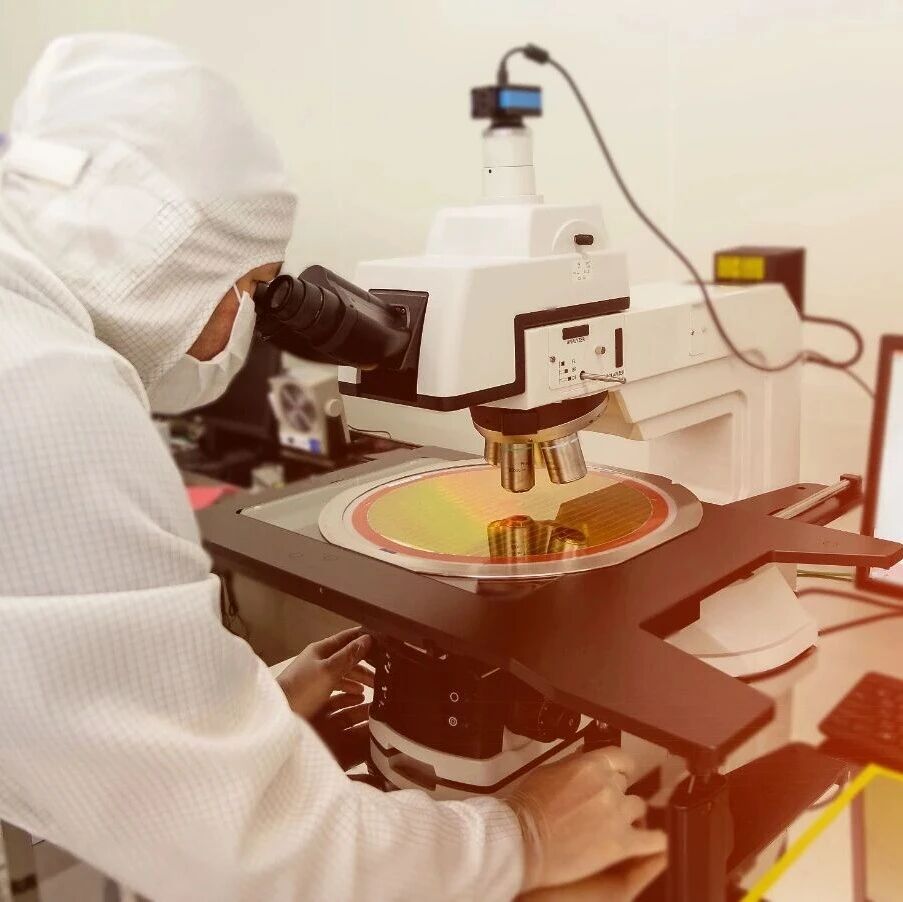
Group 1 - The core viewpoint of the article emphasizes that China's domestic semiconductor production is accelerating despite increasing regulatory restrictions from the U.S. and other countries [1] - The U.S. Department of Commerce placed Huawei on the "Entity List" in 2019, effectively prohibiting American companies from exporting components and technology to China, which has led to a push for self-sufficiency in semiconductor manufacturing [1] - From 2017 to 2025, the domestic production rate of semiconductor manufacturing equipment in China is projected to increase from 4% to 21%, according to research by MIR [1]

ASML裁员1700人,员工一头雾水
半导体行业观察· 2026-03-16 01:11
Core Viewpoint - ASML plans to cut 1,700 management positions, primarily in its technology and IT departments, despite reporting record annual revenue of €32.7 billion, leading to uncertainty among employees regarding job security [2][4][5] Group 1: Layoff Details - The layoffs will affect approximately 4% of ASML's global workforce, with 1,400 positions in the Netherlands and 300 in the United States [2] - The company aims to finalize restructuring terms by April 1, but unions have deemed this timeline unrealistic, advocating for a more thorough internal reassignment process before formal agreements [3][5] - ASML's restructuring is intended to simplify internal processes and decision-making, transitioning to a model where most engineers focus on specific products and modules [5][6] Group 2: Financial Performance and Future Outlook - ASML reported a net profit of €9.6 billion for 2025 and expects revenue to reach between €34 billion and €39 billion in 2026, with Q4 2025 orders projected at €13.2 billion, exceeding analyst expectations [3] - The company is expanding its operations with a new facility in the Brainport industrial park, which could accommodate 20,000 new employees, nearly doubling its current workforce in the Netherlands [3][6] - Due to ongoing U.S. export restrictions on extreme ultraviolet lithography equipment to Chinese manufacturers, ASML anticipates a decline in the Chinese market's revenue contribution from 33% in 2025 to 20% in 2026 [3]

欧洲陷入芯片战争,束手无策
半导体芯闻· 2025-10-28 10:34
Core Viewpoint - The article discusses the strategic vulnerabilities faced by Europe in the artificial intelligence (AI) infrastructure sector due to increasing export restrictions from the US and China, which threaten Europe's ambitions in AI development [1][2]. Group 1: Dependency on AI Chips - Europe is heavily reliant on the US for advanced AI chips, particularly GPUs, with NVIDIA controlling 80% to 90% of the global AI GPU market [4][6]. - The rapid establishment and competitiveness of European AI factories depend on the continuous and sufficient supply of NVIDIA GPUs, which is expected to face shortages and delays [4][6]. - The US government's recent legislative measures may prioritize domestic orders over European needs, exacerbating supply chain vulnerabilities for Europe [6][10]. Group 2: Dependency on Rare Earth Elements - China dominates the global rare earth element (REE) supply chain, controlling approximately 70% of mining and 90% of processing, which is critical for AI chip production [9][11]. - Recent Chinese export restrictions on rare earth elements have led to significant declines in exports, impacting the supply chain for AI chips [9][10]. - The ongoing geopolitical tensions and trade restrictions between the US and China create a self-reinforcing cycle that could further hinder Europe's access to essential materials for AI development [14][18]. Group 3: European Response and Future Outlook - The EU is investing heavily in AI infrastructure, aiming to establish at least 15 AI factories by the end of next year, including five super factories with significant processing capabilities [2][19]. - However, the EU's efforts may be undermined by its dual dependency on the US for AI chips and China for rare earth elements, making it difficult to achieve its AI ambitions [15][19]. - Long-term strategies include developing a domestic supply of critical materials and investing in research to create alternatives to rare earth elements, although these efforts face significant challenges [19][20].


美国汽车创新联盟敦促特朗普政府放弃机器人关税,警告将推高新车价格
Zhi Tong Cai Jing· 2025-10-23 05:48
Core Viewpoint - The Alliance for Automotive Innovation urges the Trump administration not to impose new tariffs on factory robots and machinery, warning that such tariffs could increase production costs and lead to vehicle shortages, further driving up new car prices, which are already at historical highs [1] Group 1: Industry Concerns - The Alliance represents nearly all major automakers, including General Motors, Toyota, Volkswagen, and Hyundai, and submitted comments following a national security investigation initiated by the U.S. Department of Commerce [1] - The organization highlighted that approximately 40% of all new robots and industrial machinery installed in the U.S. in 2024 will be used in automotive production facilities [1] - Automakers request that any tariffs imposed should exempt robots and equipment actually used in U.S. production [1] Group 2: Additional Industry Voices - Tesla, not a member of the Alliance, also called on the Trump administration to avoid imposing tariffs, stating that such tariffs could weaken investment and slow down the construction of new factories or upgrades to existing ones [2] - Various foreign governments, including China, Canada, Japan, Switzerland, and the EU, have submitted opinions opposing the proposed tariffs [4] Group 3: Broader Economic Implications - The American Retail Federation warned that tariffs and potential equipment shortages could raise business costs and consumer prices, noting that its members widely use robotic technology in stores, warehouses, and distribution centers [5] - The U.S. Chamber of Commerce indicated that some critical machinery is only produced abroad, including extreme ultraviolet lithography equipment used in semiconductor manufacturing, and that tariffs could undermine efforts to build domestic semiconductor manufacturing capabilities [5]


美股异动|阿斯麦股价四连跌超10%国际政经压力重重
Xin Lang Cai Jing· 2025-10-10 23:00
Core Viewpoint - ASML's stock has experienced a significant decline due to various challenges, including international political tensions and domestic expansion issues [1][2] Group 1: Stock Performance - ASML's stock price fell by 4.52% on October 10, accumulating a total decline of 10.27% over four consecutive days [1] - Investor sentiment remains cautiously optimistic despite recent stock volatility, with financial institutions maintaining a positive outlook on ASML's long-term performance [2] Group 2: International Challenges - A recent report from a U.S. congressional committee raised concerns about semiconductor manufacturing equipment exports, highlighting that China purchased $38 billion worth of such equipment from five companies, including ASML [1] - The report suggests expanding export bans on chip manufacturing equipment, increasing global trade uncertainty for ASML [1] Group 3: Domestic Expansion Plans - ASML is expanding its facility in Eindhoven, Netherlands, planning to create a new campus for 20,000 employees to meet growing market demand [1] - The expansion faces challenges such as power supply shortages, approval delays, and political instability, despite local government support for infrastructure development [1] Group 4: Technological Advancements - ASML is actively increasing the production capacity of its extreme ultraviolet lithography equipment, crucial for modern semiconductor manufacturing [2] - Balancing technological innovation with community needs and environmental protection is a key challenge for the company's future development [2] Group 5: Market Position - Despite slightly lower expected order volumes and financial metrics compared to market consensus, ASML's technological expertise and market position in the semiconductor sector remain strong [2] - Investors are advised to monitor upcoming financial reports for potential investment opportunities, especially if market corrections occur [2]
光刻机巨头二季度业绩超预期,2026年恐难实现增长
Guan Cha Zhe Wang· 2025-07-18 05:06
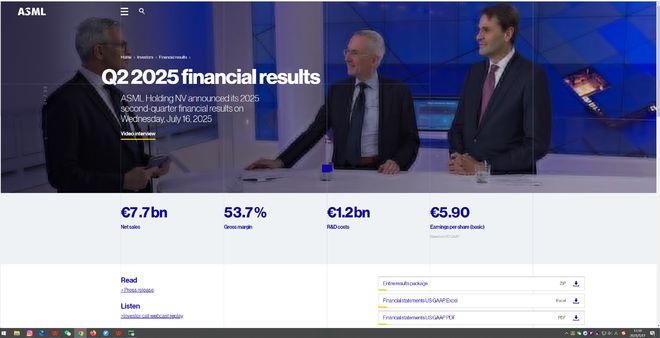
Core Viewpoint - ASML warns that it may not achieve revenue growth by 2026 due to uncertainties from U.S. tariffs affecting chip manufacturers [1][3][6] Group 1: Financial Performance - In Q2 2025, ASML reported revenue of €7.7 billion (approximately ¥630.3 billion), exceeding market expectations of €7.54 billion [1] - The net profit for the same quarter was €2.29 billion (approximately ¥189.4 billion), also above the anticipated €2.01 billion [1] - The gross margin was reported at 53.7%, surpassing the expected 51.6% [1] - ASML's net order volume reached €5.54 billion (approximately ¥462 billion), exceeding analyst expectations by 25% [3] Group 2: Future Outlook - ASML forecasts Q3 revenue between €7.4 billion and €7.9 billion, lower than the market expectation of €8.3 billion [3] - The company expresses uncertainty about its growth prospects for 2026, despite strong fundamentals from AI customers [6] - ASML has adjusted its 2025 net sales growth forecast to 15%, revising its expected revenue range from €30 billion to €35 billion down to €32.5 billion (approximately ¥233.3 billion) [6] Group 3: Market Dynamics - ASML's extreme ultraviolet lithography equipment is essential for producing advanced chips for major clients like Apple and Nvidia [7] - Demand from Chinese manufacturers remains strong, accounting for 27% of machine sales over the past three quarters, despite U.S. export restrictions [7][8] - Analysts suggest that TSMC has had a significant impact on ASML's performance, with expectations that orders from Taiwan will continue to drive sales [7]
深夜!闪崩,暴跌!
券商中国· 2025-07-16 14:05
Group 1: ASML Performance and Outlook - ASML's stock price dropped by nearly 10%, resulting in a market value loss of $32 billion, as the company warned it may not achieve growth by 2026 due to tariffs and other factors [2][3][4] - Despite exceeding market expectations with a second-quarter sales figure of €7.7 billion and a gross margin of 53.7%, ASML's forecast for third-quarter net sales is lower than market expectations, ranging from €7.4 billion to €7.9 billion [5][6] - The CEO highlighted increasing macroeconomic and geopolitical uncertainties, including potential trade restrictions from the U.S., which could impact the semiconductor industry and ASML's growth prospects [6][7] Group 2: AI and Future Opportunities for ASML - The CEO noted that despite the downward revision of future growth expectations, the ongoing boom in artificial intelligence could provide a boost for ASML, as its clients include major players like TSMC and Intel [8] - ASML is the only company producing extreme ultraviolet lithography equipment, which is essential for advanced chips, indicating potential benefits from significant investments in AI data centers [8] Group 3: Renault's Performance and Challenges - Renault's stock plummeted over 18%, marking its largest drop in over five years, following the announcement of a new interim CEO and a downward revision of its 2025 profit margin expectations due to increased competition and a declining automotive market [9][10] - The company aims for an operating profit margin of around 6.5%, down from a previous target of 7%, and plans to achieve free cash flow of €1 billion to €1.5 billion, lower than the earlier target of approximately €2 billion [9][10] - Analysts have expressed concerns about Renault's leadership uncertainty and the challenges posed by low European demand and intensified competition from manufacturers like BYD and MG [10]

台积电巨亏!三星美国厂几乎注定会亏!
国芯网· 2025-04-24 13:51
Core Viewpoint - The article discusses the challenges faced by semiconductor companies, particularly TSMC and Samsung, in establishing and operating factories in the United States, highlighting significant financial losses and operational hurdles [3][5][6]. Group 1: TSMC's Financial Struggles - TSMC's U.S. factory has accumulated losses exceeding 39.4 billion yuan over four years, raising concerns about the long-term profitability of overseas operations [3]. - Despite TSMC's factory operating at full capacity, high labor costs and additional large-scale facility investments continue to erode profitability [3]. Group 2: Samsung's Dilemma - Samsung's semiconductor division is expected to face significant losses as it has not yet attracted major clients, with its Texas factory nearing completion but still hesitating on equipment orders [5]. - The company has stated that the Texas factory will begin operations in 2026, but market conditions and order forecasts suggest lower-than-expected sales [5]. - The U.S. government plans to impose at least a 25% tariff on semiconductors, which could lead to substantial costs for Samsung, particularly regarding the expensive EUV lithography equipment [5]. Group 3: Industry-Wide Concerns - Other South Korean companies, such as SK Hynix, are also pursuing U.S. factory projects and must focus on cost efficiency amid rising supply chain risks and potential cuts to semiconductor subsidies from the U.S. government [6]. - The possibility of significant losses similar to those experienced by TSMC is increasing for these companies due to the challenging economic environment [6].