标准DRAM

Search documents
三星第四季度利润飙升,AI推动存储市场紧张与高附加值产品需求
3 6 Ke· 2026-01-29 10:56
Core Insights - Samsung Electronics reported historic revenue and profit growth driven by AI-related demand, particularly in the high bandwidth memory (HBM) segment, which allowed the company to reclaim the DRAM sales championship from SK Hynix [2][3] Financial Performance - Total revenue for Q4 reached 93.8 trillion KRW (approximately 65.58 billion USD), a year-on-year increase of about 24%, marking a record high [2] - Operating profit was 20.1 trillion KRW (approximately 14.05 billion USD), up over 200% year-on-year, significantly exceeding market expectations [2] - Net profit stood at 19.29 trillion KRW (approximately 13.48 billion USD), also notably higher than analyst forecasts [2] Shareholder Returns - The company announced a share buyback plan worth 3.57 trillion KRW (approximately 2.5 billion USD) to reward shareholders [2] Semiconductor Division Performance - The semiconductor division contributed 16.4 trillion KRW (approximately 11.4 billion USD) in operating profit, accounting for 80% of the group's total operating profit, far exceeding analyst expectations of 10.85 trillion KRW (approximately 7.56 billion USD) [3] - Strong growth in operating profit was primarily driven by high demand for HBM products from AI high-performance computing servers and data centers [3] Market Dynamics - The strong demand for HBM is causing a rapid adjustment in the global storage market, with hyperscalers investing billions in AI infrastructure, leading to supply-demand imbalances [4] - Samsung and SK Hynix are shifting production lines from traditional DRAM and NAND to high-value HBM products, which, while increasing revenue, is causing supply tightness in consumer electronics [4] Competitive Landscape - Both Samsung and SK Hynix are competing in the next-generation HBM4 technology, with Samsung having completed development and planning to ship to Nvidia [3][4] - The performance of both companies in Q4 is seen as a bellwether for the storage chip industry, which is experiencing unprecedented adjustments in pricing and supply [4] Mobile and Display Business Performance - Despite strong memory business performance, Samsung's mobile division faced profit declines due to rising chip costs, with Q4 operating profit around 1.9 trillion KRW (approximately 1.33 billion USD) [6] - The display panel business saw profits of about 2 trillion KRW (approximately 1.4 billion USD) driven by demand from Apple's iPhone 17 series, but future demand may slow, limiting profit growth [6]

三星与SK 海力士,首次超越台积电
半导体芯闻· 2025-12-24 10:19
Core Insights - The semiconductor industry's profit structure is changing due to the rapid increase in demand for artificial intelligence (AI) and a significant rise in memory prices [2] - Samsung Electronics and SK Hynix are expected to surpass TSMC in gross margin by Q4 2025, marking the first time since Q4 2018 that the memory industry outperforms foundries [2] - Micron, the third-largest memory manufacturer, anticipates its gross margin to reach 67% in Q2 of FY2026, indicating potential for profitability to exceed TSMC as well [2] Group 1: Memory Market Dynamics - The three major memory manufacturers have allocated approximately 18% to 28% of their DRAM capacity to high bandwidth memory (HBM), which has led to a quarterly price increase of over 30% for standard DRAM [2] - The shift in memory gross margins surpassing foundries is closely linked to changes in AI industry demand structures [2] Group 2: AI and Memory Technology - As AI applications transition from training to inference, the demand for high-speed data storage and instant access has significantly increased, relying heavily on HBM to supply data to GPUs for computation [3] - Despite general memory not matching HBM's performance, the demand for high-performance general memory is rapidly growing, with GDDR7 and LPDDR5X handling initial inference workloads [3] - Memory manufacturers are developing AI-oriented high-performance products, such as Processing-In-Memory (PIM) technology, which allows memory to perform some computations traditionally handled by GPUs [3]


SK海力士内部分析曝光:DRAM缺货将持续到2028年!
Hua Er Jie Jian Wen· 2025-12-15 08:06
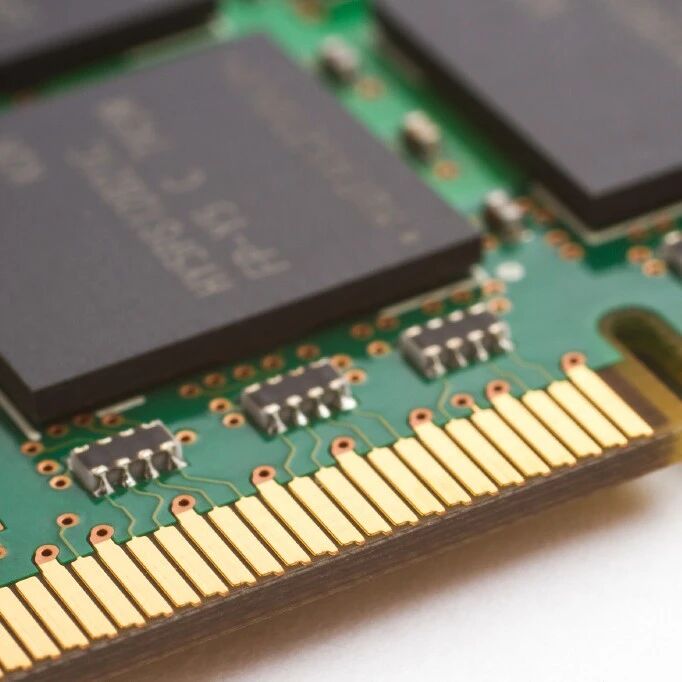
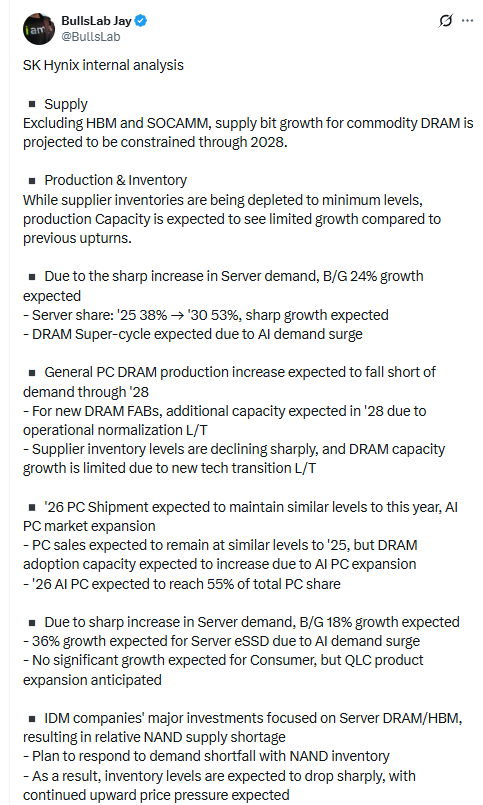
Core Insights - The global memory chip market is facing a severe supply-demand imbalance, with standard DRAM supply constraints expected to last until 2028, which is more severe than UBS's previous forecast of Q1 2027 [1][7] - The surge in artificial intelligence (AI) demand is driving a "super cycle" in the memory chip market, with AI server market share projected to rise from 38% in 2025 to 53% by 2030, leading to a 24% increase in DRAM demand [2][5] Supply Side - The primary reason for the constrained standard DRAM supply is the lengthy capacity expansion cycle, with new DRAM factories taking several years to become operational, and additional capacity not expected to be released until 2028 [4] - Even utilizing existing facilities for technology transitions faces challenges, making it difficult to alleviate supply-demand imbalances in the short term [5] - Supplier inventory levels are rapidly declining, with SK Hynix's financial executive indicating that not only HBM but also DRAM and NAND capacities are sold out for next year, with some customers even pre-purchasing traditional storage chips for 2026 [5] Demand Side - The explosive growth of AI applications is reshaping the demand landscape for memory chips, with AI PC market share expected to increase from 38% to 55% by 2026, significantly raising DRAM capacity requirements per unit [5] - The NAND Flash market is also poised for growth, with server eSSD demand expected to rise by 36% year-on-year and overall NAND demand increasing by 18% [5] Price Trends - UBS predicts a 35% quarter-on-quarter increase in DDR contract prices in Q4 this year, with a further 30% increase expected in Q1 2026, alongside a 20% rise in NAND Flash contract prices [3][7] - The internal analysis from SK Hynix suggests that the supply tightness will persist until 2028, indicating that the price increase cycle for memory chips may exceed market expectations [7] Industry Impact - Major tech companies, including Apple, are expected to face cost pressures as their long-term supply agreements with Samsung and SK Hynix are set to expire in January 2026, with plans to raise storage chip prices starting next year [3][9] - SK Hynix is actively expanding capacity, with the M15X factory, focused on HBM production, set to begin full-scale production next year after two years of construction [9][11] - The company is also building advanced production facilities, including the M15X and a planned wafer fab in Yongin, to meet the growing demand for AI storage [11]
AI正全面渗透各行各业,科技、医疗和制造业成增长最快领域
Huan Qiu Wang· 2025-12-09 01:27
Group 1 - The core report from OpenAI indicates that ChatGPT has surpassed 800 million weekly active users, with over 1 million businesses paying for OpenAI's enterprise AI products, and paid seats for workplace products reaching 7 million [1] - AI is penetrating various industries, with technology, healthcare, and manufacturing identified as the fastest-growing sectors [1] - The Financial Times notes that while technological advancements may occur rapidly, the transformation of the economy and society will proceed at a human pace, suggesting that the widespread adoption of new technologies, including AI, may be slow [1] Group 2 - As the pace of core technology advancements slows, the application of technology is becoming a key differentiator among AI companies, leading to competition in customized chatbot services [4] - The operational costs of high-end models are decreasing, making them more accessible, and it is expected that most activities will focus on new applications of existing models to maintain novelty [4] - According to the Semiconductor Industry Association (SIA), global semiconductor sales surged by 33% year-on-year in October, totaling $71.3 billion (approximately 504 billion RMB), with DRAM sales skyrocketing by 90% [4] - Analysts attribute the surge in demand for semiconductors to AI, as many industries are shifting production capacity towards high-bandwidth memory (HBM) for AI accelerators, resulting in reduced wafer output for standard DRAM and 3D NAND [4]