存储芯片供需失衡

Search documents
三星HBM4单颗定价700美元,存储芯片紧缺或延续至2027年,港股概念股闻风大涨
Jin Rong Jie· 2026-02-20 03:33
Group 1 - Samsung Electronics is negotiating the pricing for its latest high-bandwidth memory chip HBM4, aiming for a price of approximately $700 per unit, which is an increase of 20% to 30% compared to the previous generation HBM3E [1] - Samsung has achieved mass production of HBM4 and has begun delivering commercial products to customers, with expectations that HBM product sales will triple compared to 2025 [1] - The price increase of HBM4 is driven by a supply-demand imbalance in storage chips, particularly due to AI-driven demand, with major customers' order fulfillment rates at only 60% [1] Group 2 - According to招商证券, storage product prices have sharply increased since Q1 2026, and this upward trend is expected to continue throughout the year, with limited new supply anticipated until 2027 [2] - 澜起科技 is a leading developer of DDR5 RCD, MDB, and CKD chips, ranking among the top three suppliers of memory interface chips globally, and is projected to be the largest supplier of memory interconnect chips by sales in 2024 [2] - 澜起科技 expects a net profit of 2.15 billion to 2.35 billion yuan for the fiscal year 2025, representing a year-on-year growth of 52.29% to 66.46% [2]
购买一辆高配新能源车 为何交付时间会很久?
Zhong Guo Xin Wen Wang· 2026-01-30 10:16
Core Viewpoint - The delivery cycle for high-end electric vehicles in China is significantly longer than for lower-end models, primarily due to supply chain pressures and increased complexity in high-end configurations [1][2][3]. Group 1: Delivery Cycles - High-end models like the YU7 Max and ES8 have delivery cycles of 28-31 weeks and 11-12 weeks respectively, while lower configurations have much shorter cycles [1]. - The Zeekr 9X shows a stark contrast in delivery times, with low and mid-tier versions taking 2-6 weeks, while high and top versions take 19-22 weeks, a difference of approximately 15 weeks [1]. Group 2: Supply Chain Issues - Three main factors contribute to the long delivery times for high-end models: supply pressure on key automotive components, rising battery prices, and a global imbalance in memory chip supply [2][3]. - The price of battery-grade lithium carbonate has been rising since June 2025, increasing the procurement costs for power batteries and affecting production capacity, especially for high-end models with larger battery packs [2]. - The demand for automotive memory chips is being squeezed by the growing needs of data centers, which has led to longer procurement cycles for automotive applications [2][3]. Group 3: Industry Response - Companies are urged to address the long delivery times by adjusting product planning, delivery schedules, and marketing strategies [3]. - Zeekr has announced a compensation plan for customers whose delivery times exceed the expected dates, offering a daily subsidy of 200 yuan, up to a maximum of 12,000 yuan [3]. - Experts believe that while current supply chain pressures will impact delivery, they are not expected to lead to widespread production halts, but rather adjustments in model configurations and delivery timelines [3][4]. Group 4: Future Outlook - Supply chain pressures typically have a cyclical nature, with expectations that the current situation may ease within 3-6 months, although the current chip shortage may last longer than previous instances [4]. - Experts anticipate that with capacity release and supply chain adjustments, the pressures on component availability will gradually diminish within 3 to 6 months [4].
投资高达240亿美元!美光科技带头扩产,上游一行业将直接受益
Jin Rong Jie· 2026-01-28 00:35
Group 1 - Micron Technology plans to invest $24 billion in a NAND flash memory factory in Singapore over the next decade, with wafer production expected to start in the second half of 2028, creating 3,000 new jobs [1] - The expansion is driven by a surge in demand for high bandwidth memory (HBM) and enterprise-grade solid-state drives due to the construction of AI computing infrastructure, leading to a severe imbalance in supply and demand for storage chips [1] - Recent reports indicate that Samsung Electronics has raised NAND flash supply prices by over 100% in the first quarter, and major manufacturers have sold out their storage chip capacity for AI servers through 2026, highlighting the seriousness of the supply-demand imbalance [1] Group 2 - The tight supply situation for storage chips is expected to persist until 2027 or even 2028, with market value projected to reach $842.7 billion by 2027 [2] - Micron's expansion will drive demand for upstream semiconductor equipment, with the global semiconductor equipment sales expected to exceed $150 billion by 2027, and China remaining the largest market [2] - Following Micron's announcement, other manufacturers may follow suit, benefiting upstream semiconductor equipment suppliers, particularly domestic leading companies making rapid progress in semiconductor equipment localization [2]

SK海力士内部分析曝光:DRAM缺货将持续到2028年!
Hua Er Jie Jian Wen· 2025-12-15 08:06
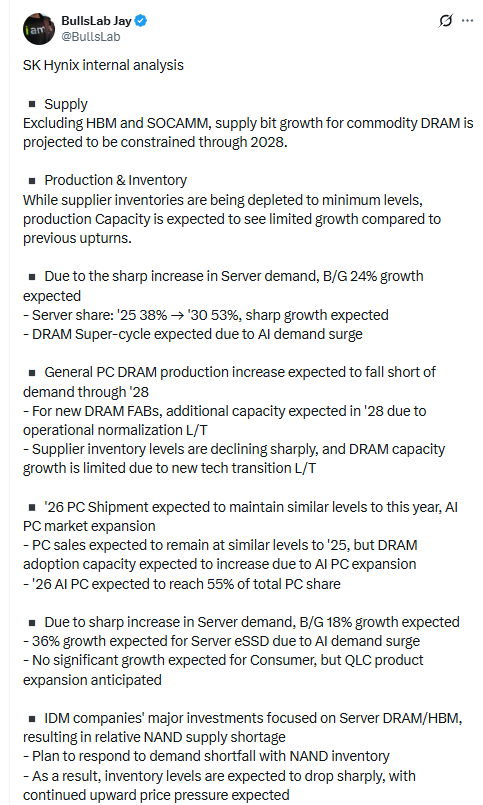
Core Insights - The global memory chip market is facing a severe supply-demand imbalance, with standard DRAM supply constraints expected to last until 2028, which is more severe than UBS's previous forecast of Q1 2027 [1][7] - The surge in artificial intelligence (AI) demand is driving a "super cycle" in the memory chip market, with AI server market share projected to rise from 38% in 2025 to 53% by 2030, leading to a 24% increase in DRAM demand [2][5] Supply Side - The primary reason for the constrained standard DRAM supply is the lengthy capacity expansion cycle, with new DRAM factories taking several years to become operational, and additional capacity not expected to be released until 2028 [4] - Even utilizing existing facilities for technology transitions faces challenges, making it difficult to alleviate supply-demand imbalances in the short term [5] - Supplier inventory levels are rapidly declining, with SK Hynix's financial executive indicating that not only HBM but also DRAM and NAND capacities are sold out for next year, with some customers even pre-purchasing traditional storage chips for 2026 [5] Demand Side - The explosive growth of AI applications is reshaping the demand landscape for memory chips, with AI PC market share expected to increase from 38% to 55% by 2026, significantly raising DRAM capacity requirements per unit [5] - The NAND Flash market is also poised for growth, with server eSSD demand expected to rise by 36% year-on-year and overall NAND demand increasing by 18% [5] Price Trends - UBS predicts a 35% quarter-on-quarter increase in DDR contract prices in Q4 this year, with a further 30% increase expected in Q1 2026, alongside a 20% rise in NAND Flash contract prices [3][7] - The internal analysis from SK Hynix suggests that the supply tightness will persist until 2028, indicating that the price increase cycle for memory chips may exceed market expectations [7] Industry Impact - Major tech companies, including Apple, are expected to face cost pressures as their long-term supply agreements with Samsung and SK Hynix are set to expire in January 2026, with plans to raise storage chip prices starting next year [3][9] - SK Hynix is actively expanding capacity, with the M15X factory, focused on HBM production, set to begin full-scale production next year after two years of construction [9][11] - The company is also building advanced production facilities, including the M15X and a planned wafer fab in Yongin, to meet the growing demand for AI storage [11]

全球跳水!A股,尾盘突变!
Zheng Quan Shi Bao· 2025-11-14 09:23
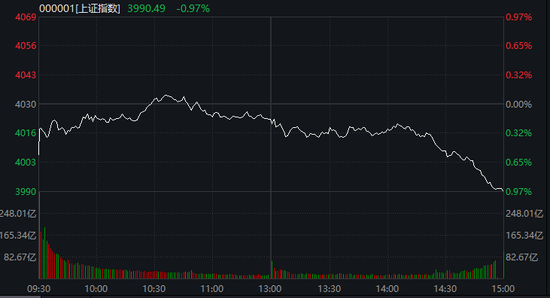
Market Overview - The Asia-Pacific stock markets mostly declined, with the Nikkei 225 index down 1.77% to 50,376.53 points and the South Korean KOSPI down 3.81% to 4,011.57 points [1] - European stocks opened lower, with the FTSE 100 and Italian FTSE MIB indices dropping over 1% [1] - A-shares showed initial strength but ended lower, with the Shanghai Composite Index down nearly 1% below the 4,000-point mark [1][3] A-Shares Performance - The Shanghai Composite Index closed down 0.97% at 3,990.49 points, while the Shenzhen Component Index fell 1.93% to 13,216.03 points [3] - The ChiNext Index and the STAR 50 Index dropped nearly 3% [1][3] - Over 3,300 stocks in the market were in the red, with the semiconductor sector experiencing significant declines [3][12] Sector Highlights - The semiconductor sector saw a sharp drop, with companies like Baidu, Xpeng Motors, and JD Group declining around 7% to over 6% [4] - The gas and oil sectors showed strong performance, with several companies hitting the daily limit up [3][8] - The pharmaceutical sector was notably active, with companies like Chengda Pharmaceutical and Kangzhi Pharmaceutical reaching the daily limit up of 20% [5][6] Pharmaceutical Sector Insights - The pharmaceutical sector has been supported by favorable policies since 2020, promoting a shift from generic to innovative drugs [5][7] - Analysts expect the medical health industry to gradually return to a market pricing system driven by clinical value and demand, indicating a stable growth trend for listed companies [7] Energy Sector Outlook - The gas and coal sectors are expected to benefit from rising fuel prices due to seasonal demand increases [10][11] - Analysts predict that the overall market will maintain an upward trend in the short term, with a focus on energy stocks [11] Storage Chip Sector Concerns - The storage chip sector faced significant declines, with companies like Baidu and Jiangbolong dropping over 10% [12][14] - Concerns about the global supply-demand imbalance in the storage chip market were exacerbated by poor earnings reports from major players like Kioxia [14]