核心PCE物价指数

Search documents
美国CPI降温,市场为何无动于衷?数据失真,关键要看下周的PCE
Hua Er Jie Jian Wen· 2026-01-14 03:07
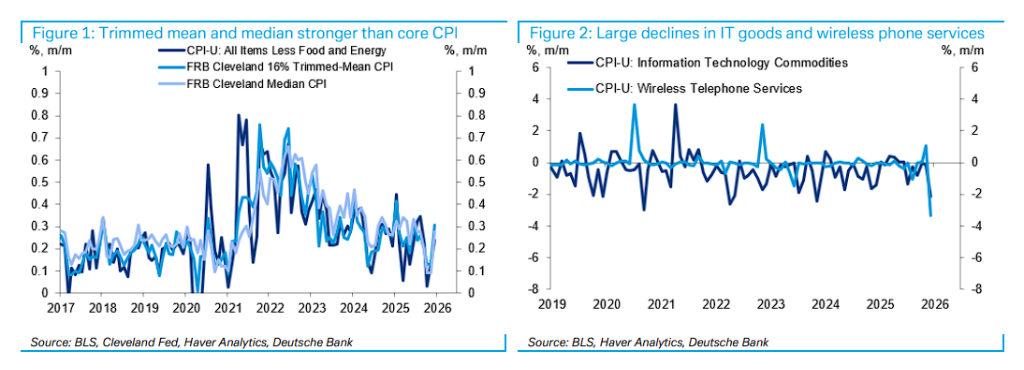
Core Viewpoint - The December CPI data appears mild but is filled with unsustainable noise and statistical distortions, according to Deutsche Bank and Morgan Stanley. The true test will be the upcoming PCE data [1][3]. CPI Analysis - The December CPI data showed a year-over-year core CPI increase of 2.6%, the lowest since March 2021, and a month-over-month increase of 0.2%, both below expectations [1]. - Deutsche Bank highlighted that the CPI data is distorted, with significant downward pressure from abnormal declines in information technology goods and wireless phone services, which together lowered the core CPI by about 6 basis points [4][6]. - The trimmed mean CPI and median CPI, which exclude extreme values, were reported at 0.31% and 0.28% respectively, indicating stronger underlying inflation pressures [1][6]. PCE Forecast - Morgan Stanley warned that despite the lower-than-expected core CPI, their forecast for the December PCE price index suggests a month-over-month increase of 0.46%, significantly higher than the CPI performance [2][9]. - The divergence between CPI and PCE is attributed to the differing weightings of goods and services in the two indices, with PCE showing stronger price increases in categories that have higher weights [9][11]. Market Implications - The market is awaiting the PCE data to confirm the true inflation trend. If the PCE rebounds as expected, it will limit the Federal Reserve's ability to continue lowering interest rates [3]. - Deutsche Bank noted that the CPI data reflects a mix of distorted November data recovery and genuine weakness, suggesting the Fed will likely wait for more data before signaling further rate cuts [14]. Tariff Effects - Both Deutsche Bank and Morgan Stanley observed signs of tariff impacts on inflation data, with prices of tariff-sensitive goods rising again in December, indicating potential future consumer price increases [12].


美联储最爱通胀指标温和上升,5月核心PCE物价环比上涨0.2%,消费支出创年初最大降幅
Hua Er Jie Jian Wen· 2025-06-27 13:50
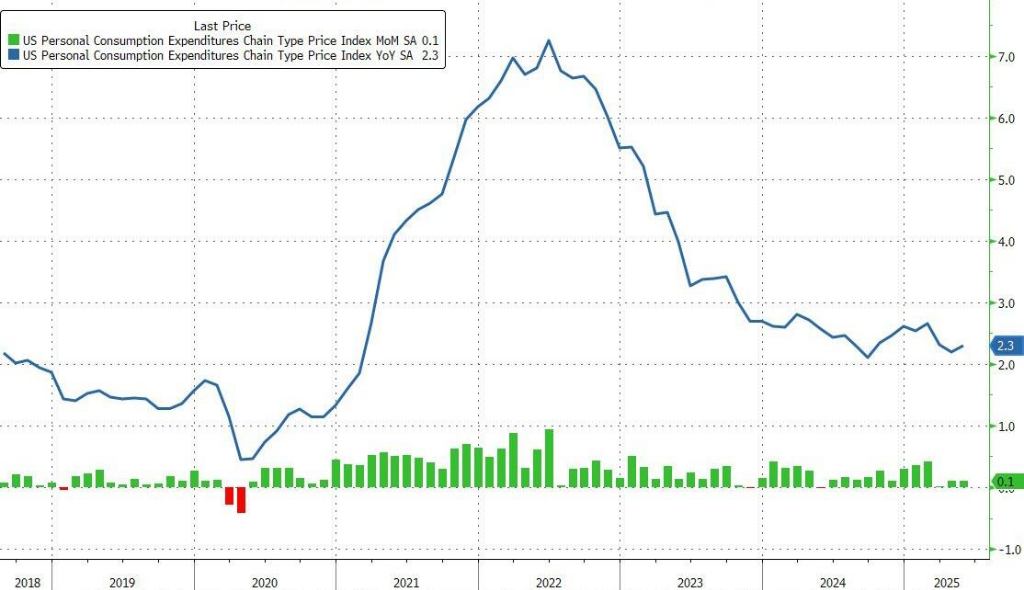
Core Insights - The core Personal Consumption Expenditures (PCE) price index in May rose by 0.2%, slightly exceeding expectations, indicating persistent price pressures [1][5] - Consumer spending in the U.S. experienced its largest decline since the beginning of the year, reflecting growing uncertainty in the economic outlook due to government policies [1][8] Inflation Indicators - The year-on-year core PCE price index for May was 2.68%, above the expected 2.6% and the previous value of 2.5% [3] - The overall PCE price index for May showed a year-on-year increase of 2.3%, matching expectations but up from 2.1% previously [4] - SuperCore PCE, which excludes food and energy, increased slightly to 3.12% year-on-year from 3.07% [5] Consumer Spending and Income - Personal consumption expenditures fell by 0.3% in May, with a notable 6% drop in automobile purchases, reversing previous gains [11] - Personal income also declined, marking the largest drop since 2021, primarily due to reduced government transfer payments [12] - The savings rate decreased significantly to 4.5% of disposable income [14] Economic Outlook - Many economists anticipate a rise in inflation in the coming months as higher import tariffs are passed on to consumers [9] - Federal Reserve officials have indicated potential support for interest rate cuts if inflation remains moderate, with discussions around a possible cut as early as the next policy meeting [16] Market Reaction - The U.S. dollar index experienced a short-term decline, dropping 0.16% to 97.12 [18]
美联储最青睐通胀指标公布在即!5月核心PCE环比涨幅料保持温和
Zhi Tong Cai Jing· 2025-06-27 06:20
Group 1 - The core PCE price index, a key inflation indicator favored by the Federal Reserve, is set to be released, with expectations for a month-over-month increase of 0.1% for both core and overall PCE indices, maintaining the same level as April [1] - Year-over-year, the core PCE price index is expected to rise to 2.6% in May, up from 2.5% in April, while the overall PCE index is projected to increase to 2.3%, compared to 2.1% in April [1] - The upcoming data will also provide insights into consumer spending and income growth, with personal spending expected to grow by 0.2% month-over-month and personal income by 0.3%, a slowdown from April's 0.8% [1] Group 2 - Citi analysts predict that used car prices will remain volatile in the coming months, with the Manheim used car price index rising by 1.7% in early June after a 1.4% decline in May [2] - The Manheim index, reflecting wholesale prices, may indicate an overall upward trend in car prices, as rising new car prices could drive consumers to the used car market [2] - Evercore ISI analysts noted that the core PCE deflator increased by 0.15% in May, with tariffs expected to impact prices in the future but not currently affecting them [2]
地缘政治压过经济议题!美军空袭升级以伊冲突 未来一周还有何看点?
智通财经网· 2025-06-23 00:53
Geopolitical Risks and Market Resilience - The ongoing Israel-Iran conflict has not significantly impacted the market, but recent U.S. military actions may change this situation [2] - The S&P 500 index has remained relatively stable since the conflict began, with a slight increase in oil prices by approximately 10% since June 13 [2] - A warning has been issued regarding the potential economic impact if oil prices rise significantly, with a critical threshold identified at $120 per barrel [2] Federal Reserve and Interest Rate Discussions - The Federal Reserve's recent meeting concluded with no change in interest rates, maintaining a forecast of a 50 basis point cut by the end of 2025 [5] - There is a growing concern about "stagflation," where economic growth slows while inflation remains above the 2% target [5] - Disagreements among Fed officials regarding interest rate cuts and inflation trends are expected to influence future policy decisions [5] Inflation Data Outlook - The upcoming release of the May core PCE price index is anticipated to show an annual increase from 2.5% in April to 2.6%, with a monthly rate expected to remain at 0.1% [9] - Analysts suggest that while this data may be positive for the Fed, uncertainties surrounding tariff policies could complicate the inflation outlook [9] S&P 500 Index Performance - The S&P 500 index has been hovering near historical highs but has not yet surpassed the record closing of 6144.15 points set on February 19 [12] - Historical analysis indicates that after significant declines, the S&P 500 typically takes over three months to reach new highs after coming within 5% of previous peaks [12]