毛戈平化妆品

Search documents
强call顺周期消费-低估港股先行
2026-03-18 02:31
Summary of Key Points from Conference Call Records Industry Overview - The consumer sector, particularly the cyclical consumption segment, is showing signs of bottoming out, with potential for rebound or reversal in demand. This is supported by positive trends in the restaurant industry, which serves as a key reference point [2][2] - The restaurant industry is experiencing a slowdown in price wars, with companies like McDonald's and KFC implementing slight price increases, indicating a more rational pricing environment [2][2] Company-Specific Insights Haidilao - Haidilao's table turnover rate has improved to over 4.0, with expectations for 2026 revenue to reach approximately 4.6 billion yuan [1][5] - The return of founder Zhang Yong as CEO is expected to accelerate the growth of the main brand and the "hard bone" sub-brands, with plans to expand into lower-tier cities and introduce new dining formats [6][6] - If Haidilao maintains a turnover rate above 4.0 and a customer price close to 100 yuan, it could achieve a profit recovery to around 4.6 billion yuan, corresponding to a valuation of about 20 times [6][6] Mixue Ice Cream - Mixue Ice Cream is expected to see over 20% growth in store openings in 2026, with its price advantage under 10 yuan becoming more pronounced as delivery subsidies decline [1][7] - Despite market concerns about same-store sales and growth, Mixue's actual performance may exceed pessimistic expectations, with a stable same-store sales growth forecast [7][8] Songcheng Performance - Songcheng Performance is projected to achieve revenue between 1 billion to 1.1 billion yuan in 2026, driven by improvements in existing projects and new developments [3][4] Old Puhuang Gold - Old Puhuang Gold is transitioning towards a luxury goods model, with expected revenue of around 7.2 billion yuan in 2026 and a low valuation of 15 times [1][10] - The company is focusing on high-value customers, with significant growth potential in its high-end gold product offerings [11][11] China Oriental Education - China Oriental Education has seen a year-on-year increase of over 25% in spring recruitment collections, with a projected profit of 1 billion yuan for 2026 [1][17] - The company is expanding into new sectors such as beauty and pet care, indicating a strategic diversification [17][18] Dongfang Zhenxuan - Dongfang Zhenxuan is experiencing a fundamental turnaround, with plans to expand its self-operated product offerings by 90% to approximately 1,500 SKUs in the 2026 fiscal year [1][18] - The company is enhancing its multi-channel strategy, including expanding its own app and offline teaching networks [18][18] Bluko - Bluko is guiding for a 30% revenue growth in 2026, with a focus on international expansion and new product categories like building vehicles [1][16] - The company aims for a 70%-80% growth in its overseas segment, leveraging popular IPs for market penetration [16][16] Additional Insights - The overall sentiment in the cyclical consumption sector is cautiously optimistic, with signs of recovery in consumer spending and strategic shifts among key players [2][2] - Companies are increasingly focusing on enhancing customer experience and product offerings to drive sales growth in a competitive environment [1][1]

需要13亿来“改善生活”?毛戈平家族的上市财富盛宴
Guan Cha Zhe Wang· 2026-01-12 10:44
Core Viewpoint - The article discusses the financial maneuvers of the Mao Geping family following their company's IPO in Hong Kong, highlighting significant cash withdrawals and questioning the alignment of their actions with the company's stated growth strategies and investor interests [1][4][6]. Group 1: IPO and Financial Maneuvers - Mao Geping withdrew its IPO application from A-shares three times, citing "business prospects, future development strategy, and market environment" as reasons [1]. - After the withdrawal, the Mao Geping family repurchased 10% of shares from Jiuding for 730 million yuan and distributed dividends totaling 1 billion yuan within three months, exceeding the previous year's net profit [1][6]. - The company successfully listed on the Hong Kong Stock Exchange, raising approximately 2.1 billion yuan, while the family has since cashed out over 2 billion yuan through dividends and share sales [1][6][7]. Group 2: Shareholder Actions and Market Reactions - Recently, the family announced plans to sell up to 17.2 million H-shares, representing 3.51% of the total shares, with a potential value of 1.41 billion HKD (approximately 1.3 billion yuan) [4][5]. - Investors have expressed skepticism regarding the rationale behind the family's cashing out, questioning the need for personal financial improvement when substantial dividends have already been distributed [5][15]. - The family's actions have raised concerns about the alignment of their financial interests with those of minority shareholders, especially given the significant amount of cash withdrawn from the company [15]. Group 3: Business Model and Governance Structure - Mao Geping's business model relies heavily on outsourcing production, with a low investment in R&D (only 0.59% of revenue), raising questions about the sustainability of its "high-end" branding [8][12]. - The company has a family-dominated board, with six out of nine directors being family members, leading to potential conflicts of interest between family and corporate goals [13][14]. - The governance structure suggests that the family's financial interests are prioritized, as evidenced by their substantial compensation and the timing of their cash withdrawals [14][15].


知名企业上市一年多,创始人团队套现十几亿
Di Yi Cai Jing Zi Xun· 2026-01-08 03:15
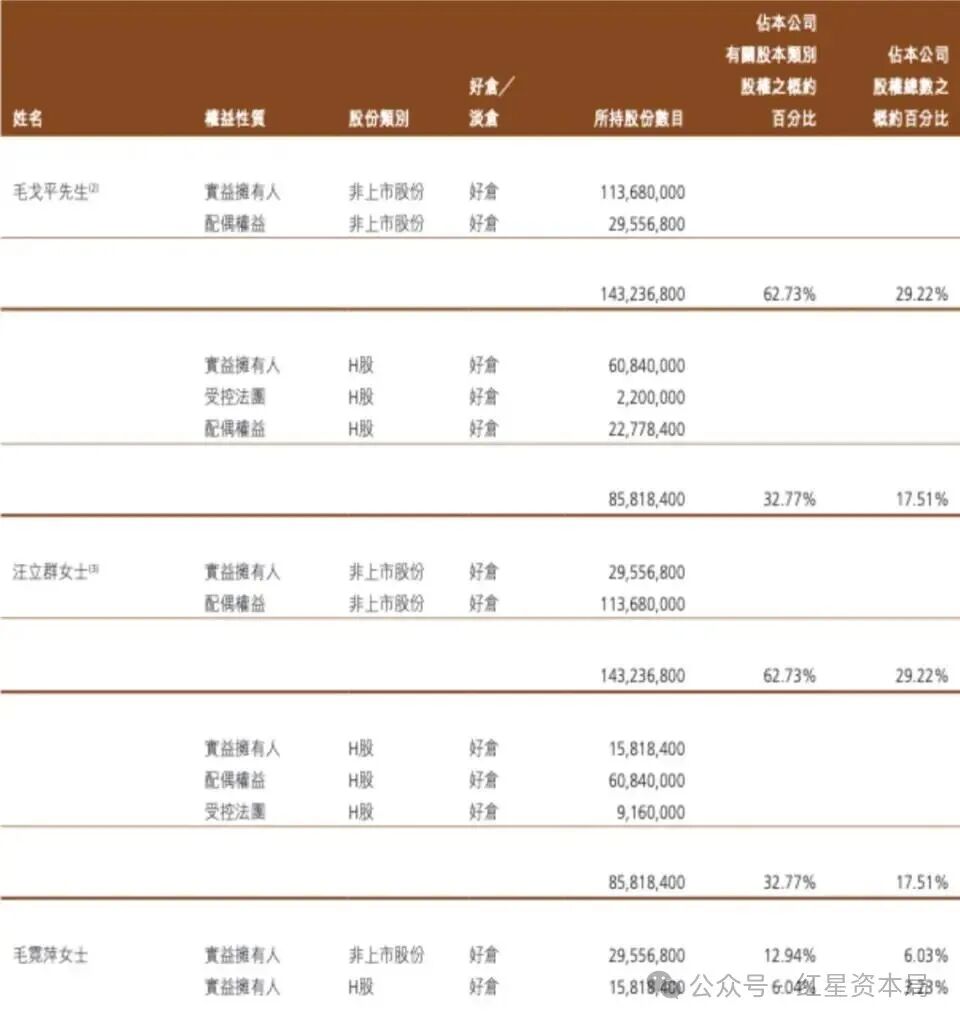
Core Viewpoint - The announcement of share reduction by the controlling shareholders of Mao Geping Cosmetics Co., Ltd. indicates a strategic move to meet personal financial needs while expressing confidence in the company's future development [2][3]. Group 1: Share Reduction Announcement - On January 6, Mao Geping announced that six controlling shareholders, including founders Mao Geping and Wang Liqun, plan to reduce their holdings by up to 17.2 million H-shares, representing 3.51% of the total issued shares within six months [2]. - The share price saw an increase of 5.3% on January 7, with a trading range between 81.75 HKD and 88.90 HKD, allowing the shareholders to potentially cash out at least 1.4 billion HKD [2]. - The shareholders' stated purpose for the reduction includes personal financial needs and investments in the beauty industry, while emphasizing their ongoing commitment to product development and management [2]. Group 2: Market Context and Performance - Mao Geping was listed on the Hong Kong Stock Exchange in October 2024, initially priced at 29.8 HKD, with the opening price reaching 47.65 HKD, nearly doubling since then [3]. - The timing of the share reduction coincides with the first window period after the lifting of the lock-up period, which typically lasts for 12 months for controlling shareholders and executives [3].

毛戈平创始人家族等,拟集体减持套现14亿港元:用于投资、改善个人生活
Cai Jing Wang· 2026-01-07 14:46
Core Viewpoint - The controlling shareholders and executive directors of Maogeping Cosmetics Co., Ltd. plan to collectively reduce their holdings in the company, citing personal financial needs, despite the company's stock price having doubled since its IPO [1][11]. Shareholder Reduction Plan - The shareholders intend to reduce their holdings by up to 17.2 million H shares, representing no more than 3.51% of the company's total issued shares, primarily through block trades within six months from the announcement date [1]. - Based on the closing price of HKD 82 per share on January 6, the total cashing out amount is estimated at HKD 1.41 billion [1]. Shareholder Background - The shareholders involved in the reduction include Maogeping, his spouse Wang Liqun, and other family members, all of whom are executive directors of the company [1][4]. Financial Performance - For the first half of 2025, the company reported revenue of CNY 2.588 billion, a year-on-year increase of 31.3%, and a net profit of CNY 670 million, up 36.1% [10][11]. - The overall gross margin for the first half of 2025 was 84.2%, showing a slight decline compared to the same period in 2024 [11]. Market Reaction - Following the announcement of the share reduction, Maogeping's stock price rose by 7.26%, closing at HKD 87.95, with a market capitalization of HKD 43.112 billion [4][5]. Company Overview - Maogeping was founded in 2000 and went public in Hong Kong on December 10, 2024, recognized as the "first high-end domestic beauty stock" in the Hong Kong market [7]. - The company operates in cosmetics, makeup artistry training, product design, and development, with a significant online and e-commerce presence [10].
毛戈平创始人家族等拟集体减持套现14亿港元,股价为何大涨8%?
Xin Lang Cai Jing· 2026-01-07 06:53
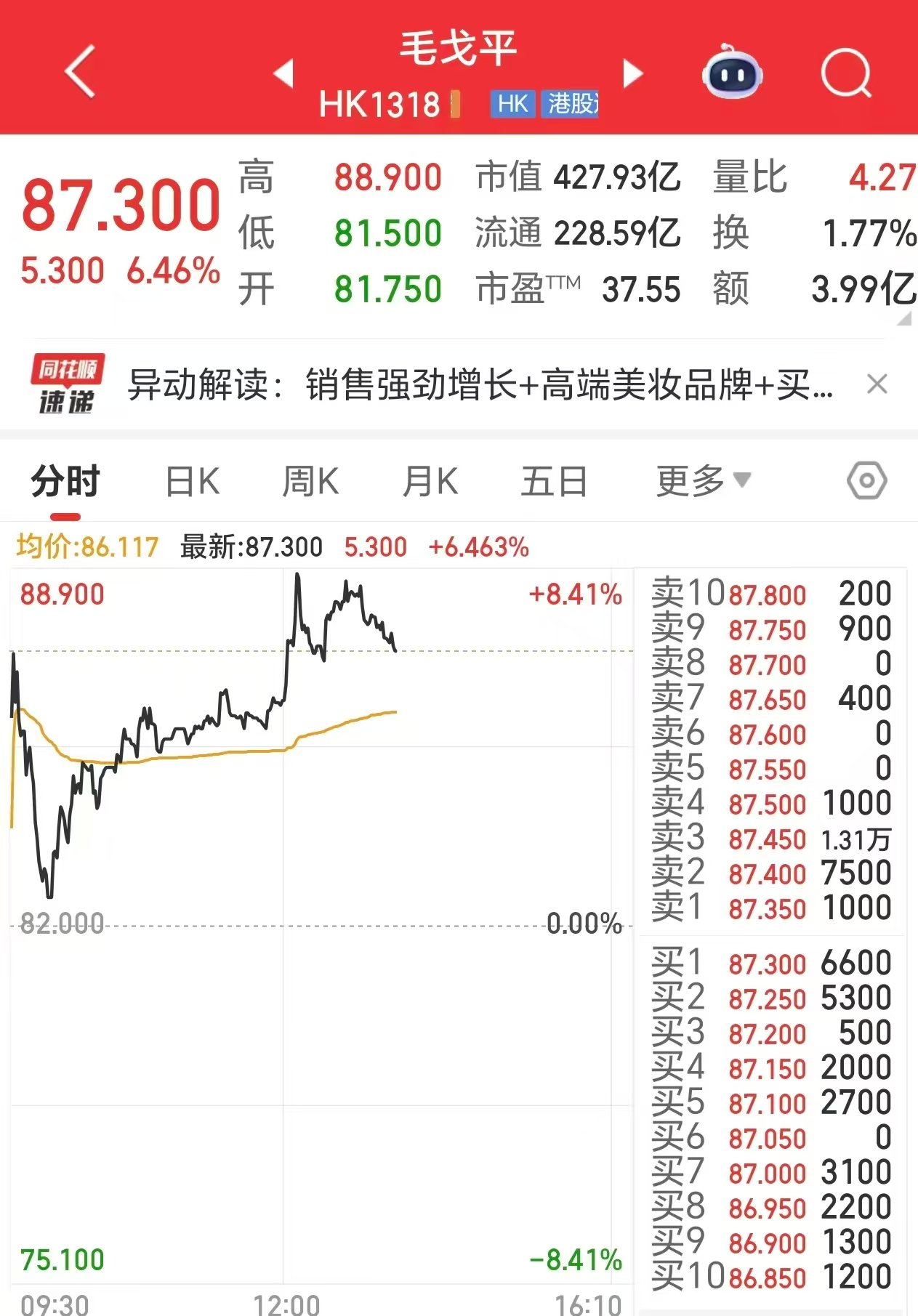
Core Viewpoint - The stock price of MAOGEPING Cosmetics Co., Ltd. surged after the announcement of a planned share reduction by several executive directors, indicating market confidence despite the reduction [1][3]. Group 1: Share Reduction Announcement - On January 6, MAOGEPING announced that its controlling shareholder and executive directors plan to reduce their holdings by up to 17.2 million shares, representing 3.51% of the total issued shares [3]. - The intended reduction is primarily for personal financial needs and will be executed mainly through block trades over a six-month period [3]. - The estimated cash-out from this reduction, based on the closing price of HKD 82 per share, amounts to approximately HKD 1.41 billion [3]. Group 2: Market Reaction - Following the announcement, MAOGEPING's stock price increased by over 8% at one point, closing with a gain of 6.46% at HKD 87.30 per share, resulting in a market capitalization of HKD 42.793 billion [1][3]. - The controlled nature of the share reduction and the positive intended use of the proceeds are seen as factors that mitigate potential negative impacts on the stock price [4]. Group 3: Company Performance - For the first half of 2025, MAOGEPING reported revenue of RMB 2.588 billion, a year-on-year increase of 31.3%, and a net profit of RMB 670 million, up 36.1% [4]. - In 2024, the company achieved a revenue of RMB 3.885 billion, reflecting a growth of 34.61%, with a net profit of RMB 881 million, a 32.8% increase [4]. Group 4: Future Outlook - According to a report by Caitong Securities, MAOGEPING is expected to maintain a "buy" rating, with projected net profits for 2025 to 2027 of RMB 1.204 billion, RMB 1.583 billion, and RMB 2.025 billion, respectively, while maintaining a stable gross margin of around 84% [5].
消费者偏好正发生结构性转变
2 1 Shi Ji Jing Ji Bao Dao· 2025-11-18 23:03
Core Insights - The global luxury goods giants are facing challenges from the Chinese market as consumer preferences shift from international brands to local high-end brands [1][2] - This structural change in consumer behavior is reshaping the competitive landscape of the world's largest luxury market, with local brands experiencing significant sales growth [1][2] Group 1: Market Trends - Chinese consumers are increasingly favoring domestic high-end brands, leading to a decline in sales for traditional international brands like Gucci and Louis Vuitton [1] - In the first three quarters of 2023, local brands such as Laopuhuangjin, Songmont, and Maogeping have seen substantial sales increases, surpassing the growth rates of seven major foreign competitors [1] - The shift in consumer preference is driven by a systemic upgrade in consumer values, moving from external displays of wealth to internal satisfaction and self-expression [1][2] Group 2: Cultural Influence - The rise of national pride and cultural connection is influencing consumer preferences towards domestic luxury brands, initially seen in mass consumption and now penetrating the high-end market [2] - High-end Chinese brands are increasingly accepted at premium price points, with brands like Yangwang and Zun Jie achieving sales comparable to or exceeding Western counterparts [2] - Local brands are integrating traditional craftsmanship with modern design, creating cultural value beyond the material itself, as seen with Laopuhuangjin and Songmont [2] Group 3: Global Consumer Behavior - There is a global trend towards more affordable, quality-focused brands, reflecting the democratizing effect of the internet on consumption [3] - Young consumers are shifting their focus from brand names to product innovation and quality, moving away from luxury items that merely symbolize wealth and status [3] - The current Chinese luxury market is characterized by cultural confidence, mature consumers, and competition between local and international brands, positioning Chinese companies for future global expansion [3]
毛戈平发布中期业绩 股东应占溢利6.7亿元 同比增加36.11%
Zhi Tong Cai Jing· 2025-08-27 13:40
Core Viewpoint - 毛戈平 (01318) reported a significant increase in both revenue and profit for the six months ending June 30, 2025, indicating strong business performance and growth potential [1] Financial Performance - Revenue reached 2.588 billion RMB, representing a year-on-year increase of 31.28% [1] - Shareholder profit amounted to 670 million RMB, reflecting a year-on-year growth of 36.11% [1] - Basic earnings per share were reported at 1.37 RMB [1] Sales Growth - The increase in revenue was primarily driven by product sales, which rose from 1.9 billion RMB in the same period last year to 2.521 billion RMB, marking a 32.7% increase [1]
毛戈平(01318)发布中期业绩 股东应占溢利6.7亿元 同比增加36.11%
智通财经网· 2025-08-27 12:28
Core Viewpoint - The company reported a significant increase in revenue and profit for the six months ending June 30, 2025, indicating strong business performance and growth potential [1] Financial Performance - Revenue reached 2.588 billion RMB, representing a year-on-year increase of 31.28% [1] - Shareholder profit amounted to 670 million RMB, reflecting a year-on-year growth of 36.11% [1] - Basic earnings per share were reported at 1.37 RMB [1] Sales Growth - The increase in revenue was primarily driven by product sales, which rose from 1.9 billion RMB in the same period last year to 2.521 billion RMB, marking a 32.7% increase [1]
市场如何看待毛戈平
新财富· 2025-08-18 09:03
Core Viewpoint - The article highlights that Mao Geping, a domestic high-end cosmetics brand, has benefited from the consumption downgrade trend in the luxury goods market, achieving significant revenue growth despite a challenging industry backdrop [1]. Group 1: Company Performance - Mao Geping has achieved a compound revenue growth of 35%-40% over the past three years and is expected to maintain a growth rate of around 30% in the next 2-3 years [1]. - The brand's sales expense ratio is 49%, which is considered moderate in the industry, with a significant portion allocated to employee salaries and rental costs [7]. - The number of offline counters for Mao Geping has increased from 135 in 2017 to 372 by the first half of 2024, indicating a strong expansion strategy [7]. Group 2: Market Positioning - The brand has successfully captured the market share lost by foreign high-end brands like Estée Lauder and YSL due to their poor performance in China [1]. - Mao Geping's strategy focuses on offline sales and a robust membership system, which differentiates it from other domestic brands that primarily rely on online traffic for growth [4][10]. Group 3: Membership and Customer Engagement - Mao Geping has developed a strong private membership operation, with core member repurchase rates exceeding 80% and core member consumption accounting for over 75% of total sales [16]. - The brand's unique service experience includes a well-trained staff of over 2,700 beauty consultants, providing personalized makeup advice and services [19]. - The company has established a comprehensive membership system with various tiers, enhancing customer loyalty and engagement [22]. Group 4: Sales Strategy - Mao Geping's sales strategy involves using online platforms to attract new customers while focusing on offline experiences to deepen customer relationships [25]. - The average annual revenue per counter has shown a steady increase, from 3.2 million in 2021 to an expected 4.3 million in 2023 [27]. - The brand emphasizes a consistent pricing strategy across online and offline channels, encouraging customers to purchase in-store [21].

「四大金刚」,挤满商场一楼
投资界· 2025-06-22 07:23
Core Viewpoint - The retail landscape is shifting, with traditional beauty brands being replaced by new categories such as trendy toys, outdoor sports, and tea beverage brands, which are now dominating the first floor of shopping malls [4][5][7]. Group 1: Changing Retail Dynamics - The flagship store of Innisfree, a Korean beauty brand, was replaced by Pop Mart, a trendy toy company, highlighting a significant shift in consumer preferences [4]. - The emergence of the "Four Kings" (trendy toys, outdoor sports, new energy vehicles, and tea beverages) reflects a broader trend where traditional beauty counters are losing prominence in shopping malls [5][6]. - The vacancy rate in shopping malls, even in major cities, has approached 14%, providing an opportunity for the "Four Kings" to establish a presence [7]. Group 2: Impact on Beauty Brands - The number of beauty counters in China has decreased from 15,415 in 2020 to 11,365 in 2022, with low-end beauty counters experiencing the most significant decline [7]. - High-end beauty brands like Chanel and Lancôme continue to maintain their presence in malls despite overall declines in sales, as they contribute to the mall's image and customer traffic [8][9]. - The first floor of shopping malls serves as a "face" for the mall, influencing consumer perceptions and foot traffic [8]. Group 3: The Rise of New Categories - New energy vehicle brands have become a significant presence in shopping malls, with Tesla being a pioneer in this space [11][12]. - The tea beverage sector is rapidly evolving, with brands like Nayuki and Heytea adjusting their pricing strategies to adapt to changing consumer behaviors [15][16]. - The number of tea beverage brands is increasing, with some brands like Bawang Tea Ji opening nearly 3,000 new stores in 2024, indicating a strong expansion trend [16]. Group 4: Strategic Brand Positioning - Brands like Lululemon and Pop Mart are focusing on prime locations in high-end shopping malls, which enhances their brand visibility and consumer engagement [20][22]. - The "Bird Nest Plan" by brands like Arc'teryx emphasizes opening flagship stores in key urban areas, reflecting a strategic shift towards high-value locations [22][23]. - The competition for prime retail space is intensifying, with many mid-tier malls struggling to attract high-end brands, leading to a concentration of successful brands in top-tier malls [23]. Group 5: Future Outlook - The retail environment remains unpredictable, with some brands thriving while others struggle to maintain their presence [24]. - Emerging brands like Mao Geping are successfully expanding in the offline market, demonstrating that opportunities still exist for brands that offer unique customer experiences [24]. - The future of the "Four Kings" and their potential replacements remains uncertain, as consumer preferences continue to evolve [24].