洋桔梗

Search documents
年味里的新质生产力|春花“赶春”有新招
Ren Min Ri Bao· 2026-02-11 02:18
Core Insights - The article highlights the transformation of the flower industry in Yunnan, particularly in Kunming, where technology and innovative practices are reshaping the production and sale of flowers, especially during the Spring Festival season [1][5][9] Group 1: Industry Transformation - The Yunnan flower industry is shifting from traditional methods to data-driven approaches, enhancing production efficiency and market responsiveness [1][3] - The Kunming Flower Auction Center has become a significant hub, facilitating the trade of over 154.76 billion flowers with a transaction value of 134.84 billion yuan in 2025, maintaining its position as the top flower trading center in China for over 20 years [3][4] - The introduction of a flower trading database at the auction center allows for better data integration across production, trading, and distribution, aiding both government policy-making and farmers' market strategies [3][4] Group 2: Technological Advancements - The use of smart greenhouses and automated systems in flower cultivation has significantly improved yield and quality, with some farms reporting a threefold increase in flower production compared to traditional methods [5][6] - Advanced technologies enable precise control over growing conditions, allowing for the synchronization of flower blooming with market demand, thus reducing reliance on weather conditions [5][6] - The implementation of automated sorting and packaging systems has streamlined post-harvest processes, enhancing freshness and reducing labor costs [6] Group 3: Breeding and Innovation - The Yunnan Agricultural Academy is actively working on developing new flower varieties, with a rigorous selection process that can take several years before a new variety reaches the market [7][9] - The academy has collected over 1,500 flower varieties, with plans to expand domestic breeding efforts to reduce reliance on imported varieties, which currently account for about 85% of the market [9] - The focus is shifting towards creating unique Chinese flower varieties, aiming for self-sufficiency in the flower breeding sector [9]
泗洪界集镇发展花卉种植助农增收
Xin Lang Cai Jing· 2026-01-11 21:22
Core Viewpoint - The article highlights the development of specialty flower cultivation in Jiejitown, Sihong County, focusing on African daisies, lilies, and洋桔梗, and emphasizes the "Party branch + cooperative + farmers" operational model to achieve industry-driven wealth for the local community [1] Group 1 - Jiejitown is actively promoting the cultivation of specialty flowers such as African daisies, lilies, and洋桔梗 [1] - The operational model implemented is "Party branch + cooperative + farmers," which aims to enhance local economic development [1] - The article features a scene from January 11, where flower farmers are busy harvesting African daisies to supply the market [1]
九块九的鲜花让悦己消费成为日常
Sou Hu Cai Jing· 2025-11-24 21:05
Core Insights - The flower retail market in China is projected to reach nearly 220 billion yuan in 2024, with daily self-consumption accounting for over 40% of sales [1] - The shift from seasonal gifting to everyday purchases is driven by changing consumer attitudes and improved supply chain efficiencies [1][11] Group 1: Market Trends - The demand for affordable flower bouquets, such as the 9.9 yuan offerings, has increased significantly, with Meituan's flash purchase platform reporting a 15.7% year-on-year growth in flower transaction volume for 2024 [1][5] - In five-tier cities, flower transaction volume is expected to grow by 24.6% year-on-year, contributing over one-third of total sales [5] - The primary motivation for purchasing flowers has shifted, with 66% of consumers buying flowers to express emotions and 59% for home decoration, surpassing the 36% who buy for celebrations [5] Group 2: Consumer Behavior - The 25-35 age group accounts for 68% of online flower orders, with female users making up 74%, indicating a trend towards frequent, small-scale purchases [7] - Consumers are increasingly viewing flowers as a daily necessity rather than a luxury, with the average annual flower consumption in China at only about 10 stems, compared to 60 stems in countries with similar income levels [7] Group 3: Supply Chain Innovations - Supply chain upgrades have significantly reduced costs, allowing vendors to sell bouquets at lower prices while maintaining profitability; for instance, the cost of a bouquet is now controlled at under 5 yuan [8][9] - The OMO (Online-Merge-Offline) model has been effectively implemented, with examples like Yunnan's green fresh flower city warehouse reducing procurement costs by 25% and waste rates from 15% to below 5% [9] - The integration of e-commerce platforms has further accelerated market growth, with companies like Hema establishing efficient cold chain logistics to deliver fresh flowers within 24 hours [9][11]

习近平总书记关切事|幸福生活像花儿一样——把地方特色产业做优做强之二
Xin Hua She· 2025-07-24 12:46
Core Insights - The article highlights the development and modernization of the flower industry in Yunnan, particularly in Lijiang, showcasing its potential to enhance local livelihoods and contribute to the economy [1][2][3]. Industry Overview - Yunnan is recognized as one of the most suitable regions for flower production globally, with an annual output of over 20 billion fresh-cut flowers, accounting for 70% of the national market [2]. - The flower industry in Yunnan has transformed from small-scale self-sustaining operations to a modern, full-chain agricultural model, driven by technological advancements and cooperative efforts [2][3]. Economic Impact - The flower industry has significantly improved the income of local farmers, with an average increase of over 50,000 yuan per household annually, benefiting around 190,000 households and creating over 1 million jobs [4]. - In 2024, the total output value of the flower industry chain is expected to exceed 140 billion yuan [4]. Technological Advancements - The use of smart greenhouse technology in flower cultivation enhances flower quality and consistency, demonstrating a shift towards modern agricultural practices [1]. - Research and development in flower breeding are crucial, with efforts to reduce reliance on imported varieties and promote indigenous species [5]. Market Dynamics - The Kunming International Flower Auction Center has become the largest flower auction center in Asia and the second largest globally, facilitating the sale of over 7 million fresh-cut flowers daily [4]. - New business models, including e-commerce and live streaming, are expanding market access for local farmers and enhancing profitability [4].
芬芳“夜经济”一路繁花燃动消费热力 定制化拍卖游客“尝尝鲜”
Yang Shi Wang· 2025-07-07 03:43
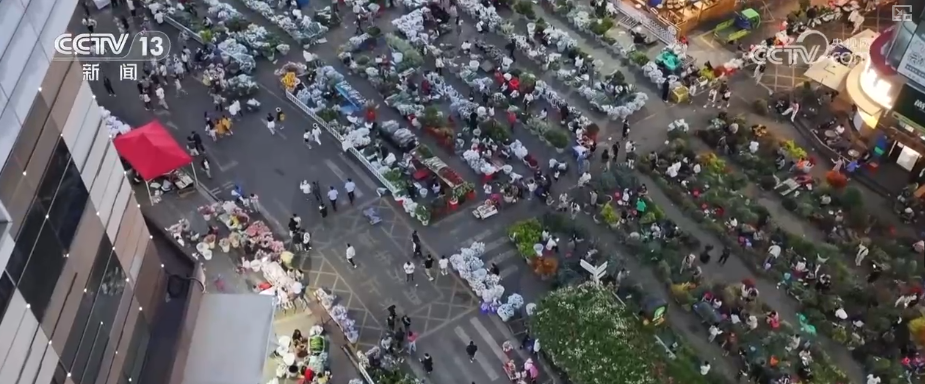
Core Insights - The Dou Nan Flower Market in Kunming, known as "Asia's Flower Capital," is the largest fresh-cut flower trading market in Asia, operating both day and night [1][3][17] - The night market begins around 8:40 PM and continues until approximately 1 AM, attracting numerous flower farmers and merchants [5][17] - The market offers over 1,600 varieties of fresh-cut flowers, with a daily trading volume of nearly 30 million stems [12][17] Market Operations - The Dou Nan Flower Market features a unique night market experience, allowing visitors to shop for flowers late into the evening, which is different from typical flower markets [3][5] - The market includes a flower auction service, which has recently expanded to include a "tourist-exclusive" auction that operates until 10 PM [20][22] - The auction utilizes a "Dutch-style descending price" method, where participants can bid through a mobile app, creating a competitive and engaging atmosphere [22] Flower Varieties and Seasonal Highlights - The market boasts a wide range of flower types, including popular varieties such as roses, lilies, and seasonal flowers like hydrangeas and lotus flowers [9][11] - The summer season features vibrant flowers that are particularly popular among consumers, contributing to the market's high trading volume [11][17] Customer Engagement - Visitors can participate in customized auctions, selecting their preferred flower arrangements and receiving on-site packaging from florists [27] - The market's lively atmosphere and the opportunity for spontaneous deals enhance the overall shopping experience for both locals and tourists [20][27]