深海生境智能认知与探索多模态大模型

Search documents
全球海洋治理新实践——专家解读我国参加《海洋生物多样性协定》意义及影响
Zhong Guo Zi Ran Zi Yuan Bao· 2025-12-25 08:44
Core Points - China submitted its approval of the "Agreement on the Conservation and Sustainable Use of Marine Biological Diversity of Areas Beyond National Jurisdiction" to the UN Secretary-General, marking a significant step in global marine governance and China's commitment to multilateralism [1][3] - The agreement, which will come into effect on January 17, 2026, is a result of 19 years of negotiations among over 190 UN member states and is seen as a major achievement in multilateral negotiations [3][11] Group 1: Global Governance and Sustainable Development - The agreement focuses on the conservation and sustainable use of marine biodiversity in areas beyond national jurisdiction, establishing key frameworks such as deep-sea genetic resources management and environmental impact assessments [3][4] - China's participation in the agreement reflects its commitment to ecological civilization and global governance, aiming to contribute to sustainable development goals [3][5] Group 2: National Interests and Global Responsibilities - As a leading marine nation, China's decision to approve the agreement is driven by its development needs and a sense of global responsibility [5] - The approval includes four declarations to protect China's interests, ensuring that pre-agreement deep-sea genetic resources are not subject to the agreement's constraints [5][6] Group 3: Institutional Adjustments and Industry Transformation - Following the agreement's enactment, China will undergo institutional adjustments and industry transformations, with the Ministry of Natural Resources taking the lead in compliance efforts [7][8] - The agreement is expected to promote a shift towards greener and smarter industries, enhancing resource utilization and developing high-value products through international collaboration [8] Group 4: International Cooperation and Capacity Building - China is actively promoting international cooperation under the agreement, having signed marine cooperation agreements with over 50 countries and organizations [10] - Initiatives such as the establishment of international research centers and joint marine research projects aim to enhance scientific understanding and collaboration in deep-sea exploration [10]
推动“人工智能+海洋经济”走深走实
Zhong Guo Zi Ran Zi Yuan Bao· 2025-12-15 10:59
Core Insights - The release of two significant large models at the 2025 Xiamen International Marine Week marks a technological breakthrough in the integration of artificial intelligence with the marine economy, indicating a transformative shift towards a blue economy [2] - The Chinese government is promoting the deep integration of artificial intelligence across various sectors, with a focus on high-quality development driven by technological innovation in the marine economy [2] - Coastal regions are rapidly implementing action plans to develop the "AI + Marine" sector, with initiatives from provinces like Zhejiang and Guangdong to create landmark application scenarios [2] Group 1: Opportunities in AI and Marine Economy - AI is becoming a key driver for high-quality development in the marine economy, with applications ranging from smart ports to underwater robotics [3] - The transition towards intelligent marine economic practices is underway, but challenges remain in fully integrating AI into this sector [3] Group 2: Challenges in Integration - There is a lack of top-level design in the integration of AI and the marine economy, necessitating a strategic framework that aligns with local industry characteristics and resources [4] - The current application scenarios are often limited to single industries, highlighting the need for innovation that breaks traditional boundaries and promotes multi-scenario collaboration [4] - Data fragmentation in the marine sector poses a significant challenge, requiring improved data governance and the establishment of a unified marine data system [4] - The scarcity of interdisciplinary talent who understand both marine science and AI is a major bottleneck, necessitating educational reforms and collaborative efforts to cultivate skilled professionals [4]


深海探索和海洋环境预测有了全新工具 两大海洋AI大模型正式发布
Ke Ji Ri Bao· 2025-11-27 02:02
Core Insights - The launch of the "Kanhai" AI model and the multi-modal deep-sea habitat cognitive and exploration model aims to enhance understanding and prediction of deep-sea environments, addressing significant gaps in human knowledge about the deep sea [1][2] - The models leverage artificial intelligence and satellite remote sensing data to improve marine disaster warning accuracy and provide intelligent solutions for deep-sea protection [1] Group 1: Model Development and Features - The deep-sea cognitive model can intelligently simulate typical deep-sea habitats, such as seamounts and hydrothermal vents, and provide solutions for deep-sea conservation [1] - The "Kanhai" model integrates data from ocean satellites, offering a comprehensive view from the ocean surface to underwater environments, enhancing predictive capabilities for marine conditions [1] Group 2: Importance and Impact - The application of digital and AI technologies is expected to overcome traditional limitations in deep-sea observation, significantly improving efficiency in understanding deep-sea ecosystems and sustainable resource utilization [2] - The 2025 Xiamen International Marine Week serves as a platform for international collaboration to address challenges facing the oceans, such as climate change and biodiversity loss [2]
走向下一个“蓝色十年”
Zhong Guo Zi Ran Zi Yuan Bao· 2025-11-19 04:07
Core Insights - The 2025 Xiamen International Ocean Week is set to take place from November 6 to 12, featuring project signings, forums, and cultural activities, highlighting marine achievements and innovative ideas [1][2] Group 1: Innovation - The Ocean Week serves as a platform to showcase marine development achievements [3] - A significant outcome of the event is the release of the "Deep Sea Habitat Intelligent Cognition and Exploration Multimodal Model," marking a breakthrough in deep-sea science and AI integration, developed by various Chinese research institutions [4] - The "Kanhai" end-to-end AI ocean model was also launched, enabling comprehensive observation and prediction of ocean conditions, having completed its development and deployment [4] Group 2: Connectivity - The Ocean Week connects government, research, enterprises, and finance, facilitating practical cooperation in the blue economy between China and Europe [7] - The establishment of the China-Europe Blue Development Investment Fund aims to accelerate the industrialization of marine technology achievements, with an initial fundraising target of €2 billion and a corresponding 10 billion RMB fund [7][8] - A total of 19 projects were signed during the event, with a combined value exceeding 139 billion RMB [8] Group 3: Deep Sea - The deep sea is gaining increased attention, with various activities focusing on deep-sea habitat models and the establishment of a deep-sea biological manufacturing innovation center [8][9] - The first Deep Sea Biological Manufacturing and Bioeconomy Seminar gathered experts to discuss the development of deep-sea biological manufacturing and its strategic significance [10][11] Group 4: BBNJ - The approval of the BBNJ Agreement marks a new chapter in China's international cooperation on marine biodiversity [13] - A seminar discussing the implications of the BBNJ Agreement for China's marine industry highlighted the need for improved top-level design and technological innovation [14] - The agreement's impact on various sectors, including shipping, fisheries, and deep-sea mining, was analyzed, emphasizing the importance of adapting to new international rules [15][16] Group 5: Lifestyle - The Ocean Week features a variety of cultural exchange activities that connect people's lives with the ocean, including public markets, science open days, and youth activities [20][23] - Events such as the 19th China Club Cup Sailing Challenge and the 18th China (Xiamen) International Yacht Show aim to promote marine leisure activities and enhance public engagement with the ocean [31][33]

AI伪造巴菲特发言,伯克希尔发布澄清;全球首个深海生境智能多模态大模型发布丨AIGC日报
创业邦· 2025-11-08 01:09
Group 1 - Alibaba's CEO Wu Yongming announced the construction of a super-large AI infrastructure, emphasizing the investment in a super AI cloud to provide leading AI services to global developers [2] - Berkshire Hathaway issued a statement regarding AI-generated videos that falsely depict Warren Buffett, expressing concern over the potential for misinformation among those unfamiliar with Buffett's actual voice [2] - JD.com's founder Liu Qiangdong discussed the future of work, suggesting that employees may only need to work one day a week or even one hour, and that delivery could be fully automated by robots [2] Group 2 - The Ministry of Natural Resources of China launched the world's first intelligent multimodal model for deep-sea habitats, which includes functions for intelligent perception, decision-making, and immersive cognitive navigation [2]
首个、首座、首次!本周,中国硬核实力再刷屏
Yang Shi Xin Wen· 2025-11-06 22:49
Group 1: Aerospace and Technology Breakthroughs - China's Tianwen-1 spacecraft has successfully observed the interstellar object Atlas, marking the first time a Chinese spacecraft has achieved this feat. The spacecraft was approximately 30 million kilometers away from the target during the observation [3][4] - The successful observation of Atlas is considered an important expansion task for Tianwen-1, which will aid in technical trials for asteroid exploration by Tianwen-2 [3] Group 2: Infrastructure Developments - The Tongling Yangtze River Bridge, the world's first double-layer cable-stayed and suspension collaborative system bridge, officially opened on November 6. The bridge spans 11.88 kilometers with a main span of 988 meters, serving both rail and road traffic [5] - The opening of the bridge enhances the regional river crossing capacity and allows for uninterrupted high-speed travel along the 641-kilometer G3 Jing-Tai Expressway in Anhui [5] Group 3: Marine and Environmental Innovations - China's Ministry of Natural Resources has released the world's first multi-modal large model for deep-sea habitats, named "Intelligent Cognition and Exploration Multi-modal Model for Deep-sea Habitats," which is a significant outcome of the United Nations' "Decade of Ocean Science" initiative [8] - This model features intelligent perception of deep-sea habitats, comprehensive intelligent simulation, governance decision-making solutions, and immersive cognitive navigation [8] Group 4: Navigation and Satellite Industry Growth - The China Satellite Navigation Association reported a strong growth trend in the BeiDou industry, with a steady increase in the comprehensive index and expanding application penetration across multiple fields [9] - By the end of 2024, China is expected to have 50 BeiDou navigation satellites in orbit, including 15 BeiDou-2 satellites and 35 BeiDou-3 satellites, marking a new phase of marketization, industrialization, and internationalization for the BeiDou system [9] - Currently, 88 BeiDou sounding stations in China are connected to the global meteorological data exchange system, contributing to global weather forecasting with "Chinese precision" [9]

全球首个深海生境智能多模态大模型发布
Yang Shi Xin Wen· 2025-11-06 11:14
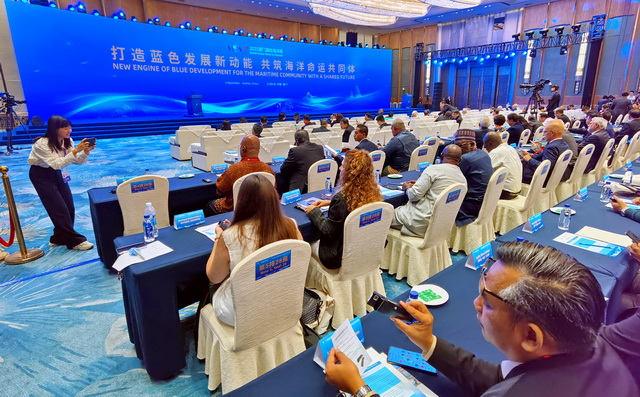
Core Insights - The Ministry of Natural Resources released the world's first multimodal large model for typical deep-sea habitats, named "Intelligent Cognition and Exploration Multimodal Large Model for Deep-Sea Habitats" during the opening ceremony of the 2025 Xiamen International Ocean Week [1] - This model, guided by the China Ocean Affairs Administration and developed in collaboration with multiple research institutions, is a significant outcome of the United Nations' "Decade of Ocean Science for Sustainable Development" initiative [1] - The model features intelligent perception of deep-sea habitats, comprehensive intelligent simulation, governance decision-making solutions, and immersive cognitive navigation [1] - It has successfully constructed an intelligent cognition system for a deep-sea seamount and a hydrothermal area [1] - The model will be made available to global research institutions and international organizations, aiming to expand habitat coverage and build intelligent cognition systems for various deep-sea environments [1] APEC Report - The "APEC Marine Sustainable Development Report" was officially released at the same event, establishing a "five-in-one" conceptual framework for marine sustainable development [1] - This framework aims to provide scientific support for building a resilient, inclusive, and sustainable Asia-Pacific marine community [1]
海洋治理进入深度调整期,中方建议深化务实合作
Di Yi Cai Jing· 2025-11-06 06:25
Core Viewpoint - The global marine governance system is undergoing significant adjustments, with an emphasis on addressing climate change, marine pollution, and sustainable development, highlighting China's evolving role from a latecomer to a contributor in global marine governance [1][2]. Group 1: Global Marine Governance - The current global marine governance landscape is challenged by unprecedented environmental issues, necessitating a shift in governance concepts and models [1]. - Experts emphasize the need for fairness, cooperation, and sustainability in global marine governance, advocating for enhanced international legal frameworks and organizational coordination [1][2]. - China is increasingly recognized for its constructive participation in global marine governance, aiming to build a fair and reasonable international marine order [2]. Group 2: Economic Impact - The global marine economy is projected to double every decade, currently accounting for over 4% of global GDP, with an expected increase to $5.2 trillion by 2050 [2]. - The marine economy is identified as a blue engine for sustainable development, despite facing risks from climate change and marine pollution [2]. Group 3: Technological Innovation - Technological advancements in marine observation, detection, and information technology are crucial for global marine governance, enabling interdisciplinary integration [3]. - China has initiated major scientific programs focusing on climate and ecological research, implementing over 100 projects aimed at marine ecosystem protection and sustainable management [3]. Group 4: Investment Initiatives - The launch of the China-Europe Blue Development Investment Fund, with an initial fundraising target of €2 billion, aims to invest in sustainable blue economy sectors [3]. - The fund is supported by various domestic and international capital institutions, reflecting a commitment to fostering sustainable marine industries [3]. Group 5: AI and Digital Solutions - The development of AI models for deep-sea habitat exploration and marine environment monitoring represents a significant advancement in marine science [4]. - These AI models are designed to enhance the understanding and predictive capabilities of marine environments, supporting the goals of a strong marine nation [4].