清洁低碳氢

Search documents
五部门印发《工业绿色微电网建设与应用指南(2026—2030年)》
国家能源局· 2026-01-09 09:24
Core Viewpoint - The article emphasizes the importance of developing industrial green microgrids as a key strategy for achieving low-carbon transformation in industrial energy use and meeting carbon peak targets in the industrial sector. It outlines guidelines for the construction and application of these microgrids from 2026 to 2030, integrating renewable energy sources and advanced technologies to enhance energy efficiency and sustainability [2][4]. Summary by Sections Construction Principles - Promote efficient multi-energy complementary utilization by integrating local solar, wind, hydrogen, and waste heat resources to create a clean energy supply system that meets diverse industrial energy needs [2]. - Encourage high local consumption of renewable energy by analyzing industrial load conditions and planning the scale and mix of renewable energy and new storage systems [2]. Main Construction Content - Industrial green microgrids should include renewable energy generation, industrial waste energy utilization, clean hydrogen production and use, new energy storage applications, energy conversion, and digital energy management systems [5]. - Renewable energy generation should aim for a self-consumption rate of at least 60% for new solar and wind projects, with distributed photovoltaic systems participating in the electricity market [5][6]. Construction Models - Two main construction models are proposed: self-built by industrial enterprises or parks, and third-party co-built with qualified service providers. Each model has specific operational and regulatory responsibilities [13][14]. Application Scenarios - High energy-consuming industries such as steel, petrochemicals, and non-ferrous metals should utilize waste heat and renewable energy to improve energy efficiency and reduce reliance on fossil fuels [17]. - Flexible application scenarios for industries like machinery and textiles should leverage clean energy output and load forecasting to optimize energy use and reduce costs [15]. - Scalable adjustable applications in sectors like electrolytic aluminum and polysilicon should utilize real-time load adjustment capabilities to participate in demand response and ancillary services [16]. Construction Requirements - Strict adherence to standards and regulations for microgrid construction and operation is essential to ensure safety and reliability [18]. - Accelerate the application of advanced technologies such as AI, big data, and IoT to enhance the intelligence of industrial green microgrids [19]. - Ensure economic feasibility by analyzing cost-effectiveness and encouraging social capital participation in project construction [20].


国家能源局发布重点行业标准
中国能源报· 2026-01-07 03:27
Core Viewpoint - The National Energy Administration has released a series of key industry standards aimed at regulating energy project planning, construction, and safety management, promoting new technologies and industries, and supporting energy efficiency and carbon emission management [1]. Group 1: Comprehensive Technical Specifications - The "Guidelines for Assessing the Capacity of Distributed Power Sources Connected to the Power System" standardizes the assessment of the capacity and available capacity for distributed power sources, enhancing the acceptance and configuration capabilities of the distribution network for distributed renewable energy [2]. - A series of safety production standardization implementation specifications for power generation enterprises have been established, covering various types of power generation including hydropower, gas, coal, and solar, aimed at improving safety management levels in power generation enterprises [2]. Group 2: Important Product Standards - The "Clean Low-Carbon Hydrogen Evaluation Standard" provides a lifecycle assessment method for hydrogen products, guiding hydrogen production enterprises in accurately defining carbon footprint accounting boundaries and promoting the transition to green and clean hydrogen production processes [5]. - The standards for "Green Ammonia" and "Green Methanol" aim to fill gaps in product evaluation and promote the green low-carbon transformation of the ammonia and methanol industries, supporting carbon trading market development [7][8]. Group 3: New Technologies, Industries, and Business Models - The "General Technical Conditions for Photovoltaic Power Plant Inspection Robots" standardizes the technical requirements and testing methods for inspection robots, enhancing the intelligent operation and maintenance of photovoltaic power plants [9]. - The "Deep Peak Regulation Capability Assessment Guidelines for Coal-Fired Power Generation Units" provide a framework for evaluating the peak regulation capabilities of coal-fired power plants, supporting the integration of renewable energy [11]. Group 4: Energy Efficiency and Carbon Emission Management Standards - The "Quantification Methods and Evaluation Standards for Carbon Emissions of Wind Power Projects" and "Photovoltaic Power Projects" establish guidelines for assessing the carbon emissions throughout the lifecycle of these projects, aiding in low-carbon management and industry development [12][13].
国家能源局发布《分布式电源接入电力系统承载力评估导则》等重点行业标准
国家能源局· 2026-01-06 10:00
Core Viewpoint - The article discusses the recent announcement by the National Energy Administration regarding the issuance of key industry standards aimed at regulating energy project planning, construction, and safety management, as well as promoting new technologies and industries to support energy efficiency and carbon emission management [2] Group 1: Comprehensive Technical Specifications - The guideline for assessing the carrying capacity of distributed power sources connected to the power system is established, which aims to enhance the evaluation of distributed renewable energy integration and improve the capacity of the distribution network [3] - A series of safety production standardization implementation specifications for power generation enterprises have been released, covering various types of power generation including hydropower, gas, coal, photovoltaic, and wind power, to strengthen safety management and supervision [4][5] - The operational and maintenance regulations for special transmission channels have been defined, focusing on improving the efficiency and safety of large power grid operations [6] - Standards for the construction of basic geographic information databases for power engineering have been established to support the digitalization of power engineering [7][8] - The continuous mining machine excavation and mining technical specifications have been introduced to promote safe and efficient mining practices in coal enterprises [9][10] Group 2: Important Product Standards - The clean low-carbon hydrogen evaluation standard has been set to guide hydrogen production companies in accurately defining carbon footprint accounting boundaries and methods, promoting a shift towards greener hydrogen production processes [11] - A standard for evaluating green ammonia products has been established, filling a gap in the evaluation of green ammonia and supporting the industry's low-carbon transition [12] - The green methanol product evaluation standard has been introduced to regulate the technical requirements for green methanol, aiding in the industry's transition to low-carbon practices [13] - The B24 heavy marine fuel oil standard has been defined to support the production and sales of bio-marine fuels, guiding the industry's green transformation [14][15] Group 3: New Technologies, Industries, and Business Models - General technical conditions for photovoltaic power station inspection robots have been established, which will enhance the intelligent operation and maintenance of photovoltaic power stations [17] - Guidelines for assessing the deep peak-shaving capacity of coal-fired power units have been introduced, aimed at improving the utilization of renewable energy and reducing waste [18][19] - Design regulations for gas-insulated metal-enclosed transmission lines have been set to provide technical basis and standardize requirements for engineering applications [20][21] Group 4: Energy Efficiency and Carbon Emission Management Standards - The carbon emission quantification method and evaluation standard for wind power projects throughout their lifecycle have been established, providing a technical basis for accurate carbon accounting [22][23] - The carbon emission quantification method and evaluation standard for photovoltaic power projects have been defined, supporting low-carbon management in the industry [24][25] - The energy consumption status evaluation technical specification for coal-fired power plants has been introduced, aimed at optimizing energy consumption levels and supporting environmental upgrades [26][27]
氢能政策雨!李强总理审议通过,推动氢能规模化应用!
DT新材料· 2025-06-09 15:33
Core Viewpoint - The hydrogen energy industry is experiencing a significant policy shift in China, with a focus on promoting clean low-carbon hydrogen rather than solely green hydrogen, aiming for practical applications in various industrial sectors [3][4][5]. Policy Developments - On May 12, 2023, Vice Premier Ding Xuexiang conducted research on green shipping and hydrogen applications, highlighting the government's commitment to hydrogen energy [3]. - A joint document titled "Action Plan for the Protection and Construction of Beautiful Rivers and Lakes (2025-2027)" was released, emphasizing the promotion of green hydrogen and other renewable energy vessels, notably excluding pure electric vessels [3]. - On May 23, 2023, the State Council approved the "Action Plan for Green and Low-Carbon Development of Manufacturing Industry (2025-2027)," which includes promoting clean low-carbon hydrogen in industrial applications [4]. Industry Focus - The new policies aim to address bottlenecks in the application of clean low-carbon hydrogen, facilitating its large-scale use in metallurgy, chemical, and petrochemical industries [4][5]. - The definition of hydrogen is shifting towards clean low-carbon hydrogen, encouraging the use of various hydrogen production methods, including by-products and coal-derived hydrogen [4]. Technological Advancements - The hydrogen storage and transportation sector is expected to accelerate, with policies likely to support the development of related projects [5]. - Emphasis is placed on technological breakthroughs and the effective implementation of hydrogen projects to drive innovation and avoid stagnation in the industry [5]. Upcoming Events - DT New Energy will host the "2025 (Fifth) Renewable Energy Hydrogen Production Industry Development Forum" on July 10-11, 2025, in Jiangsu, focusing on key materials and hydrogen production systems [6][7]. - The forum will cover various topics, including the current status and trends of renewable energy electrolysis for hydrogen production, advancements in key materials, and the integration of hydrogen and ammonia projects [10][11]. Participation and Collaboration - The forum aims to foster collaboration among industry experts, research institutions, and enterprises, promoting integrated development and addressing new challenges in the hydrogen sector [6][10].

制造业绿色低碳转型如何突破?国常会发布新行动方案
Nan Fang Du Shi Bao· 2025-05-24 07:11
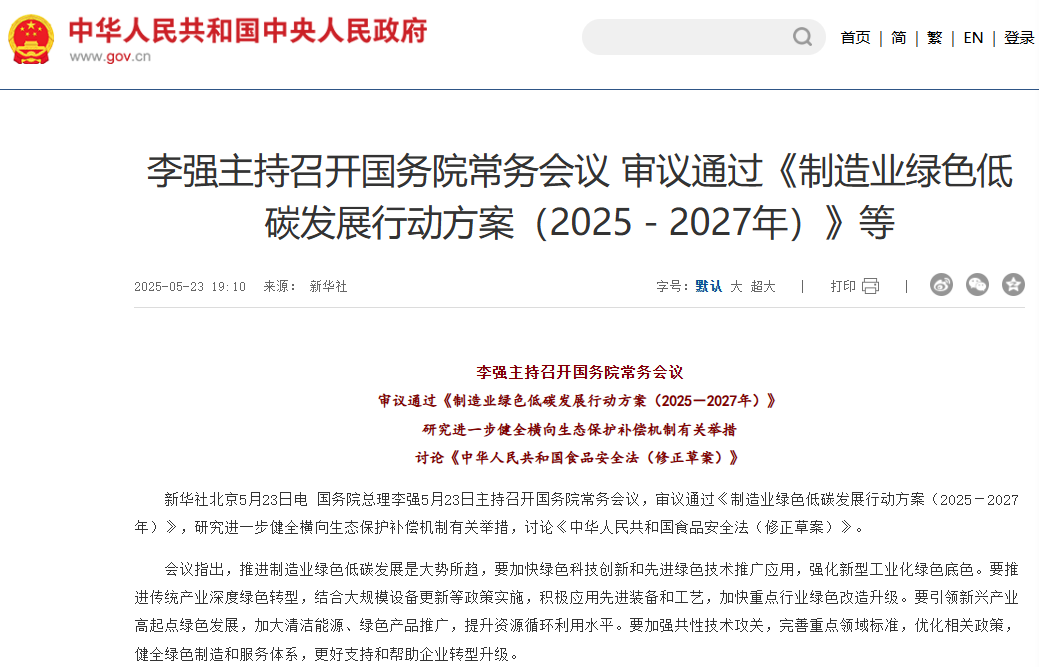
Group 1 - The State Council of China has approved the "Manufacturing Green Low-Carbon Development Action Plan (2025-2027)", emphasizing the need for green technology innovation and the promotion of advanced green technologies [1] - The plan aims to accelerate the deep green transformation of traditional industries and promote the green development of emerging industries, focusing on clean energy and resource recycling [1] - As of the end of 2024, China has cultivated 6,430 green factories, accounting for over 20% of the total manufacturing output value, with significant investments in green low-carbon transformation projects exceeding 250 billion yuan [1] Group 2 - Despite progress in green development, China's manufacturing sector still faces challenges such as the need to improve green technology levels and optimize industrial structure [2] - The Ministry of Industry and Information Technology plans to establish a green low-carbon development mechanism and develop carbon footprint accounting standards for key products like steel and new energy vehicles [2] - There is a focus on the comprehensive utilization of waste materials, including used power batteries and photovoltaic components, to prepare for the upcoming retirement peak [2]

《制造业绿色低碳三年行动方案》出炉
Huan Qiu Wang· 2025-05-24 02:20
Group 1 - The core viewpoint of the article emphasizes that green development will become the core driving force for promoting high-quality economic development in China, as indicated by the approval of the "Manufacturing Green Low-Carbon Development Action Plan (2025-2027)" [1][3] - The meeting highlighted the necessity of advancing green low-carbon development in the manufacturing sector, accelerating green technology innovation, and promoting the application of advanced green technologies [3] - The government plans to focus on key products such as steel, electrolytic aluminum, lithium batteries, and new energy vehicles, and will develop carbon footprint accounting standards while preparing for the comprehensive utilization of retired products like used power batteries and photovoltaic components [3] Group 2 - Establishing a horizontal ecological protection compensation mechanism is crucial for enhancing ecological environment protection and promoting regional collaborative development [4] - The meeting called for a comprehensive, clear, and efficient horizontal ecological protection compensation mechanism, which will facilitate the interaction between ecological product supply areas and beneficiary areas [4] - The discussion on the revision of the Food Safety Law reflects the government's high emphasis on food safety issues, providing a stronger legal guarantee for ensuring the safety of food for the public [4]
国常会,最新部署!
券商中国· 2025-05-23 15:16
Core Viewpoint - The article emphasizes the importance of promoting green and low-carbon development in the manufacturing industry, highlighting the need for technological innovation and the establishment of effective ecological compensation mechanisms [2][3]. Group 1: Green Low-Carbon Development - The State Council has approved the "Manufacturing Green Low-Carbon Development Action Plan (2025-2027)", focusing on deep green transformation of traditional industries and high-start green development of emerging industries [3][4]. - Key industries such as steel, electrolytic aluminum, lithium batteries, and new energy vehicles will be prioritized for green transformation, with efforts to establish carbon footprint accounting standards [4]. - The plan aims to enhance resource recycling and promote clean energy and green products, supported by policies for equipment upgrades and technological advancements [3][4]. Group 2: Ecological Protection Compensation Mechanism - The meeting discussed the establishment of a comprehensive horizontal ecological protection compensation mechanism, which is crucial for ecological environment protection and regional collaborative development [2][5]. - The mechanism will focus on clear responsibilities, diverse methods, and efficient governance, promoting interaction between ecological product supply areas and beneficiary areas [5]. - The article mentions the implementation of the "Ecological Protection Compensation Regulations" in June 2024, which establishes basic rules for ecological protection compensation in China [5][6].

国常会最新部署!
证券时报· 2025-05-23 12:49
Core Viewpoint - The article emphasizes the importance of promoting green and low-carbon development in the manufacturing industry, highlighting the need for technological innovation and the establishment of effective ecological compensation mechanisms [1][3]. Group 1: Green Low-Carbon Development - The State Council has approved the "Manufacturing Green Low-Carbon Development Action Plan (2025-2027)", which aims to accelerate the green transformation of traditional industries and promote high-start green development in emerging industries [3]. - Key industries such as steel, electrolytic aluminum, lithium batteries, and new energy vehicles will be the focus for accelerating green upgrades and the establishment of carbon footprint accounting standards [4]. - The plan includes enhancing the recycling of resources and promoting clean energy and green products [3]. Group 2: Horizontal Ecological Protection Compensation Mechanism - The meeting discussed measures to improve the horizontal ecological protection compensation mechanism, which is crucial for enhancing ecological protection and promoting regional collaborative development [1][6]. - The mechanism aims to create a clearer responsibility framework and more diverse governance methods, ensuring a positive interaction between ecological product supply areas and beneficiary areas [6]. - The article highlights the need for a well-defined incentive and constraint policy to attract more social capital into ecological civilization construction [6][7].