港股通科技ETF招商

Search documents
恒生科技大涨!网友:诚不我欺!流动性冲击退潮+估值历史最低,三大港股科技ETF齐涨超1%
Jin Rong Jie· 2026-02-10 02:43
Core Viewpoint - The recent rebound in the Hong Kong tech sector is attributed to the easing of multiple negative factors and the emergence of positive influences, as highlighted in a report by China Merchants Securities [1][2]. Group 1: Market Dynamics - The peak of liquidity shock has passed, alleviating the primary constraint on the market. The report indicates that the recent decline in Hong Kong stocks was primarily due to short-term liquidity shocks from "Wash Trading," rather than a deterioration in fundamentals. This shock was mainly micro-level and a correction of previous overly optimistic trading. With the peak of this shock now over, market liquidity expectations are improving, creating essential conditions for valuation recovery [1]. Group 2: Valuation Insights - Valuations have reached historically low levels, presenting a rare "high-odds" opportunity. The report emphasizes that the Hang Seng Tech Index is trading at a significant discount compared to the A-share tech index, even lower than during periods of severe regulatory challenges in 2022 and 2023. In the context of the current AI industry wave and national support for tech innovation, this extreme discount indicates that the Hong Kong tech sector is "significantly undervalued," providing a high margin of safety and potential for future recovery [2]. Group 3: Fundamental and Sentiment Support - Earnings expectations have stabilized, and industry trends provide long-term momentum. Although earnings expectations were previously downgraded, signs of stabilization have emerged, suggesting that the market's pessimistic outlook on performance has largely been priced in. Additionally, positive developments from industry giants like Tencent and Alibaba in large model fields, along with better-than-expected commercialization progress from companies like Kuaishou, collectively form a solid industrial foundation for long-term growth in the sector [2]. Group 4: Future Outlook - The current rebound can be viewed as a corrective market trend resulting from the simultaneous alleviation of "liquidity, valuation, and fundamentals" pressures. While challenges may still lie ahead, the "six reasons" proposed during the most pessimistic times are gradually being validated by the market, indicating that a long-term value strategy may be entering a favorable window for investment [2].


腾讯、阿里接连走低,恒生科技坠入“技术性熊市”?主力逆市抄底ETF意图何在
Jin Rong Jie· 2026-02-05 06:35
Core Viewpoint - The Hong Kong technology sector continues to experience a downward adjustment, with the Hang Seng Technology Index dropping over 20% since its peak in October last year, while certain stocks related to hardware or AI concepts are showing resilience [1][3]. Group 1: Market Performance - The Hang Seng Technology Index fell more than 1% on February 5, reflecting a significant decline in major stocks like Tencent and Alibaba, while companies like Xiaomi and Lenovo saw gains [1]. - Despite the overall weak performance of the index, ETF products tracking the technology sector experienced a net inflow of over 200 million, indicating a "buy the dip" strategy among long-term investors [2]. Group 2: Factors Influencing Market Adjustment - The current market adjustment is attributed to three main factors: a shift in global macro liquidity expectations, a cooling optimism regarding potential interest rate cuts by the Federal Reserve, and concerns over the quality of growth due to intense competition in AI applications [3]. - Some companies have issued earnings forecasts that fell short of expectations, contributing to a heightened risk-averse sentiment among investors [3]. Group 3: Investment Opportunities - The reverse capital inflow suggests that the valuations of the Hong Kong technology sector have reached historically low levels, presenting an opportunity for long-term investors to acquire quality assets at lower costs [3]. - The core position of the underlying assets in the ETFs, representing China's digital economy and long-term trends in artificial intelligence, remains unchanged despite current market volatility [3].

中国资产全面爆发!港股科技50ETF(159750)、港股通科技ETF招商(159125)携手高开!华虹半导体领涨
Jin Rong Jie· 2026-01-22 01:57
Group 1 - The core viewpoint of the article highlights a positive trend in Chinese technology stocks, driven by overnight gains in the US stock market, with significant increases in Hong Kong's technology ETFs [1] - The Hong Kong Technology 50 ETF (159750) and the Hong Kong Stock Connect Technology ETF (159125) saw increases of 0.95% and 0.65% respectively, with intraday highs of 1.52% and 1.29% [1] Group 2 - Goldman Sachs' Chief China Equity Strategist Liu Jinjun projects a target of 100 points for the MSCI China Index and 5200 points for the CSI 300 Index by the end of 2026 [2] - The expected return rate for the Chinese stock market in 2026 is estimated to be between 15% and 20%, primarily driven by earnings growth, with a projected earnings growth rate of 14% for Chinese stocks [2] Group 3 - Three main factors are identified to drive earnings growth in Chinese stocks: 1. The AI industry is expected to contribute significantly, with annual contributions of 2% to 3% to overall market earnings growth over the next 3 to 5 years as the focus shifts from computing power to application and commercialization [2] 2. The overseas strategy shows potential, as companies listed in the US S&P 500 have 28% of their revenue from overseas, compared to only 16% for Chinese companies, indicating substantial room for growth [2] 3. The "anti-involution" trend is also anticipated to positively impact earnings growth [3]

南向资金回流,被动外资加速流入港股,机构:科技仍是主线
Sou Hu Cai Jing· 2025-12-23 06:48
Economic Indicators - The core CPI in the US increased by 2.6% year-on-year in November, which is lower than the market expectation of 3% [19] - Non-farm employment in the US rose by 64,000 in November, exceeding the market expectation of 50,000; however, the unemployment rate unexpectedly increased to 4.6%, the highest since September 2021 [19] - Federal Reserve officials indicated that with a weakening job market and controlled inflation, there is significant room for interest rate cuts [19] Capital Flows - Southbound capital flow returned with an inflow of HKD 16.27 billion in one week, compared to an outflow of HKD 3.44 billion the previous week [19] - According to EPFR data, active foreign capital saw an outflow of USD 640 million as of last Wednesday, compared to an outflow of USD 220 million the previous week; however, passive foreign capital accelerated inflows, with USD 3.43 billion entering Hong Kong stocks in one week, up from USD 900 million the previous week [19] Market Outlook - Galaxy Securities noted that with the Bank of Japan's recent decisions and a slightly more dovish expectation from the Federal Reserve, external risks are narrowing, suggesting that Hong Kong stocks may experience a volatile upward trend [22] - The technology sector remains a long-term investment focus, with valuations having corrected after previous adjustments, and is expected to rebound due to multiple favorable factors [22] - The consumer sector is anticipated to receive substantial policy support, with current valuations at relatively low levels; attention should be paid to the implementation of policies and improvements in consumer data [22] Index Information - The National Index for Hong Kong Stock Connect Technology selects 30 leading technology companies based on market capitalization, R&D investment, and revenue growth, including major players like Tencent, Alibaba, Xiaomi, Meituan, SMIC, and BYD [2][7] - The index requires constituent stocks to have a compound revenue growth rate exceeding 10% over the past two years or an R&D expense ratio above 5%, balancing scale and growth potential [7] - The index has a flexible sample adjustment mechanism, with quarterly adjustments to maintain competitiveness [7]

招商基金董事长人选定了!招行副行长王颖兼任
券商中国· 2025-11-26 23:36
Core Viewpoint - The appointment of Wang Ying as the new chairman of China Merchants Fund marks a significant leadership change, with expectations for new strategic directions and enhanced collaboration with the parent company, China Merchants Bank [1][4][7]. Group 1: Leadership Changes - Wang Ying will assume the role of chairman of China Merchants Fund starting November 27, 2023, while also serving as the vice president of China Merchants Bank [1][2]. - The previous chairman, Wang Xiaoqing, stepped down on September 24, 2023, with the general manager, Zhong Wenyue, temporarily taking over the role until Wang Ying's appointment [4][5]. - Zhong Wenyue will officially cease to act as chairman on November 27, 2025, after returning to the fund in May 2025 [4][5]. Group 2: Company Performance and Strategy - As of the latest data, China Merchants Fund has a total asset size of 957.37 billion yuan, with non-monetary management assets amounting to 570.7 billion yuan [6]. - The new leadership aims to leverage their extensive experience within the China Merchants Bank system to drive the fund's development and enhance strategic collaboration with its parent company [7]. - The fund plans to focus on three key areas: deep research sharing, quality asset organization and product creation, and innovation as a testing ground, to strengthen strategic alignment with its shareholders [7]. Group 3: Recent Developments and Market Position - Since Zhong Wenyue's return, China Merchants Fund has successfully launched several new funds, including the招商均衡优选基金, which raised over 5 billion yuan in just one day [8]. - The fund has also been active in the ETF market, with multiple index funds achieving significant fundraising milestones in recent months [8]. - A recent memorandum of cooperation was signed with a New Zealand fund company to enhance cross-border investment product development, indicating a push towards internationalization [8]. Group 4: Industry Context - The year has seen significant turnover in leadership across the public fund industry, with over 20 fund companies changing general managers and more than 30 changing chairpersons, reflecting a trend of banks consolidating control over their fund management subsidiaries [9][10].

中概股大爆发,百度涨超7%,阿里巴巴涨超5%,机构:港股科技股有望营收与盈利共振上行
Ge Long Hui· 2025-11-25 03:47
Core Viewpoint - Chinese concept stocks experienced a collective surge, with the Nasdaq China Golden Dragon Index rising by 2.82% on November 24, 2023, driven by expectations of a potential interest rate cut by the Federal Reserve in December [1] Group 1: Market Performance - Major Chinese stocks saw significant gains: Baidu increased by over 7%, Bilibili by over 6%, Alibaba by over 5%, NetEase by over 4%, and NIO by over 3% [1] - The probability of a 25 basis point rate cut by the Federal Reserve in December rose to 82.9%, a substantial increase from previous forecasts [1] Group 2: Industry Outlook - CITIC Securities indicated that with macroeconomic improvements, Hong Kong stocks are expected to transition from "earnings recovery" to "revenue expansion," creating a sustainable upward trend in both revenue and profit [1] - The Hong Kong stock market is poised to benefit from the outflow of liquidity from domestic and international markets, alongside the ongoing AI narrative, as more high-quality leading A-share companies list in Hong Kong [1] Group 3: Index and ETF Information - The National Index Hong Kong Stock Connect Technology Index selects 30 leading technology companies based on market capitalization, R&D investment, and revenue growth, including Tencent, Alibaba, Xiaomi, Meituan, SMIC, and BYD [5][8] - The index requires constituent stocks to have a compound revenue growth rate exceeding 10% over the past two years or an R&D expense ratio above 5%, balancing scale and growth potential [5] - The latest valuation of the Hong Kong Technology Index is 22.92 times PE, positioned at the 15th percentile since its inception [12] Group 4: Key Constituents - The top five constituents of the Hong Kong Stock Connect Technology Index include Alibaba (18.03%), Tencent (15.27%), Xiaomi (11.83%), Meituan (9.10%), and SMIC (6.80%) [9] - The index has a high concentration, with the top five stocks accounting for over 61% and the top ten nearly 80% of the total weight [7] Group 5: Future Market Sentiment - Huatai Securities noted that the sentiment in the Hong Kong stock market remains pessimistic, indicating a balanced risk profile, suggesting that investors may gradually build positions [20] - CITIC Securities anticipates that the "money-making effect" in the Chinese stock market will continue, with domestic investors likely to increase their allocation to Hong Kong stocks due to current underexposure [20]



科技股暴力反弹!恒科跌19%超历史均值,布局时机显现?
Sou Hu Cai Jing· 2025-11-25 02:37
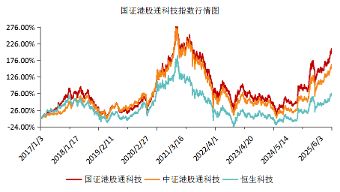
Group 1 - The core viewpoint of the news highlights a significant rebound in Hong Kong stocks, particularly in the technology sector, driven by multiple factors including the U.S. "Genesis Project" aimed at transforming scientific research through AI [2] - The Hang Seng Index and Hang Seng Tech Index opened strongly, with notable gains in tech stocks such as Bilibili, Xiaomi, and ZTE [1][2] - Goldman Sachs' chief China equity strategist indicates that the rise in Chinese stocks led by AI is not a bubble, suggesting that tech companies have room to enhance valuations and profits through AI applications [2] Group 2 - The Hang Seng Index and Hang Seng Tech Index experienced declines of 7.58% and 19.26% respectively from October 3 to November 21, indicating a potential for recovery [3] - The valuation of the Hong Kong Stock Connect Technology ETF is at a price-to-earnings ratio of 23.55, which is considered attractive compared to global tech indices like the Nasdaq and ChiNext [3] - Historical performance shows that the Hong Kong Stock Connect Technology Index has outperformed other indices significantly, with a cumulative increase of 164.61% since early 2017, suggesting strong potential for future gains [3]
ETF市场日报 | 光伏板块再度领涨!日韩、软件相关ETF回调居前
Sou Hu Cai Jing· 2025-11-05 07:41
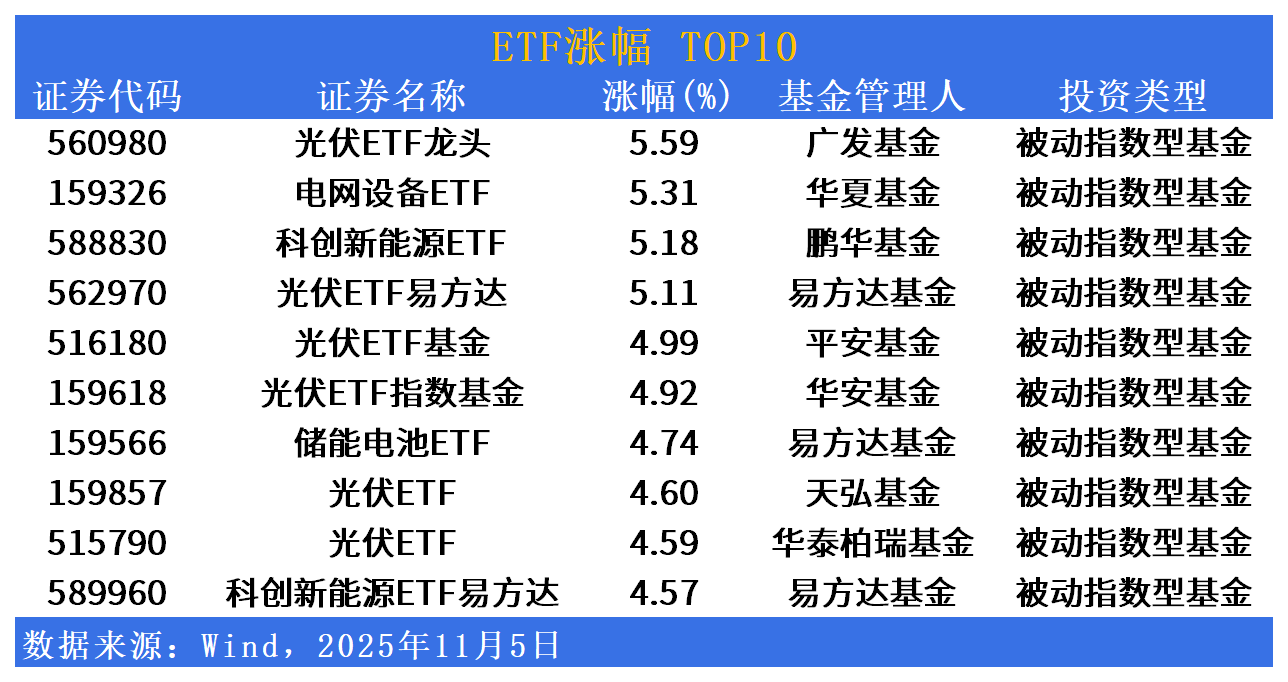
Group 1: ETF Performance - The top-performing ETFs include the Photovoltaic ETF Leader (560980) with a gain of 5.59%, followed by the Grid Equipment ETF (159326) at 5.31% and the Innovation New Energy ETF (588830) at 5.18% [1] - Other notable gainers are the E Fund Photovoltaic ETF (562970) at 5.11% and the Photovoltaic ETF Fund (516180) at 4.99% [1] Group 2: Photovoltaic Sector Insights - The improvement in Q3 profitability for the photovoltaic sector is driven by two main factors: stabilization of the photovoltaic industry chain prices and a reduction in inventory impairment losses [2] - The overall gross margin level has increased, particularly in the silicon material segment, indicating a positive trend in profitability [2] - Future demand in the photovoltaic market remains under pressure, especially with the implementation of Document No. 136, which may affect pricing and profitability levels [2] Group 3: ETF Declines - The worst-performing ETFs include the Asia-Pacific Select ETF (159687) with a decline of 3.56%, followed by the Sino-Korean Semiconductor ETF (213310) at 3.13% [3] - Other notable declines are seen in the Dividend Low Volatility ETF (260890) at 2.94% and the Nikkei 225 ETF (213880) at 2.43% [3] Group 4: ETF Trading Activity - The Short-term Bond ETF (511360) recorded the highest trading volume at 29.218 billion yuan, followed by the Yinhua Daily ETF (511880) at 15.899 billion yuan [4] - The turnover rate for the Government Bond ETF (511580) was the highest at 341%, indicating significant trading activity [4] Group 5: New ETF Offerings - The E Fund A500 Dividend Low Volatility ETF (563510) will begin fundraising, tracking the CSI A500 Dividend Low Volatility Index [5] - The Hong Kong Stock Connect Technology ETF (159125) will be listed, focusing on major technology companies like Alibaba and Tencent, appealing to investors optimistic about the long-term growth of the Hong Kong tech sector [5]
聚焦“硬科技+新经济”,港股通科技ETF招商(159125)10月13日发行
2 1 Shi Ji Jing Ji Bao Dao· 2025-10-13 02:34
Core Viewpoint - The launch of the China Securities Hong Kong Stock Connect Technology ETF (code: 159125) aims to closely track the China Securities Hong Kong Stock Connect Technology Index, which includes leading technology companies in the Hong Kong market with core competitiveness [1] Group 1: Index Composition and Focus - The China Securities Hong Kong Stock Connect Technology Index selects 30 leading technology companies based on market capitalization, R&D investment, and revenue growth, focusing on "hard technology" and "new economy" sectors [2] - The index requires constituent stocks to have a compound revenue growth rate exceeding 10% over the past two years or an R&D expense ratio above 5%, ensuring a balance between scale and growth potential [2] - As of September 30, the index's sector weightings include 43% in consumer discretionary, 42% in information technology, and 12% in healthcare, with the top ten constituents accounting for 79% of the index [2] Group 2: Performance Metrics - The China Securities Hong Kong Stock Connect Technology Index has shown strong long-term performance, with a cumulative return of 209.77% and an annualized return of 14.03% since 2017, outperforming similar indices [3] - The index exhibits high elasticity, with an annualized volatility of 33.78%, indicating relatively high fluctuations [4] Group 3: Valuation and Market Trends - As of September 30, the index's price-to-earnings ratio stands at 26.45, positioned at the 39th percentile since inception, suggesting a favorable valuation compared to global tech indices like NASDAQ and ChiNext [6] - Hong Kong's technology companies have become significant players in stock buybacks, with a total buyback amount of 136.7 billion HKD in the first nine months of the year, indicating strong institutional confidence in long-term opportunities [8] - The influx of mainland capital into the Hong Kong market has reached a record high of 1.17 trillion HKD in net inflows this year, with technology stocks being a primary focus for investment [8]