牛油果(Avocado)

Search documents
AI日报丨中国AI大模型调用量连续两周超越美国,神秘模型Hunter Alpha上榜,Meta千亿自研大模型遭延期,据称拟裁员20%
美股研究社· 2026-03-16 12:07
Core Insights - The article highlights the rapid development of artificial intelligence (AI) technology, presenting significant opportunities in the market [3]. Group 1: AI Model Usage - China's AI large model usage surpassed that of the United States for two consecutive weeks, with a weekly call volume of 46.9 trillion tokens, an increase of 11.83% from the previous week [5]. - The U.S. AI large model call volume was 32.94 trillion tokens, reflecting a decline of 9.33% [5]. - The top three global AI models by call volume were all from China, with the newly introduced Hunter Alpha model achieving a weekly call volume of 6.66 trillion tokens, ranking seventh [5]. Group 2: AI Security Concerns - Hong Kong's government has advised against using the AI application OpenClaw on government-connected computers due to its uncertainties, urging adequate security measures for external users [6]. - Experts have raised concerns about "poisoning" of AI large models, where businesses manipulate models to generate biased recommendations, constituting a new form of unfair competition and consumer deception [8]. Group 3: Company Developments - Meituan's CEO Wang Puzhong emphasized the company's strategy to enhance AI capabilities for merchants, aiming to provide each merchant with their own AI assistant [9]. - Tesla's CEO Elon Musk announced that the AI chip factory project, codenamed "Terafab," will officially launch within seven days, marking a step towards vertical integration in chip production for autonomous driving [11]. - Meta Platforms has delayed the release of its self-developed AI model "Avocado" from March to at least May and is reportedly planning to lay off 20% of its workforce, potentially affecting over 15,000 employees [12]. - Amazon has partnered with Cerebras Systems to integrate AI inference chips into a new service aimed at accelerating various AI applications, with a focus on the critical inference process [13].



苹果、英伟达、特斯拉,集体下跌
财联社· 2026-03-14 01:12
Market Overview - The U.S. stock market indices collectively declined, ending a volatile week, with significant fluctuations in oil prices impacting the market as investors assess the effects of the Iran conflict on global oil supply [1][2] - The major U.S. indices recorded both daily and weekly losses, with the Russell 2000 index hitting its lowest level of the year [2] Oil Market Dynamics - Oil prices experienced high volatility, with WTI crude oil futures settling at $98.71 per barrel, up 3.11%, and Brent crude rising 2.67% to $103.14 per barrel [3] - President Trump vowed to impose severe strikes on Iran, and reports indicated the conflict has spread to multiple countries, diminishing hopes for a resolution [3] Economic Data and Federal Reserve Outlook - The U.S. Commerce Department significantly revised down the fourth-quarter GDP growth rate, highlighting a series of disappointing economic indicators, including weak durable goods demand [4] - Despite the weak economic data, the Federal Reserve is expected to maintain key interest rates, with rising oil prices exacerbating inflation concerns [4] Sector Performance - The Dow Jones Industrial Average fell by 119.38 points (0.26%) to 46,558.47, the Nasdaq dropped by 206.62 points (0.93%) to 22,105.36, and the S&P 500 decreased by 40.43 points (0.61%) to 6,632.19 [4] - Among the 11 major sectors in the S&P 500, the technology sector saw the largest decline, while the utilities sector experienced the most significant gain [4] ETF and Stock Performance - In the ETF market, global technology stock indices fell by 0.87%, while energy and utilities ETFs saw gains of 0.33% and 0.99%, respectively [5] - Major tech stocks experienced declines, with Apple down 2.21%, Nvidia down 1.58%, and Microsoft down 1.57% [6] Company News - Amazon announced a partnership with AI chip startup Cerebras Systems to integrate their computing chips into a new service aimed at accelerating AI applications [8] - Elon Musk publicly apologized for issues at his AI company xAI, which faced significant talent departures, and confirmed that the "Digital Optimus" will be ready for user experience in about six months [9]




Meta再爆大瓜,气走杨立昆的Wang也受不了小扎了?
3 6 Ke· 2025-12-18 08:12
Core Viewpoint - Meta is undergoing significant restructuring in its AI division, led by CEO Mark Zuckerberg, but faces internal challenges and management issues that may hinder its ambitious AI goals, particularly the development of a new closed-source model codenamed "Avocado" set for release in Q1 2024 [1][12]. Group 1: Management and Internal Dynamics - Zuckerberg has heavily invested in AI talent, including acquiring a 49% stake in Scale AI for $14.3 billion and appointing its founder, Alexandr Wang, as Chief AI Officer, but internal dissatisfaction is growing [2][4]. - Wang has expressed frustration with Zuckerberg's micromanagement style, which is causing tension within the team [2][5]. - Key figures like Yann LeCun, Meta's Chief AI Scientist, are leaving due to internal conflicts and disagreements over the direction of AI development, particularly the shift towards closed-source models [5][7]. Group 2: AI Development and Financial Implications - Meta's AI division has undergone four reorganizations, culminating in the establishment of the "Super Intelligence Lab," which includes departments focused on research, infrastructure, product application, and the new TBD Lab, which is tasked with overseeing the development of the "Avocado" model [11]. - The "Avocado" model aims to achieve performance levels comparable to Gemini 2.5 at launch and Gemini 3 by summer 2024, but it is being built from scratch rather than as an iteration of the existing Llama model [11]. - Meta's capital expenditures for 2025 are projected to reach at least $70 billion, significantly higher than the previous year's $39 billion, with plans for AI spending potentially exceeding $100 billion, raising concerns among investors [12].

阿里千问成全球开源模型“新标杆”,Meta新项目被曝蒸馏千问
Xin Lang Cai Jing· 2025-12-11 12:59
Core Insights - Meta plans to launch a new model called "Avocado" in spring 2024, likely in a closed-source format, which has drawn inspiration from various open-source models, including Alibaba's Qwen [1][2] - The shift in Meta's strategy reflects a significant change in CEO Mark Zuckerberg's stance, moving from advocating for U.S. models to adopting insights from strong Chinese open-source models like Qwen [2][3] Group 1: Meta's New Model - Meta's new model "Avocado" is being developed by the newly formed TBD lab team and is expected to distill insights from multiple open-source models, including those from Google and OpenAI [1] - The launch of "Avocado" comes after Meta's Llama4 project faced setbacks, prompting a reevaluation of its approach to model development [2] Group 2: Alibaba's Qwen Model - Alibaba's Qwen model has seen significant success, with its derivative models expected to surpass Llama in number by August 2024 and in global download volume by October 2025 [2][3] - Qwen has been recognized for its performance, recently surpassing competitors like GPT-5 and Claude Opus 4, positioning itself among the top three models globally [3] Group 3: Industry Impact - Qwen's influence extends beyond Alibaba, with major companies like Amazon and Airbnb utilizing it for new business developments, and various institutions leveraging it for technological innovations [3][6] - The rapid growth of Qwen is evidenced by its monthly active users exceeding 30 million within just 23 days of its public testing, marking it as one of the fastest-growing AI applications globally [6]

Meta大转向:下一代模型“牛油果”推迟,开源时代或将终结
3 6 Ke· 2025-12-11 10:00
Core Insights - Meta is accelerating its adjustment of AI strategy, with the next-generation model "Avocado" being postponed from late 2025 to Q1 2026 and likely to be released in a closed-source format, indicating a shift from its previously open-source approach [2] - The company is increasing its capital expenditure for 2025 to $70-72 billion, focusing on training clusters and data center expansions, which is seen as a foundational investment for its AI initiatives [3] Group 1: Organizational Changes - The delay of Avocado reflects deeper organizational changes, with a significant turnover in AI leadership as the company shifts from an academic-oriented research system to one that emphasizes product implementation and speed [6] - The introduction of external high-end talent, including Alexandr Wang from Scale AI, has accelerated this restructuring, leading to a more closed and startup-like environment within the Meta Superintelligence Labs [6][8] - The AI-related teams have undergone multiple rounds of restructuring and layoffs, with over 600 personnel in foundational research being cut, indicating a move towards a more engineering-focused and commercially driven approach [8] Group 2: Hardware Strategy Shift - Meta's AI strategy overhaul has impacted its hardware roadmap, with a comprehensive review of the Reality Labs hardware department and a slowdown in the development of augmented reality (XR) projects [11] - The company plans to reduce its metaverse budget over the next two years, reallocating resources towards AI models and related technologies such as smart glasses and voice assistants [11] - Meta is transitioning from a primarily self-built infrastructure to a more pragmatic mixed model, expanding partnerships with CoreWeave, Oracle, and Blue Owl Capital to support the high computational demands of closed-source models [11] Group 3: Strategic Direction - The postponement of Avocado signifies a clear strategic pivot for Meta, driven by competitive pressures and the need to deliver investment returns more rapidly [12] - This shift represents Meta's third major strategic migration in over a decade, moving from a focus on mobile internet and the metaverse to a more concentrated effort on closed-source AI models [12] - The current environment reflects a transition from visionary discussions to a focus on ensuring competitive positioning, with all resources being mobilized to avoid being left behind in the evolving landscape [12]

Meta新AI大模型“牛油果”有望明年一季度发布,使用阿里Qwen模型蒸馏学习
Xin Lang Cai Jing· 2025-12-11 03:32
Core Insights - Meta is developing a new AI model codenamed "Avocado," utilizing Alibaba's Qwen model for distillation optimization, with a potential closed-source release planned for Q1 2026 [1] - CEO Mark Zuckerberg is personally involved in the project, shifting the company's strategy towards monetizable AI models after significant investment [1] - The internal development team, led by Alexandr Wang, is facing challenges in optimizing the model for complex reasoning and cross-modal generation capabilities [1] Group 1 - Meta's shift from open-source ambitions to leveraging competitor models reflects a strategic pivot amid market pressures [2] - The failure of the Llama 4 model has catalyzed a change in strategy and significant personnel shifts within the company [2] - High-profile hires, including Alexandr Wang and Nat Friedman, are expected to bring cutting-edge AI research capabilities to Meta [2] Group 2 - Recent leadership changes, including the departure of Chief Revenue Officer John Hegeman, indicate ongoing organizational adjustments in response to investor pressures [3] - Meta's substantial capital expenditures have raised concerns about its profitability outlook, necessitating proof of the viability of its AI strategy [3] - The performance of Meta's AI short video platform, Vibes, has been underwhelming compared to competitors, highlighting the urgency for breakthroughs in its core AI projects [3]
Meta人工智能方向转向闭源模式 据悉训练模型的工具包括通义千问
Xin Lang Cai Jing· 2025-12-10 16:40
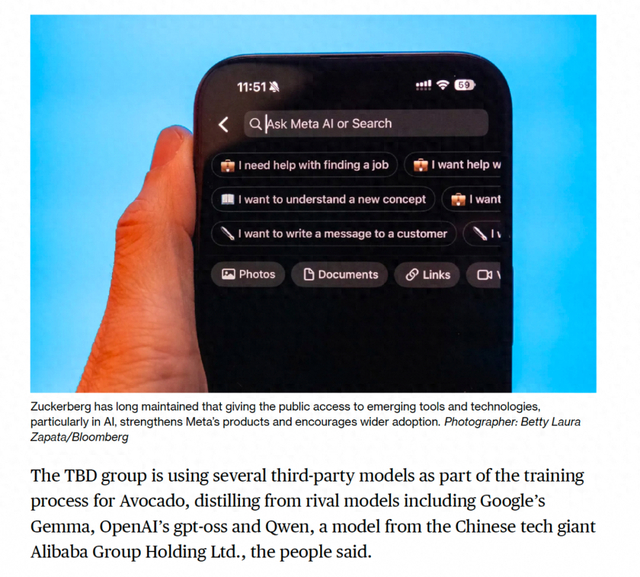
Core Insights - Meta Platforms Inc. is shifting its focus towards commercializable AI models, with CEO Mark Zuckerberg personally involved in daily operations to build one of the most expensive tech teams in history [1][8] - A new model, codenamed "Avocado," is expected to be launched in spring next year as a "closed" model, marking a significant shift from Meta's previously promoted open-source strategy [1][8] - The company has faced disappointment with its open-source model Llama 4, leading to a strategic pivot and the recruitment of top AI researchers with lucrative compensation packages [1][8] Group 1: Strategic Shift - The new AI model "Avocado" will be strictly controlled and accessible for purchase, aligning with approaches taken by competitors like Google and OpenAI [1][8] - Meta's new Chief AI Officer, Alexandr Wang, supports the closed model approach, indicating a departure from the open-source philosophy [1][8] - The company has marginalized some personnel involved in the Llama project and is now focusing on a team called TBD Lab, which is closely monitored by Zuckerberg [1][4] Group 2: Training and Development - The TBD team is utilizing various third-party models, including Google's Gemma, OpenAI's gpt-oss, and Alibaba's Tongyi Qianwen, to train the new model [2][9] - Zuckerberg's previous concerns about national scrutiny of models have shifted, as he now calls for U.S. government support for domestic tech firms to maintain a competitive edge in AI [2][9] Group 3: Leadership and Personnel Changes - Alexandr Wang, a 28-year-old talent from Scale AI, is seen as crucial for the success of Meta's upcoming AI products, with Zuckerberg positioning himself as Wang's mentor [4][12] - The departure of Yann LeCun, a prominent figure in AI research at Meta, reflects internal challenges and a lack of resources, as well as a shift away from the open-source strategy [7][15] - Following the release of Llama 4, the next generation model was initially codenamed Behemoth but has been abandoned in favor of new directions [15]