
独立储能

Search documents
电力行业周报:多省健全储能机制,现货+辅助服务+容量补偿构建稳盈利模式
GOLDEN SUN SECURITIES· 2026-03-29 10:24
Investment Rating - The report maintains an "Overweight" rating for the power sector [4] Core Viewpoints - Multiple provinces are improving energy storage mechanisms, establishing a stable profit model through spot market, auxiliary services, and capacity compensation [3][15] - The user-side energy storage installation plan is set at 8 million kilowatts, becoming a significant growth driver, covering industries such as chemicals, steel, manufacturing, and data centers [3][16] - The report emphasizes the importance of a market-oriented approach, allowing energy storage to fully participate in the market while exempting it from transmission and distribution fees, thus ensuring reliable returns on investment [3][7] Summary by Sections Industry Insights - The report highlights the establishment of a three-pronged profit model for energy storage, combining pricing mechanisms, market mechanisms, and capacity compensation [3][16] - Jilin Province has detailed rules for independent energy storage market participation, creating a revenue framework that includes energy trading, auxiliary services, and capacity compensation [3][7] - Henan Province aims for an energy storage installation capacity of 23 GW by 2030, with direct project investments of 40 billion yuan, enhancing market mechanisms and commercial models [7][17] - Shaanxi Province is exploring flexible participation mechanisms for independent energy storage, allowing for dual revenue streams from both spot and auxiliary service markets [8][18] Market Performance - The report notes that the power and public utilities index rose by 2.01%, outperforming the CSI 300 index by 3.42 percentage points [63][64] - The overall market performance indicates a positive trend for the power sector, with most listed companies in the sector experiencing gains [64][68] Key Companies - The report suggests focusing on companies involved in energy storage and power generation, including Fuling Power, Jinkai New Energy, and Gansu Energy [9] - It also highlights companies with significant potential in flexible coal power transformation, such as Huaneng International and Huadian International [9]
广西独立储能首次以“报量报价”方式进入电力现货市场
中关村储能产业技术联盟· 2026-03-18 12:08
Core Viewpoint - The successful trading of the Guangxi 220 kV Honghua Energy Storage Power Station in the southern regional electricity spot market marks the first independent energy storage participation in the market through "quantity-based pricing," indicating a shift to fully market-oriented operations [2][3]. Group 1: Market Participation and Innovations - The Honghua Energy Storage Power Station autonomously declared its charging and discharging capacity curves, operational limits, and storage status, optimizing its participation in the market based on supply-demand dynamics and safety constraints [2]. - The innovative "long-term segmented self-selected charging and discharging + spot independent quantity-based pricing" model allows energy storage enterprises to participate as independent entities, enhancing their ability to respond to market demands and mitigate price volatility risks [2][3]. - The maximum charging and discharging power of the Honghua Energy Storage Power Station is 150,000 kW, significantly contributing to grid peak load regulation over the past year [3]. Group 2: Industry Growth and Future Prospects - As of February 2026, Guangxi's energy storage installed capacity has exceeded 3.4 million kW, representing a year-on-year growth of 40.5% [4]. - The participation of independent energy storage stations in electricity spot trading signifies their proactive role in market dynamics, establishing them as new market entities with autonomous operations and strong market competitiveness [4].

政策持续引爆独立储能江湖|独家
24潮· 2026-03-01 23:03
Core Viewpoint - The independent energy storage sector is entering a period of explosive growth due to policy changes and market dynamics, with independent storage expected to dominate new electrochemical storage applications in China by 2025 [2][3]. Policy Impact - The cancellation of mandatory energy storage requirements has led to independent storage accounting for 61% of new installations by mid-2025, with a projected cumulative operational capacity of 42.9 GW, representing 56.6% of total electrochemical storage [2]. - A new policy effective January 27, 2026, will incorporate independent storage into the generation-side capacity pricing mechanism, potentially enhancing investment value and growth trajectories for independent storage projects [2][3]. Revenue Mechanisms - The strategic significance of the new capacity pricing mechanism lies in institutionalizing revenue sources linked to "capacity contribution," providing more stable income and clearer accounting standards for independent storage [3]. - Capacity compensation and peak-valley arbitrage are identified as the primary revenue sources for independent storage projects, accounting for approximately 30% and 65% of total income, respectively [8]. Regional Policy Variations - Various provinces have implemented distinct capacity pricing compensation mechanisms, including reliable capacity compensation (Gansu, Ningxia), capacity pricing mechanisms (Hubei, Hebei), and discharge volume compensation (Inner Mongolia, Xinjiang) [8][9]. - The compensation standards vary significantly across provinces, with Gansu's capacity pricing set to reach 330 yuan/kW·year by 2026, while other provinces like Ningxia and Hebei have lower standards [9][10]. Investment Viability - Independent storage projects in regions with capacity compensation, such as Inner Mongolia, show higher investment viability, with projected internal rates of return (IRR) of 7.3% to 9.0% based on different compensation scenarios [10][12]. - Gansu, Xinjiang, and Hebei are also expected to achieve IRR of 5% or higher due to favorable capacity pricing and arbitrage opportunities [12][21]. Future Trends - The independent storage sector is anticipated to transition into a long-duration storage era, driven by the increasing share of renewable energy in the energy mix, necessitating storage solutions with longer durations [22][23]. - By 2025, it is projected that long-duration storage (4 hours or more) will account for 21% of the market, with significant growth expected in subsequent years [23]. Technological Considerations - The industry is at a critical juncture for technological advancements, with various storage technologies like pumped hydro, compressed air, and liquid flow batteries being evaluated for their suitability in long-duration applications [24][25]. - The focus on safety, cost, scalability, and environmental sustainability will be crucial for the successful deployment of long-duration storage technologies [24].
山西电力市场建设渐入佳境
Zhong Guo Dian Li Bao· 2026-02-05 01:35
Core Insights - Shanxi province is transforming its electricity market with significant advancements in long-term, spot, and ancillary service trading, leading to a more structured electricity market with 22,000 registered market participants [1] Group 1: Market Development - The introduction of time-segmented long-term trading in July 2021 allows for 24 distinct pricing periods each day, enhancing price discovery and encouraging better supply-demand balance [2] - The establishment of a spot market has revealed discrepancies in pricing, such as solar power prices dropping from 0.33 yuan per kWh in long-term contracts to below 0.2 yuan in the spot market, demonstrating the coupling of long-term and spot market prices [3] - Shanxi has initiated multi-month long-term trading, extending transactions up to six months ahead, which provides more opportunities for market participants to hedge risks and discover future electricity prices [3] Group 2: Renewable Energy Integration - Shanxi's wind and solar resources are projected to support over 150 million kW of installed renewable capacity by 2030, with annual renewable electricity generation exceeding 200 billion kWh [4] - The province's market mechanisms allow for flexible adjustments in thermal power generation to accommodate the variable nature of renewable energy, maintaining a high utilization rate of over 97% for renewables [4] - The introduction of market-driven mechanisms for thermal power to support renewable energy generation has improved the overall efficiency of energy consumption [4] Group 3: Market Mechanisms and Innovations - Shanxi plans to implement a real-time market with a 5-minute rolling clearing mechanism to enhance the granularity of market tracking and reduce frequency deviation [5] - The entry of virtual power plants into the market has aggregated 191 users with a total adjustable capacity of 312.28 MW, demonstrating the potential for improved resource utilization and flexibility in the power system [7] - Independent energy storage systems are being integrated into the frequency regulation market, providing rapid response capabilities that enhance grid stability and operational safety [8]
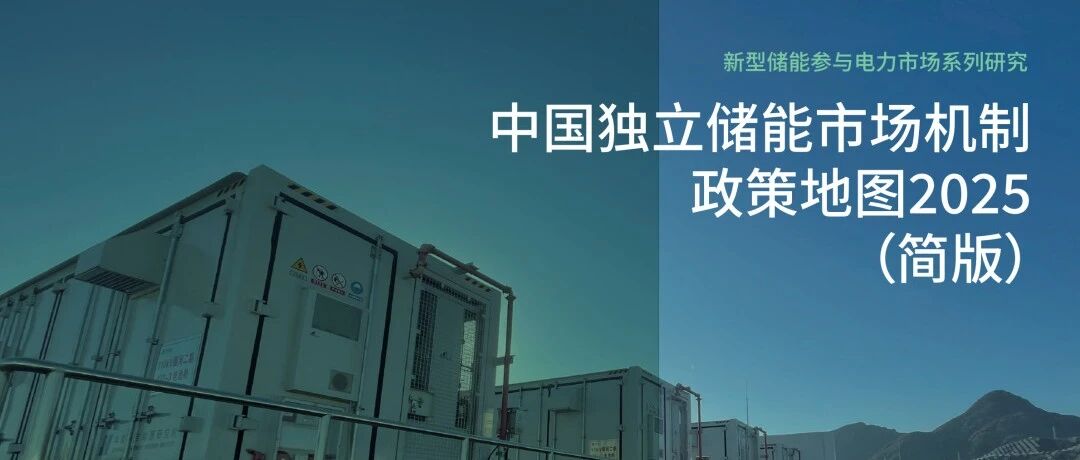
CNESA报告分享 | 《中国独立储能市场机制政策地图2025》
中关村储能产业技术联盟· 2026-02-03 09:12
Core Viewpoint - The report titled "China Independent Energy Storage Market Mechanism Policy Map 2025" aims to provide a comprehensive reference for stakeholders in the energy storage industry, focusing on the characteristics of energy structures, business models, special mechanisms, and revenue assessments across 21 key provinces in China [3][14]. Summary by Sections Introduction - The report is the first of its kind to focus on independent energy storage market mechanisms, designed to assist government departments, energy storage companies, investment institutions, and power industry practitioners in understanding market dynamics and formulating strategies [3][14]. Market Overview - By 2025, China's electricity spot market is expected to be fully covered, with renewable energy entering the market in full volume, and load sides gradually participating [13]. - The report highlights the ongoing evolution of independent energy storage market mechanisms across different regions, emphasizing the significant differences in market structures, revenue models, and pricing mechanisms [13][14]. Provincial Insights - The report provides detailed insights into the energy structure, business models, and special mechanisms for each of the 21 provinces, including: - **Hebei Province**: Notable for its high proportion of renewable energy installations and a unique pricing mechanism that reduces charging costs for independent storage [27]. - **Shanxi Province**: Features a multi-channel profit model including spot markets and frequency modulation, with a high level of market maturity [30]. - **Inner Mongolia**: Leads in renewable energy installations, with a compensation mechanism based on discharge volume [36]. - **Henan Province**: Focuses on integrated projects with a diverse revenue model, including capacity leasing and frequency modulation [41]. - **Hubei Province**: Rich in hydropower resources, with a core revenue source from the spot market and capacity compensation [46]. - **Gansu Province**: High renewable energy share with a capacity compensation standard of 330 yuan per kilowatt per year [54]. - **Ningxia**: Features a compensation mechanism that exempts certain fees, enhancing the profitability of energy storage [60]. - **Jiangsu Province**: Emphasizes peak supply and renewable energy consumption, with a focus on administrative price differences [75]. - **Zhejiang Province**: Active user-side storage demand with a capacity compensation fund to support revenue [81]. - **Shandong Province**: Transitioning from a coal-dominated structure to a more diversified energy market with active market transactions [87]. Conclusion - The report serves as a vital tool for stakeholders to navigate the complexities of the independent energy storage market in China, facilitating informed decision-making and strategic planning [3][14].
立新能源:预计2025年度归母净利润同比增长89.31%-119.20%
Xin Lang Cai Jing· 2026-01-29 10:46
Core Viewpoint - The company expects a net profit attributable to shareholders of 95 million to 110 million yuan in 2025, representing a year-on-year growth of 89.31% to 119.20% driven by new wind power and independent energy storage projects [1] Financial Performance - The increase in on-grid electricity and operating revenue is attributed to newly commissioned wind power and independent energy storage projects during the reporting period [1] - The investment income has increased due to the commissioning of the "Three Channels for External Power Transmission" project by the company's joint venture, Xinjiang Huadian Tianshan Power Generation Co., Ltd. [1]
广东建工:清洁能源累计投产装机超5094MW,储能项目稳步推进
Mei Ri Jing Ji Xin Wen· 2026-01-22 10:22
Core Viewpoint - Guangdong Construction (002060) announced that by December 23, 2025, the total installed capacity of its operational clean energy projects will reach 5,094.52 MW, comprising solar, wind, and hydropower generation [1] Summary by Category Clean Energy Projects - The total installed capacity includes 3,613.66 MW from solar power, 800.36 MW from wind power, and 380.50 MW from hydropower [1] - Additionally, the company has independent energy storage capacity of 300 MW and hydrogen production capability of 600 Nm/h [1] Project Locations - The projects are primarily located in Xinjiang, Gansu, Guangdong, Hunan, and Shandong [1] Current Developments - Completed projects include the Guangdong Yunfu Yaogu independent energy storage station and the Xinjiang Buerjin independent energy storage station [1] - The Akesu Awati County 200 MW/800 MWh energy storage project is currently under construction [1]

2026年新型储能十大预测
行家说储能· 2026-01-14 11:44
Core Viewpoint - The new energy storage industry is at a critical juncture in 2026, transitioning towards market-oriented independence amidst the dissolution of old paradigms and the construction of new models [2]. Group 1: Global Energy Storage Market - The global new energy storage installed capacity is expected to reach 123.87GW/392.76GWh in 2026, with a growth rate of 42% [4]. - The global commercial and industrial (C&I) storage market is projected to grow significantly, with an expected installed capacity of 30.14GWh in 2026, representing a year-on-year increase of 58.96% [7]. - By 2030, the global new energy storage installed capacity is anticipated to reach 850.5GWh, indicating a robust growth trajectory [6]. Group 2: China's Energy Storage Market - In China, the C&I storage market is expected to achieve an installed capacity of 12.11GWh in 2025, with a growth rate of 61.4% [11]. - The transition from a single peak-valley price profit model to a diversified revenue model is anticipated as the market reforms accelerate [13]. - The capacity price mechanism reform is expected to stimulate independent storage, with various provinces introducing capacity compensation policies [16]. Group 3: Technological Advancements - The integration of AI and digital technologies is becoming a key trend in the evolution of energy storage systems, enhancing operational efficiency and predictive capabilities [29]. - The development of long-duration energy storage solutions is expected to gain momentum, with over 30GWh of new installations projected for 2026 [22]. - The competitive landscape is shifting towards a focus on technological capabilities, project experience, and financial strength among leading firms [35]. Group 4: Market Dynamics and Competition - The energy storage market is experiencing a significant reshaping, with a wave of new entrants leading to a temporary dilution of market concentration [33]. - As the market matures, competition will increasingly focus on understanding electricity market rules, operational capabilities, and customized solutions for specific scenarios [35]. - The emergence of virtual power plants is expected to open new market opportunities for C&I storage, transitioning from a single revenue model to a more diversified approach [27].

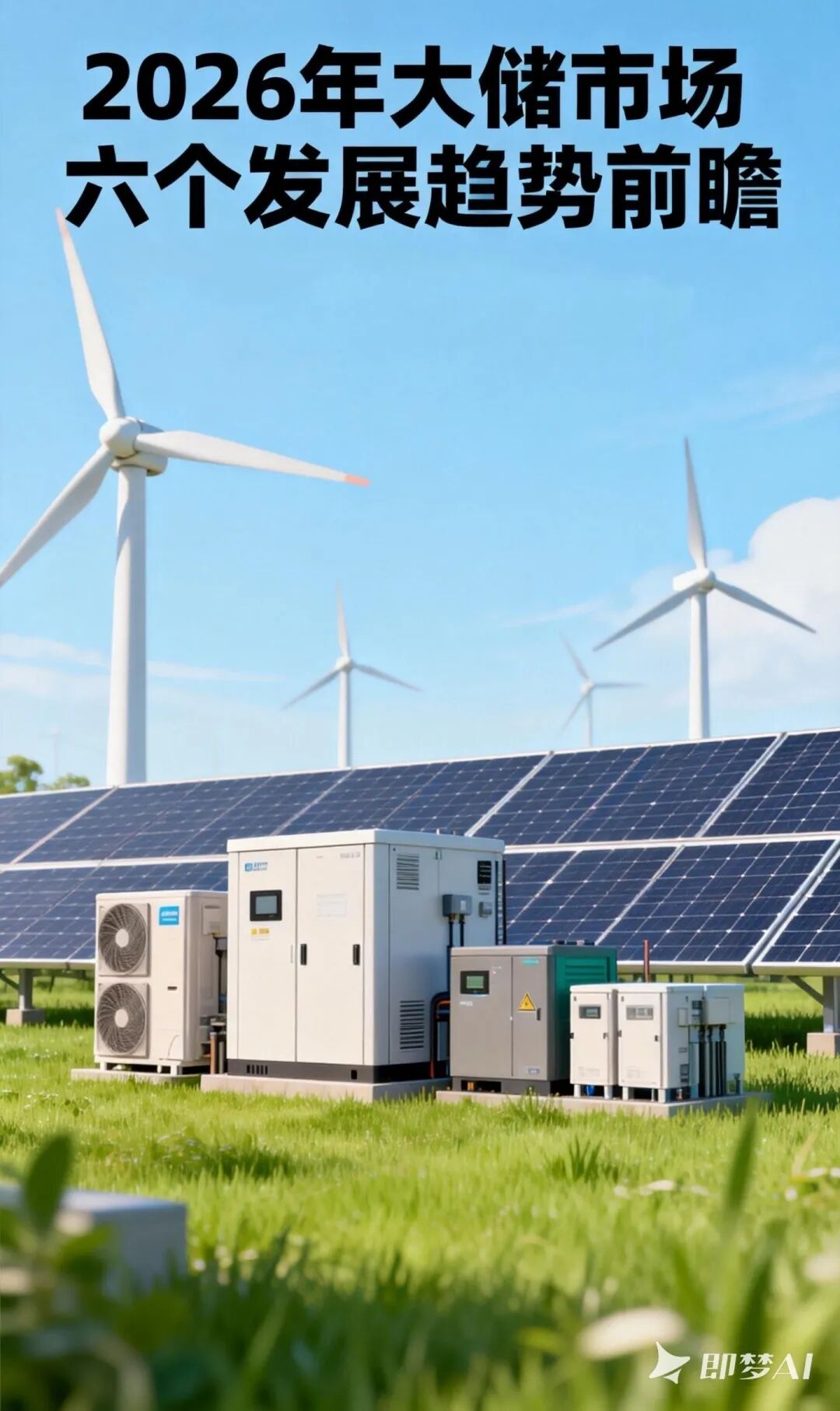
2026年大储发展6个趋势前瞻
Xin Lang Cai Jing· 2026-01-12 12:29
Core Insights - The energy storage market is transitioning from policy-driven to economically-driven high-quality development, with 2026 marking a pivotal year for China's new energy storage industry [20][21][22] - Six trends are shaping the landscape of large-scale energy storage (大储) development by 2026, focusing on market, technology, and application scenarios [19][22] Group 1: Independent Energy Storage - The independent energy storage sector is solidifying its leading position due to the cancellation of mandatory storage requirements and the acceleration of the electricity spot market [25] - In 2025, over 126 GWh of new independent energy storage capacity is expected to be connected to the grid, accounting for over 70% of the market [25] - Various provinces are implementing capacity compensation mechanisms, enhancing the economic viability of independent energy storage [25] Group 2: Networked Energy Storage - Networked energy storage is expected to achieve breakthroughs in three areas: power side, grid side, and user side, with a target penetration rate of over 30% by 2026 [27] - The market for networked energy storage is projected to experience explosive growth, with 2.9 GW/9 GWh of new installations in the first three quarters of 2025, surpassing the total for 2024 [26] - Companies like Sungrow, Huawei, and NARI are gaining traction in the global market, particularly as the EU mandates networked capabilities for large-scale storage starting in 2026 [28] Group 3: High-Voltage Cascade Technology - High-voltage cascade technology is becoming a core direction for large-scale energy storage systems due to its advantages in power capacity and ease of control [29] - This technology is expected to penetrate further into the market, with major players accelerating their deployment and focusing on capacity adaptation and integration efficiency [30] - By 2026, high-voltage cascade technology will enter a phase of large-scale application, supported by leading companies validating its reliability and economic viability [31] Group 4: System Integration and Temperature Control - System integration technology is evolving towards modular and integrated designs, with modularization becoming a mainstream approach for energy storage systems [33] - The market will see more integrated energy storage products that simplify installation and reduce compatibility challenges [33] - Temperature control technology is shifting towards intelligent liquid cooling solutions, enhancing safety and lifespan of energy storage systems [35][36] Group 5: Diverse Energy Storage Technologies - Sodium-ion batteries are anticipated to enter a phase of large-scale commercialization, targeting mid-to-low-end applications [36] - Flow batteries and compressed air storage are also expected to make significant advancements, particularly in long-duration storage scenarios [36][37] - The demand for long-duration storage solutions is rapidly increasing, driven by the growth of renewable energy installations [37][38]

中金:储能产业全球化进行时 AIDC配储贡献新增量
Zhi Tong Cai Jing· 2025-12-18 05:55
Group 1 - The core viewpoint is that after 2H25, China's provinces will successively implement capacity pricing policies, leading to excellent economic viability for independent energy storage under the "peak-valley arbitrage + capacity pricing + ancillary services" revenue model, with high demand expected to continue in the short term [1] - The European market is experiencing positive storage demand due to energy shortages and a lack of grid flexibility resources, with a shift in focus from household storage to large-scale and industrial storage [1] - The Australian electricity market is maturing, with large-scale storage projects accelerating, while household storage is being reinforced by high subsidies, ensuring medium to long-term demand [1] Group 2 - The AIDC (Automated Industrial Data Center) demand in the U.S. is expected to grow significantly, with projections indicating that by 2030, AIDC storage demand could reach 100-200 GWh, driven by the need for enhanced flexibility and interconnectivity [2] - The green methanol sector is seeing increased demand from the shipping industry, which is catalyzing the construction of numerous wind-solar-storage hydrogen-methanol integrated projects in China, thereby boosting storage demand [2] Group 3 - The strong demand for energy storage is leading to a tight supply of storage cells, with major companies experiencing full order books and production schedules extending into Q1 2026; however, relief is expected post-Q2 2026 as production capacity is released [3] - Major companies are building competitive barriers through overseas factories and technology licensing in response to local policy trends in Europe and the U.S., allowing them to benefit from high growth in overseas markets [3] Group 4 - Recommended companies for front-of-the-meter storage include CATL (300750.SZ, 03750), EVE Energy (300014.SZ), and Haibo Technology (688411.SH), while for behind-the-meter storage, recommended companies include Deye Technology (605117.SH), Airo Energy (688717.SH), and Pylon Technologies (688063.SH) [4]


