
玛氏度肽

Search documents
信达生物:25年业绩回顾:创新产品稳健放量;利润端实现扭亏;研发管线布局全面-20260401
海通国际· 2026-04-01 00:40
Investment Rating - The report maintains an "Outperform" rating for Innovent Biologics [2] Core Insights - Innovent Biologics achieved total revenue of RMB 13.0 billion in FY25, representing a year-on-year growth of 38%, with product sales revenue reaching RMB 11.9 billion, up 45% [3][15] - The company turned a net profit attributable to shareholders of RMB 810 million in FY25, compared to a loss of approximately RMB 100 million in the previous year [3][15] - The gross margin improved to 86.5%, an increase of 2.6 percentage points year-on-year [3][15] - The company expects to recognize out-licensing revenue progressively starting in 2026, with significant upfront payments from collaborations with Roche and Takeda [5][17] - The core asset IBI363 (PD-1/IL-2) is advancing smoothly, with three assets entering global Phase III clinical trials, estimated to have a combined addressable market exceeding USD 60 billion [19][21] Financial Summary - Revenue projections for FY26 and FY27 have been raised to RMB 17.8 billion and RMB 20.5 billion, respectively, along with net profit forecasts of RMB 2.3 billion and RMB 3.5 billion [10][21] - The company’s selling expenses increased by 31% year-on-year to RMB 5.7 billion, while R&D expenses decreased by 2% to RMB 2.6 billion [3][15] - The report indicates a strong organic sales growth driven by the oncology franchise and the expansion of the product portfolio, with multiple products included in the National Reimbursement Drug List (NRDL) expected to drive further growth in 2026 [4][16]
信达生物(01801):25年业绩回顾:创新产品稳健放量,利润端实现扭亏,研发管线布局全面
Haitong Securities International· 2026-03-31 14:32
Investment Rating - The report maintains an "Outperform" rating for Innovent Biologics [2] Core Insights - Innovent Biologics achieved total revenue of RMB 13.0 billion in FY25, representing a year-on-year growth of 38%, with product sales revenue reaching RMB 11.9 billion, up 45% [3][15] - The company turned a net profit attributable to shareholders of RMB 810 million in FY25, compared to a loss of approximately RMB 100 million in the previous year [3][15] - The gross margin improved to 86.5%, an increase of 2.6 percentage points year-on-year [3][15] - The report highlights strong organic sales growth driven by the oncology franchise and the expansion of the product portfolio, with multiple products included in the National Reimbursement Drug List (NRDL) expected to further boost sales in 2026 [4][16] - Out-licensing revenue of RMB 957 million was recognized in FY25, with significant upfront payments from collaborations with Roche and Takeda expected to be progressively recognized in the financial statements from 2026 onward [5][17] - The core asset IBI363 (PD-1/IL-2) is advancing smoothly, with three assets entering global Phase III clinical trials, estimated to have a combined addressable market exceeding USD 60 billion [7][19] - The early-stage pipeline shows strong global competitiveness, with 11 new molecules advanced into clinical development, expected to yield early data in 2026-2027 [9][20] - The target price is adjusted to HKD 107.40 based on a DCF model, reflecting an increase in revenue and net profit forecasts for 2026 and 2027 [10][21]
信达生物:与礼来达成全球战略合作,创新管线全球化进程将加速-20260209
CSC SECURITIES (HK) LTD· 2026-02-09 08:24
Investment Rating - The report assigns a "Buy" rating for the company, indicating a potential upside of 15% to less than 35% [2][4]. Core Insights - The company has entered into a global strategic collaboration with Eli Lilly to accelerate the global development of innovative drugs in oncology and immunology. The company will lead the research and development from drug discovery to clinical concept verification in China, retaining all rights in Greater China while Eli Lilly obtains exclusive rights outside this region [4][5]. - The company expects a revenue increase of 45% in 2025, projecting total product revenue of approximately RMB 11.9 billion, with Q4 alone expected to generate around RMB 3.3 billion, reflecting a year-over-year growth of over 60% [5]. - The company has a strong pipeline with 13 commercialized oncology products, and the collaboration with Eli Lilly is expected to enhance its research capabilities and market position [5]. Financial Summary - The company forecasts net profits of RMB 354 million in 2025, RMB 1.427 billion in 2026, and RMB 2.404 billion in 2027, with significant year-over-year growth rates of 304% and 68.4% for 2026 and 2027, respectively [7][9]. - Earnings per share (EPS) are projected to be RMB 0.20 in 2025, RMB 0.82 in 2026, and RMB 1.39 in 2027, with corresponding price-to-earnings (P/E) ratios of 346X, 86X, and 51X [7][9]. - The total revenue is expected to grow from RMB 6.206 billion in 2023 to RMB 20.063 billion by 2027, indicating a robust growth trajectory [9].
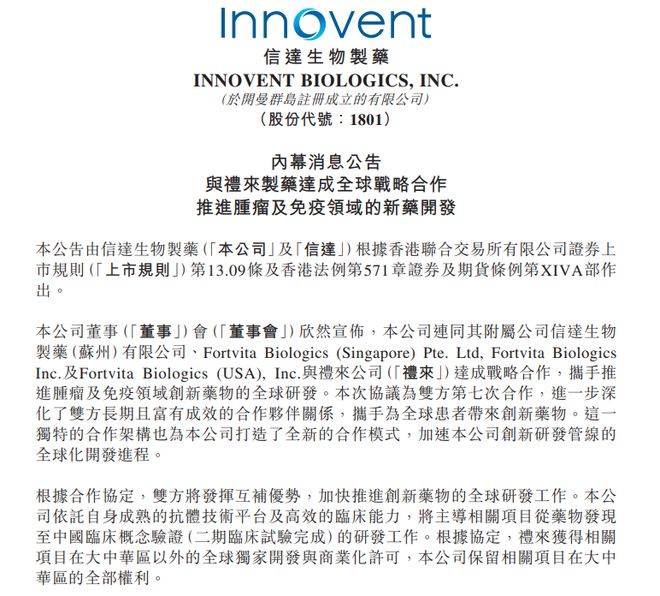
股价涨6.92%!信达生物与礼来88.5亿美元战略合作落地,加速中国创新药全球化
Jin Rong Jie· 2026-02-09 08:11
Core Insights - Chinese innovative biopharmaceutical company Innovent Biologics (01801.HK) has announced a global strategic collaboration with Eli Lilly to advance the global development of innovative drugs in oncology and immunology, marking their seventh collaboration since 2015 [1][3] Group 1: Collaboration Details - The partnership aims to leverage complementary strengths to accelerate the global development of innovative drugs, with Innovent leading the research from drug discovery to clinical concept verification in China, while Eli Lilly will have exclusive global development and commercialization rights outside Greater China [3] - Innovent will receive an upfront payment of $350 million, with potential milestone payments totaling up to $8.5 billion if all development, regulatory, and commercialization milestones are achieved [3] Group 2: Financial Performance and Market Position - Innovent has established a high-quality technology platform covering the entire cycle of biopharmaceutical development, with 18 products approved for market, 4 new drug molecules in Phase III or pivotal clinical studies, and 15 new drug candidates in clinical research [4] - Recent revenue forecasts indicate that Innovent expects approximately 11.9 billion yuan in product revenue for 2025, representing a 45% year-on-year increase, with Q4 revenue projected at around 3.3 billion yuan, showing over 60% growth year-on-year [4] - The collaboration with Eli Lilly further solidifies Innovent's position in the global innovative drug sector, following a previous $11.2 billion partnership with Takeda in October 2025 [4]

中邮证券:首予信达生物“买入”评级 内生收入与利润双高增
Zhi Tong Cai Jing· 2025-10-10 06:15
Core Viewpoint - Zhongyou Securities initiates coverage on Innovent Biologics (01801) with a "Buy" rating, projecting net profits of 0.98 billion, 1.58 billion, and 3.25 billion yuan for 2025-2027, corresponding to P/E ratios of 162, 100, and 49 respectively [1] Group 1: Financial Performance - In the first half of 2025, the company reported revenue of 5.95 billion yuan, a year-on-year increase of 50.6%, with product revenue at 5.23 billion yuan, up 37.3% [1] - EBITDA for the same period was 1.4 billion yuan, and net profit reached 1.2 billion yuan, with cash on hand amounting to 14.6 billion yuan [1] Group 2: Product Pipeline and Innovation - The company’s IBI363 has been approved to conduct global Phase III clinical trials, showcasing its potential as a next-generation IO cornerstone [2] - IBI363 is a first-in-class PD-1/IL-2α-bias bispecific fusion protein, targeting both PD-1/PD-L1 pathways and activating the IL-2 pathway [2] - The clinical trial aims to recruit approximately 600 patients to compare the efficacy and safety of IBI363 against docetaxel in treating squamous non-small cell lung cancer [2] Group 3: Diverse Pipeline and Global Expansion - Innovent's pipeline is rich and diversified, with products in cardiovascular, metabolic, and endocrine fields, including approved drugs like Ma Shidu peptide and PCSK9 [3] - The company is focusing on unmet needs with its pipeline, including IBI3002, a first-in-class immune bispecific molecule targeting TSLP and IL4Rα, showing preliminary efficacy signals in asthma patients [3] - The ongoing clinical advancements are expected to enhance global licensing collaborations and accelerate the market entry of approved products across various regions [3]
中邮证券:首予信达生物(01801)“买入”评级 内生收入与利润双高增
智通财经网· 2025-10-10 06:13
Core Viewpoint - Zhongyi Securities initiates coverage on Innovent Biologics (01801) with a "Buy" rating, projecting net profits of 9.8 billion, 15.8 billion, and 32.5 billion yuan for 2025-2027, corresponding to PE ratios of 162, 100, and 49 respectively [1] Financial Performance - For the first half of 2025, the company reported revenue of 59.5 billion yuan, a year-on-year increase of 50.6%, with product revenue at 52.3 billion yuan, up 37.3% [1] - EBITDA stood at 14 billion yuan, and net profit was 12 billion yuan, with cash reserves of 146 billion yuan [1] Product Pipeline and Innovation - The company holds a leading position in the domestic oncology drug market, with a rich pipeline that is expected to drive high growth through gradual approvals [1] - IBI363, a globally innovative PD-1/IL-2α-bias bispecific fusion protein, has received approval to initiate global Phase III clinical trials, targeting squamous non-small cell lung cancer [2] - The development strategy focuses on addressing unmet needs in the IO-treated market, with plans for registration trials in lung cancer, melanoma, and third-line colorectal cancer in 2025 [2] Diversification and Global Expansion - The company has a diverse pipeline in cardiovascular, metabolic, and endocrine areas, with products like Marsdu and PCSK9 already approved [3] - The pipeline also includes dual antibodies aimed at improving patient quality of life in ophthalmology, and the first approved product in dermatology and rheumatology, showcasing BIC potential [3] - IBI3002, a globally first-in-class immune dual antibody, has shown preliminary efficacy signals in asthma patients, indicating ongoing clinical progress and potential for global partnerships [3]
智氪 | 一季度狂揽50亿刀,替尔泊肽凭什么成为减肥顶流?
3 6 Ke· 2025-06-25 09:48
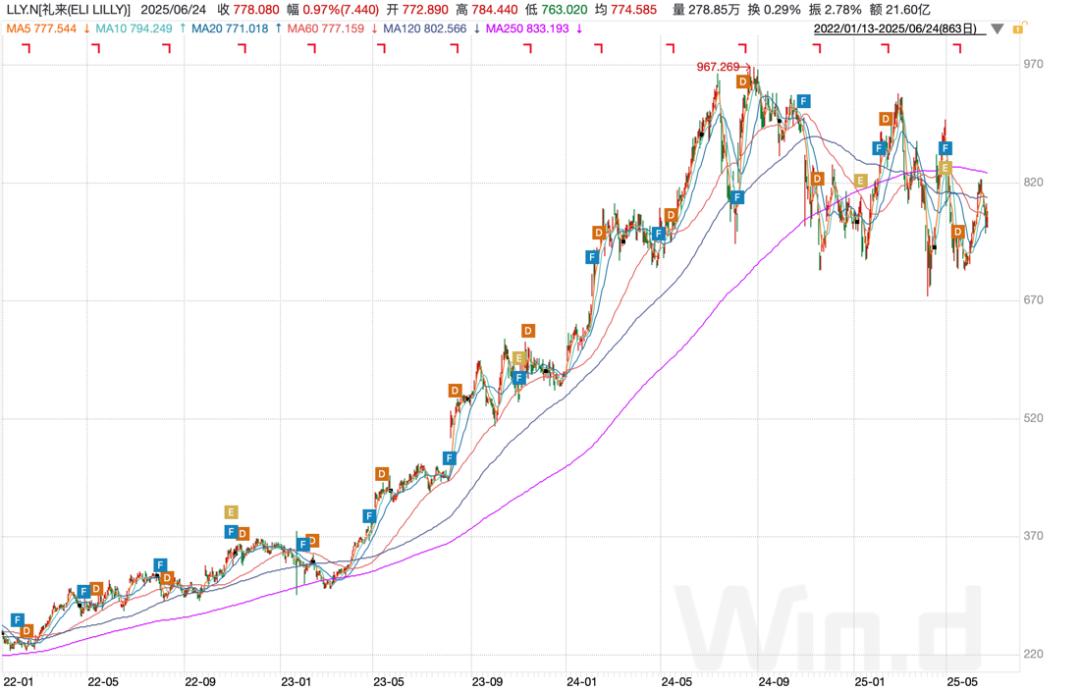
Core Viewpoint - Tirzepatide, a drug by Eli Lilly, has shown impressive sales growth and market penetration, significantly impacting the company's stock performance since its approval in May 2022, with a stock price increase of 180% [1][16]. Group 1: Sales Performance and Market Position - Tirzepatide achieved a combined revenue of $5 billion in Q1 2025, accounting for 39% of Eli Lilly's total revenue, with a year-on-year growth rate exceeding 100% [1][12]. - As of Q1 2025, Eli Lilly's total prescription volume in the U.S. for GLP-1 receptor agonists reached 53.3%, surpassing its main competitor, Novo Nordisk [3][5]. - The rapid growth in prescription volume for tirzepatide is attributed to higher patient acceptance and superior efficacy compared to semaglutide [5][10]. Group 2: Clinical Efficacy and Competitive Advantage - In head-to-head clinical trials, tirzepatide demonstrated superior weight loss results compared to semaglutide, with an average weight loss of 20.2% versus 13.7% [8][9]. - The trial results support tirzepatide's position as a more effective treatment option, which is expected to sustain its sales growth [6][10]. Group 3: Market Dynamics and Future Challenges - The demand for GLP-1 drugs has surged, leading to supply shortages for semaglutide, which has allowed tirzepatide to capture excess demand [11][12]. - The competitive landscape is intensifying, with 179 GLP-1 drug candidates in clinical stages from 45 companies, indicating potential future sales pressure for both semaglutide and tirzepatide [12][14]. - Patent expirations for semaglutide in key markets like China and India in 2026 may lead to significant price reductions for generic versions, impacting tirzepatide's market position [14][15]. Group 4: Investment Opportunities - Tirzepatide's success has stimulated investment interest across the GLP-1 supply chain, with various companies advancing their own GLP-1 drug candidates [16][17]. - Notable companies in the GLP-1 space include Hengrui Medicine, which has multiple candidates in clinical trials, and other firms like East China Pharmaceutical and Innovent Biologics that are also progressing rapidly [17].

医药专场 - 中信建投证券2025年中期资本市场投资峰会
2025-06-19 09:46
Summary of Key Points from the Conference Call Industry Overview - The conference focuses on the **Chinese healthcare industry**, particularly its international expansion through mergers, collaborations, and innovation in genomics, pharmaceuticals, and medical devices [1][2]. Core Insights and Arguments - **Global Expansion**: Chinese healthcare companies are actively pursuing international markets, facing challenges such as regulatory differences, market access restrictions, low brand recognition, and cultural differences [1][3]. - **Consulting Support**: Venture Blink offers services like compliance review, partner search, brand building, and cross-cultural training to help Chinese healthcare companies navigate these challenges [1][4]. - **Future Trends**: The Chinese healthcare industry is expected to experience growth driven by innovation, digital transformation, personalized medicine, and increased demand for chronic disease management [1][5]. - **International Collaboration**: Cooperation with countries like the US and EU is crucial for advancing China's biopharmaceutical development, enhancing treatment outcomes, and creating more opportunities for the industry [1][7]. - **Market Share**: Currently, Chinese medical technology companies hold about **10%-15%** of the global market share, which is significantly lower than their potential, indicating that international expansion is key to improving profitability [1][41]. Challenges Faced by Chinese Healthcare Companies - **Regulatory Compliance**: Different countries have varying regulatory requirements for drugs and medical devices, necessitating extensive compliance efforts [3][11]. - **Market Entry Barriers**: Some countries impose strict restrictions on foreign investments, requiring companies to find suitable local partners [3][11]. - **Brand Recognition**: Chinese brands often lack recognition in international markets, necessitating significant investment in brand building and marketing [3][11]. - **Cultural Differences**: Language barriers and differing business practices can hinder expansion efforts [3][11]. Recommendations for Emerging Chinese Healthcare Companies - **Market Understanding**: Companies should thoroughly understand target markets, including regulations, competition, and patient needs [8]. - **Quality and Safety**: Emphasizing product quality and safety is essential for gaining international recognition [8]. - **Local Partnerships**: Actively seeking local partners can help navigate market entry barriers [8]. - **Brand Building**: Strengthening brand presence and recognition in international markets is crucial [8]. - **Cross-Cultural Skills**: Developing cross-cultural communication skills within teams is necessary for adapting to diverse business environments [8]. Additional Insights - **Investment in R&D**: Companies need to invest significantly in research and development to maintain competitiveness, with pharmaceutical companies allocating **20%-25%** of revenue to R&D [26]. - **Global Market Strategy**: Successful multinational companies typically derive over **50%** of their revenue from international markets, highlighting the importance of global expansion [45]. - **Digital Marketing**: Utilizing digital marketing strategies can enhance visibility and customer engagement in international markets [74][75]. - **Long-Term Strategy**: Building brand trust in international markets requires a long-term approach, focusing on consistent quality and market presence [76]. Conclusion The Chinese healthcare industry is on a path toward internationalization, facing both significant challenges and opportunities. Companies must adopt strategic approaches to overcome barriers and enhance their global competitiveness while focusing on innovation and quality.